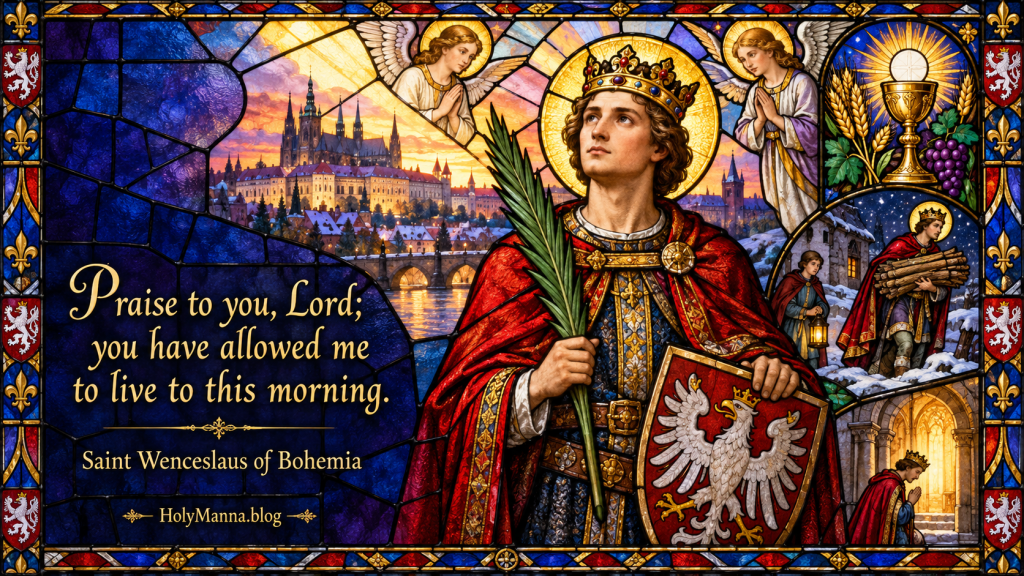
The Good King Who Served a Greater King
Every December, millions of people sing about him without knowing who he was. The carol Good King Wenceslas, written in English in 1853 by John Mason Neale, opens with the famous line, “Good King Wenceslas looked out on the Feast of Stephen.” The song tells of a king trudging through deep snow to bring food, wine, and firewood to a poor peasant, with his young page following in his footsteps. What most carolers never learn is that the man behind the melody was real, that he was not English but Bohemian, that he was not technically a king but a duke, and that he did not die peacefully in old age. He died at the door of a church, cut down by his own brother, forgiving his murderer with his final breath.
Saint Wenceslaus, known in his native Czech as Václav, was the Duke of Bohemia in the early tenth century, a young Christian ruler governing a land still half in love with its old pagan gods. The Church celebrates his Optional Memorial on September 28th, the anniversary of his martyrdom. He is the patron of Bohemia and of the Czech nation, a patronage so deeply woven into his people’s identity that his feast day is now the national Day of Czech Statehood. His story matters because it answers a question every generation asks in its own way. Can real power and real holiness live in the same person? Wenceslaus answers with his whole life, and then seals the answer with his blood. The Catechism teaches that “martyrdom is the supreme witness given to the truth of the faith: it means bearing witness even unto death” (CCC 2473). Wenceslaus gave that witness before he was thirty years old.
Raised by a Saint, Hunted by His Own Blood
Wenceslaus was born around the year 907, likely at Stochov in Bohemia, in what is today the Czech Republic. The older Catholic sources, including the Catholic Encyclopedia, place his birth as early as 903, and the honest answer is that the exact year cannot be fixed with certainty. He belonged to the Přemyslid dynasty, the ruling house of Bohemia, and his Christian roots ran deep. His great-grandfather Bořivoj, the first historically documented ruler of Bohemia, and Bořivoj’s wife Ludmila were baptized by Saint Methodius himself, the great missionary who, with his brother Saint Cyril, brought the Gospel to the Slavic peoples. Faith did not arrive in Wenceslaus’ family as a rumor. It arrived through the hands of an apostle to the Slavs.
His father, Duke Vratislaus I, was a Christian. His mother, Drahomíra, is described in the older Catholic sources as a pagan, though some accounts suggest she had been baptized while remaining loyal to the pagan party at court. Whatever the state of her soul, her actions spoke plainly. The brightest light of Wenceslaus’ childhood was his grandmother, Saint Ludmila, who took charge of his education and formed him in the faith from his earliest years. She taught him to pray, to love the poor, and to see his future authority as a stewardship under God rather than a prize to be enjoyed. He also studied at the college at Budeč, receiving an education in letters that was rare for a ruler of his time and place.
Then the darkness in his own family broke loose. When Wenceslaus was about thirteen, his father died, and a power struggle erupted over the regency. On September 15th, 921, Saint Ludmila was murdered at the castle of Tetín, and Catholic tradition holds that assassins strangled her with her own veil at the instigation of Drahomíra, who resented her influence over the young duke. The woman who taught Wenceslaus the faith became a martyr for it. Drahomíra then ruled as regent and moved against the Church, opposing the Christian clergy and favoring the pagan reaction. Around the age of eighteen, Wenceslaus took the government into his own hands, supported by the Christian nobles and the people, and his mother’s regency ended. A boy formed by a martyred saint now sat in the seat of power, and he had already learned the most expensive lesson of his life: in Bohemia, faithfulness to Christ could cost you everything, even at the hands of your own family.
The Duke Who Prepared the Bread for Mass
What did Wenceslaus do with power once he had it? The earliest accounts of his life, preserved and handed down in Catholic tradition, paint a portrait that still stops readers in their tracks. One early account declares: “He was charitable to the poor, and he would clothe the naked, feed the hungry, and offer hospitality to travelers according to the summons of the Gospel. He would not allow widows to be treated unjustly; he loved all his people, both rich and poor; he also provided for the servants of God, and he adorned many churches.” This is not the résumé of a typical tenth century warlord. This is the Sermon on the Mount wearing a ducal crown, a living echo of the Lord’s words in The Gospel of Matthew: “Amen, I say to you, whatever you did for one of these least brothers of mine, you did for me” (Mt 25:40). The Catechism teaches that “the works of mercy are charitable actions by which we come to the aid of our neighbor in his spiritual and bodily necessities” (CCC 2447), and Wenceslaus made those works the policy of his government and the habit of his private life.
Tradition adds details that reveal the heart beneath the crown. It is told that Wenceslaus, with his own hands, sowed and harvested wheat, ground the grain, and pressed grapes, so that the bread and wine offered at the Holy Sacrifice of the Mass would come from the labor of the duke himself. It is also told that he went out at night, accompanied by a single trusted page, carrying firewood and provisions to the doors of the poor, the widowed, and the imprisoned, so that his charity would be seen by God rather than by men. These beloved stories come from later tradition and cannot be verified as documented history, and it is precisely this second tradition that inspired the carol Good King Wenceslas nine centuries later. Yet the traditions grew in soil that history confirms: every early source agrees that this man was extravagantly, personally generous.
His public record is solid. He ended the persecution of Christians that had flared under his mother’s regency, recalled exiled priests, and welcomed clergy to strengthen the young Bohemian Church, favoring the Latin Rite that bound his land to the wider Church of the West. Around the year 930 he founded the rotunda church of Saint Vitus at Prague Castle, the seed from which the magnificent Saint Vitus Cathedral would one day grow. Tradition holds that he obtained the relic of the arm of Saint Vitus from the German king for this church, and here the sources conflict in an interesting way. The Catholic Encyclopedia states that Emperor Otto I conferred on Wenceslaus the regal dignity and title, while other Catholic accounts describe the royal title as a posthumous honor. Either way, the title stuck, which is why the world remembers a duke as “Good King” Wenceslaus. He also faced the hard edges of statecraft, including a military attack in 929 by Duke Arnulf of Bavaria and King Henry I the Fowler, and he chose tribute and peace with his powerful German neighbors rather than a war that would have bled his small Christian duchy dry. Some of his nobles read that peace as weakness. Heaven read it differently.
One dramatic story from his reign deserves telling on its own terms. Tradition recounts that a rebellious noble, remembered as Radislas, rose against Wenceslaus and marched on him with an army. Wenceslaus first sent envoys offering peace, and when the rebel mocked the offer as cowardice, the duke proposed that the two of them meet in single combat so that no soldier’s blood would be spilled for their quarrel. As they charged one another, the story says that two angels appeared at Wenceslaus’ side, shielding him, and that the rebel, struck with terror, threw himself from his horse and begged forgiveness, which Wenceslaus freely gave. This story is a tradition handed down in accounts of his life and cannot be verified. What can be verified is the pattern it captures: a ruler who preferred mercy to slaughter, and who trusted God with outcomes that other princes trusted only to the sword.
Betrayal at the Church Door
Holiness in high office makes enemies, and Wenceslaus’ enemies found their champion inside his own house. His younger brother Boleslav, remembered by history with the chilling surname “the Cruel,” resented the duke’s pro-Christian policy, his peace with the Germans, and quite possibly the simple fact of his existence between Boleslav and the throne. Early accounts record that discontented nobles whispered poison into Boleslav’s ears, telling him: “Your brother Wenceslaus is conspiring with his mother and his men to kill you.” The accusation was false, but it gave ambition the costume of self-defense.
The trap was set with liturgical bait. Boleslav invited Wenceslaus to his town of Stará Boleslav to celebrate the feast of Saints Cosmas and Damian, martyr physicians of the early Church. Wenceslaus, who made a practice of honoring church dedication feasts throughout his duchy, came in good faith, attended Mass, and planned to return to Prague. Boleslav pressed him to stay the night. According to the early lives, warnings reached Wenceslaus that his life was in danger, and he chose to stay anyway, unwilling to believe the worst of his brother or unwilling to run from what God might permit.
The early hagiographies preserve the scene of his final morning, and their words have been handed down for a thousand years. When the bell rang for matins before dawn on September 28th, Wenceslaus rose and said: “Praise to you, Lord; you have allowed me to live to this morning.” He walked toward the church to pray. Boleslav met him on the way, and Wenceslaus greeted him with gratitude for the feast: “Brother, you were a good subject to me yesterday.” The accounts then say that the devil had already blocked the ears of Boleslav and perverted his heart. Boleslav drew his sword and struck his brother. Three of Boleslav’s companions, named in the sources as Tira, Česta, and Hněvsa, fell upon the duke and stabbed him, and Boleslav ran him through at the door of the church. The dying words attributed to Wenceslaus in the Catholic accounts are these: “May God forgive you, brother.” These words come from the early lives of the saint rather than from a courtroom transcript, and the Church has treasured them because they ring true to everything else known about the man.
He was somewhere between twenty two and twenty eight years old. The sources conflict on the year, giving either 929 or 935, with 935 favored by most modern scholarship, and an honest account flags that uncertainty rather than smoothing it over. What no source disputes is the day, September 28th, and the place, the church door at Stará Boleslav. Some have noted that his death arose from a tangle of politics and family ambition, yet the Church has always numbered him among the martyrs, because the politics arose from his faith. He was hated for the Christianity he planted, protected, and personally practiced, and he died on his way to pray, forgiving his killer. In this he mirrored his Lord, who taught in The Gospel of Matthew: “Love your enemies and pray for those who persecute you” (Mt 5:44). The Catechism teaches that “Christian prayer extends to the forgiveness of enemies, transfiguring the disciple by configuring him to his Master” (CCC 2844). At that church door, the configuration was complete. In a grim footnote preserved by the chronicler Cosmas of Prague, a son was born to Boleslav on the very day of the murder, and tradition says the child was named Strachkvas, meaning “dreadful feast.”
A Tomb That Would Not Stay Quiet
The blood at the church door was still fresh when Bohemia began to treat the murdered duke as a saint. Catholic accounts record that miracles were reported at his tomb almost immediately, and veneration of Wenceslaus as a martyr spread with astonishing speed. One tradition holds that his blood, spilled on the church door and wall at Stará Boleslav, could not be washed away for days, remaining as a silent accusation and a sign. This story cannot be verified. Other traditions tell of healings granted at his grave and of prisoners whose chains fell away through his intercession, wonders of the kind the faithful sought at martyrs’ tombs across the Christian world. These stories likewise rest on tradition rather than documented proof, and they cannot be verified, yet they testify to what the people of Bohemia believed heaven was doing through their fallen duke.
The most remarkable miracle after his death may have been the one worked in his murderer. Boleslav, moved by remorse and by the growing devotion to his brother, repented publicly. In the year 938 he had the body of Wenceslaus solemnly translated from Stará Boleslav to the rotunda of Saint Vitus in Prague, the very church Wenceslaus had founded, and the Church long commemorated that translation on March 4th. Decades later, in 972, Boleslav built the first church in Prague dedicated to Saint Wenceslaus. A tradition adds that Boleslav II, the saint’s nephew, fell asleep while traveling from Stará Boleslav and saw his uncle Wenceslaus in a dream, urging him to build a shrine in his memory, which he did at Prosek in 970. This dream story cannot be verified. What is certain is that the family that shed his blood spent the next generation building churches to his glory, which is its own kind of wonder.
The veneration never stopped growing. His feast has been celebrated in Bohemia since at least the year 985. His tomb became one of the great pilgrimage destinations of Central Europe, and around it, quite literally, the Czech nation took shape. When Prague was raised to an archbishopric in 1344, Emperor Charles IV began the soaring Gothic cathedral of Saint Vitus over the saint’s resting place, and the Chapel of Saint Wenceslaus within it remains one of the most breathtaking sacred spaces in Europe, its walls encrusted with semiprecious stones and painted with scenes of his life and martyrdom. Above that chapel, behind a door whose location is kept secret, rests the Crown of Saint Wenceslaus, the crown of the Bohemian kings, made under Charles IV and dedicated to the saint, a golden confession that every earthly ruler of that land reigns under the patronage of the martyr duke.
His national impact is almost impossible to overstate. Every September 28th, the relic of his skull is carried in the National Saint Wenceslas Pilgrimage from Prague to Stará Boleslav, a procession of roughly twelve miles accompanied by the Castle Guard and thousands of pilgrims, ending at the place of his martyrdom. Since the year 2000, September 28th has been a public holiday in the Czech Republic, proclaimed the Day of Czech Statehood, so that the modern secular state marks its own identity by the death day of a martyr. His mounted statue towers over Wenceslas Square in Prague, and in the nation’s darkest hours, in 1918, in 1968 under Soviet tanks, and in the Velvet Revolution of 1989, the Czech people instinctively gathered at the feet of their saint. More than 170 churches and nearly 30 chapels across Czechia bear his name. A cherished national tradition, which cannot be verified and is told as a story, says that Saint Wenceslaus sleeps with an army of knights inside Blaník mountain, ready to ride out when his people face their final peril. The Church would put it differently but no less boldly. The Catechism teaches of the saints that “they do not cease to intercede with the Father for us… their fraternal concern is a great help to our weakness” (CCC 956). Wenceslaus does not sleep in a mountain. He lives in the presence of God, and he has not stopped caring for the people he once fed with his own hands.
What a 10th Century Duke Says to a 21st Century Heart
It would be easy to file Wenceslaus away as a figure from a Christmas carol, charming and distant. That would be a mistake, because his life presses on the exact nerve points of modern life. He was a young adult handed enormous responsibility in a hostile environment. He came from a family that was, to put it gently, complicated, with a saintly grandmother and a mother implicated in her murder. He worked, in effect, in a culture that tolerated his faith only as long as it stayed private, and he refused to keep it private. If you are trying to follow Christ in your twenties, thirties, or forties, in an office or a family or a friend group where faith is treated as an embarrassment, Wenceslaus is not a museum piece. He is a colleague.
Consider three lessons from his life. First, holiness is built in hidden habits before it is tested in public crises. Wenceslaus rose for matins, prepared bread and wine for the Mass, and slipped out at night to feed the poor long before anyone was watching him die. The man who could forgive at the church door was formed in a thousand quiet mornings of prayer. What is the hidden habit, the daily prayer, the weekday Mass, the secret generosity, that God is inviting you to build right now, before the crisis comes? Second, mercy is not weakness. Wenceslaus offered peace to rebels, tribute instead of war, and forgiveness to his own assassin, and his nobles called it soft. Eleven centuries later, the empire of his enemies is dust and his statue guards the heart of a nation. Where in your life are you confusing harshness with strength, and where might mercy actually be the braver road? Third, family wounds do not disqualify anyone from sanctity. Wenceslaus’ family gave him both his faith and his death. He did not choose his mother’s ambition or his brother’s sword, but he chose his response, and his response was Christ. Is there a wound from your own family that you have been waiting for permission to bring to God, and what would it look like to pray for the person who caused it, this week, by name?
Practically, his witness translates into small, doable acts. Keep the Lord’s Day and holy days with the seriousness Wenceslaus kept dedication feasts, because he was ambushed precisely while honoring the liturgy, and he would say it was worth it. Take up one concrete work of mercy each week, a meal delivered, a bill quietly paid, a visit to someone forgotten, done without posting about it. Pray by name for the person who has hurt you most, borrowing the saint’s own words if your own fail: “May God forgive you, brother.” And receive the Eucharist with fresh reverence, remembering the duke who thought the altar deserved the work of his own royal hands. The Catechism teaches that “the Eucharist is the source and summit of the Christian life” (CCC 1324), and Wenceslaus organized an entire dukedom around that truth.
Engage With Us!
The story of Saint Wenceslaus belongs to the whole Church, and that includes you. Share your thoughts and reflections in the comments below; someone reading may need exactly the insight God has given you.
- Saint Wenceslaus was formed in the faith by his grandmother, Saint Ludmila. Who handed the faith to you, and have you ever thanked God, or them, for it?
- Wenceslaus forgave his brother with his dying breath. Who is the hardest person in your life to forgive, and what is one step you could take toward forgiving them this week?
- Tradition says the duke prepared the bread and wine for Mass with his own hands. What would it look like for you to bring that kind of personal care to your participation in the Eucharist?
- Wenceslaus used his position and resources to serve the poor in secret. What position, skill, or resource has God placed in your hands, and who is the “poor peasant in the snow” He may be asking you to serve with it?
- His feast day became a national holiday, and his statue became a rallying point for a nation. How can your own quiet faithfulness today become a legacy that outlives you?
Saint Wenceslaus did not set out to become a carol, a crown, or a national holiday. He set out to pray, to serve, and to forgive, and God did the rest. Go and do the same in your corner of the world. Live your faith boldly, love the people God has placed in your path, forgive the ones who wound you, and do everything with the love and mercy that Jesus taught us.
Saint Wenceslaus of Bohemia, martyr and good king, pray for us!
Follow us on YouTube, TikTok, Instagram and Facebook for more insights and reflections on living a faith-filled life.


Leave a comment