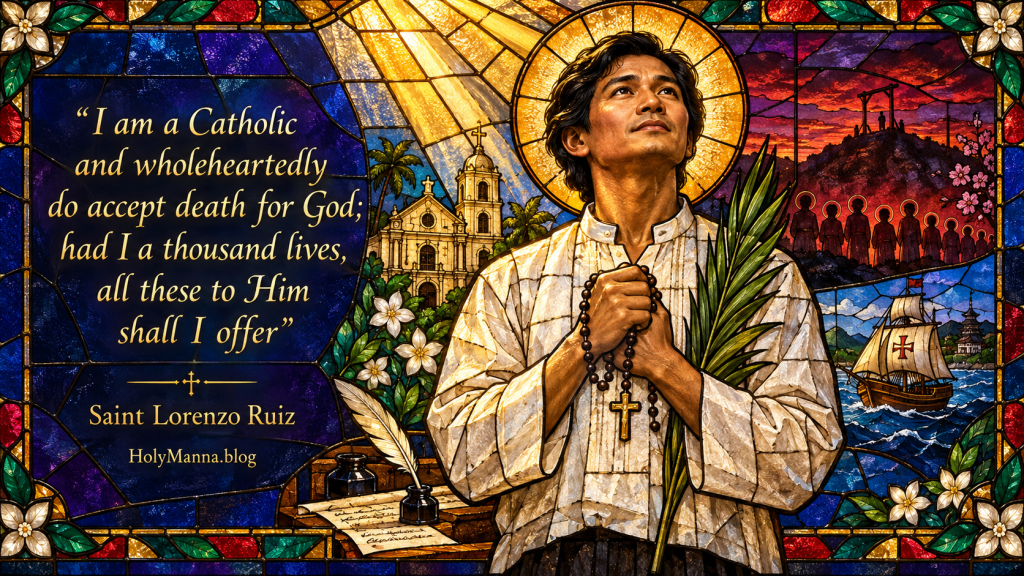
A Thousand Lives to Offer
Every September 28th, the Church lifts up a saint who never founded an order, never wrote a book, never preached a sermon, and never worked a single recorded miracle while he walked this earth. Saint Lorenzo Ruiz was a husband, a father of three, and a parish clerk with beautiful handwriting. He was also a fugitive from the law when God led him, almost by accident, to the moment that would define him forever. Hanging upside down over a pit in Nagasaki, Japan, in September of 1637, this ordinary layman from Manila was offered his life in exchange for one small act of apostasy. He refused, and in refusing he became the protomartyr of the Philippines, the first Filipino ever raised to the altars, and one of the most beloved saints of the entire Asian Church.
He did not die alone. The Church celebrates him together with 15 companions, priests, religious brothers, consecrated women, and laypeople from Japan, Spain, France, and Italy, who shed their blood at Nagasaki between 1633 and 1637. Together they testify to what The Catechism calls the supreme act of Christian witness: “Martyrdom is the supreme witness given to the truth of the faith: it means bearing witness even unto death” (CCC 2473). Saint Lorenzo Ruiz holds a wide and tender patronage. He is the patron of the Philippines and of the Filipino people, of Overseas Filipino Workers and migrant workers, of immigrants and separated families, of the poor, of Filipino youth, of Chinese-Filipinos, and of altar servers, a nod to the boy who once served Mass in a little parish in Binondo. For millions of Filipinos scattered across the globe, far from home and family, he is not a distant figure in stained glass. He is one of their own.
The Escribano of Binondo
Lorenzo Ruiz was born in Binondo, the Chinese quarter of Manila, in the Philippines under Spanish rule. The records of his cause place his birth around 1594, traditionally on November 28th of that year, though some Catholic sources give a date closer to 1600; the exact year cannot be fixed with certainty, and honest accounts say so. What is certain is the shape of his home. His father was Chinese and his mother was Tagalog, and both were fervent Catholics who raised their son in the faith. Growing up between two worlds, Lorenzo became fluent in three languages: Chinese from his father, Tagalog from his mother, and Spanish from the Dominican friars who ran his school and his parish.
That parish, dedicated to Saint Gabriel, was the center of his young life. He served there as an altar boy, and as he grew, the friars noticed his elegant penmanship and made him an escribano, a clerk and calligrapher who copied documents in an age before printing presses were common in the islands. It was quiet, hidden, faithful work, the kind of work most people do every day without anyone noticing. As a young man he joined the Dominican Confraternity of the Most Holy Rosary, binding his ordinary life to Our Lady and her beads. He married a woman remembered in later accounts by the name Rosario, a detail that comes from tradition rather than the trial documents, and together they had three children, two sons and a daughter. By every account, they were a happy and unremarkable Catholic family. If the story had ended there, no one outside Binondo would ever have heard his name.
In 1636, everything collapsed. Lorenzo was implicated in the death of a Spaniard. The one surviving documentary witness says only that he was sought by the authorities on account of a homicide at which he was present or which was attributed to him. That single sentence is all history gives. Was he guilty? Was he a witness? Was he framed? The sources do not say, and no faithful biographer should pretend otherwise. What the record does show is that Lorenzo, facing Spanish colonial justice and likely execution, turned to the only people he had ever trusted: the Dominican fathers. They were preparing a secret missionary expedition, and on June 10th, 1636, Lorenzo boarded their ship. He believed he might be dropped at Formosa, present-day Taiwan. Only at sea did he learn the true destination. The ship was sailing for Japan, the most dangerous place on earth to be a Catholic. His own recorded words are disarmingly human: “I decided to stay with the Fathers, because the Spaniards would hang me there.” He was not seeking martyrdom. He was a frightened man running for his life, and God was quietly steering the boat.
Nine Priests, Two Brothers, and a Band of Holy Companions
Lorenzo performed no recorded miracles during his lifetime, and it matters that this be said plainly. His sanctity before Nagasaki consisted of nothing more spectacular than the sacraments, the rosary, honest work, and love of his family. That is precisely why the Church holds him up. The Catechism teaches that “the disciple of Christ must not only keep the faith and live on it, but also profess it, confidently bear witness to it, and spread it” (CCC 1816), and Lorenzo shows that this professing begins in kitchens and parish offices long before it is ever tested in courtrooms.
The men on that ship, and the wider circle of martyrs with whom he is canonized, supply the missionary dimension of the story. Traveling with Lorenzo were the expedition’s superior, Father Antonio González, a Spanish Dominican from León; Father Guillaume Courtet, a French Dominican; Father Miguel de Aozaraza, a Spaniard from the Basque country; Father Vicente Shiwozuka de la Cruz, a Japanese Dominican priest returning to his persecuted homeland; and a Japanese layman named Lázaro of Kyoto, a leper who served as guide and interpreter. These 5, with Lorenzo, formed the final wave of a movement of witness that had been pouring out of Manila for years.
The full company of 16 was martyred at Nagasaki in 3 waves, in 1633, 1634, and 1637, and Pope John Paul II described the group at their beatification as led by two men: Father Domingo Ibáñez de Erquicia, vicar provincial of the Japanese mission from Régil in Spain, and Father Jacobo Kyushei Tomonaga, a Japanese priest from the region of Nagasaki itself. Both belonged to the Dominican Province of the Holy Rosary, founded in Manila in 1587 to evangelize the Far East. The company included 9 priests, 2 professed religious brothers, 2 members of the Dominican Third Order, a catechist, and a guide-interpreter; 9 were Japanese, 4 were Spaniards, 1 was French, and 1, Father Giordano Ansalone, was Italian. Among them shine 2 heroic women: Marina of Omura, a Dominican tertiary who sheltered the missionaries and was burned alive in November of 1634, and Magdalene of Nagasaki, a young catechist and translator who freely presented herself to the persecutors and died over the pit in October of 1634. The others bear names worth speaking aloud: Brother Francisco Shoyemon, the catechist Miguel Kurobioye, Father Lucas del Espíritu Santo, the young Brother Mateo Kohioye, and Father Tomás Hioji de San Jacinto Nishi. When the judges at Nagasaki demanded to know why the missionaries had come, Father Courtet answered for all of them: “We have come to Japan only to preach faith in God and to teach salvation to little ones and to the innocent and to all the rest of the people.” That sentence is the whole missionary Church in miniature, and it echoes the words of the Lord in The Gospel of Matthew, “Go therefore and make disciples of all nations” (Mt 28:19).
Why should you remember these 16? Because they prove that the Church is truly catholic, gathered, as The Book of Revelation says of the redeemed, “from every tribe and tongue and people and nation” (Rev 5:9). A Filipino clerk, a French friar, a Japanese leper, and an Italian professor all died the same death for the same Lord, and heaven received them as one family.
The Water, the Needles, and the Gallows over the Pit
Japan in 1636 was closing like a fist. The Tokugawa shogunate had outlawed Christianity and was hunting down a Church that only a generation earlier had numbered more than 50,000 faithful in Nagasaki alone. Suspected Christians were ordered to perform the fumie, trampling upon a sacred image of Christ or of the Blessed Virgin holding the Child Jesus. Those who refused faced tortures designed not merely to kill but to break the soul, because the shogunate wanted apostates, not martyrs.
Lorenzo and his companions were discovered soon after landing at Okinawa in 1636. They were arrested, imprisoned for roughly a year, and then transported to Nagasaki in September of 1637 for trial and torment. The eyewitness accounts preserved in the records of their cause describe what followed with terrible precision. The prisoners were subjected to the water torture: enormous quantities of water were forced down their throats, they were made to lie down, long boards were placed on their stomachs, and guards stepped on the ends of the boards until the water burst violently from mouth, nose, and ears. Bamboo needles were driven under their fingernails. Under this unbearable pressure, Father Shiwozuka and the interpreter Lázaro momentarily broke and signaled a willingness to renounce the faith. Their companions did not condemn them; they encouraged them, and both men recovered their courage and recanted their apostasy, choosing death after all. Father González, the superior, died in prison from the effects of the torture on September 24th, 1637.
Then came Lorenzo’s moment, the moment for which God had been preparing him through every rosary and every quiet year in Binondo. Interrogated by the magistrates and ordered to renounce Christ, the exhausted layman wavered and asked, through the interpreter, whether they would spare his life if he apostatized. The judges answered with silence. In that silence Lorenzo prayed, and when he spoke again, the fugitive was gone and the martyr stood in his place. The testimony recorded by eyewitnesses, and quoted by Pope John Paul II at his beatification, gives his answer: he declared that he was a Christian and must die for God, and would give his life for him a thousand times. In the rendering the Church has made her own, “Had I many thousands of lives I would offer them all for him. Never shall I apostatize. You may kill me if that is what you want. To die for God, such is my will.” A widely shared translation of the same testimony reads, “I am a Catholic and wholeheartedly do accept death for God; had I a thousand lives, all these to Him shall I offer.” Both come from the same trial record; neither is an internet invention. The Lord had promised, “Everyone who acknowledges me before others I will acknowledge before my heavenly Father” (Mt 10:32), and Lorenzo took him at his word.
The sentence was tsurushi, known in the Spanish accounts as the gallows and the pit. The condemned were bound tightly, hung upside down from a gallows, and lowered headfirst into a pit, with a small cut made at the temple so that blood would drain slowly and death would come by agonizing degrees, sometimes over days, while apostasy remained available at any moment with the raising of a hand. The eyewitnesses record that these designated martyrs sang psalms to the Lord both in prison and during the 3 days of their execution. Lorenzo Ruiz and Lázaro of Kyoto died first, Lorenzo of blood loss and suffocation, most accounts placing his death on September 29th, 1637, though some records give the 28th; he was about 42 years old. The 3 surviving priests, Courtet, Aozaraza, and Shiwozuka, were beheaded. The persecutors, knowing well what Catholics do with relics, burned the bodies and threw the ashes into the sea. Father Aozaraza had already given the Church the words that transfigure all this horror; contemplating the wounds of Christ, he exclaimed, “What beautiful carnations, what bloodred roses shed for love of you, my God!” When the news reached Manila on December 27th, 1637, the city did not mourn. That very evening the church of Santo Domingo rang with the Te Deum, the great hymn of thanksgiving, for Manila understood that her son had not been destroyed. He had been crowned.
From Scattered Ashes to the Altars of the World
The shogunate scattered Lorenzo’s ashes into the Pacific to erase him, and by every human measure it worked for 300 years. There are no relics of Saint Lorenzo Ruiz, no tomb, no incorrupt body. There is only testimony, and testimony proved indestructible. The ancient observation of Tertullian, enshrined in The Catechism, held true once more: “The blood of martyrs is the seed of Christians” (CCC 852). The Japanese Church survived underground for over 2 centuries, and the Filipino Church grew into the great Catholic nation of Asia.
The modern chapter of the story reads almost like a detective novel. When the cause of the Nagasaki martyrs was prepared, the Spanish Dominican historian Father Fidel Villarroel discovered the decisive document, an eyewitness account of the martyrdom written by two Japanese former Jesuit priests, resting in the Jesuit Generalate archive in Rome, an unlikely home for the records of a Dominican mission. On the strength of that testimony, Pope John Paul II issued the decree of martyrdom on October 11th, 1980, and then did something no pope had ever done. On February 18th, 1981, in Rizal Park in Manila, he beatified Lorenzo Ruiz and his 15 companions in the first beatification ceremony ever celebrated outside the Vatican in the history of the Church. The pope came to the martyr’s own city to raise him up, telling the Filipino people that the example of Lorenzo Ruiz is a reminder that everyone’s life, and the whole of one’s life, must be at Christ’s disposal.
Canonization required a miracle, and God supplied one quickly. In 1983, a 2-year-old girl named Cecilia Alegria Policarpio, from Calinog in the province of Iloilo, was suffering from brain atrophy, a hydrocephalic condition diagnosed shortly after her birth, and was under treatment at a medical center in Manila with little hope of recovery. Her family and their supporters stormed heaven through the intercession of Blessed Lorenzo, and the child was cured. The case was rigorously investigated by physicians and by the Church and was formally accepted by the Vatican as the miracle supporting the canonization. On October 18th, 1987, in Saint Peter’s Square, Pope John Paul II canonized Lorenzo Ruiz and his companions, and the Philippines had its first saint. In his homily for the Filipino pilgrims, the pope declared that the canonization “speaks to the Philippines”, a nation which “from being evangelized is called to become an evangelizer in the great work of bringing the Gospel to the peoples of Asia”. Filipino devotion also cherishes the fact that the Vatican decree formally named the group after the first of them to die, Dominic Ibáñez de Erquicia and his companion martyrs, while in the Philippines they are lovingly known as San Lorenzo Ruiz and Companions.
This canonization is exactly what The Catechism describes: “By canonizing some of the faithful, i.e., by solemnly proclaiming that they practiced heroic virtue and lived in fidelity to God’s grace, the Church recognizes the power of the Spirit of holiness within her and sustains the hope of believers by proposing the saints to them as models and intercessors” (CCC 828). And the saints do intercede, for The Catechism also teaches that those in heaven “do not cease to intercede with the Father for us” (CCC 956). Filipino devotion holds that many favors, cures, and conversions have continued to flow through the intercession of San Lorenzo since his beatification; these accounts are told and retold among the faithful as stories of grace, and it should be said plainly that, apart from the Policarpio healing formally examined by the Church, these individual stories cannot be verified.
His memory now has a geography. His principal shrine is the Minor Basilica and National Shrine of Saint Lorenzo Ruiz, the historic Binondo Church in Manila, standing in the very neighborhood where he was baptized and where he copied documents for the friars. Pilgrims also honor Nishizaka Hill in Nagasaki, the holy hill where he and so many companions suffered, today marked by a monument and museum to the martyrs of Japan. Parishes, schools, and chapels bearing his name have multiplied across the Philippines and everywhere the Filipino diaspora has settled, from Chicago to the Middle East. For the millions of Overseas Filipino Workers who leave home to support their families, the migrant saint who died far from Manila with a rosary in his heart has become companion, patron, and proof that no one is ever farther from home than God’s reach.
The Saint for People Who Feel Ordinary
Here is the uncomfortable, liberating truth of Saint Lorenzo Ruiz: he was not ready, and he was not remarkable, and he was still enough for God. He did not set out for Japan burning with missionary zeal. He climbed onto that ship because he was terrified of a Spanish gallows. Yet decades of hidden faithfulness, the altar serving, the sacraments, the confraternity, the rosary, the daily duty of a husband and father, had built in him something that torture could not tear down. When the silence of the judges gave him one last chance to save himself, everything he had quietly received came pouring out as courage.
That is a word for you. Most of the Christian life is lived in Binondo, so to speak, in the office, the kitchen, the commute, the parish pew, where nothing looks heroic. But The Catechism insists that the family is the domestic church, and that in a world often alien and even hostile to faith, “believing families are of primary importance as centers of living, radiant faith” (CCC 1656). Lorenzo’s radiance was formed at home and at the parish long before it blazed at Nagasaki. Your fidelity in small things is not small. It is training. When the moment comes that costs you something real, a friendship, a promotion, your reputation, what will your quiet years have prepared you to say?
Consider praying the rosary this week the way Lorenzo’s confraternity did, not as a decoration but as a lifeline. Consider, too, the moment when he wavered and asked if apostasy would buy his life. The Church did not hide that detail, and neither should you hide your own hesitations from God. Sanctity is not the absence of fear; it is prayer inside the fear. Lorenzo prayed in the silence and then chose Christ. Where in your life are you currently negotiating with the world, hoping to keep both your comfort and your Lord? And remember his companions who fell and rose again. Father Shiwozuka and Lázaro broke under torture, and their brothers loved them back to courage. Who in your life needs you to be that kind of companion right now?
Engage With Us!
Saint Lorenzo Ruiz has a way of finding the people who think they are too ordinary, too compromised, or too far from home for God to use them, so share your thoughts and reflections in the comments below; this community grows stronger every time someone has the courage to speak honestly about their walk with Christ. Here are some questions to pray with and to answer together:
- Lorenzo’s faith was formed by ordinary parish life long before it was tested. What daily practice is quietly forming you right now, and what practice do you need to recover?
- Lorenzo fled to that ship out of fear, yet God turned his flight into a path to glory. When has God redirected a painful or shameful chapter of your life toward something holy?
- In the judges’ silence, Lorenzo asked if apostasy would spare him, then chose Christ anyway. What is the modern equivalent of the fumie in your own life, the small act of denial the world invites you to perform?
- Two of the companions broke under torture and were restored by their brothers. Who restored your courage when you fell, and to whom could you offer that same mercy this week?
- San Lorenzo is the patron of migrants and separated families. How can you concretely serve the immigrants, overseas workers, or lonely newcomers in your own parish or city this month?
Take heart from the escribano of Binondo. God does not wait for you to become extraordinary; he takes your ordinary fidelity and, in his time, makes it shine like the martyrs. So live this week at Christ’s disposal, hold nothing back from him, and do everything, the hidden work and the hard choices alike, with the love and mercy that Jesus taught us. Had you a thousand lives, they would all be safest in his hands.
Saint Lorenzo Ruiz and all the Holy Martyrs of Nagasaki, pray for us!
Follow us on YouTube, TikTok, Instagram and Facebook for more insights and reflections on living a faith-filled life.


Leave a comment