A Heart That Belonged to the Poor
Every September 27th, the Church celebrates a priest who changed forever the way Christians see the poor. Saint Vincent de Paul (1581 to 1660) began life herding pigs in the fields of Gascony and ended it as the most beloved man in France, the founder of the Congregation of the Mission, the Confraternities of Charity, and, together with Saint Louise de Marillac, the Daughters of Charity. He is remembered as the Apostle of Charity, the priest who organized love itself, who ransomed slaves, rescued abandoned infants, fed war-ravaged provinces, and reformed the clergy of an entire nation. In 1885, Pope Leo XIII declared him the heavenly patron of all charitable societies and works of charity in the Catholic world, and he is also invoked as a patron of hospitals, prisoners, and volunteers. His life is a living commentary on the words of Our Lord in The Gospel of Matthew: “Amen, I say to you, whatever you did for one of these least brothers of mine, you did for me” (Mt 25:40). The Church teaches in The Catechism that “the works of mercy are charitable actions by which we come to the aid of our neighbor in his spiritual and bodily necessities” (CCC 2447), and few saints in history have embodied that teaching so completely, so practically, and with such contagious joy. His story is proof that God delights in taking the smallest beginnings and turning them into something the whole world cannot ignore.
From the Pig Fields of Gascony to the Altar
Vincent was born in the tiny village of Pouy in southwestern France, near the town of Dax, a village so transformed by his memory that it is now named Saint-Vincent-de-Paul. His parents, Jean de Paul and Bertrande de Moras, were peasant farmers, and Vincent was the third of six children. His boyhood was spent doing exactly what a poor farmer’s son did in the 16th century: tending his father’s pigs and sheep. It is worth pausing on the date of his birth, because it teaches a lesson in honesty. Older biographies give the year 1576, but the careful research of Father Pierre Coste established that Vincent was born on April 24th, 1581. The confusion arose partly because Vincent was ordained a priest on September 23rd, 1600, when he was only about 19 years old, well below the canonical age of 24, and early accounts quietly adjusted his age to smooth over the irregularity, which was sadly common in that era.
His father saw the boy’s intelligence and made real sacrifices to educate him, sending him to study with the Franciscans at Dax. Vincent helped pay his own way by tutoring the children of a local lawyer, Monsieur de Comet, and went on to study theology at Toulouse, earning a bachelor’s degree in theology in 1604. Here honesty demands another admission, one Vincent himself made freely in later life: the young priest was ambitious. He wanted a comfortable benefice, a respectable income, a way to retire his family from poverty. God had other plans, and He revealed them slowly.
The most dramatic episode of Vincent’s early life comes from his own pen. In two surviving letters written in 1607 and 1608 to Monsieur de Comet, Vincent explained a mysterious two-year disappearance. According to his account, while sailing from Marseilles toward Narbonne in 1605, his ship was seized by Barbary corsairs, and he was carried to Tunis and sold in the slave market. He wrote that he passed through several masters, first a fisherman, then an alchemist physician, and finally a renegade Christian from Nice who had abandoned the faith. One of this man’s wives, moved by hearing Vincent sing Psalm 137 and the Salve Regina in the fields, reproached her husband for deserting so beautiful a religion. The master repented, and in 1607 slave and master escaped together across the sea in a small boat; the renegade formally abjured his apostasy before Church authorities at Avignon. It is a magnificent story of faith conquering chains. Yet integrity requires saying plainly that this account rests solely on Vincent’s own letters, which he later tried to recover and destroy out of humility or discomfort, and most current Vincentian historians doubt its veracity, while others defend its plausibility, since tens of thousands of real Christian captives did suffer in North Africa in those years. This story cannot be verified.
What is documented is the conversion that followed. In Paris around 1609, Vincent came under the spiritual direction of Father Pierre de Bérulle, founder of the French Oratory and one of the great masters of the French school of spirituality. Two more trials shaped his soul, both told by his first biographer, Louis Abelly. In the first, a roommate accused Vincent of stealing 400 crowns. Vincent bore the slander patiently for years, saying only that God knew the truth, until the real thief finally confessed. In the second, Vincent offered to take upon himself, through prayer, the violent temptations against faith that were tormenting a learned theologian; the theologian found peace, and Vincent then endured a long interior darkness that lifted only when he vowed to devote his entire life to the service of the poor. Both accounts come from early biography rather than external documentation, and they cannot be verified, but they fit perfectly the man who emerged: a priest emptied of ambition and filled with fire.
The Year Everything Changed
If one year can be called the hinge of Vincent’s life, it is 1617. He was then serving as tutor and chaplain in the household of the powerful de Gondi family. On January 25th, 1617, at Gannes, he was called to the bedside of a dying peasant who, though outwardly respectable, confessed sins he had concealed for years and declared afterward that without that general confession he would have been damned. Vincent was shattered by the realization that the rural poor of France were spiritually abandoned, starving for the sacraments while educated clergy clustered in the cities. Days later, preaching at Folleville on general confession, he saw such crowds pour into the confessionals that extra priests had to be summoned. He would later call it the first sermon of the Mission.
That same year, as pastor of Châtillon-les-Dombes, he announced from the pulpit that a whole family in the parish lay sick and destitute. The response overwhelmed him; so many parishioners carried food that most of it spoiled before it could be eaten. Vincent drew a conclusion that would echo through four centuries: charity must be organized, or love wastes itself. Within days he founded the first Confraternity of Charity, laywomen pledged by rule to serve the sick poor in an orderly, sustained way. That humble parish association is the seed of the worldwide Ladies of Charity and, in spirit, of every organized Catholic charity since.
From these two graces flowed an astonishing river of works. In 1619 he was named Chaplain Royal of the Galleys of France, bringing the Gospel and material relief to convicts chained to the oars, men society had thrown away. A famous story holds that Vincent once took the place of an exhausted convict at the oar; even his admirers have long doubted it, his first biographer reported it only cautiously, and it cannot be verified. In 1625, with the support of the de Gondis, he founded the Congregation of the Mission, a company of priests vowed to evangelize the rural poor and to help form good clergy; Pope Urban VIII approved it in 1633, and from their Paris priory of Saint-Lazare its members became known as Lazarists, or Vincentians. Vincent gave the little company its charter straight from The Gospel of Luke, the words Christ read in the synagogue: “The Spirit of the Lord is upon me, because he has anointed me to bring glad tidings to the poor” (Lk 4:18). He told his missionaries what that meant in one of his conferences: “He came to set the world on fire in order to inflame it with His love.”
Then came the revolution no one saw coming. On November 29th, 1633, with the widow Louise de Marillac, now Saint Louise, Vincent founded the Daughters of Charity. In that age, canon law required religious women to live behind cloister walls. Vincent and Louise formed something the Church had never seen: consecrated women living in the streets, serving the sick, the orphaned, and the enslaved wherever they were found. Vincent described their rule in words that still take the breath away: they would have “for monastery only the houses of the sick, for cell a hired room, for chapel the parish church, for cloister the streets of the city.” He taught them that if a sister must leave her prayers because a poor person urgently needs her, she does not abandon God at all; she simply goes to “leave God for God.” And he never let them forget who they were really serving, telling his communities again and again that the poor are “our lords and masters.” This is precisely what The Catechism teaches when it recalls the Church’s “love for the poor” and states that this love “is a part of her constant tradition” (CCC 2444), inspired by the Gospel of the Beatitudes and by the poverty of Jesus Himself.
Vincent’s compassion reached the most defenseless of all. From about 1638 he organized the rescue of the foundlings of Paris, infants abandoned by the hundreds each year to die in the streets. When funds ran short and the Ladies of Charity wavered, Vincent made an appeal in 1647 that is preserved among his conferences, laying the babies’ fate directly before them: “They will live if you continue your charitable care of them; and, on the contrary, they will all die and perish without fail if you abandon them.” The ladies wept, and the work continued. There are no thunderbolt miracles in this story, no multiplied loaves; and yet contemporaries insisted that the sheer scale of what this one aging priest accomplished, feeding entire provinces, was itself a standing miracle of Providence. Vincent would have agreed only that Providence deserved the credit, for he taught, in words preserved in his correspondence, “We cannot better assure our eternal happiness than by living and dying in the service of the poor, in the arms of Providence, and with genuine renouncement of ourselves in order to follow Jesus Christ.”
Chains, Slander, and the Long War for Souls
Vincent was not a martyr; he was a confessor, and his hardships were the slow, grinding kind that test a soul over decades. If his own account is believed, he began adulthood in literal chains as a slave in Tunis. What is certain is that he bore years of false accusation of theft without defending himself, and a years-long interior trial against faith, according to his early biographers, both stories told above with the caution they require. He knew humiliation from the inside, and it made him incapable of humiliating anyone else.
His public life was one long battle against enormous obstacles. The France of his day was bleeding from the Thirty Years’ War and then torn apart by the civil wars of the Fronde. Whole provinces, Lorraine, Picardy, and Champagne, were reduced to famine, and Vincent organized relief on a scale no private person had ever attempted, gathering and distributing millions of livres in aid, sending his missionaries into plague zones and battlefields where more than a few of them died. He sent priests to Poland, Ireland, and Scotland during times of persecution, to North Africa to ransom Christian slaves, and to the distant island of Madagascar, where mission after mission ended in death by fever and shipwreck, and Vincent, grieving, kept sending volunteers because souls were at stake.
He also fought battles within the Church. The Council of Trent had called for the reform of clergy formation, and in France that reform had barely begun; Vincent made it his life’s work, founding retreats for men about to be ordained, gathering priests into the famous Tuesday Conferences beginning in 1633, and opening seminaries that formed a new generation of holy pastors. From 1643 he sat on Queen Anne of Austria’s Council of Conscience, where he pushed, against furious court intrigue, for bishops to be chosen for holiness rather than politics; his honesty eventually cost him his influence there, and he accepted the loss with peace. He stood firmly against the rigorist heresy of Jansenism, which distorted God’s grace and drove souls to despair, and he supported its condemnation by Pope Innocent X in 1653. In this he defended what The Catechism affirms, that God “desires all men to be saved and to come to the knowledge of the truth” (CCC 74, citing 1 Tim 2:4).
Old age brought its own cross. His legs, ulcerated and failing, left him unable to walk, and the man who had crossed France for the poor spent his final years confined to a chair at Saint-Lazare, still directing his communities by letter, still receiving the poor. Shortly before the end, he spoke of himself with the humility that had become his second nature: “Soon the miserable body of this old sinner will be handed over to the earth, turned into dust, and trampled underfoot.” In the early hours of September 27th, 1660, seated in his chair, fully clothed, he died peacefully, months after his great collaborator Saint Louise de Marillac. He was 79 years old.
An Incorrupt Heart and a World Set on Fire
Death did not end Vincent’s story; in many ways it accelerated it. Devotion spread immediately, and the Church examined his cause with her usual rigor. Miraculous cures attributed to his intercession were investigated and approved in the formal processes, and on August 13th, 1729, Pope Benedict XIII beatified him; on June 16th, 1737, Pope Clement XII canonized him. The detailed accounts of those approved cures live in the process records, and popular retellings of them vary, so they are best stated at that level of certainty and no further. This is exactly how the Church understands canonization, for The Catechism teaches that “by canonizing some of the faithful, i.e., by solemnly proclaiming that they practiced heroic virtue and lived in fidelity to God’s grace, the Church recognizes the power of the Spirit of holiness within her” (CCC 828).
His relics have their own remarkable history. When his body was exhumed in 1712, 53 years after his death, an eyewitness recorded that “the eyes and nose alone showed some decay”; the rest was found largely intact. When the tomb was opened again for the canonization in 1737, the body was found to have decomposed, a change attributed to an underground flood that had reached the vault. His bones were reverently encased within a wax effigy, which rests today in a magnificent silver reliquary above the high altar of the Chapel of Saint Vincent de Paul on the rue de Sèvres in Paris, where pilgrims from around the world still climb the stairs behind the altar to pray beside him. During the French Revolution the relics were hidden from the mobs that desecrated so many shrines, and on April 25th, 1830 they were carried through Paris in a solemn procession led by King Charles X himself, with bishops, religious, and, fittingly, crowds of the poor and the orphaned. The Vincentian Family worldwide still celebrates the Translation of the Relics every April 26th. His heart, regarded as incorrupt, is enshrined separately in the Chapel of Our Lady of the Miraculous Medal on the rue du Bac. There is a beautiful and providential connection attached to that chapel: in April 1830, in the very months after the translation, the young novice Catherine Labouré, now a canonized saint, testified that the heart of Saint Vincent appeared to her above its reliquary on several evenings, shortly before the apparitions of Our Lady that gave the world the Miraculous Medal. This rests on her own testimony and belongs to the realm of private revelation, and as an apparition account it cannot be verified as public fact, though her cause and the apparitions of the Miraculous Medal received Church approval.
Perhaps the greatest miracle after his death is the sheer scale of what his intercession has inspired. In 1833, a 20-year-old university student named Frédéric Ozanam, now Blessed Frédéric Ozanam, and a handful of friends in Paris founded a lay society for personal service to the poor and placed it under Vincent’s patronage: the Society of Saint Vincent de Paul, which today serves in roughly 150 countries and is, for millions of people, the face of the Catholic Church in their neighborhood. The wider Vincentian Family, the Congregation of the Mission, the Daughters of Charity, the Ladies of Charity, and dozens of related communities and institutions, spans the globe, and it was in recognition of this unmatched fruitfulness that Pope Leo XIII in 1885 named Vincent the patron of all works of charity. Hospitals, schools, universities, thrift stores, soup kitchens, and parish conferences on every continent bear his name. Four centuries later, when a Catholic anywhere in the world quietly knocks on the door of a struggling family with groceries in hand, Vincent de Paul is there.
Leaving God for God
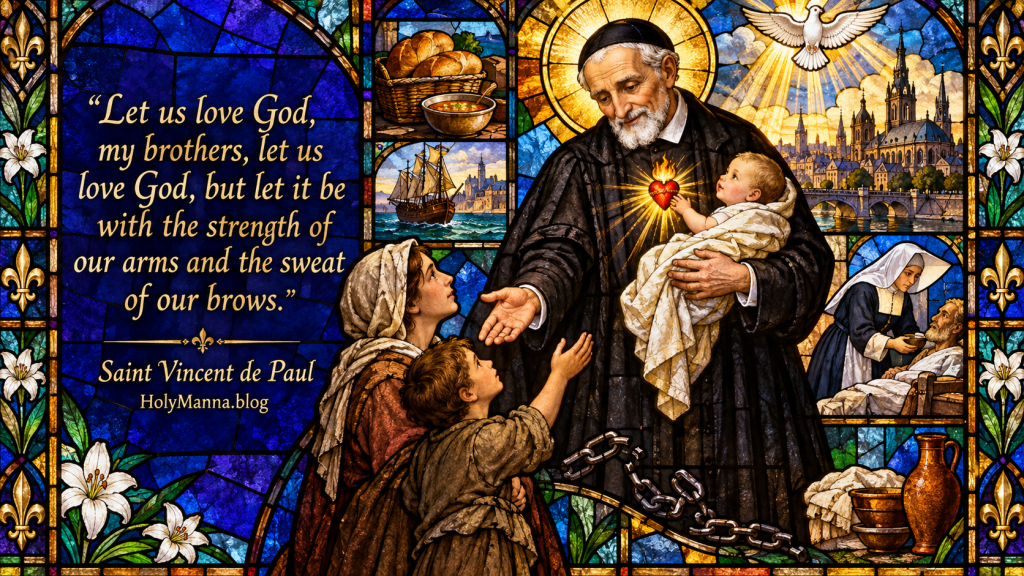
What does a 17th-century French priest have to say to you, living in a world of screens, schedules, and self-improvement plans? Everything, actually. Vincent’s genius was not mystical visions or spectacular wonders; it was the stubborn, practical conviction that love of God is proved by love of neighbor, and that this love must be organized, scheduled, and sweated over. He said it himself: “Let us love God, my brothers, let us love God, but let it be with the strength of our arms and the sweat of our brows.” That is a direct challenge to a generation tempted to mistake good feelings, good intentions, and good posts for good works. The Catechism defines charity as “the theological virtue by which we love God above all things for his own sake, and our neighbor as ourselves for the love of God” (CCC 1822), and it adds a line Vincent would have loved, that “the Eucharist commits us to the poor” (CCC 1397). If receiving Communion on Sunday does not change how a person treats the inconvenient people in their life by Tuesday, Vincent would gently ask why.
His life also speaks to anyone who feels their faith started badly. Vincent began as an ambitious young cleric chasing a comfortable income, and God did not discard him; God converted him, slowly, through failures, slanders, and the faces of the poor. How does the story of a self-interested young priest becoming the Apostle of Charity change the way you think about your own false starts? No one is too compromised, too late, or too ordinary for God to use. The Catechism insists that “all Christians in any state or walk of life are called to the fullness of Christian life and to the perfection of charity” (CCC 2013), and Vincent shows what that call looks like in work clothes.
There are simple, concrete ways to walk his path this week. A person can join or support the local Society of Saint Vincent de Paul conference at their parish, which continues his home-visit charism to this day. They can pick one hidden work of mercy, a meal for a sick neighbor, a visit to someone in a nursing home, an hour at a food pantry, and put it on the calendar the way Vincent put charity into rules, because what gets scheduled gets done. They can practice his patience under criticism, answering slander with silence and trust, as he did for years under a false accusation. They can imitate his reverence by refusing to speak of the poor as problems and learning to see them as he did, as lords and masters who carry Christ. And they can adopt his interior secret, abandonment to Providence, trusting that God writes straight with the crooked lines of a life. When charity interrupts your plans this week, will you resent the interruption, or will you recognize the moment Vincent described, the chance to leave God for God?
Engage With Us!
The HolyManna community would love to hear from you. Share your thoughts and reflections on Saint Vincent de Paul in the comments below, especially any experience you have had serving with the Society of Saint Vincent de Paul or seeing Christ in someone the world overlooks. To help the conversation along, here are some questions to pray with:
- Vincent admitted that he entered the priesthood seeking comfort, and God transformed his ambition into charity. What mixed motive in your own life might God be waiting to purify and use?
- At Châtillon, Vincent learned that unorganized love wastes itself. What is one act of charity you could turn from a good intention into a scheduled commitment this month?
- Vincent called the poor “our lords and masters.” Who is one person you tend to avoid or look past, and how could you serve them this week as you would serve Christ?
- Vincent bore a false accusation for years in silence, trusting God with his reputation. How do you respond when you are misjudged, and what would trusting Providence look like there?
- If the Eucharist truly “commits us to the poor” (CCC 1397), how should your next Holy Communion change your next ordinary day?
Saint Vincent de Paul spent his whole life proving that holiness is love with its sleeves rolled up. Take one step he would recognize this week: feed someone, visit someone, forgive someone, and do it quietly, joyfully, and for Jesus. Live your faith out loud through your hands, and do everything with the love and mercy that Jesus taught us.
Saint Vincent de Paul, pray for us!
Follow us on YouTube, TikTok, Instagram and Facebook for more insights and reflections on living a faith-filled life.


Leave a comment