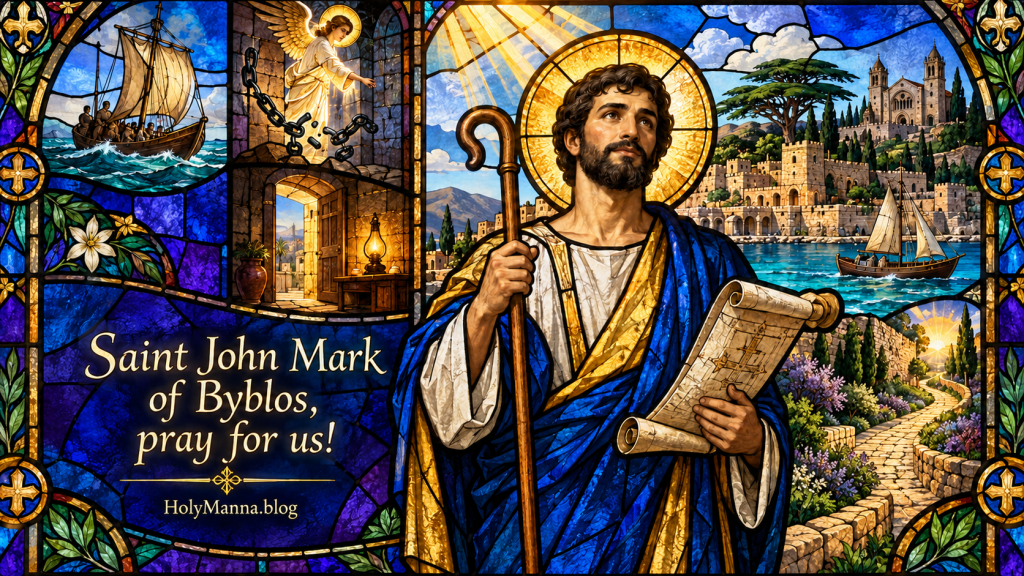
The Saint Who Came Back
Some saints thunder across history. They preach to emperors, convert nations, and leave behind volumes of writing that shape the Church for centuries. And then there are saints like John Mark of Byblos, celebrated on September 27th, whose greatness is quieter, more hidden, and in some ways far closer to the life of the ordinary believer. He appears in the Acts of the Apostles not as a hero but as a helper, a young man from a devout Jerusalem household who tagged along on the first great missionary journey of the Church, faltered partway through, went home, and then, by the grace of God, found his way back into the mission and finished his race as a bishop.
The traditional Roman Martyrology honors him on September 27th with these words: “At Byblos in Phoenicia, Bishop Saint Mark, whom Saint Luke calls John.” The Byzantine tradition venerates him on the same day as one of the Seventy disciples and as the first bishop of Byblos, that ancient Phoenician harbor city in what is now Lebanon, one of the oldest continuously inhabited cities on the face of the earth. To this day, John Mark is honored as the patron saint of Byblos and the founder of its first Christian community, and the city’s medieval cathedral bears his name.
Why does the Church remember a man whose most famous recorded act was quitting? Because the Church has always understood something the world forgets: sanctity is not the absence of failure. It is fidelity after failure. John Mark is the saint of the second chance, the patron in practice of everyone who has walked away from something God asked of them and wondered whether the door was still open. The Catechism teaches that “Christ’s call to conversion continues to resound in the lives of Christians. This second conversion is an uninterrupted task for the whole Church” (CCC 1428). John Mark lived that second conversion in full view of the apostles, and the Church has never stopped telling his story.
A Boy in the House Where the Church Prayed
John Mark was a Jew of Jerusalem, born in the first century into a family that stood at the very center of the newborn Church. Scripture introduces him through his mother. Around the year 44, King Herod Agrippa unleashed a persecution on the Church in Jerusalem. He put the apostle James, the brother of John, to the sword, and seeing that it pleased the crowds, he arrested Peter and held him under heavy guard, intending to execute him after Passover. The Church did the only thing it could do. It prayed. And The Acts of the Apostles records exactly where it prayed.
On the night before his trial, an angel of the Lord woke Peter, struck the chains from his hands, led him past the guards, and opened the iron gate of the city before him. Peter, realizing he was not dreaming, made straight for a particular house: “he went to the house of Mary, the mother of John whose other name was Mark, where many were gathered together and were praying” (Acts 12:12). This single verse reveals a great deal. The house belonged to Mary herself, which suggests she was a widow. It was large enough to host “many,” and she kept at least one servant girl, the famous Rhoda who was so overjoyed at hearing Peter’s voice that she left him standing at the gate. Mary was, in other words, a woman of some means who had placed her home, her safety, and her resources entirely at the disposal of the persecuted Church. The Church honors her in the traditional Roman Martyrology on June 29th.
This is the household that formed John Mark. Before he ever set foot on a mission field, he grew up in a home that was itself a church, where apostles were family friends, where the Eucharist was likely celebrated, and where prayer was the family’s answer to persecution. The Catechism teaches that “in a world often alien and even hostile to faith, believing families are of primary importance as centers of living, radiant faith” (CCC 1656), and it calls the Christian family by an ancient name, the Ecclesia domestica, the domestic church (CCC 1655 to 1656). Mary’s house in Jerusalem is one of the very first domestic churches in history, and John Mark was its son.
If the Mark named in The Letter to the Colossians is the same man, and the ancient Church largely read it so, then John Mark was also the cousin of Saint Barnabas (Colossians 4:10), the generous Levite from Cyprus who sold his field and laid the money at the apostles’ feet, and who later became the great encourager of the early Church. Faith ran in this family like a current. When Barnabas and Saul completed their famine relief mission to Jerusalem, they did not leave alone: “And Barnabas and Saul returned from Jerusalem when they had fulfilled their mission, bringing with them John whose other name was Mark” (Acts 12:25). The boy who had watched Peter walk free from prison was now stepping into the mission himself.
Companion of Apostles, Shepherd of Byblos
The Holy Spirit spoke to the church at Antioch: set apart Barnabas and Saul for the work. So began the first missionary journey, the moment the Gospel deliberately launched itself toward the wider world. And John Mark went with them. Scripture describes his role simply: when Barnabas and Saul proclaimed the word of God in the synagogues of Cyprus, “they had John to assist them” (Acts 13:5). He was the assistant, the helper, the one who handled the practical needs of the mission so the apostles could preach. It is an unglamorous title, and it is worth pausing over, because most Christians will spend their whole lives in exactly that position: not the preacher, but the one who makes the preaching possible.
In Cyprus, John Mark witnessed the power of God firsthand. At Paphos, the Roman proconsul Sergius Paulus summoned Barnabas and Saul to hear the word of God, and a magician named Elymas opposed them, trying to turn the proconsul from the faith. Paul, filled with the Holy Spirit, rebuked him, and Elymas was struck blind for a time, and the proconsul believed (Acts 13:6 to 12). John Mark stood in the room for that. He had already seen an angel’s work at his own mother’s door. Now he saw the Gospel confront paganism and sorcery and win.
Here honesty requires a clear statement, because the standing rule of this blog is that nothing gets invented. No miracles are attributed to John Mark personally in any documented source. He is not remembered for wonders worked by his own hands. He is remembered as a witness of wonders and a servant of those through whom God worked them. That is not a lesser vocation. The Church has always taught that holiness consists in doing the will of God in the state of life He assigns, and for John Mark that state was service, perseverance, and eventually the pastoral care of souls.
For after the drama of his young adulthood, ancient tradition gives John Mark a long and fruitful ending. The Eastern Church, in agreement with the Roman Martyrology, holds that he preached the word of God alongside Paul and Barnabas and was afterward made bishop of the Phoenician city of Byblos. The ancient list attributed to Hippolytus, On the Seventy Apostles, carefully distinguishes the Marks of the New Testament and names him “Mark, who is also John, Bishop of Bibloupolis.” Byblos was no backwater. It was an ancient port whose very name gave the Greek language its word for book, and through it, the world the word Bible. There is something fitting, almost playful, in God’s providence: the man from the house of prayer became the shepherd of the city of the book.
A note of scholarly honesty belongs here, because readers deserve it. Is John Mark of Byblos the same person as Saint Mark the Evangelist, the author of The Gospel of Mark, whose feast falls on April 25th? The ancient sources generally said no, distinguishing John Mark of Byblos from Mark the Evangelist of Alexandria and from Mark the cousin of Barnabas. Medieval writers and many modern scholars have said yes, seeing one Mark behind all the New Testament references. The traditional Roman Martyrology keeps them distinct, giving John Mark his own commemoration on September 27th, and this post follows the Martyrology. But the question remains genuinely open, and the reader should know it. If the identification holds, then the later New Testament references to Mark belong to him too, and his story grows even richer: Paul, near death, writing “Get Mark and bring him with you; for he is very useful in serving me” (2 Timothy 4:11), and Peter, from Rome, sending greetings from “my son Mark” (1 Peter 5:13). Whether those verses describe John Mark of Byblos or another Mark, they describe the arc the Church has always seen in him: the one who left, restored to usefulness and beloved sonship.
As a bishop, John Mark took his place in the unbroken chain the apostles forged. The Catechism teaches that “in order that the full and living Gospel might always be preserved in the Church the apostles left bishops as their successors” (CCC 77), and that the office of shepherding the Church is exercised without interruption by the sacred order of bishops (CCC 861 to 862). Every Catholic who has ever received a sacrament from a validly ordained priest stands downstream of men like John Mark, first-generation bishops who carried the apostolic deposit out of Jerusalem and planted it in cities that had never heard the name of Jesus.
The Departure at Perga and the Long Road Back
Now for the part of the story everyone remembers, the part that makes John Mark one of the most relatable figures in the entire New Testament. After Cyprus, the mission pressed on toward the mainland of Asia Minor, into rougher country and greater danger. And Scripture records, with devastating brevity: “Now Paul and his company set sail from Paphos, and came to Perga in Pamphylia. And John left them and returned to Jerusalem” (Acts 13:13).
That is all it says. Scripture gives no reason. Across the centuries, readers have proposed many: homesickness, fear of the bandit-ridden mountain roads into the interior, illness, discomfort at the mission’s increasing turn toward the Gentiles, or loyalty to his cousin Barnabas as Paul assumed leadership of the expedition. Every one of those explanations is speculation, and it is important to say so plainly. What is documented is only the fact: at Perga, the young man turned around and went home. Whatever the reason, Paul regarded it as desertion, and the wound did not heal quickly.
It surfaced again years later, when Paul proposed revisiting the churches from the first journey. “And Barnabas wanted to take with them John called Mark. But Paul thought best not to take with them one who had withdrawn from them in Pamphylia, and had not gone with them to the work. And there arose a sharp contention, so that they separated from each other; Barnabas took Mark with him and sailed away to Cyprus” (Acts 15:37 to 39). Read that slowly. Two of the greatest saints of the apostolic age, men who had risked their lives together, parted ways over John Mark. His failure did not stay private. It became the occasion of a public dispute between apostles, recorded in inspired Scripture for every generation to read. If you have ever felt that your worst moment defines you, imagine having your worst moment written into the Bible.
And yet notice what Scripture also records. Barnabas did not give up on him. The son of encouragement lived up to his name, took his young cousin, and sailed for Cyprus, back to the very mission field where John Mark had once served faithfully. God, in His providence, even drew good from the quarrel itself, for now there were two missions where there had been one. The Church does not canonize the contention; The Catechism is sober about the wounds sin and weakness leave in human relationships, and it insists that forgiveness is the summit of Christian prayer, teaching that “it is there, in fact, ‘in the depths of the heart,’ that everything is bound and loosed” (CCC 2843). The ancient reading of the New Testament saw exactly that binding up: the man Paul refused at Antioch reappears, in the letters the Church read as referring to him, as Paul’s fellow worker (Philemon 24) and as the helper Paul asked for by name at the end of his life (2 Timothy 4:11).
These were John Mark’s hardships. He was not, so far as any documented source records, a martyr. He faced instead the trials that most believers actually face: fear, failure, the shame of having quit, the sting of a great man’s disapproval, and the slow, unglamorous work of rebuilding trust. He also lived his entire Christian life inside the furnace of the first persecutions, in a Church whose members were imprisoned and killed, whose gatherings met at night behind locked doors, and whose missionaries walked roads where beatings and stonings awaited them. Perseverance in that world was itself heroic. The Catechism teaches that “to live, grow, and persevere in the faith until the end we must nourish it with the word of God; we must beg the Lord to increase our faith” (CCC 162). John Mark’s life is that paragraph in flesh and blood. He faltered, he was nourished, he persevered to the end, and he died a shepherd of Christ’s flock at Byblos in the first century.
A City That Never Forgot Its First Bishop
Honesty must govern this section too. No documented miracles are attributed to John Mark after his death. There are no recorded healings at his tomb, no chronicled translations of his relics, no wonder stories attached to his name in the sources. What history hands down instead is something rarer and, in its own way, more remarkable: a city that has held onto his memory for nearly two thousand years.
John Mark is venerated as the patron saint of Byblos and the founder of its first Christian community. When the Crusaders reached the Lebanese coast, they raised a Romanesque cathedral in the city in 1115, and that church, battered across the centuries by earthquakes and war, was given in 1764 to the Lebanese Maronite Order, which restored it and reopened it in 1776. It stands today as Saint John Mark Cathedral, still in use, still bearing his name beside the old harbor. When the Maronite Catholic Eparchy of Byblos was organized, its cathedral seat was placed under his patronage as well, so that the Catholic bishop of Byblos today sits, quite literally, in the house of Saint John Mark, a successor in the very see tradition says he founded. Pilgrims and travelers who visit Byblos, one of the great heritage cities of the Mediterranean, can pray in a church dedicated to the first man who preached Christ there.
One venerable tradition deserves to be told, with its status stated plainly. Ancient Christian memory in Jerusalem connected the house of Mary, the mother of John Mark, with the Upper Room itself, the place of the Last Supper and of Pentecost. The Monastery of Saint Mark in the Old City of Jerusalem preserves a sixth-century inscription claiming that spot as the site of the house of Mary, mother of John Mark, and the community there has treasured that identification for many centuries. If the tradition were true, then the Eucharist was instituted under John Mark’s own roof, and the Holy Spirit descended at Pentecost in his family home. It is a beautiful story, and the inscription itself is real and ancient, but the claim it makes cannot be verified. The same must be said of the Byzantine tradition that counts John Mark among the Seventy disciples sent out by the Lord Himself (Luke 10), which would make him an eyewitness of Jesus in the flesh. It is an ancient and honored tradition, but it cannot be verified.
What can be verified is the Church’s steady veneration. The traditional Roman Martyrology fixed his memory on September 27th, and the Byzantine churches keep the same day. In honoring him, the Church does what she always does with her saints. The Catechism teaches that by proposing the saints as models and intercessors, “the Church recognizes the power of the Spirit of holiness within her and sustains the hope of believers” (CCC 828). John Mark sustains a very particular hope: the hope of everyone who has ever quit.
What John Mark Teaches a Restless Generation
There is a reason this obscure first-century bishop speaks so directly to Catholics in their twenties, thirties, and forties. His story is the story of a generation. He grew up in a believing home, surrounded by the faith, formed by a praying mother. He stepped out into the mission with enthusiasm. And then, somewhere on the road, when the way grew hard and the cost became real, he went home. How many people do you know who fit that description? How many times has that description fit you?
Here is the first lesson: leaving is not the end of the story unless you decide it is. John Mark walked away at Perga, and the Church still celebrates his feast two thousand years later, not because the failure did not matter, but because he did not let the failure have the last word. He accepted Barnabas’s hand, went back to the work, and grew into a shepherd of souls. Is there something you walked away from, a vocation, a ministry, a practice of the faith, a relationship, that God may be inviting you to return to? The Catechism insists that conversion is not a one-time event but “an uninterrupted task for the whole Church” (CCC 1428). The confessional exists precisely for the John Marks of the world, which is to say, for everyone.
The second lesson is about the Barnabases. John Mark’s restoration did not happen in a vacuum. It happened because one man refused to define him by his worst day. Every returning Catholic, every person limping back to the Church after years away, needs a Barnabas, someone who will vouch for them, walk with them, and absorb some cost on their behalf. Who has been a Barnabas in your life? And more searchingly, is there someone in your life right now, someone who failed, someone others have written off, for whom God is asking you to be Barnabas? The Lord teaches that forgiveness must come from the depths of the heart (CCC 2843), and Barnabas shows what that forgiveness looks like when it puts on work clothes and books passage to Cyprus.
The third lesson comes from the house on the hill in Jerusalem. John Mark became the man he became because Mary made her home a sanctuary. In an age when so many young Catholics feel they must do something spectacular for God, her example is bracing: she opened her door, set out food, and let the Church pray in her living room, and from that hidden hospitality came a bishop and, if tradition is right, perhaps far more. Practically, this can begin tonight. Pray with the people in your home, even briefly. Host a rosary, a Bible study, a meal for friends drifting from the faith. Make your dwelling, whatever its size, a place where Christ is welcome, because The Catechism calls the believing household a center of “living, radiant faith” (CCC 1656). What would it take for your home to become a domestic church?
And the last lesson is the quietest: it is holy to be the assistant. John Mark’s scriptural job title was helper. He carried bags, arranged lodgings, and served the men who preached. Most of the Kingdom’s work is done by people like him, catechists and cantors, parents and godparents, the volunteers who stack chairs after the parish event. If your service feels invisible, remember that the Church canonized the assistant who came back. God saw Perga, and God also saw everything after Perga.
Engage With Us!
Saint John Mark of Byblos has walked the road so many are walking right now, out of the mission and back into it, and his intercession is a gift for anyone seeking the courage to return. Share your thoughts and reflections in the comments below; your story of coming back, or of waiting for someone to come back, may be exactly what another reader needs to see today.
- Where is your Perga, the place where you turned back from something God was asking of you, and what would returning look like?
- Who has been a Barnabas to you, refusing to define you by your failure, and have you ever thanked them?
- Is there a person in your life whom others have written off, and whom God may be calling you to encourage back into the mission?
- John Mark’s mother made her home a house of prayer in a time of persecution; what is one concrete step you could take this week to make your home a domestic church?
- John Mark served as an assistant so that others could preach; where is God asking you to serve in a hidden, supporting role, and can you embrace it with joy?
Take heart from this saint of the second chance. The God who welcomed John Mark back at Cyprus, who seated him as a shepherd in Byblos, and who kept his memory alive for two thousand years is the same God who waits for you with patience and delight. So return, persevere, open your door, and serve without needing to be seen, doing everything with the love and the mercy that Jesus taught us.
Saint John Mark of Byblos, pray for us!
Follow us on YouTube, TikTok, Instagram and Facebook for more insights and reflections on living a faith-filled life.


Leave a comment