Twenty-sixth Sunday in Ordinary Time – Lectionary: 136
The God Who Waits for the Turn
Everyone knows someone who talks a big game and never shows up, and everyone knows someone who stumbled badly and then quietly turned life around. On this Twenty-sixth Sunday in Ordinary Time, September 27th, 2026, the Church places both people in front of the congregation and asks a piercing question: which one actually did the Father’s will?
The central theme uniting these readings is that God judges the heart by where it turns, not by where it began. In the First Reading, the exiles in Babylon grumble that the Lord’s way is unfair, and God answers that His way is fairness itself: the wicked man who turns back to righteousness shall live. The Responsorial Psalm becomes the prayer of that returning sinner, begging God to forget the sins of youth and remember His ancient mercies instead. The Second Reading reveals the perfect pattern of the turned heart, Christ Jesus, who did not cling to His divine glory but emptied Himself in obedience even to death on a cross. And in the Gospel, Jesus tells the chief priests a deceptively simple story about two sons, a vineyard, and the difference between saying yes and living yes.
The historical backdrop sharpens everything. Ezekiel spoke to a people in exile who felt trapped by their parents’ failures. Paul wrote from a prison cell to a young church in a proud Roman colony. Jesus spoke in the Temple during the final week of His earthly life, to religious leaders already plotting His death. In every setting, the message lands the same way: the door of mercy stands open, and the only thing God asks is the turn. What would it look like to make that turn today?
First Reading — Ezekiel 18:25-28
The Prophet Who Told the Exiles to Stop Blaming Everyone Else
Ezekiel was a priest who never got to serve in the Temple he was trained for. In 597 BC, the Babylonians deported him along with King Jehoiachin and thousands of Judah’s leading citizens, and God called him to prophesy among the exiles settled at Tel Abib by the Chebar canal. The exiles had a favorite proverb, quoted earlier in this same chapter at Ezekiel 18:2, complaining that the fathers had eaten sour grapes and the children’s teeth were set on edge. In other words, they believed they were suffering for their ancestors’ sins and that God was therefore unjust. Chapter 18 is God’s thundering response, one of the clearest declarations of personal moral responsibility in the entire Old Testament. It fits the day’s theme perfectly, because it establishes the ground rule the Gospel will dramatize: no one is locked into the past, and every soul is judged by its own turning.
Ezekiel 18:25-28
Thus says the LORD:
You say, “The LORD’s way is not fair!”
Hear now, house of Israel:
Is it my way that is unfair, or rather, are not your ways unfair?
When someone virtuous turns away from virtue to commit iniquity, and dies,
it is because of the iniquity he committed that he must die.
But if he turns from the wickedness he has committed,
and does what is right and just,
he shall preserve his life;
since he has turned away from all the sins that he has committed,
he shall surely live, he shall not die.
Detailed Exegesis
Verse 25: “You say, ‘The LORD’s way is not fair!’ Hear now, house of Israel: Is it my way that is unfair, or rather, are not your ways unfair?”
God quotes His people’s complaint back to them, then flips it. The Hebrew word behind “fair” carries the sense of being measured or properly weighed, like a merchant’s honest scale. The exiles accuse God of using a crooked scale, and God replies that the crookedness lies in their own hearts. The Catechism affirms the dignity this verse presupposes, teaching in CCC 1730 that God created man a rational being with the dignity of a person who can initiate and control his own actions. Blame-shifting insults that dignity.
Verse 26: “When someone virtuous turns away from virtue to commit iniquity, and dies, it is because of the iniquity he committed that he must die.”
This is the sobering half of the equation. A virtuous past is not a savings account that covers future sin. The verse warns against presumption, the attitude that yesterday’s holiness excuses today’s compromise. Judgment falls on the direction a life is actually facing.
Verse 27: “But if he turns from the wickedness he has committed, and does what is right and just, he shall preserve his life;”
Here is the heartbeat of the passage. The Hebrew verb for turning, shub, is the great Old Testament word for repentance, a physical about-face on the road. Notice that the turn is completed by action, doing what is right and just, not by feelings of regret alone. This is exactly the anatomy of conversion the Church describes in CCC 1431, which teaches that “Interior repentance is a radical reorientation of our whole life, a return, a conversion to God with all our heart, an end of sin, a turning away from evil, with repugnance toward the evil actions we have committed.”
Verse 28: “since he has turned away from all the sins that he has committed, he shall surely live, he shall not die.”
The Hebrew doubles the verb for emphasis, and the NABRE captures it with “he shall surely live.” God does not merely tolerate the returning sinner; He guarantees life to him. The verdict of mercy is spoken with more force than the verdict of judgment.
Teachings
The Catechism addresses the exact complaint of Ezekiel’s audience. In CCC 1037, the Church teaches that “God predestines no one to go to hell; for this, a willful turning away from God (a mortal sin) is necessary, and persistence in it until the end.” No one is doomed by heredity, upbringing, or history. At the same time, God will not force the turn. The Church preserves a beloved saying of Saint Augustine in CCC 1847, drawn from his Sermo 169: “God created us without us: but he did not will to save us without us.” Salvation is a partnership in which God supplies all the grace and the soul supplies the yes. Church history offers a living illustration in Augustine himself, who spent years far from God before his conversion in 386 AD and later cried out in his Confessions, “Late have I loved you, O Beauty ever ancient, ever new, late have I loved you!” The man who once turned away became a Doctor of the Church precisely because he finally turned back.
Reflection
It is remarkably easy to keep a running list of the people and circumstances responsible for one’s spiritual state: the parish that disappointed, the family that wounded, the culture that corroded. Ezekiel’s word cuts through all of it. You are not your parents’ sins, and you are not even your own past. Consider one concrete step this week: name the one habit or grudge that most represents “your ways,” bring it to the Sacrament of Reconciliation, and replace it with one just action, perhaps repaying a debt, apologizing first, or restoring a relationship you let die. Where in your life have you been calling God unfair when the real unfairness lives in a choice you keep making? What would “turning” look like for you, not as a feeling, but as a visible action this week?
Responsorial Psalm — Psalm 25:4-9
The Prayer of the Sinner Who Decided to Come Home
Psalm 25 is an acrostic, a Hebrew poem in which each verse begins with a successive letter of the alphabet, a form the tradition associates with David and with prayers meant to be memorized and carried through life. It is the natural prayer of the person Ezekiel just described, the sinner mid-turn. Having decided to come home, the soul now needs two things: a map and mercy. This Psalm asks God for both, and in doing so it supplies the emotional bridge between the courtroom of the First Reading and the vineyard of the Gospel. The refrain the Church sings today, “Remember your mercies, O Lord,” is the anthem of everyone who has ever needed a second chance.
Psalm 25:4-9
R. (6a) Remember your mercies, O Lord.
Your ways, O LORD, make known to me;
teach me your paths,
guide me in your truth and teach me,
for you are God my savior.
R. Remember your mercies, O Lord.
Remember that your compassion, O LORD,
and your love are from of old.
The sins of my youth and my frailties remember not;
in your kindness remember me,
because of your goodness, O LORD.
R. Remember your mercies, O Lord.
Good and upright is the LORD;
thus he shows sinners the way.
He guides the humble to justice,
and teaches the humble his way.
R. Remember your mercies, O Lord.
Detailed Exegesis
Verses 4 and 5: “Your ways, O LORD, make known to me; teach me your paths, guide me in your truth and teach me, for you are God my savior.”
The exiles complained about the Lord’s way; the psalmist begs to learn it. The repetition of “teach me” reveals the posture of a lifelong student. Significantly, the psalmist grounds the request in salvation, not curiosity. He wants God’s paths because God is his savior, and the Church has always read such verses as prayers ultimately answered in Christ, who declares Himself the way, the truth, and the life in The Gospel of John.
Verses 6 and 7: “Remember that your compassion, O LORD, and your love are from of old. The sins of my youth and my frailties remember not; in your kindness remember me, because of your goodness, O LORD.”
This is one of the boldest bargaining prayers in Scripture. The psalmist asks God to exercise selective memory: remember Your ancient mercies, forget my youthful sins, and when You look at me, let Your own goodness set the terms. This is precisely the exchange offered in the confessional, where absolution does not merely file sin away but removes it.
Verses 8 and 9: “Good and upright is the LORD; thus he shows sinners the way. He guides the humble to justice, and teaches the humble his way.”
Here the Psalm answers Ezekiel’s controversy directly. Because the Lord is good and upright, He shows sinners the way; His fairness is proven by His mercy, not contradicted by it. Notice who receives the teaching: the humble, mentioned twice. Pride cannot learn.
Teachings
The Catechism seizes on exactly this connection between humility and prayer. CCC 2559 teaches plainly that “humility is the foundation of prayer,” and the whole structure of Psalm 25 proves it, since every request flows from the admission of sin and need. Saint Thomas Aquinas, Doctor of the Church, taught in the Summa Theologiae that humility removes the obstacle of pride so that grace can enter, which is why the humble alone are described as teachable in verse 9. The Church also draws the thread forward to the Sacrament of Penance, where the psalmist’s plea becomes a lived reality. The turn described by Ezekiel and prayed by David finds its ordinary home in the confessional, where, as CCC 1428 teaches, “Christ’s call to conversion continues to resound in the lives of Christians.”
Reflection
Most people carry at least one memory they wish God would delete, a season of life filed under “the sins of my youth.” This Psalm gives you permission to pray about it out loud. A concrete practice: take verses 6 and 7 into ten minutes of silent prayer this week, slowly, asking God to hold your history inside His mercy rather than the other way around. Then act on verse 4 by choosing one way to actually learn His paths, perhaps reading the Sunday readings before Mass or picking up the Catechism for ten minutes a day. Which memory do you most need to hand over to the mercy of God? Are you humble enough to be taught, or have you quietly decided you already know the way?
Second Reading — Philippians 2:1-11
The Hymn That Sang the Truth About Jesus Before the Creeds Did
Paul wrote The Letter to the Philippians from prison, most likely in Rome around 62 AD, to the first Christian community he founded on European soil. Philippi was a proud Roman colony full of retired soldiers, a city obsessed with rank, citizenship, and honor. Into that culture Paul dropped what many scholars believe is one of the earliest Christian hymns, the Carmen Christi of verses 6 through 11, a song about a God who moved down the ladder of honor on purpose. This reading supplies the day’s theme with its ultimate example. Ezekiel called for the turn, the Psalm prayed for it, and now Paul unveils the perfect obedience that makes every human turn possible: the Son who said yes to the Father with His whole existence.
Philippians 2:1-11
Brothers and sisters:
If there is any encouragement in Christ,
any solace in love,
any participation in the Spirit,
any compassion and mercy,
complete my joy by being of the same mind, with the same love,
united in heart, thinking one thing.
Do nothing out of selfishness or out of vainglory;
rather, humbly regard others as more important than yourselves,
each looking out not for his own interests,
but also for those of others.Have in you the same attitude
that is also in Christ Jesus,
Who, though he was in the form of God,
did not regard equality with God
something to be grasped.
Rather, he emptied himself,
taking the form of a slave,
coming in human likeness;
and found human in appearance,
he humbled himself,
becoming obedient to the point of death,
even death on a cross.
Because of this, God greatly exalted him
and bestowed on him the name
which is above every name,
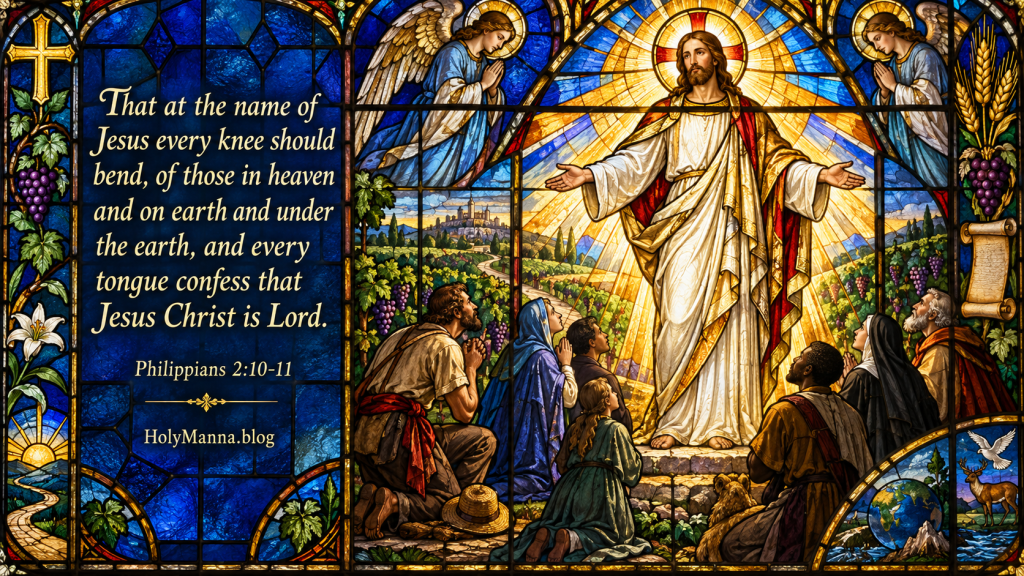
that at the name of Jesus
every knee should bend,
of those in heaven and on earth and under the earth,
and every tongue confess that
Jesus Christ is Lord,
to the glory of God the Father.
Detailed Exegesis
Verse 1: “If there is any encouragement in Christ, any solace in love, any participation in the Spirit, any compassion and mercy,”
Paul stacks four “ifs” that are really “sinces.” The Philippians have experienced all of these gifts, and Paul appeals to that shared experience as the basis for what he is about to ask.
Verse 2: “complete my joy by being of the same mind, with the same love, united in heart, thinking one thing.”
Unity is the request. A community quietly fraying over status and rivalry, as later chapters suggest Philippi was, can only be healed by a common mind, and Paul is about to name whose mind that must be.
Verses 3 and 4: “Do nothing out of selfishness or out of vainglory; rather, humbly regard others as more important than yourselves, each looking out not for his own interests, but also for those of others.”
Vainglory, empty glory, was the currency of Roman Philippi. Paul demands the opposite economy, where others are counted as more important. This is not low self-esteem; it is deliberate self-forgetfulness for the good of another.
Verse 5: “Have in you the same attitude that is also in Christ Jesus,”
The hinge of the whole passage. Christian humility is not a technique but a participation in the actual mind of Christ.
Verses 6 and 7: “Who, though he was in the form of God, did not regard equality with God something to be grasped. Rather, he emptied himself, taking the form of a slave, coming in human likeness; and found human in appearance,”
Here is the kenosis, the self-emptying. The Son eternally possesses the form of God, full divinity, yet does not cling to its glory. He empties Himself, not by subtracting divinity but by adding humanity and hiding His majesty under the form of a slave. The Church built her confession of the Incarnation on these verses, teaching in CCC 461 that “the Church calls ‘Incarnation’ the fact that the Son of God assumed a human nature in order to accomplish our salvation in it.”
Verse 8: “he humbled himself, becoming obedient to the point of death, even death on a cross.”
The descent bottoms out at the most shameful death Rome could invent, a death Philippian citizens were legally exempt from even discussing in polite company. Obedience to the Father, the perfect yes, goes all the way down.
Verses 9 through 11: “Because of this, God greatly exalted him and bestowed on him the name which is above every name, that at the name of Jesus every knee should bend, of those in heaven and on earth and under the earth, and every tongue confess that Jesus Christ is Lord, to the glory of God the Father.”
The hymn turns upward. The Father answers the Son’s obedience with exaltation, and the hymn deliberately echoes Isaiah 45:23, where every knee bends to the God of Israel alone. Applying that verse to Jesus is one of the New Testament’s clearest confessions of His divinity.
Teachings
This hymn stood at the center of the Church’s earliest doctrinal battles. When the priest Arius denied the full divinity of Christ, the Council of Nicaea in 325 AD confessed the Son as consubstantial with the Father, a truth this hymn had been singing for centuries, since only one who truly possesses the form of God can meaningfully empty Himself of its glory. On the moral side, Saint Augustine made humility the master key of the Christian life. Writing to the young scholar Dioscorus in Letter 118, he taught: “In that way the first part is humility; the second, humility; the third, humility: and this I would continue to repeat as often as you might ask direction.” The Catechism gathers it all together in CCC 520, teaching that “In humbling himself, he has given us an example to imitate, through his prayer he draws us to pray, and by his poverty he calls us to accept freely the privation and persecutions that may come our way.”
Reflection
Modern life runs on the Philippian operating system: build the brand, guard the status, grasp the advantage. Paul offers a different program, and it starts small. This week, choose one deliberate act of downward mobility: take the task no one wants at work, let someone else receive the credit, or serve someone who can never repay you, and do it in secret. Then pray verse 5 each morning as a one-line examen. Where are you still grasping at “equality,” at recognition, control, or credit, instead of emptying yourself? Whose interests, other than your own, will you actively look out for this week?
Holy Gospel — Matthew 21:28-32
The Story Jesus Told the Men Who Were Planning His Death
The setting could not be more charged. It is Holy Week. Jesus has entered Jerusalem to shouts of Hosanna, overturned the money changers’ tables, and returned to teach in the Temple, where the chief priests and elders confront Him, demanding to know by what authority He acts. Instead of answering directly, Jesus tells the first of three judgment parables, and He makes His interrogators deliver their own verdict. The parable of the two sons is short enough to read in thirty seconds and sharp enough to cut through a lifetime of religious performance. It gathers the whole day into one scene: Ezekiel’s turning sinner becomes the first son, the Psalm’s humble student becomes the tax collector at the Jordan, and the obedience of Christ in Philippians 2 stands silently behind it all as the one Son who said yes and went.
Matthew 21:28-32
Jesus said to the chief priests and elders of the people:
“What is your opinion?
A man had two sons.
He came to the first and said,
‘Son, go out and work in the vineyard today.’
He said in reply, ‘I will not,’
but afterwards changed his mind and went.
The man came to the other son and gave the same order.
He said in reply, ‘Yes, sir, ‘but did not go.
Which of the two did his father’s will?”
They answered, “The first.”
Jesus said to them, “Amen, I say to you,
tax collectors and prostitutes
are entering the kingdom of God before you.
When John came to you in the way of righteousness,
you did not believe him;
but tax collectors and prostitutes did.
Yet even when you saw that,
you did not later change your minds and believe him.”
Detailed Exegesis
Verse 28: “What is your opinion? A man had two sons. He came to the first and said, ‘Son, go out and work in the vineyard today.’”
Jesus invites His opponents to judge the case themselves, exactly as the prophet Nathan once did with King David. The vineyard is Israel’s oldest self-portrait, drawn from Isaiah 5, so every listener knows the father is God and the vineyard is His people. The word “today” matters; the call carries urgency.
Verse 29: “He said in reply, ‘I will not,’ but afterwards changed his mind and went.”
In a first-century household, a son’s flat refusal to his father’s face was a public disgrace. Yet the story does not end at the refusal. The Greek verb for changing his mind carries the sense of regret that becomes action, and the proof of his repentance is a single word: went.
Verse 30: “The man came to the other son and gave the same order. He said in reply, ‘Yes, sir,’ but did not go.”
The second son gives the socially perfect answer, respectful and prompt, and it is worth nothing. His yes is a costume. Jesus is describing religiosity that performs obedience in public while withholding the heart.
Verse 31: “Which of the two did his father’s will?” They answered, “The first.” Jesus said to them, “Amen, I say to you, tax collectors and prostitutes are entering the kingdom of God before you.”
The chief priests condemn themselves with their own answer, and Jesus detonates the application. Tax collectors, despised as collaborators with Rome, and prostitutes, the most publicly shamed sinners in Israel, are entering the kingdom ahead of the professionally religious, because they made the turn.
Verse 32: “When John came to you in the way of righteousness, you did not believe him; but tax collectors and prostitutes did. Yet even when you saw that, you did not later change your minds and believe him.”
The final line is the most devastating. The leaders watched conversions happen in front of them at the Jordan, real lives visibly changed, and still refused to reconsider. Their sin is not merely the first no but the refusal of every subsequent chance to turn it into a yes.
Teachings
Saint John Chrysostom, Doctor of the Church, preached on this parable in his Homily 67 on Matthew and saw in the two sons the whole sweep of salvation history, observing that “these two children declare what came to pass with respect to both the Gentiles and the Jews.” He also marveled at the mercy hidden in Jesus’ method, asking, “Do you see how He rendered His discourse less offensive, and more penetrating, by the parable, by His bringing in the harlots?” Even in rebuke, Christ was still trying to win the hearts of His enemies. The Catechism confirms the pattern, teaching in CCC 588 that “Jesus scandalized the Pharisees by eating with tax collectors and sinners as familiarly as with themselves.” And preaching on this very Gospel at the Angelus on September 27th, 2020, Pope Francis described the Father’s heart behind the parable, saying that He “anxiously awaits our ‘yes’, so as to welcome us anew in his fatherly arms and to fill us with his boundless mercy.”
Reflection
Nearly everyone lives some version of both sons. There are areas of life where the no came first, and grace is still working on the turn, and there are areas polished with a public yes that never left the driveway. The parable asks for honesty about which is which. A concrete practice: identify one standing yes you have given God, perhaps at Baptism, Confirmation, or marriage, that has quietly gone unfulfilled, and take one visible step into the vineyard this week, whether that means returning to Confession, restoring Sunday Mass, or finally having the conversation you have been avoiding. Which son are you right now, in this season, and in which specific area of your life? When you saw real conversion in someone else, did it soften your heart or harden it?
Walking Into the Vineyard Before Sunset
Put the whole Sunday together and a single storyline emerges. A people in exile accuse God of unfairness, and God answers that His scale is perfectly true: whoever turns from wickedness shall surely live. A repentant king turns that promise into a prayer, begging the Lord to remember His mercies and forget the sins of youth. An imprisoned apostle then unveils the secret engine of every turn, the mind of Christ, who emptied Himself and obeyed the Father all the way to a cross and through it to exaltation. And finally, in the Temple, days before that cross, Jesus tells a story proving the point one last time: the kingdom belongs not to those who say the right words but to those who get up and go.
The good news hiding in all of it is that God grades by trajectory. The tax collectors and prostitutes did not enter the kingdom because their past was clean but because their turn was real. The chief priests were not shut out because their past was wicked but because they refused to move. That means today, September 27th, is not too late for anyone. The Father is still standing at the edge of the vineyard, and as Pope Francis said of this very Gospel, He anxiously awaits the yes that lets Him fill His children with boundless mercy.
So take the step. Get to Confession this week and make the turn sacramental. Trade one act of vainglory for one act of hidden service. Pray Psalm 25 until its humility becomes second nature. The vineyard has work in it with a specific name attached, and the day laborers who arrive late, embarrassed, and finally willing are exactly the ones the Master delights to welcome home.
Engage With Us!
The conversation does not end when the post does, so please share your reflections in the comments below. This community grows every time someone honestly names where God met them in the Word, and your story might be the nudge another reader needs to make the turn.
Here are some questions to pray with this week:
- In Ezekiel 18:25-28, God insists that the person who turns from wickedness shall surely live. Where have you been blaming your past, your family, or your circumstances instead of making the turn that is yours to make?
- In Psalm 25:4-9, David asks God to remember His mercies and forget the sins of his youth. Which memory do you most need to place inside the mercy of God, and what would it change if you truly believed He held it there?
- In Philippians 2:1-11, Paul urges believers to have the same attitude as Christ, who emptied Himself. What is one concrete act of hidden, downward-moving service you can perform this week without seeking any credit?
- In Matthew 21:28-32, two sons answer the same father in opposite ways. In which area of your life are you the first son, and in which are you the second?
- Taking all the readings together, what is one standing yes you have already given God that needs to finally become action before this week ends?
Keep walking, keep turning, and keep showing up in the vineyard. A life of faith is not built on perfect beginnings but on faithful returns, so do everything this week with the love and mercy Jesus taught us, and trust that the Father is already running to meet you.
Sacred Heart of Jesus, we trust in You!
Immaculate Heart of Mary, pray for us!
Saint Michael the Archangel, defend us in battle!
Follow us on YouTube, TikTok, Instagram and Facebook for more insights and reflections on living a faith-filled life.


Leave a comment