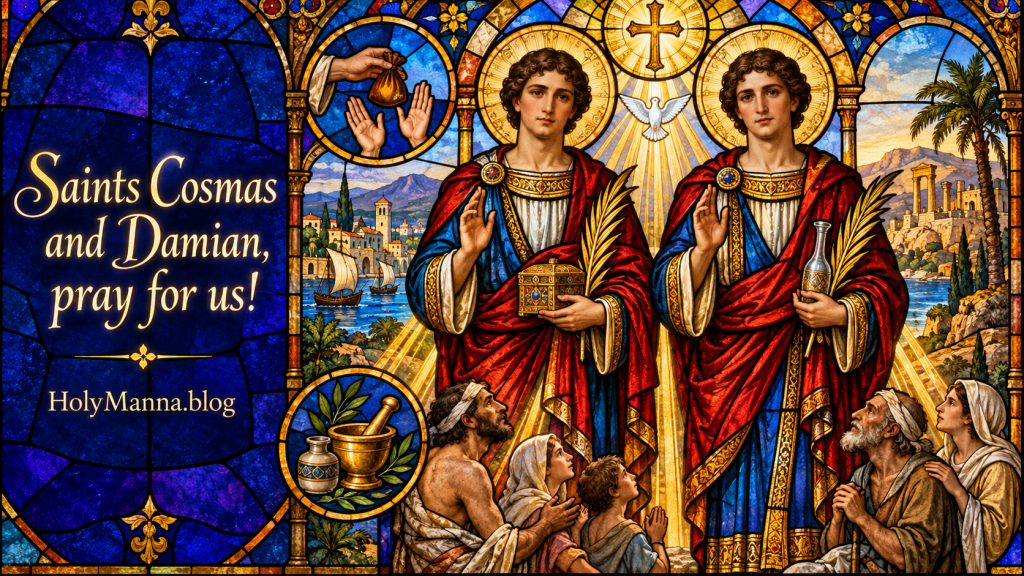
The Doctors Who Refused to Be Paid
Some saints are remembered for what they wrote. Some are remembered for what they built. Saints Cosmas and Damian are remembered for what they gave away. These twin brothers of the third century were physicians, and by every account they were very good ones, yet the thing that made them unforgettable was not their skill. It was their price. They charged nothing. Not a coin, not a favor, not so much as a basket of eggs. The Greek-speaking Christians of the East gave them a nickname that stuck for seventeen centuries: the anargyroi, the moneyless ones, the silverless. In an age when medicine was a business and healers were paid according to their reputation, two brothers treated every patient for free, told each one about Jesus Christ, and eventually paid for that witness with their heads.
The Church has never forgotten them. Their names are spoken at the altar in the most ancient Eucharistic Prayer of the Roman Rite, The Roman Canon, where the priest asks God to grant the faithful “some share and fellowship” with the apostles and martyrs, and lists among them “Cosmas and Damian.” They are invoked in The Litany of the Saints. Emperors built churches over their bones, popes raised a basilica to them in the middle of the Roman Forum, and Renaissance masters painted their story in gold. Today the Church celebrates their memorial on September 26th.
Saints Cosmas and Damian hold several patronages. They are the patron saints of physicians and surgeons, and they are also invoked as patrons of pharmacists and of twins. The great banking family of Florence, the Medici, whose very name means “doctors,” took them as family patrons as well. For anyone who works in medicine, anyone who has a twin, anyone who has ever wondered whether a career and a calling can be the same thing, these two brothers are worth knowing.
Sons of a Believing Mother
Here is an honest word before the story begins. The historical record for Cosmas and Damian is ancient but thin. What is documented with confidence is this: they were real men, they were martyred during the great persecution of the Emperor Diocletian, they were buried at Cyrrhus in Syria, and devotion to them exploded across the Christian world almost immediately, so fast and so widespread that it testifies to a genuine and beloved memory. Nearly everything else comes from their Passio, the traditional account of their life and death, and from later devotional writings. Those traditions deserve to be told, because the Church has treasured them for well over a thousand years, but they will be told here as traditions, and this post will say so plainly wherever a story cannot be verified.
According to that tradition, Cosmas and Damian were twins, born in Arabia in the third century, perhaps around the year 270. Some accounts place their family origins near Cyrrhus, in what is now Syria, the city where their bodies would one day rest. Tradition holds that their mother was a devout Christian who raised her sons in the faith; the Eastern churches remember her by the name Theodota and venerate her as a saint in her own right, telling that she was widowed young and formed her boys through her own example and through the reading of holy books. Their father may also have been a Christian, though the accounts differ. None of these family details can be verified, and they are presented here as the tradition hands them down.
What the tradition describes next is a decision that would shape everything. The brothers studied medicine, according to one strand of the tradition in the great city of Antioch, and they became skilled in what the ancient world called the art of healing. Then they settled and practiced in the seaport of Aegeae on the Gulf of Iskenderun in Cilicia, in what is today southern Turkey. And there they made the choice that gave them their name. They would take no payment. Ever. From anyone.
This was not a marketing strategy. It was obedience. The Lord Jesus, sending out the Twelve to “cure the sick, raise the dead, cleanse lepers, drive out demons,” had given them a rule for the road: “Without cost you have received; without cost you are to give” (The Gospel of Matthew, Mt 10:8). Cosmas and Damian took that verse literally and personally. They had received their skill, their intelligence, their health, and above all their faith as free gifts from God. So they gave freely. Their medicine became their pulpit. Patients came for a cure and left having heard the Gospel, and the tradition says that many pagans in that region came to Christ precisely because two doctors would not take their money.
Medicine Without a Price Tag
Why does the Church hold up two ancient physicians as models, when the reader will likely never set a bone or lance a wound? Because Cosmas and Damian show what it looks like when ordinary professional work is handed over completely to God. The Catechism teaches that “Christ’s compassion toward the sick and his many healings of every kind of infirmity are a resplendent sign that ‘God has visited his people’” (CCC 1503). When the brothers healed the sick without charge, they were not merely being generous. They were making Christ’s own compassion visible in their city. The Church has always understood care for the sick as part of her mission, because the risen Lord renews the sending of the apostles, and The Catechism puts His command in two blunt words: “Heal the sick!” (CCC 1509). Cosmas and Damian obeyed that command with a stethoscope’s worth of tools and a martyr’s worth of courage, centuries before hospitals as the world knows them existed.
Tradition attributes many healings to the brothers during their lifetime, healings that went beyond natural medicine, worked through their prayer and faith. The Eastern accounts say the brothers received from the Holy Spirit the gift of healing illnesses of both body and soul, and that their charity was so wide it extended even to sick animals, which is one reason veterinarians have also claimed them as patrons in some traditions.
The most famous story of their practicing years is small, human, and a little bit funny, which is often how the truest stories feel. Tradition tells of a woman named Palladia, gravely ill, in some accounts suffering from a hemorrhage that no physician had been able to treat. The brothers came, prayed, and she was healed. Overflowing with gratitude, and knowing they would never accept a fee, she came to Damian privately and begged him to accept a tiny gift of three eggs, imploring him in the name of God to take them. Damian, unwilling to wound her or to refuse what she offered in the holy Name, accepted the eggs. When Cosmas learned of it, he was so grieved that their rule of absolute gratuity had been bent, even by three eggs, even in charity, that he declared he did not wish to be buried beside his brother after death. This story comes from the traditional accounts and cannot be verified. But the Church has loved it for centuries, because it captures both the fierce purity of Cosmas and the tender pastoral heart of Damian, and because God Himself, as the tradition goes on to tell, would settle the burial question in His own way.
Sit with that image for a moment. Two men so serious about giving freely that three eggs could cause a crisis of conscience. Most people negotiate with their generosity. Cosmas and Damian guarded theirs like a treasure, because for them the free gift was the whole sermon. The moment healing had a price, the Gospel they preached through it would have a price too.
Tortures That Would Not Take
The brothers practiced their free medicine in dangerous times. Around the turn of the fourth century, the Emperor Diocletian unleashed against the Church the most systematic persecution Rome had ever attempted. Christians were ordered to sacrifice to the gods of the empire, and those who refused faced torture and death. Two famous doctors who healed in the name of Christ and converted their patients were never going to stay off the list.
According to the traditional account, the prefect Lysias had Cosmas and Damian arrested and ordered them to renounce Christ. They refused. What the Passio describes next reads like a catalog of everything the ancient world could do to a human body, and of God’s refusal to let any of it succeed before its hour. The tradition says the brothers were bound and thrown into the sea, and did not drown. They were cast into fire, and were not burned. Later accounts, gathered in the medieval collection The Golden Legend, add that they were stoned, and the stones turned back upon the throwers, and that archers shot at them, and the arrows wounded the executioners instead. Finally, when every torment had failed, they were beheaded with the sword. These miraculous escapes belong to the traditional account and cannot be verified as history; the martyrdom itself, the fact that these two men died for Christ under Diocletian’s persecution, is the documented core that the whole Church received and never doubted. Tradition adds that three of their brothers, Anthimus, Leontius, and Euprepius, were martyred alongside them, a detail likewise handed down in the tradition rather than established by independent record.
The sources do not fully agree on the details, and honesty requires saying so. The traditional date of their death is September 27th, probably in the year 287, though other respected references place it around 303, at the height of Diocletian’s great persecution. The Passio sets the martyrdom at Aegeae in Cilicia, while the more historically cautious tradition ties their death and burial to Cyrrhus in Syria. What no source disputes is the ending: they died rather than deny Jesus Christ.
The Catechism teaches exactly what their deaths mean: “Martyrdom is the supreme witness given to the truth of the faith: it means bearing witness even unto death. The martyr bears witness to Christ who died and rose, to whom he is united by charity” (CCC 2473). Notice the logic of their lives. First they bore witness by charity, healing for free, year after year. Then they bore witness by blood. The second witness was only possible because of the first. Men do not usually die well for a faith they have not first lived generously.
One more story attaches to their burial, and it is one of the most charming in all the lives of the saints. The tradition, recounted in The Golden Legend and later painted by Blessed Fra Angelico, says that the Christians who recovered the brothers’ bodies remembered Cosmas’s declaration that he would not be buried beside Damian because of the three eggs, and they hesitated, unsure what to do. At that moment a camel that had served the brothers spoke with a human voice and said, “Do not separate them in the grave, for they were not separated in merit.” So the twins were laid to rest side by side. This story cannot be verified. Yet generations of Catholics have smiled at it and understood its point perfectly: what God has joined in grace, not even a scruple over three eggs may put asunder.
The Saints Who Kept Making House Calls
If the record of their lives is modest, the record of what happened after their deaths is enormous, and much of it is solid history. The brothers were buried at Cyrrhus in Syria, and their tomb almost immediately became a place of pilgrimage and healing. Devotion spread with astonishing speed across East and West alike.
The most famous beneficiary of their intercession was an emperor. Justinian I, who reigned from 527 to 565, fell dangerously ill, and the historical tradition records that he attributed his cure to the intercession of Saints Cosmas and Damian. In gratitude he sumptuously restored the city of Cyrrhus in their honor and rebuilt and adorned their great church in Constantinople, which became one of the most celebrated pilgrimage shrines of the Christian East. The sick would spend the night sleeping within the shrine, a practice called incubation, praying that the holy physicians would visit them in their dreams and heal them, and countless cures were reported there across the centuries. In God’s providence, the healing shrines of the twin doctors rose in a world that had once sought cures from the pagan god Asclepius; the true Physician quietly replaced the false one through two brothers who worked for free.
Rome embraced them just as warmly. Pope Symmachus, who reigned from 498 to 514, dedicated an oratory in their honor at the Basilica of Saint Mary Major. Then Pope Felix IV (526 to 530) took two ancient structures at the edge of the Roman Forum and joined them into a basilica dedicated to Saints Cosmas and Damian. Its sixth-century apse mosaic, showing the two physicians being presented to Christ by Saint Peter and Saint Paul, still blazes with color today and ranks among the most precious works of early Christian art in the entire city. A pilgrim in Rome today can stand beneath faces set in glass and gold nearly fifteen centuries ago and pray with the same confidence as the Christians of the sixth century. Their veneration reached the very heart of the liturgy as well, for they are among the small company of saints named daily for centuries in The Roman Canon, and the Church still prays on their memorial the Collect of The Roman Missal: “May you be magnified, O Lord, by the revered memory of your Saints Cosmas and Damian, for with providence beyond words you have conferred on them everlasting glory, and on us, your unfailing help.”
The most spectacular miracle story attached to them after death is known as the Miracle of the Black Leg. Tradition tells that a devout man, in most versions the Deacon Justinian who served at their basilica in Rome, was dying from a diseased leg, consumed by gangrene or cancer. As he slept, Saints Cosmas and Damian appeared to him carrying the instruments of their earthly trade. They amputated the ruined leg and, in its place, attached the healthy leg of an Ethiopian man who had recently been buried nearby, and the sick man awoke healed, standing on two sound legs, one of them not originally his own. This story arose in the West, centuries after the martyrs’ deaths, and it cannot be verified. Yet it seized the Christian imagination so powerfully that it became one of the most frequently painted miracles in Western art, and modern transplant surgeons still point to it as the first dream of what their field would one day attempt. The tradition preached something the Church knows to be true even where the story itself cannot be established: in the communion of saints, the holy physicians never stopped making house calls.
That phrase, the communion of saints, is the doctrine underneath all of this, and The Catechism states it beautifully: “Being more closely united to Christ, those who dwell in heaven fix the whole Church more firmly in holiness. . . . They do not cease to intercede with the Father for us, as they proffer the merits which they acquired on earth through the one mediator between God and men, Christ Jesus” (CCC 956). The veneration of their relics and shrines is likewise a form of popular piety that the Church has always cherished, for The Catechism teaches that the religious sense of the Christian people has found expression in forms of piety surrounding the Church’s sacramental life, “such as the veneration of relics, visits to sanctuaries, pilgrimages” and more (CCC 1674).
Their cultural footprint is global. In Florence, the Medici family took the holy doctors as patrons, and Cosimo de’ Medici commissioned Blessed Fra Angelico to paint their story for the altarpiece of San Marco, panels now treasured in museums across the world. In Italy, the Basilica of the Holy Doctors in Bitonto draws pilgrims, and Italian immigrant communities carried the twins’ feast across the ocean, where large annual celebrations in their honor continue in the United States to this day. In Spain, relics associated with them are venerated at the Convent of the Poor Clares in Madrid. And in Brazil the devotion became a national phenomenon. The oldest church in the entire country, built in 1535 at Igarassu in Pernambuco, is dedicated to São Cosme e São Damião, and each September, Brazilians honor the twins with a beloved popular custom of giving candy to children, a joyful echo of two brothers who asked nothing in return. Where that custom has been mixed in some places with non-Christian practices, Catholics rightly keep their eyes fixed on the saints themselves, honoring the martyrs as the Church honors them, as friends of Christ who point only to Him. One final curiosity for the calendar-minded reader: the twins were long celebrated on September 27th, the traditional date of their martyrdom, but when the Church reformed the General Roman Calendar in 1969, their memorial moved one day earlier, to September 26th, so that September 27th could belong to Saint Vincent de Paul, who verifiably died on that date. Even in death, the free physicians gave something away to a brother saint famous for serving the poor. It is hard to imagine they minded.
Freely You Have Received
What do two third-century doctors have to say to a reader juggling meetings, commutes, tuition bills, and a phone that never stops? More than it might seem,.
Start with work. Cosmas and Damian did not become holy in spite of their careers or beside their careers. They became holy through their careers. Medicine was the raw material God used to sanctify them and to evangelize a city. The same offer stands for every baptized person with a job. The Catechism teaches that “life and physical health are precious gifts entrusted to us by God” (CCC 2288), and the brothers treated their skill in guarding those gifts as something held in trust for others. The reader’s spreadsheet, classroom, kitchen, patient list, or sales territory is the same kind of trust. What would change on Monday morning if you treated your professional skill as something you received without cost, on loan from God, for the good of the people in front of you?
Next, generosity. The world runs on transactions; the Kingdom runs on gifts. Nobody is asked to work without a salary; workers deserve their wages. But every life has a margin where the meter can be turned off, an hour of expertise given to someone who could never pay for it, a skill volunteered at the parish, patience given freely to a person who offers nothing in return. That margin is where Cosmas and Damian lived their whole lives. Where in your week could you give away, completely free of charge, the very thing people usually have to pay you for?
Then, witness. Notice that the brothers’ evangelization was not a program. It was a question their lives forced people to ask: why would two brilliant doctors work for free? The answer was Jesus Christ, and patients wanted to hear it because the charity came first. The most persuasive apologetics most people will ever perform is an unexplainable act of generosity that makes someone ask why. Does your life make anyone curious about your faith, and if not, what free gift might start the conversation?
Finally, perseverance. The brothers’ story ends at a chopping block, and it is worth being honest that faithfulness cost them everything. Few readers will face a prefect Lysias. Many will face the quieter pressure to keep quiet, to blend in, to let faith become a private hobby rather than a public identity. The twins endured torture rather than deny the Name they had preached through their healing hands. Their feast is a yearly invitation to a smaller but real courage. What is the “small martyrdom” in your life right now, the place where being openly Catholic costs you something, and what would it look like to stand firm there this week?
And for those who work in health care, this feast belongs to them in a special way. Every nurse pulling a night shift, every physician delivering hard news with gentleness, every pharmacist, aide, and therapist who treats a patient as a person and not a chart is standing in a line of succession that runs straight back to two brothers in Cilicia. Ask their intercession by name. They understand the work.
Engage With Us!
Saints Cosmas and Damian gave their skill, their years, and finally their lives without asking anything in return, and seventeen centuries of Christians have loved them for it. Now the conversation turns to the readers. Share thoughts, reflections, and stories in the comments below; this community grows the same way the brothers’ waiting room did, one person telling another. Here are some questions to pray with and to answer:
- Which gift, talent, or skill have you received “without cost,” and how is God inviting you to give it away more freely?
- The brothers evangelized through their profession rather than apart from it. What would it look like for your daily work to become a form of witness this month?
- Cosmas was grieved over three eggs because he guarded the purity of a free gift. Is there an area of your generosity where you quietly expect repayment, recognition, or a return favor?
- The sick slept in the saints’ shrines trusting that heaven still cared about their bodies. Who in your life is ill right now, and will you commit to asking Saints Cosmas and Damian to intercede for that person by name this week?
- If standing firm in faith cost you comfort, reputation, or opportunity, as it cost the twins their lives, where would you be most tempted to bend, and what one habit of prayer could strengthen you there?
The story of Cosmas and Damian is proof that no life is too ordinary, and no job too practical, to become the raw material of sainthood. They healed for free because they had been loved for free, and that love carried them through fire, water, and the sword into everlasting glory. Go and do likewise in the life you actually have. Give freely, serve joyfully, stand firm when it costs, and do everything, from the biggest sacrifice to the smallest kindness, with the love and mercy that Jesus taught us.
Saints Cosmas and Damian, pray for us!
Follow us on YouTube, TikTok, Instagram and Facebook for more insights and reflections on living a faith-filled life.


Leave a comment