The Surrendered Soul
Some saints blaze across history like comets. Others burn like the sanctuary lamp, steady, quiet, and easy to walk past without noticing. Saint Thérèse Couderc belongs to the second kind, and that is exactly why she matters so much right now. She founded a religious congregation that changed the spiritual lives of countless women, the Congregation of Our Lady of the Retreat in the Cenacle, and then she watched other people take credit for it, mismanage it, and forget her name for decades. She did not fight back with lawsuits or letters of protest. She peeled vegetables, scrubbed floors, prayed, and surrendered. And out of that surrender came one of the most beautiful spiritual texts of the nineteenth century.
The Church holds her up as a model of what could be called a hidden holiness, the kind The Catechism describes when it teaches that “The way of perfection passes by way of the Cross. There is no holiness without renunciation and spiritual battle” (CCC 2015). Her feast is celebrated on September 26, the anniversary of her death in 1885. She is honored as the patroness of the Cenacle Sisters, the congregation she founded, and beyond that she has become an unofficial companion for anyone whose good work has gone unrecognized, anyone who has been pushed aside, and anyone learning the long, slow art of letting God be enough.
The Roman Martyrology commemorates her with a single sentence that captures her whole life: “At Lyon, in 1885, Saint Thérèse Couderc, virgin, who founded at La Louvesc, near the tomb of Saint John Francis Régis, the Society of Our Lady of the Cenacle, not without great difficulties, but with an ever serene heart.” Not without great difficulties. With an ever serene heart. That is the story you are about to read.
A Farm Girl from the Ardèche
Marie-Victoire Couderc was born on February 1, 1805, at Le Mas, a hamlet of the village of Sablières, tucked into the rugged Ardèche region of southern France. Her parents, Claude Couderc and Anne Méjean, were farmers, people of the land who worked hard, prayed hard, and raised a large family; most accounts count twelve children, though sources vary on the exact number, and Marie-Victoire was the fourth. The France she was born into was still staggering from the French Revolution, which had shuttered churches, martyred priests, and gutted the religious life of the countryside. The generation of Catholics who rebuilt the faith of France in the nineteenth century did so on the ruins of what the Revolution had torn down, and Thérèse would become one of those rebuilders.
From childhood she felt drawn to God. As a teenager she was sent to boarding school at Les Vans to receive an education, something not guaranteed for a farm girl of her era. The turning point of her young life came around 1825, when a diocesan missionary priest named Father Jean-Pierre Étienne Terme preached a parish mission in her region. Father Terme was himself a fruit of the post-Revolution Catholic revival, a tireless priest devoted to restoring the faith in the mountain parishes of the Ardèche. Something in his preaching struck home. Marie-Victoire discerned that God was calling her to religious life, and in 1826, at the age of twenty-one, she entered the novitiate of a young teaching community Father Terme had founded, the Sisters of Saint Regis, at Alba-la-Romaine. There she received the name that history would remember: Sister Thérèse.
Her conversion was not a dramatic swing from sin to grace. It was the deepening of a faith already planted, the moment a seed pushes through the soil. The Catechism teaches that “Jesus asks for childlike abandonment to the providence of our heavenly Father who takes care of his children’s smallest needs” (CCC 305), and abandonment to providence became the defining grammar of her whole life. She could not have known, kneeling in that novitiate chapel, that providence was about to hand her both a great work and a great cross, wrapped in the same package.
The Hostel That Became an Upper Room
In 1827, Father Terme sent Sister Thérèse and two companions to La Louvesc, a remote mountain village in the Ardèche that held the tomb of Saint John Francis Régis, the beloved Jesuit missionary of the 1600s. Pilgrims streamed to the shrine, and among them were women who had nowhere decent to stay. The inns were rough, sometimes morally dangerous, and always unsuitable for women traveling to pray. The sisters’ assignment was practical and humble: run a hostel where women pilgrims could sleep safely.
Thérèse was only twenty-two, and within a year, in 1828, Father Terme named her superior of the little house. What happened next is the kind of quiet genius that changes the Church. Thérèse and Father Terme noticed that the women coming through their doors did not just need beds. They needed God. They needed silence, teaching, and time to pray. Father Terme, who had made the Spiritual Exercises of Saint Ignatius of Loyola under the direction of the Jesuits, was seized by an idea that was almost unheard of at the time: give the Spiritual Exercises to laywomen. Ignatian retreats were then largely the territory of priests and religious men. Opening that treasury to ordinary women, farm wives and servants and seamstresses, was a genuinely new work in the Church.
So the hostel became a retreat house, and the retreat house became the seed of a congregation. The community took its name from the Cenacle, the Upper Room in Jerusalem where the Apostles gathered with Our Lady after the Ascension. The Acts of the Apostles describes that first retreat in the Church’s history: “All these with one accord devoted themselves to prayer, together with the women and Mary the mother of Jesus” (Acts 1:14). That image, Mary praying in the midst of the Church as it waited for the Holy Spirit, became the icon of everything the Cenacle sisters would do. The Church has always cherished this ministry; The Catechism names spiritual exercises and pilgrimages among the privileged practices of interior conversion (CCC 1438), and it teaches that meditation, the engagement of “thought, imagination, emotion, and desire” in prayer, is a necessity of the Christian life (CCC 2705). Thérèse Couderc built a house, and eventually a worldwide family, dedicated to exactly that.
No wonder-working miracles are recorded from her lifetime, and honesty requires saying so plainly. She healed no lepers and raised no dead. Her miracles during life were of a quieter kind: the miracle of a farm girl running a growing religious work in her twenties, the miracle of hundreds of women leaving La Louvesc with their souls set on fire, and later, the miracle of a heart that refused to grow bitter when it had every earthly reason to. The mystical graces God gave her, which came in her later years, will appear in their place in this story. Why should you remember her and emulate her? Because most Christian lives look more like hers than like the lives of the famous wonder-workers. Most holiness is hidden. Hers shows what hidden holiness can become when it is given entirely to God.
Thirty Years in the Shadows
In 1834, Father Terme died suddenly. He was only forty-three. Thérèse, not yet thirty, was left to carry the young community forward, and she did, with the help of the Jesuit fathers who took over spiritual direction of the work. Under their guidance the community formally divided into two branches: the teaching sisters kept the name Sisters of Saint Regis, while the retreat sisters, under Thérèse, became the Congregation of Our Lady of the Retreat in the Cenacle.
Then came the cross. To sustain and expand the work at La Louvesc, the community had taken on building projects and debts, and expected funds fell through. The finances of the young congregation faltered. The failure was not Thérèse’s fault; historians and her own congregation affirm this. But she was the superior, and she took the blame upon herself rather than defend her record. In 1837, when she made her final vows, she also made an act of consecration in which she abdicated her authority, and in October 1838 the Bishop of Viviers accepted her resignation; she stepped down fully on October 27, 1838. She was thirty-three years old. She would live another forty-seven years, and she would never govern her congregation again.
What followed reads almost like a passion narrative. The Jesuit provincial, Father Renault, replaced her with a wealthy widow, Mother Charlotte Contenet, who had barely begun her novitiate and who, for reasons that biographers to this day struggle to explain, treated Thérèse with open animosity. A succession of ill-chosen superiors followed. One of them held Mother Thérèse in such low regard that she assigned her only menial tasks and tried to cut her off from contact with the other sisters. Another eventually left the congregation altogether amid the internal strife. Through the turmoil, the community’s memory of its own origins blurred, and astonishingly, Thérèse’s role as foundress was forgotten. New sisters entered and did not know that the quiet older nun peeling potatoes had started it all.
She spent long years at the convent in Fourvière, in Lyon, in charge of manual labor. Accounts of her life preserve her own recollection of the poverty of those years: “We gathered up pieces of black bread which a man used to throw beside the convent wall.” The foundress of a growing religious family, eating discarded bread in the shadow of the house she had built. She was moved from house to house, Lyon in 1842, Paris in 1852, a brief superiorship at Tournon in 1856 that ended when the house was sold. In October 1859 she made a retreat preached by a Jesuit on the theme of Christian sacrifice, and it pierced her; afterward she made an act of offering herself entirely to God, holding nothing back.
Here is what makes her a saint rather than merely a victim: she never grew resentful. She did not leave. She did not campaign for vindication. Her later writings show why. The Catechism teaches that “humility is the foundation of prayer” (CCC 2559), and Thérèse had come to see her humiliations not as theft but as invitation. She once wrote words that could serve as her rule of life: “I ask God that we never do anything for show, but do our good in the shadows, always seeing ourselves as the littlest ones in the Church of God.” She was not martyred in blood. Hers was the slow martyrdom of obscurity, misjudgment, and silence, endured with what the Roman Martyrology calls an ever serene heart.
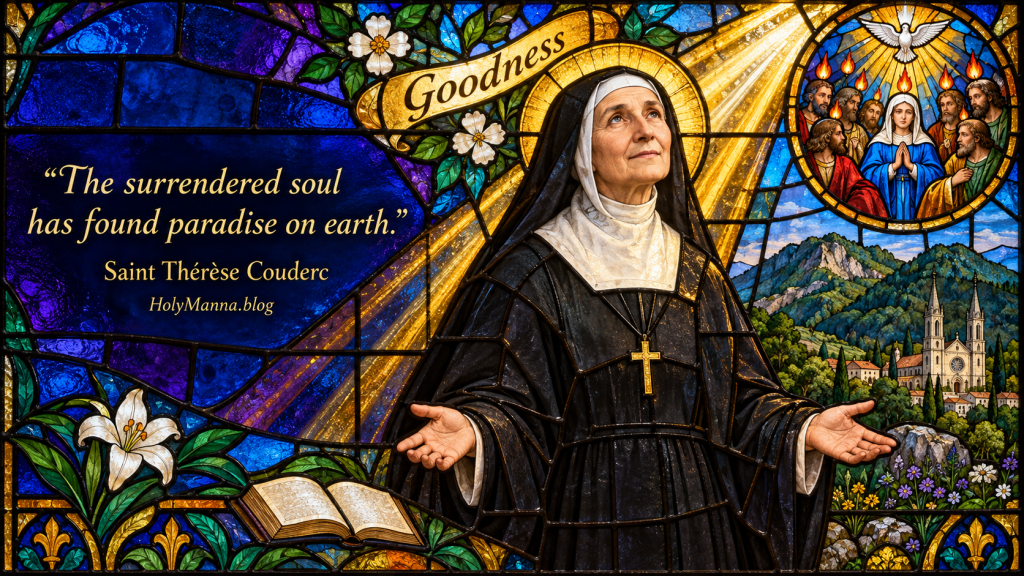
And in the shadows, God spoke. On June 26, 1864, during a time of prayer, she wrote the short text that became her legacy, Se Livrer, To Surrender Oneself. Her words deserve to be read slowly: “To surrender oneself is more than to devote oneself, more than to give oneself; it is even something more than to abandon oneself to God. In a word, to surrender oneself is to die to everything and to self, to be no longer concerned with self except to keep it continually turned toward God.” And then this, from a woman who had lost everything she built: “Oh! If people could just understand ahead of time the sweetness and peace that are savored when nothing is held back from the good God! How he communicates himself to the soul that seeks him sincerely and has known how to surrender itself. Let them experience it and they will see that here is found the true happiness they are vainly seeking elsewhere. The surrendered soul has found paradise on earth.”
Two years later came the grace that crowned her interior life. On August 10, 1866, she described in a letter to Mother de Larochenégly a vision granted to her during her thanksgiving after Holy Communion: “I saw written this word Goodness, as in letters of gold, on all creatures, animate and inanimate, rational or not; all bore this name of goodness; I saw it even on the chair that served me as a kneeler! God is good, He is more than good, He is Goodness itself; I do not want to forget it!” Think about who received that vision. Not a sister sheltered from disappointment, but the one who had been discarded by her own community. The woman with the most human cause for bitterness was the one to whom God showed His goodness written on every created thing, including the furniture. Within congregational testimony there also circulates an account of an interior vision she received of many altars with the Blood of the Lamb flowing down upon them, an image of the Mass being offered throughout the world; this is told as a tradition handed on within her religious family, and it cannot be verified.
In her last decades, the tide finally turned. The younger sisters began to recognize the wisdom, faith, and detachment of the old nun among them, and she quietly catechized young adults, accompanied retreatants, and helped the congregation through delicate moments. When the Bishop of Viviers launched a formal inquiry into the origins of the congregation late in her life, the truth came out at last: Mother Thérèse Couderc was the foundress. She wrote in a letter of August 7, 1867, the conviction that had carried her through it all: “God is the center of our heart, and He alone can fill it and make it happy.” Her final years brought deafness and painful arthritis, and by 1885 she was confined by her sufferings, which she bore with patience and deep peace. A contemporary biographer reported a story from those last days: that the Poor Souls in Purgatory would come to visit her, singing the Te Deum with great love and humility. It is a moving story handed down in accounts of her life, and it cannot be verified. On September 26, 1885, in Lyon, Thérèse Couderc closed her eyes to this world. She was eighty years old.
Incorrupt in Body, Vindicated in Heaven
If her life was a slow burial, her afterlife has been a slow and glorious unearthing. She was buried at Lalouvesc, the mountain village where it all began, near the tomb of Saint John Francis Régis. Devotion to her grew steadily, and the Church began the careful examination of her life and virtues. On November 4, 1951, Pope Pius XII beatified her in Saint Peter’s Basilica, and on May 10, 1970, Pope Paul VI canonized her in Saint Peter’s Square, after the Church approved two further miracles attributed to her intercession, in keeping with the canonical requirement of verified miraculous cures. The detailed medical records of those cures are preserved in the acts of her cause rather than in popular accounts, so this post will not invent particulars; what the Church has solemnly declared is that God worked miracles through her intercession, and that she now reigns with Christ. The Catechism explains what a canonization means: “By canonizing some of the faithful, i.e., by solemnly proclaiming that they practiced heroic virtue and lived in fidelity to God’s grace, the Church recognizes the power of the Spirit of holiness within her and sustains the hope of believers by proposing the saints to them as models and intercessors” (CCC 828). The woman whose own community forgot she was the foundress was proclaimed a saint before the whole world by the Vicar of Christ.
Her congregation reports a remarkable grace concerning her body. Since her beatification in 1951, her body has rested in a glass reliquary case where pilgrims can see her and entrust the intentions of their hearts to her intercession. The Cenacle Sisters state that her body remains incorrupt, having undergone only a natural process of mummification, with her face and hands covered by wax masks, as is customary for such relics. On September 22, 2018, in a moment rich with meaning, her body was solemnly transferred from the Cenacle chapel in Lalouvesc to the village basilica, where she now rests alongside Saint John Francis Régis, the very saint whose pilgrims she once housed as a young sister. Her own spiritual daughters described the move beautifully: their foundress had left their private home to take her place in a church open to the world, no longer only theirs, but a saint for all.
Lalouvesc itself has become a double pilgrimage site. For centuries the faithful climbed those mountain roads to pray at the tomb of Saint John Francis Régis; now they come for Thérèse as well, and the little Ardèche village holds two canonized saints within one basilica. Pilgrims continue to entrust their prayers to her, and stories of graces received through her intercession are part of the living devotion at her shrine; individual favors reported by pilgrims remain, by their nature, unverified unless examined by the Church, and they are best received as testimonies of faith. Her wider impact is measured in souls rather than monuments. The Congregation of Our Lady of the Retreat in the Cenacle spread from that one mountain hostel across Europe, then to North and South America, Africa, Asia, and Oceania, and Cenacle sisters around the world today carry on the ministry she and Father Terme began: spiritual direction and Ignatian retreats, especially for women seeking to meet God in silence. Every laywoman who has ever made a directed retreat stands, whether she knows it or not, in a river that began flowing at La Louvesc in 1827. This is the communion of saints in action, for as The Catechism teaches, the saints “do not cease to intercede with the Father for us” and their concern for the Church continues from heaven (CCC 956).
What Surrender Looks Like on a Tuesday
So what does a nineteenth century French nun have to say to you, scrolling on your phone in the middle of a noisy century? More than almost anyone, actually, because Thérèse Couderc is the saint of situations you actually live through. Most people will never be thrown to lions. Nearly everyone will, at some point, be passed over, blamed unfairly, forgotten, or watch someone else take credit for their work. The question is never whether that happens. The question is what it makes of you.
Thérèse shows the Catholic answer, and it is not passivity. She did not surrender to Mother Contenet or to injustice; she surrendered to God through those circumstances, which is a completely different thing. She kept working, kept serving, kept loving her community, and let God be the keeper of her reputation. That is the difference between resignation and se livrer. Resignation says, nothing matters. Surrender says, God matters so much that even this can be trusted to Him. How would this week change if the wound you are carrying right now, the overlooked effort, the unfair blame, the credit that went to someone else, were handed over to God as deliberately as Thérèse handed over hers?
There are practical ways to walk her path. First, make a retreat. It is the most Couderc thing you can possibly do, and it is exactly what The Catechism commends when it names spiritual exercises among the privileged means of conversion (CCC 1438). Even a single silent day with the Lord, phone off, will show you why women walked mountain roads to reach her house. Second, borrow her vision of Goodness as a daily practice. She saw the word Goodness written on every creature, even her chair. Try it: once a day, look at one ordinary thing or one difficult person and deliberately recall that God’s goodness is written there. Third, do one good thing this week entirely in secret, taking her words as your instruction: do your good in the shadows. Tell no one. Post nothing. Let the Father who sees in secret be your only audience. Fourth, when you are wronged in some small way, practice her serenity before you practice your defense; sometimes defense is right and necessary, but let peace, not wounded pride, choose your response. Where in your life are you still doing good mainly for show, and what would it cost you to move that good into the shadows? Is there a work, a role, or a reputation you are gripping so tightly that God cannot yet be its center?
Her whole message fits into her own sentence, worth memorizing and carrying: “The surrendered soul has found paradise on earth.” Not the successful soul, not the vindicated soul, not the recognized soul. The surrendered one.
Engage With Us!
Saint Thérèse Couderc waited half a century for the truth to come out, and she is wonderfully patient with slow hearts, so bring her your own story. Share your thoughts and reflections in the comments below; someone else in this community may need exactly the experience you have lived. To get the conversation going, here are some questions to pray with and respond to:
- When have you been overlooked or unfairly blamed, and how did you respond? What would responding like Thérèse have looked like?
- Thérèse saw the word Goodness written on all creation, even on her chair. Where did you see God’s goodness today in something completely ordinary?
- What is one good deed you could do this week entirely in the shadows, with no one knowing but God?
- Have you ever made a silent retreat? If so, what did God do in that silence? If not, what is honestly holding you back?
- Thérèse wrote that surrender is more than giving, more even than abandoning oneself to God. What is the one thing you find hardest to surrender, and what would it take to place it in His hands?
Take heart from this hidden foundress. If God could write the word Goodness on a wooden chair, He can certainly write it on your ordinary Tuesday, your unnoticed work, and your unhealed wound. Live this week surrendered rather than merely resigned, do your good in the shadows, and do everything, the great things and the small ones, with the love and mercy that Jesus taught us.
Saint Thérèse Couderc, pray for us!
Follow us on YouTube, TikTok, Instagram and Facebook for more insights and reflections on living a faith-filled life.


Leave a comment