Saturday of the Twenty-Fifth Week in Ordinary Time – Lectionary: 454
When a Vapor Meets the Eternal
There is a moment in every life when the calendar stops feeling infinite. Saturday of the Twenty-Fifth Week in Ordinary Time, September 26th, hands that moment to the whole Church and asks her to sit with it. The first reading gives the final poem of Ecclesiastes, where Qoheleth, the old Preacher of Jerusalem, tells the young to rejoice while they can and then paints old age and death with some of the most haunting imagery in all of Scripture. The word he keeps repeating, “vanity,” is the Hebrew hevel, a breath, a wisp of vapor on a cold morning. Everything under the sun is real, and everything under the sun is slipping away. The responsorial psalm answers with the prayer of Moses, the only psalm bearing his name, begging God to “teach us to number our days aright, that we may gain wisdom of heart.” Then the Gospel delivers the twist no philosopher saw coming. While the crowds are still cheering His miracles, Jesus turns to His disciples and announces that “the Son of Man is to be handed over to men.” The eternal God, before whom a thousand years are a single night watch, has entered the vapor Himself. He will not merely watch human life fade like morning grass; He will take that fragile life to the Cross and carry it through death to glory. These readings are not morbid. They are a rescue operation for anyone tempted to waste a short life on small things, and they end where all Christian realism ends, at the feet of a Savior who chose to die so that dust could rise.
First Reading — Ecclesiastes 11:9—12:8
The Poem That Teaches the Young How to Grow Old
Ecclesiastes is the strangest book a young adult will ever love. Tradition associates it with Solomon, and its speaker, Qoheleth, is an old man who has tried everything, pleasure, wealth, work, and wisdom, and found that none of it lasts. In this closing poem he does something unexpected: he blesses youth instead of scolding it, then walks the reader, image by image, through the slow shutting down of the human body, so that the memory of God gets planted before the winter comes. The passage fits the day’s theme perfectly, because only a heart that admits life is short will ever pray for wisdom.
Ecclesiastes 11:9—12:8
Rejoice, O young man, while you are young
and let your heart be glad in the days of your youth.
Follow the ways of your heart,
the vision of your eyes;
Yet understand that as regards all this
God will bring you to judgment.
Ward off grief from your heart
and put away trouble from your presence,
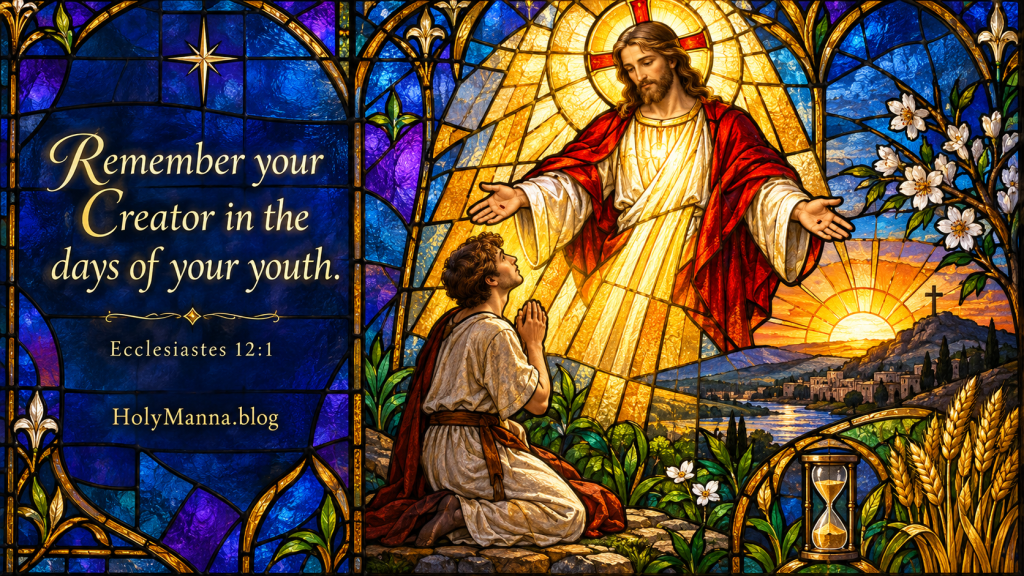
though the dawn of youth is fleeting.Remember your Creator in the days of your youth,
before the evil days come
And the years approach of which you will say,
I have no pleasure in them;
Before the sun is darkened,
and the light, and the moon, and the stars,
while the clouds return after the rain;
When the guardians of the house tremble,
and the strong men are bent,
And the grinders are idle because they are few,
and they who look through the windows grow blind;
When the doors to the street are shut,
and the sound of the mill is low;
When one waits for the chirp of a bird,
but all the daughters of song are suppressed;
And one fears heights,
and perils in the street;
When the almond tree blooms,
and the locust grows sluggish
and the caper berry is without effect,
Because man goes to his lasting home,
and mourners go about the streets;
Before the silver cord is snapped
and the golden bowl is broken,
And the pitcher is shattered at the spring,
and the broken pulley falls into the well,
And the dust returns to the earth as it once was,
and the life breath returns to God who gave it.Vanity of vanities, says Qoheleth,
all things are vanity!
Detailed Exegesis
11:9 “Rejoice, O young man, while you are young and let your heart be glad in the days of your youth. Follow the ways of your heart, the vision of your eyes; Yet understand that as regards all this God will bring you to judgment.”
Qoheleth is no killjoy; joy in youth is commanded, not merely permitted. Yet joy is bracketed by judgment, meaning every pleasure will one day be weighed by the God who gave it. Freedom and accountability arrive together, which is exactly how the Church still teaches conscience.
11:10 “Ward off grief from your heart and put away trouble from your presence, though the dawn of youth is fleeting.”
Anxiety is treated here as something to be actively resisted, because the dawn does not last. The verse anticipates the Lord’s own command in The Gospel of Matthew not to be consumed by worry, since worry cannot add a single moment to life.
12:1 “Remember your Creator in the days of your youth, before the evil days come And the years approach of which you will say, I have no pleasure in them;”
This is the hinge of the entire book. To “remember” in Hebrew thought is not nostalgia but allegiance, living each day aware of the One who made it. The habits of twenty-five become the character of seventy-five, so the time to turn to God is always now.
12:2 “Before the sun is darkened, and the light, and the moon, and the stars, while the clouds return after the rain;”
The failing of the great lights pictures the dimming of life’s vitality, a personal winter in which storms follow storms without a clear sky between them.
12:3 “When the guardians of the house tremble, and the strong men are bent, And the grinders are idle because they are few, and they who look through the windows grow blind;”
The body becomes a great house in decline. The Fathers, following Saint Jerome’s reading, saw the trembling guardians as the arms, the bent strong men as the legs, the idle grinders as the teeth, and the darkened windows as the eyes.
12:4 “When the doors to the street are shut, and the sound of the mill is low; When one waits for the chirp of a bird, but all the daughters of song are suppressed;”
Hearing fades and speech grows quiet; the elderly sleeper wakes at a sparrow’s chirp yet can no longer enjoy music. The house that once opened onto the street now closes in on itself.
12:5 “And one fears heights, and perils in the street; When the almond tree blooms, and the locust grows sluggish and the caper berry is without effect, Because man goes to his lasting home, and mourners go about the streets;”
The white blossoms of the almond tree picture white hair, the sluggish locust the stiffened frame, and the failed caper berry the fading of appetite and desire. Then comes the destination named plainly: the lasting home, the grave, and beyond it eternity.
12:6 “Before the silver cord is snapped and the golden bowl is broken, And the pitcher is shattered at the spring, and the broken pulley falls into the well,”
A golden lamp crashes when its silver chain snaps; a pitcher shatters at the well. Precious, fragile, irreversible: this is death described by a poet who refuses euphemism.
12:7 “And the dust returns to the earth as it once was, and the life breath returns to God who gave it.”
Here Qoheleth quotes creation back to itself. Genesis 2:7 says God formed man of dust and breathed life into him, and Genesis 3:19 promised a return to dust. Yet the breath does not dissolve into nothing; it returns to God, and that single line leaves the door open for everything the Resurrection will later reveal.
12:8 “Vanity of vanities, says Qoheleth, all things are vanity!”
The book ends where it began, with vapor. Nothing under the sun can bear the weight of a human heart, which is precisely why the heart must look above the sun.
Teachings
The Church has never been embarrassed by this poem; she quotes it at the center of her teaching on death. The Catechism states in CCC 1007, “Death is the end of earthly life. Our lives are measured by time, in the course of which we change, grow old and, as with all living beings on earth, death seems like the normal end of life. That aspect of death lends urgency to our lives: remembering our mortality helps us realize that we have only a limited time in which to bring our lives to fulfillment.” The paragraph then cites this very reading, Ecclesiastes 12:1, 7. Saint Jerome, a Doctor of the Church, composed the first Latin Christian commentary on Ecclesiastes around the year 389, written for Saint Paula and her daughter Eustochium, and he taught that the book trains the soul in detachment, loosening its grip on what passes so it can cling to what remains. Thomas à Kempis distilled the whole matter in the opening chapter of The Imitation of Christ: “Vanity of vanities, and all is vanity, except to love God and serve Him alone.” Every Ash Wednesday, the Church repeats Qoheleth’s realism over each bowed head, and she does it out of love, not gloom.
Reflection
Qoheleth’s counsel lands hardest on those who feel they have plenty of time. Consider one concrete practice this week: begin each morning by offering the day to God before touching a phone, a small act of remembering the Creator in the days of youth. Consider also making a good examination of conscience tonight, since verse 9 promises that joy and judgment travel together, and confession turns judgment into mercy. Which pleasures in life are being enjoyed with gratitude toward God, and which ones are quietly replacing Him? If the silver cord snapped this year, what would need to change today?
Responsorial Psalm — Psalm 90:3-6, 12-14, 17
The Prayer of Moses for Hearts That Count Their Days
Psalm 90 is the only psalm attributed to Moses, “the man of God,” and it reads like the prayer of a man who spent forty years in the desert watching an entire generation return to dust. Placed beside Qoheleth, it transforms his diagnosis into a petition. The Preacher says life is vapor; Moses agrees, then does the one thing philosophy cannot do, he prays. The refrain the Church sings today, “In every age, O Lord, you have been our refuge,” is the antidote to vanity: mortal creatures sheltering in an eternal God.
Psalm 90:3-6, 12-14, 17
R. (1) In every age, O Lord, you have been our refuge.
You turn man back to dust,
saying, “Return, O children of men.”
For a thousand years in your sight
are as yesterday, now that it is past,
or as a watch of the night.
R. In every age, O Lord, you have been our refuge.
You make an end of them in their sleep;
the next morning they are like the changing grass,
Which at dawn springs up anew,
but by evening wilts and fades.
R. In every age, O Lord, you have been our refuge.
Teach us to number our days aright,
that we may gain wisdom of heart.
Return, O LORD! How long?
Have pity on your servants!
R. In every age, O Lord, you have been our refuge.
Fill us at daybreak with your kindness,
that we may shout for joy and gladness all our days.
And may the gracious care of the LORD our God be ours;
prosper the work of our hands for us!
Prosper the work of our hands!
R. In every age, O Lord, you have been our refuge.
Detailed Exegesis
Verse 3 “You turn man back to dust, saying, ‘Return, O children of men.’”
Moses echoes Genesis 3:19 directly. Death is not random chaos but a summons spoken by God, which means even mortality remains inside His providence.
Verse 4 “For a thousand years in your sight are as yesterday, now that it is past, or as a watch of the night.”
Human centuries are a night watch to God, roughly four hours of guard duty. 2 Peter 3:8 takes up this verse to explain the Lord’s patience; what feels like delay to man is a moment to God.
Verses 5 and 6 “You make an end of them in their sleep; the next morning they are like the changing grass, Which at dawn springs up anew, but by evening wilts and fades.”
The grass of the Judean hills sprouts after rain and withers in a single day of sun. Moses chooses that grass, not the cedar, as the honest image of human strength.
Verse 12 “Teach us to number our days aright, that we may gain wisdom of heart.”
This is the psalm’s summit and one of the great one-line prayers of Scripture. Numbering days is not counting down in dread but budgeting a gift, and the fruit is not information but wisdom of heart, the practical knowledge of how to live before God.
Verse 13 “Return, O LORD! How long? Have pity on your servants!”
The God who said “Return” to man in verse 3 is now begged to return Himself. The boldness is stunning, and it is answered definitively when God does return to His people in the Incarnation.
Verse 14 “Fill us at daybreak with your kindness, that we may shout for joy and gladness all our days.”
The Hebrew word behind “kindness” is hesed, God’s covenant love. Moses asks for it at daybreak, teaching that joy is strongest when God is sought first, before the day’s noise begins.
Verse 17 “And may the gracious care of the LORD our God be ours; prosper the work of our hands for us! Prosper the work of our hands!”
The psalm ends with work. Mortal hands building mortal things would be vanity, except that God’s blessing can give ordinary labor eternal significance. The repetition is the sound of a man who really means it.
Teachings
The monastic tradition built its whole rhythm of life on this psalm’s wisdom. Saint Benedict, in chapter 4 of The Rule of Saint Benedict, lists among the instruments of good works the command to “keep death daily before your eyes.” That practice, memento mori, is not medieval pessimism but the practical application of verse 12, and it has produced some of the most joyful saints in history. The Catechism teaches in CCC 1006, “It is in regard to death that man’s condition is most shrouded in doubt,” quoting the Second Vatican Council’s Gaudium et Spes, and the Church answers that doubt not with slogans but with Christ’s own death and Resurrection. Saint Augustine, a Doctor of the Church, gave the psalm’s logic its most famous expression in The Confessions: “You have made us for yourself, O Lord, and our heart is restless until it rests in you.” A creature made of morning grass will only find peace by taking refuge in the One for whom a thousand years are as yesterday.
Reflection
Numbering days sounds abstract until it becomes a calendar decision. Try this: choose one recurring commitment this month that exists mainly to impress others or numb boredom, and replace it with something eternal, a Holy Hour, a phone call to a lonely relative, or a daily Rosary. Pray verse 12 slowly before opening a planner or a scheduling app, letting God set the priorities. What would this week’s schedule look like if every day were treated as numbered? Where is God being asked to bless work that has never actually been offered to Him?
Holy Gospel — Luke 9:43b-45
The Announcement Nobody Wanted to Hear
The scene could not be better staged. Jesus has just come down from the Transfiguration, healed a boy tormented by a demon, and left the crowd astonished at the majesty of God. Applause is still hanging in the air. That is the exact moment He chooses to tell His disciples, for the second time in The Gospel of Luke, that He will be handed over. The Preacher said all under the sun is vapor; Moses prayed for God to return; and here God has returned, walking toward Jerusalem with His face set toward a Cross. The day’s theme reaches its resolution in these three verses, because the eternal One now freely enters death itself in order to break it open.
Luke 9:43b-45
While they were all amazed at his every deed,
Jesus said to his disciples,
“Pay attention to what I am telling you.
The Son of Man is to be handed over to men.”
But they did not understand this saying;
its meaning was hidden from them
so that they should not understand it,
and they were afraid to ask him about this saying.
Detailed Exegesis
Verse 43b “While they were all amazed at his every deed, Jesus said to his disciples,”
Saint Luke deliberately links the announcement to the amazement. Jesus refuses to let His disciples build their faith on popularity and spectacle, because crowds that cheer on one day can cry out for crucifixion on another.
Verse 44 “‘Pay attention to what I am telling you. The Son of Man is to be handed over to men.’”
The command to pay attention, rendered elsewhere as letting these words sink into the ears, signals that a mystery is being entrusted, not merely information. “Son of Man” recalls the glorious figure of Daniel 7, while “handed over” carries the language of the Suffering Servant in Isaiah 53. The passive voice hints that behind Judas and Pilate stands the Father’s own saving plan, freely embraced by the Son.
Verse 45 “But they did not understand this saying; its meaning was hidden from them so that they should not understand it, and they were afraid to ask him about this saying.”
The veiling is presented as providential, a mercy for men not yet ready to carry the full weight of Calvary before Easter gave it meaning. Their fear to ask is painfully human; there are truths people avoid clarifying precisely because they suspect the answer. Understanding will come when the risen Lord opens the Scriptures on the road to Emmaus.
Teachings
Saint Cyril of Alexandria, a Doctor of the Church, preached directly on this passage in Sermon 53 of his Commentary on the Gospel of Saint Luke. He explains that Jesus foretold the Passion so the disciples would not be scandalized when it arrived, and he places these words on the Lord’s lips: “I am not led by human compulsion, but go willingly thereunto… But I submit to suffer, in order that I may redeem all beneath the heavens.” Cyril anchors this in the Lord’s own declaration in The Gospel of John: “No man taketh My life from Me, but I lay it down of My own will.” The Catechism teaches the same truth in CCC 599: “Jesus’ violent death was not the result of chance in an unfortunate coincidence of circumstances, but is part of the mystery of God’s plan.” And CCC 572 adds, “The Church remains faithful to the interpretation of ‘all the Scriptures’ that Jesus gave both before and after his Passover: ‘Was it not necessary that the Christ should suffer these things and enter into his glory?’” Cyril also confronts the disciples’ incomprehension honestly, teaching that “the divinely-inspired Scriptures conduct him who has understanding to an accurate knowledge of the doctrines of the truth,” while the heart must first be opened by God. His prescribed prayer comes straight from the Psalter: “Open mine eyes: and I shall perceive the wondrous things of Thy law.”
Reflection
Every disciple eventually meets a version of verse 45, a truth from God that feels too heavy to ask about: a diagnosis, a vocation, a sin that needs confessing, a cross that will not move. The disciples stayed silent out of fear, and the invitation today is to do the opposite. Bring the frightening question directly to Jesus in prayer this week, perhaps before the Blessed Sacrament, and ask Him plainly what He is saying. Then imitate His own pattern by accepting one small, unwanted sacrifice with the words, not by compulsion but willingly. What question has fear kept off the table in prayer? When applause and comfort fade, is faith resting on the miracles or on the Crucified Lord Himself?
The Vapor, the Refuge, and the Cross
Put the three readings side by side and a single story emerges. Qoheleth stands at the end of a long life and tells the truth no advertisement will ever tell: everything under the sun is vapor, so remember the Creator before the silver cord snaps. Moses takes that truth and turns it into the only reasonable prayer, “teach us to number our days aright, that we may gain wisdom of heart,” because a creature of morning grass survives only by taking refuge in the eternal God. And then Jesus does what neither the Preacher nor the Lawgiver could have imagined. The God before whom a thousand years are a night watch steps into the vapor, takes on the dust of Genesis, and announces that He will be handed over to men. The lasting home Qoheleth feared becomes, through the Cross and Resurrection, a Father’s house with many rooms. This is why the Church reads these texts without flinching. Mortality, honestly faced, is not the enemy of joy but its doorway, because it drives the heart out of vanity and into the arms of the only Refuge that holds in every age. So let this Saturday become a small act of remembering. Go to Mass and receive the One who was handed over. Bring the fears that have gone unspoken and lay them before Him. Offer the work of these hands, the emails, the dishes, the studying, the caregiving, and ask Him to prosper it for eternity. Youth is fleeting, the almond tree will bloom soon enough, and none of that is bad news anymore. The Son of Man has gone ahead through death itself, and He is trustworthy.
Engage With Us!
Share a reflection in the comments below; hearing how God is working through these readings in real lives encourages the whole HolyManna community. Here are a few questions to pray with today:
- In Ecclesiastes 11:9—12:8, Qoheleth commands both rejoicing in youth and remembering the Creator before the evil days come. What is one concrete habit that could plant the memory of God more deeply into ordinary daily life right now?
- In Psalm 90:3-6, 12-14, 17, Moses prays for God to teach the numbering of days and to prosper the work of human hands. Which part of daily work has never been offered to God, and what would change if it were?
- In Luke 9:43b-45, the disciples were afraid to ask Jesus about His Passion. What difficult question is fear currently keeping out of prayer, and what would it take to ask it this week?
- Taken together, the readings teach that life is short and God is the refuge in every age. If this were truly believed, what would be done differently before the sun goes down today?
May every reader walk this brief, beautiful life with a wise heart, numbering the days without dread, and doing everything, from the greatest sacrifice to the smallest chore, with the love and mercy Jesus taught. He was handed over willingly so that dust could rise to glory, and He remains, in every age, the refuge that never fails.
Sacred Heart of Jesus, we trust in You!
Immaculate Heart of Mary, pray for us!
Saint Michael the Archangel, defend us in battle!
Follow us on YouTube, TikTok, Instagram and Facebook for more insights and reflections on living a faith-filled life.


Leave a comment