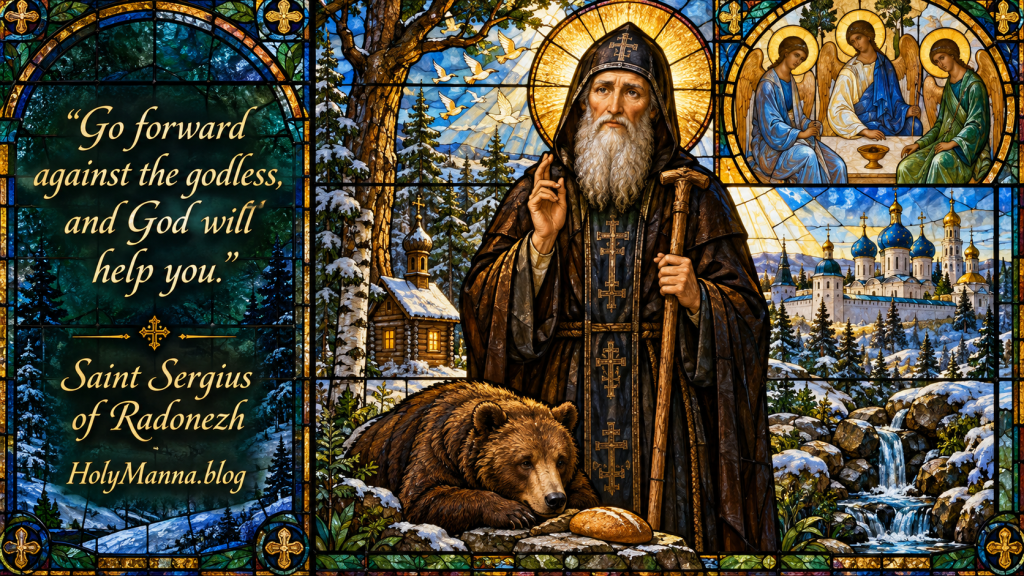
The Abbot of All Russia
Every so often God raises up a soul whose quiet holiness reshapes an entire people. Saint Sergius of Radonezh, celebrated on September 25th, is one of those souls. He was a 14th century monk who never wrote a book and spent much of his life avoiding attention, yet he became the spiritual father of Russian monasticism, founder of the great Holy Trinity Monastery at Sergiyev Posad, and the man his people lovingly called the Abbot of all Russia. When he first walked into the wilderness, monastic life in the Russian lands lay in ruins after the Mongol invasions. By the time he died in 1392, his disciples were already carrying a spiritual renewal across the Russian north, founding monastery after monastery in his footsteps.
Sergius belongs first to the Orthodox Church, which canonized him in the 15th century, yet he genuinely belongs to Catholics as well. He was added to the liturgical calendar for Russian Catholics in union with Rome in 1940, he is venerated by the Russian Byzantine Catholic Church, and modern editions of the Roman Martyrology commemorate him on September 25th. The Catechism teaches that “with the Orthodox Churches, this communion is so profound ‘that it lacks little to attain the fullness that would permit a common celebration of the Lord’s Eucharist’” (CCC 838), and few saints embody that closeness more beautifully than this gentle abbot of the forest. He is honored as a patron of Russia, and a long Russian tradition also turns to him as an intercessor for students who struggle in their studies. One caution for the curious: this is not the ancient Roman soldier Sergius martyred alongside Saint Bacchus; the saint of September 25th is the Russian monk, whose road to holiness ran not through the sword but through silence, labor, humility, and prayer.
The Boy Who Could Not Read
He was born around 1314 at Varnitsa, a village near the ancient city of Rostov Veliky, and he was baptized Bartholomew. The sources do not fully agree on the year; 1314 is the date most commonly given, while some older accounts place his birth in 1315, 1319, or even 1322. What is beyond dispute is the home he came from. His parents, Cyril and Maria, were devout boyars, members of the minor nobility, who raised Bartholomew and his brothers Stephen and Peter in serious piety. Their own holiness was so evident that the Russian Church eventually glorified Cyril and Maria as saints in their own right, extending their veneration to the whole Church in 1992.
Bartholomew’s earliest cross was a humble one that many people will recognize instantly. He could not learn to read. He was sent to school at the age of 7, and while his brothers advanced in their lessons, Bartholomew fell painfully behind, despite being a serious and earnest child. He grieved over it and begged God for the gift of understanding. His earliest biographer, the monk Epiphanius the Wise, who knew Sergius personally and composed his Life of the saint around 1417, records what happened next. One day the boy was sent out to find the family’s horses and came upon a mysterious monk praying beneath an oak tree. Bartholomew poured out his sorrow, and the elder gave him a small piece of blessed bread with the words, “Take and eat this which is given to you as a token of the grace of God and for the understanding of the Holy Scripture.” The monk then told the boy’s anxious parents, “the boy will be great before God and man,” and declared that their son would one day serve the Holy Trinity. Then, as the Life tells it, the elder became invisible at the doorway, leaving the family to wonder whether an angel had visited them. From that day forward, the Life records, Bartholomew read with ease and never stopped reading the sacred books. This is the most beloved story of his childhood, later immortalized in Mikhail Nesterov’s famous painting The Vision of the Youth Bartholomew, and it explains why generations of struggling students have asked his prayers. It comes from the early hagiographic tradition rather than from independent records, and as a historical event it cannot be verified.
Hard times soon struck the family. Political pressure and heavy exactions accompanying Moscow’s absorption of Rostov all but wiped out their wealth, and when Bartholomew was about 15 the family resettled in the small village of Radonezh near Moscow, where the once noble family lived as simple farmers. Bartholomew devoted himself to caring for his parents, and in their final years Cyril and Maria entered monastic life at the monastery of Khotkovo before their deaths around 1335. Only then, with his duty of honor fulfilled, did Bartholomew follow the desire that had burned in him since childhood. He gave away his inheritance, and together with his recently widowed brother Stephen he walked into the deep forest at a hill called Makovets. There the brothers built a hut and a small wooden chapel, which a visiting priest consecrated in honor of the Holy Trinity. The choice of that dedication was no accident. His biographer transmits the reason in words that have echoed through the centuries: the church of the Trinity was raised as a mirror for those gathered into common life, “so that the contemplation of the Holy Trinity might vanquish the fear of the hateful dividedness of the world.” That single sentence, handed down through the Life tradition, contains the whole program of his sanctity. The harsh solitude proved too much for Stephen, who departed for a monastery in Moscow, but Bartholomew remained. At about 23 years of age he was tonsured a monk by an abbot named Mitrofan, and because the day was October 7th, the feast of the martyrs Sergius and Bacchus, he received the name by which the world now knows him: Sergius.
A Monastery Rises from the Wilderness
For several years Sergius lived utterly alone on Makovets, enduring bitter northern winters, hunger, and the fears that visit anyone who stays in real silence long enough. The Life speaks frankly of spiritual battles in that solitude, of temptations and terrors that he overcame through unceasing prayer. The Catechism could be describing him directly when it teaches that “the way of perfection passes by way of the Cross. There is no holiness without renunciation and spiritual battle” (CCC 2015). One of the most tender traditions from these years tells of a wild bear that began visiting the hermit. Sergius, seeing the animal was hungry, shared his bread with it, and the bear returned to him like a friend for a whole year. The story comes from the early Life and cannot be verified, but it has shaped his iconography and captures his gentleness, so deep that even the wilderness seemed to soften around him.
Holiness in hiding never stays hidden for long. The Catechism observes that “hidden from the eyes of men, the life of the hermit is a silent preaching of the Lord” (CCC 921), and that silent preaching drew listeners. Monks began arriving one by one, asking to live near him, and eventually 12 cells stood around the little Trinity chapel. Sergius refused any privilege of seniority. He built cells for the brothers with his own hands, chopped their firewood, ground flour, baked bread, sewed clothing, and carried water up the hill, serving the community like the least of its members. When the brethren pressed him to become their abbot, he resisted until obedience to the local bishop left him no escape; he was ordained a priest at Pereyaslavl-Zalessky and installed as abbot of the community he had never intended to found. His whole style of leadership was a living commentary on the words of Christ in The Gospel of Matthew: “whoever would be great among you must be your servant” (Mt 20:26). The Life recounts that his poverty remained absolute. In one famous episode, when food had run out, Sergius worked for 3 days building an entryway onto the cell of one of his own monks, and accepted as his wages only a few pieces of old, moldy bread, refusing to eat until the work was done.
Two decisions during his abbacy changed the history of monasticism in the Russian lands. First, with the blessing of Patriarch Philotheus of Constantinople and Metropolitan Alexis of Moscow, Sergius introduced the cenobitic rule, the fully common life in which the monks held all things together rather than living as loosely connected hermits. It restored the great communal tradition that the Mongol devastation had destroyed, and it became the seedbed of a monastic revival. The reform was not painless. Some of the brethren resisted, and the Life records that when murmuring against his authority arose, involving even his own brother Stephen, Sergius did not argue and did not fight for his position. He simply and quietly left his own monastery and began another one on the Kirzhach River, until Metropolitan Alexis intervened and the repentant brethren begged him to return. Second, when Metropolitan Alexis lay dying in 1378 and asked Sergius to succeed him as Metropolitan of Moscow, the highest office in the Russian Church, Sergius flatly refused. He wanted the forest, the brethren, and the Trinity, nothing more.
The Life by Epiphanius records numerous miracles during these years, and honesty requires saying plainly that they rest on the testimony of the early hagiographic tradition rather than independent verification. The tradition tells that when the monastery lacked water, a spring burst forth through his prayer, a spring pilgrims still visit. It tells that a grieving father carried his dying son to Sergius, and the boy died on the way; while the father went to prepare a coffin, Sergius knelt in prayer, and the child revived, the saint deflecting all credit by insisting the boy had merely been numbed by the cold. It tells of a night vision in which Sergius saw a multitude of radiant birds filling the sky while a voice promised that his disciples would be just as numerous. It tells that his disciple Simon once saw divine fire descend and enter the chalice as Sergius celebrated the Divine Liturgy. And it tells of the night the Mother of God herself, accompanied by the Apostles Peter and John, appeared to Sergius in his cell and promised her unfailing protection over his monastery, an event the tradition treasures as the first recorded appearance of the Blessed Virgin to a Russian saint. Each of these stories comes from the Life and cannot be verified, yet together they explain why his contemporaries regarded him not merely as an organizer of monasteries but as a man transparent to God.
His influence reached far beyond the cloister. In an age when the Russian principalities tore at one another while the Mongol Horde ruled over them all, Sergius became the peacemaker whom no prince could ignore. He walked on foot to feuding cities to reconcile their rulers, and his quiet words accomplished what armies could not, including the reconciliation of Prince Oleg of Ryazan with Moscow in 1385. He was living out the Beatitude, “Blessed are the peacemakers, for they shall be called sons of God” (Mt 5:9). The most famous moment came in 1380, when Grand Prince Dmitry of Moscow prepared to face the massive army of the Horde commander Mamai. The tradition, recorded in later sources, holds that Dmitry came to the Trinity Monastery, that Sergius blessed him and foretold his victory with words to the effect of “Go forward against the godless, and God will help you,” and that the abbot sent 2 of his own monks, the former warriors Peresvet and Oslyabya, to accompany the army. On September 8th, 1380, the feast of the Nativity of the Blessed Virgin Mary, the Russians won the Battle of Kulikovo, the first great victory over the Horde and a turning point in the nation’s history, and the prince entered history as Dmitry Donskoy. Historians note honestly that the details of the blessing appear in accounts written after the events rather than in contemporary records, so the episode is best received as cherished early tradition. What is documented is the moral authority behind it: a barefoot monk in a patched habit had become the conscience of a nation.
The Yoke, the Hunger, and the Cross of Leadership
Sergius was not a martyr, and his feast is kept without the palm. His cross was slower, and it lasted a lifetime. He knew the humiliation of academic failure as a child and the collapse of his family’s fortune as a teenager. He knew real hunger; the Life recalls stretches in the wilderness when food simply ran out, and later seasons when the whole community went days without bread and some monks grumbled bitterly against him. He answered hunger with work and complaint with patience, teaching the brethren to trust Providence, and the tradition holds that provisions arrived unlooked for at the moment of greatest need.
He carried the interior battles of the solitary life, which the Life describes as assaults of the enemy meant to drive him from the forest. He carried the wound of division inside his own community, when the very brothers he served resisted his reform; his silent departure rather than clinging to power remains one of the most disarming acts of humility in monastic history. He carried the weight of an office he never wanted, and then the greater weight of refusing an even higher one. And he carried the sorrow of his era itself: a land burned and bled by the Mongol Yoke, princes at each other’s throats, plague sweeping through the towns, and churches in ashes. His answer to all of it was the Holy Trinity, contemplated until fear of the world’s hateful dividedness gave way. The Catechism teaches that “the mystery of the Most Holy Trinity is the central mystery of Christian faith and life” (CCC 234), and Sergius staked his entire existence on that truth.
To the end he refused every external sign of greatness. He wore clothing so poor and patched that visitors regularly failed to recognize him. The Life tells of a peasant who traveled far to see the famous abbot and, finding a shabby old man digging in the garden, refused to believe this could be the great Sergius, until a prince arrived and bowed to the ground before the gardener. The story comes from the Life and cannot be verified, but it was told because it matched the man everyone knew. In 1392, having fallen seriously ill for the first time in his life, Sergius sensed that his death was near. He resigned the abbacy to his disciple Nikon, gave the brethren a final exhortation to guard the purity of their faith, their unity, their humility, and their hospitality to the poor, received the Holy Mysteries, and died in peace on September 25th, 1392, at about 78 years of age. He was buried in the monastery he had built with his own hands.
Incorrupt Relics and the Soul of a Nation
Death did not end his story; in a real sense it widened it. The Catechism teaches of the saints in glory that “they do not cease to intercede with the Father for us” (CCC 956), and the faithful of Rus began seeking his intercession immediately. In 1408, when the Tatar commander Edigei devastated the region and burned the Trinity monastery to the ground, the monks escaped into the forests; the tradition holds that Sergius had forewarned his successor Nikon in a vision of the coming trial and of the monastery’s future restoration. That story belongs to the tradition and cannot be verified. On July 5th, 1422, during the construction of the new stone Trinity cathedral, his relics were solemnly uncovered, and the tradition reports that after 30 years in the earth his body and even his clothing were found whole and incorrupt. This account likewise comes from the tradition and cannot be verified, but the uncovering itself is a documented event, and July 5th remains his second feast to this day. His formal canonization followed in the mid 15th century, with sources variously giving 1448, 1449, or 1452.
For the new cathedral raised over his tomb, the monk Andrei Rublev painted the icon of The Holy Trinity, created, as the tradition says, in praise of Saint Sergius. It became the most celebrated icon ever produced in Russia, three angelic figures seated in perfect, silent communion, the visual echo of everything Sergius taught. The monastery itself grew into the Trinity-St. Sergius Lavra at the town now named Sergiyev Posad in his honor, the most venerated monastic house in Russia and one of the great pilgrimage destinations of the Christian world, where pilgrims have prayed at his relics for 6 centuries. His disciples and their disciples founded monasteries by the dozen, roughly 40 communities tracing directly to him and his circle, and generations of foundations after that, a movement that carried the Gospel, literacy, and settled life across the vast Russian north. This is why he is called the Abbot of all Russia, and why the 14th century in Russia is sometimes simply called the century of Saint Sergius.
The centuries kept adding chapters. During the Time of Troubles, the Lavra withstood a 16 month siege by Polish and Lithuanian forces between 1608 and 1610, and the defenders attributed their survival to the intercession of Sergius, with accounts reporting appearances of the saint encouraging the besieged; these reports come from the tradition surrounding the siege and cannot be verified. Countless healings have been reported at his tomb across the centuries; they belong to the ongoing tradition of the shrine and cannot be individually verified here. In the 20th century his monastery was closed by the Soviet government in 1920, and his relics were subjected to public desecration, yet the faithful never stopped venerating him, and after World War II the Lavra reopened and his relics were restored to their place of honor. His great anniversaries in 1992, 2014, and 2022 were celebrated as national events, drawing crowds of pilgrims to the Lavra. Nesterov’s painting of the young Bartholomew hangs among the most beloved works of Russian art, and for Catholics, his commemoration stands as a quiet sign of hope for the healing of the wound between East and West, a hope Sergius himself would surely have carried straight to the Trinity.
Learning to Read Again
It is tempting to file Saint Sergius away as a figure from a distant forest in a distant century, but his life presses uncomfortably close to modern life. Start with the schoolboy who could not read. Nearly everyone knows the private shame of being behind, of watching others advance while effort seems to produce nothing. Sergius did not respond with despair or with bluffing; he responded with prayer, and God answered in His own time and manner. Where in life right now does slowness or failure feel like proof of worthlessness, and what would it mean to hand that exact spot over to God? His story suggests that the very place of weakness can become the doorway of grace, which is why students still ask his prayers before exams.
Then there is his answer to a divided world. Sergius lived amid political rage, factions, and violence that make modern feuds look tame, and his response was not a strategy but a mystery: the contemplation of the Holy Trinity until the fear of division loses its grip. The Catechism teaches that “the ultimate end of the whole divine economy is the entry of God’s creatures into the perfect unity of the Blessed Trinity” (CCC 260), which means unity is not a nice idea but the destination of everything. Christ Himself prayed “that they may all be one” (Jn 17:21). A practical way to imitate Sergius is simple and hard: before entering any conflict, whether a tense family dinner, a heated comment thread, or a workplace standoff, pause and pray briefly to the Father, the Son, and the Holy Spirit, and ask that the encounter serve communion rather than victory. Which relationship most needs that prayer today?
Finally, there is his leadership. Sergius led by carrying water, by building other men’s cells, by walking away from power rather than grasping it, and by refusing the highest office in his Church because it would take him from his calling. In a culture that measures people by platform and title, he measures by towel and basin. Anyone can practice this tomorrow: do the unglamorous task no one wants, without announcing it; let someone else take the credit; choose peace over winning one argument. What is one hidden act of service that could be done this week that no one will ever see? That question, faithfully answered over a lifetime, is roughly the biography of Saint Sergius.
Engage With Us!
Share thoughts and reflections on Saint Sergius of Radonezh in the comments below. His story of struggle, silence, service, and the Holy Trinity speaks to every stage of the journey, and hearing how it lands in different lives builds up the whole HolyManna community. Here are some questions for prayerful reflection:
- Saint Sergius struggled deeply as a student before grace transformed him. Where has a personal weakness or failure unexpectedly become a place where God worked?
- He dedicated his life to the Holy Trinity so that contemplating divine unity would overcome the fear of a divided world. What division, in family, parish, or society, most needs to be brought before the Trinity in prayer?
- When his own community turned against him, Sergius chose humble silence and departure over defending his position. How difficult is it to release the need to win, and what might that surrender look like in a current conflict?
- Sergius refused the office of Metropolitan to remain faithful to his calling. Is there an ambition or opportunity that God may be asking to be set aside for the sake of a deeper vocation?
- He served his monks by chopping wood, sewing clothes, and carrying water. What is one concrete, hidden act of service that could be offered this week?
Saint Sergius shows that a single soul, hidden in prayer and poured out in service, can help heal a broken nation, and that the same Trinity he contemplated in the forest dwells in every baptized heart. Take his example into the week ahead: pray patiently, serve quietly, make peace boldly, and do everything with the love and mercy that Jesus taught.
Saint Sergius of Radonezh, pray for us!
Follow us on YouTube, TikTok, Instagram and Facebook for more insights and reflections on living a faith-filled life.


Leave a comment