The Stranger on the Road
Every year on September 25th, the Roman Catholic Church remembers a man who appears by name in only a single verse of Scripture, yet whose story has shaped the way Catholics understand the Mass for two thousand years. Saint Cleophas, also spelled Cleopas, was a first century disciple of Jesus Christ and one of the two travelers who met the risen Lord on the road to Emmaus on the very first Easter Sunday, as recounted in The Gospel of Luke, chapter 24. He belongs to the small and privileged circle who saw the risen Christ with their own eyes before a single Gospel had been written.
The traditional Roman Martyrology honors him with these words: “At Emmaus, the birthday of the blessed Cleopas, disciple of Christ. It is related that he was killed by the Jews for the confession of our Lord, in the same house in which he had entertained Him, and where he was honorably buried.” The Martyrology’s word “birthday” is worth pausing over. The Church has always called the day of a martyr’s death his dies natalis, his birthday into heaven, because death for Christ is not an ending but an entrance into eternal life. The current 2004 edition of the Martyrologium Romanum commemorates him more simply as the disciple whose heart burned within him when Christ appeared on Easter evening, explained the Scriptures along the way, and was recognized in the breaking of the bread.
Why does a man with one verse to his name matter so much? Because his seven-mile walk became the Church’s clearest biblical picture of the Mass. The Catechism teaches that the liturgy of the Eucharist unfolds according to a fundamental structure, the liturgy of the Word and the liturgy of the Eucharist together forming one act of worship, and it points directly to the Emmaus account as the pattern, describing the risen Jesus’ Paschal meal with his disciples as the very movement of the Mass (CCC 1346 to 1347). When a Catholic hears the Scriptures opened at Mass and then receives the Lord in the Eucharist, that Catholic is walking the road Cleophas walked; his feast is the family memory of the day the Church first learned to recognize her Lord at the table.
A Kinsman of the Carpenter’s House
Documented history gives very little about the origins of Saint Cleophas, and honesty demands saying so up front. Scripture names him exactly once, in Luke 24:18, where he asks the unrecognized stranger whether He is the only visitor to Jerusalem who does not know what has just taken place there. The Catholic Encyclopedia states frankly that there is no reliable data concerning him beyond this scene, and that his name entered the martyrology on September 25th. He was a Jew of the Holy Land, a disciple of Jesus during the Lord’s public ministry, and a man close enough to the apostolic circle to know the women who went to the tomb and the apostles who received their report. Everything beyond that comes from tradition, and the traditions are rich.
The most important of these traditions identifies Cleophas of Emmaus with Clopas, the man named in The Gospel of John, where the evangelist records that standing by the cross of Jesus were His mother, His mother’s sister, Mary the wife of Clopas, and Mary Magdalene (Jn 19:25). If the two names belong to one man, then the wife of Cleophas stood at the foot of the cross on Good Friday while her husband walked away from Jerusalem in grief two days later. The identification is ancient and widely held in both the Catholic and Eastern traditions, though it must be noted that the Catholic Encyclopedia considers it doubtful, observing that the Greek forms of the two names are actually different, Cleopas being a shortened form of Cleopatros and Clopas likely a transliteration of an Aramaic name. The question remains open, and the Church has never defined it. The post presents it as what it is, a venerable tradition rather than established fact.
That tradition, however, carries remarkable weight behind it. The second century chronicler Hegesippus, a Christian of the Holy Land who personally interviewed surviving relatives of the Lord’s family, recorded that after the martyrdom of James the Just, the Christians of Jerusalem unanimously chose Simeon, the son of Clopas, to occupy the see of Jerusalem, calling him a cousin of the Saviour. Hegesippus adds the crucial detail, preserved for posterity in Eusebius of Caesarea’s Ecclesiastical History, Book III: “Clopas was a brother of Joseph.” Saint Epiphanius repeats the same claim in the fourth century. If this tradition holds, then Saint Cleophas was the brother of Saint Joseph, which would make him the uncle of Jesus according to the law, a member of the Holy Family’s extended household, and the father of the second bishop of Jerusalem. Later devotional writers, including the seventeenth century Jesuit commentator Cornelius a Lapide, built out a fuller family tree naming Cleophas as father of James the Less and Jude. Those expanded genealogies are late harmonizations and cannot be verified; the sober core of the tradition is the testimony of Hegesippus that Clopas was Joseph’s brother and Simeon’s father.
Greek tradition also counts Cleophas among the seventy disciples whom Jesus sent out ahead of Him, the mission recorded in Luke 10:1. This too is tradition rather than documented history, but it fits the picture Luke paints of a man who knew Jesus’ ministry intimately, who spoke of Him as “a prophet mighty in deed and word” (Lk 24:19), and who had staked his hopes on Him completely. Cleophas did not need a conversion from paganism. His conversion was of a subtler and more painful kind, the conversion from a faith built on personal expectations to a faith surrendered to God’s actual plan. On Good Friday his expectations died on a cross; on Easter Sunday, without knowing it yet, he was about to receive something infinitely better than what he had hoped for.
Seven Miles That Changed the World
The Gospel of Luke, chapter 24, verses 13 to 35, tells the story that made Cleophas immortal, and it deserves to be walked through slowly, because every detail matters. On the afternoon of Easter Sunday, two disciples left Jerusalem for a village called Emmaus, about seven miles away, talking over everything that had happened, the arrest, the crucifixion, the burial, and the bewildering report from the women that the tomb was empty and angels had declared Him alive. They were, in a word, leaving; whatever their errand in Emmaus, their direction was away from the city of the apostles and away from the wreckage of their hope.
And then a stranger fell into step beside them. Luke records that “their eyes were prevented from recognizing him” (Lk 24:16). The stranger asked what they were discussing, and they stopped, looking downcast. Cleophas answered with the astonished question of a man who cannot believe anyone could have missed the news, asking whether this visitor alone did not know the things that had happened in Jerusalem in those days. When the stranger asked what things, the grief poured out. They told Him about Jesus the Nazarene, the mighty prophet, handed over and crucified. Then came the sentence that may be the most human line in all the Resurrection narratives: “we were hoping that he would be the one to redeem Israel” (Lk 24:21). The hope is spoken of in the past tense, as something already buried, and in that single sentence Cleophas speaks for every believer who has ever grieved a hope and kept walking.
What happened next is the heart of the story. The stranger did not begin by revealing Himself. He began by opening the Scriptures. “Beginning with Moses and all the prophets” (Lk 24:27), He interpreted for them everything in the sacred writings that referred to the Messiah, showing that it was necessary for the Christ to suffer these things and so enter into His glory. Here Jesus Himself models the way the Catholic Church reads the Bible to this day. The Catechism teaches that Scripture must be read with attention to the content and unity of the whole of Scripture, since the plan of God of which Christ is the center holds the Old and New Testaments together (CCC 112), and that Christians read the Old Testament in the light of Christ crucified and risen (CCC 129). The first person ever to teach that method of reading was the risen Lord Himself, on the road, to Cleophas.
As they drew near the village, Jesus gave the impression He was going on farther, and here Cleophas and his companion did the thing for which heaven will forever remember them. They urged Him: “Stay with us, for it is nearly evening” (Lk 24:29). It was an act of simple hospitality to a stranger, and it changed everything. Saint Gregory the Great, preaching on this passage in his Homilies on the Gospels (Homily 23), drew the lesson that the disciples came to know God not merely by hearing the Scriptures explained but by practicing what they heard, welcoming the stranger to their table; because they offered hospitality, they merited the revelation that hearing alone had not yet given them. The Lord who could not be recognized on the road allowed Himself to be recognized by men who opened their door to Him.
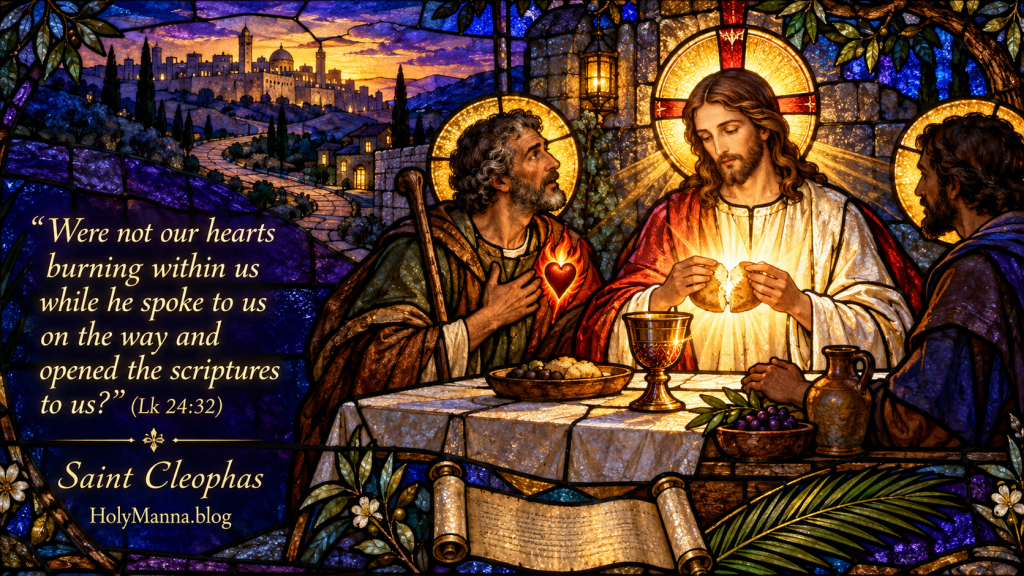
At table the guest became the host. He took bread, said the blessing, broke it, and gave it to them, the same fourfold action of the Last Supper and of every Mass since. “With that their eyes were opened and they recognized him” (Lk 24:31), and He vanished from their sight. They turned to each other with the words that have burned in Christian memory ever since: “Were not our hearts burning within us while he spoke to us on the way” (Lk 24:32). The Catechism teaches that from the beginning the Eucharist was called the Breaking of Bread precisely because Jesus used this rite when He blessed and distributed bread as master of the table, above all at the Last Supper, and that it is by this action that His disciples recognized Him after His Resurrection (CCC 1329). Saint Augustine, preaching on the Emmaus account in his Sermon 235, taught that the Lord allowed Himself to be known in the breaking of the bread so that every believer who receives the Eucharist with faith may recognize the same Lord the disciples recognized.
Then comes the detail that seals the miracle of the day. It was evening, the hour they had just cited as the reason a traveler should stop. They stopped for nothing. Luke says they set out at once, that same hour, and walked the seven miles back to Jerusalem in the dark, where they found the Eleven gathered and were greeted with the news, “The Lord has truly been raised and has appeared to Simon!” (Lk 24:34). Then the two recounted what had taken place on the road and how He was made known to them in the breaking of the bread. No miracle of healing or prophecy is recorded of Cleophas personally, in his lifetime or afterward, and integrity requires saying that plainly. But the miracle that happened to him is the one on which every other Christian miracle depends: he saw, spoke with, and ate with the risen Jesus Christ, and he ran through the night to say so. His witness stands inside the Gospel itself, part of the inspired testimony of the Church to the Resurrection.
Martyred at His Own Table
The New Testament says nothing about the later life of Cleophas, but the tradition of the Church fills in an ending of piercing beauty, and it must be told as the tradition it is. According to the account preserved in the Roman Martyrology and handed down through ancient sources, Cleophas remained in Emmaus and continued to confess boldly what he had seen, that Jesus of Nazareth, crucified under Pontius Pilate, had risen from the dead and had sat at his own table. For this confession, the tradition holds, he was killed by his own countrymen, and not just anywhere; he was slain in the very house in which he had entertained the Lord, the house of the breaking of the bread. Cornelius a Lapide records the older witness, traced through Saint Jerome, that Cleophas was one of the seventy disciples and was slain by the Jews at Emmaus because of Christ, and was therefore venerated as a martyr. The tradition of the shrine at Emmaus itself tells the same story, that in the same town and the same house where Cleophas had once received the Lord as a pilgrim at his table, he was put to death for his confession of the One he had recognized in the breaking of the bread. This account cannot be verified by contemporary historical documentation, and the Martyrology itself introduces it with the careful words “it is related”; it is told here as the Church’s received tradition, not as established fact.
Yet even as tradition, the story teaches. Think of the geography of it. The room where his eyes were opened became the room where his eyes closed. The table where he first recognized the risen Lord became the altar of his own sacrifice. There is a profound Eucharistic logic in that ending, for The Catechism teaches that the altar of the New Covenant represents both the altar of sacrifice and the table of the Lord (CCC 1382); in the tradition, Cleophas did not merely receive the sacrifice at that table, he was conformed to it.
His hardship, even apart from the martyrdom account, is documented in the Gospel itself, and it is a hardship the modern reader knows well: he endured the collapse of everything he had believed God was doing, and the public shame of having followed a condemned and executed man. He endured confusion, grief, and the temptation to walk away, and he was in the very act of walking away when Christ came after him. What tradition adds is that once his hope was restored, nothing could take it from him again, not social pressure, not danger, and finally not death. The Catechism teaches that “martyrdom is the supreme witness given to the truth of the faith” (CCC 2473), the witness of a man who bears testimony even unto death. The Church has honored Cleophas under the title of martyr for many centuries because the tradition of his death fits perfectly the shape of his life: a man who could not stop telling what he had seen.
The Village That Became a Shrine
According to the same ancient tradition, Cleophas was honorably buried at Emmaus, in the place of his death and of the Lord’s self-revelation, and the village itself became his living memorial. From the early centuries, Christians identified the Gospel’s Emmaus with the town later renamed Nicopolis, on the road from Jerusalem toward the coastal plain. A great Byzantine basilica rose over the venerated site, was later destroyed, and was succeeded in the twelfth century by a smaller Crusader church built upon its ruins. Those ruins still stand today at Emmaus-Nicopolis, near Latrun in the Holy Land, where a religious community keeps the shrine and welcomes pilgrims, with special devotion on Easter Monday, when the Emmaus Gospel is proclaimed in the octave of Easter. Honesty requires noting that the location of biblical Emmaus is genuinely disputed; Nicopolis, El-Qubeibeh, Abu Ghosh, and Motza have all been proposed, and Franciscan friars have long led their own Easter Monday pilgrimage to El-Qubeibeh. The uncertainty of the map has never diminished the certainty of the event.
No miracles of healing worked through the relics or intercession of Saint Cleophas are recorded in reliable sources, and none is invented here. One ancient tradition of the place deserves mention, told as tradition. The fifth century church historian Sozomen reported that at Emmaus there was a spring with curative powers, where the sick washed and were healed of their diseases, a power the local Christians connected with the Lord’s presence in that place. This story of the healing spring cannot be verified.
The impact of Cleophas after death is measured less in wonders than in the immense shadow his seven miles cast across Christian history. The Supper at Emmaus became one of the most beloved subjects in Christian art; Caravaggio painted it twice, and Rembrandt returned to it throughout his life. Retreat movements, parishes, and ministries beyond counting bear the name Emmaus, all built on the conviction that Christ still draws near to discouraged travelers. Saint John Paul II placed the whole Church inside the story when he opened the Year of the Eucharist in 2004 with the apostolic letter Mane Nobiscum Domine, taking his title, “Stay with us, Lord”, directly from the plea of Cleophas in Luke 24:29. And if the tradition of his family holds, his legacy continued in flesh and blood: his son Simeon governed the Church of Jerusalem for decades as her second bishop and, according to the account of Hegesippus preserved by Eusebius, died a martyr in extreme old age under the emperor Trajan. The father recognized the risen Lord at table; the son shepherded the Lord’s first church through the destruction of Jerusalem. Few families in history have stood so close to the center of the story of salvation.
Walking Your Own Road to Emmaus
The road to Emmaus is not a place on a map so much as a season of the soul, and nearly everyone walks it eventually. Cleophas is a model and companion for every believer who has ever said “were hoping” about God. He walked away from Jerusalem carrying dashed expectations, unanswered questions, and a grief he could not talk his way out of, and the risen Christ chose exactly that man, on exactly that road, for one of the first appearances of Easter. Jesus did not wait for Cleophas to sort out his theology or turn back toward the holy city; He came after him while he was still headed the wrong way. Have you ever felt that God let your hopes die, and have you considered that He might be walking beside you precisely in that disappointment?
The story also teaches the reader where to look for Him now. Cleophas met Christ in the Scriptures opened and in the bread broken, and The Catechism teaches that this is not a coincidence of one afternoon but the permanent structure of the Church’s worship, the liturgy of the Word and the liturgy of the Eucharist forming together one single act (CCC 1346). The practical application is direct: the person who wants a burning heart should go where Cleophas found his, to the Scriptures read daily within the living Tradition of the Church, and to the Eucharist received in a state of grace. A simple rule of life honors him well: read the Gospel of the day before Mass, arrive early enough to quiet the heart, and after Communion pray his prayer, asking the Lord to stay. When the Scriptures are read at Mass, does your heart burn, or has the listening grown routine, and what one change this week could help you listen the way Cleophas listened?
There is also the lesson of hospitality. The revelation at Emmaus was unlocked by an ordinary act of kindness to an apparent stranger. Saint Gregory the Great insisted this was no accident: charity opened the door that study alone had not. In everyday terms, this means the coworker eating alone, the new family at the parish, the friend going through a divorce, the neighbor nobody checks on. Christ has a long history of arriving unrecognized. Who is the stranger on your road right now, and what would it cost you to say to them, in some concrete way, stay with us?
Finally, Cleophas models the urgency of witness. The moment he recognized the Lord, the seven miles that had taken all afternoon in sorrow took no time at all in joy; he left his dinner on the table and went back through the dark to tell the others. Evangelization, for him, was not a program but a reflex. For a generation of Catholics whose friends have walked away from the faith carrying the same disappointment Cleophas carried, his example is a commission to tell what happened on the road. If Christ has ever made Himself known to you, in the sacraments, in prayer, in a moment of undeserved grace, who in your life has never heard you say so, and what is stopping you?
Engage With Us!
Saint Cleophas walked seven miles with Jesus without recognizing Him, and then could not stop talking about Him once his eyes were opened. His story belongs to everyone who has ever struggled to see God on a hard road, so share your thoughts and reflections in the comments below; someone else walking their own road to Emmaus may need exactly what you have seen. To help the conversation begin, here are a few questions to pray with and to answer:
- When in your life have you said “we were hoping” about God, and looking back, can you now see where Christ was walking beside you in that season?
- Cleophas recognized Jesus in the breaking of the bread. What would it take for you to approach the Eucharist this Sunday with the expectation of a real encounter rather than a routine?
- The disciples’ hearts burned when the Scriptures were opened to them. What is one concrete step you can take this week to let Scripture speak to you, such as reading the daily Mass Gospel or praying with Luke 24?
- Hospitality to a stranger unlocked the revelation at Emmaus. Who is one person you could welcome, invite, or simply sit with this week as if welcoming Christ Himself?
- Cleophas returned to Jerusalem the same hour to share the news. Who needs to hear your witness, and what small act of courage would it take to give it?
Saint Cleophas did not have all the answers when the Lord found him; he had a broken hope, an open door, and a heart still willing to burn. That was enough, and it is enough for you. Go to the Mass expecting to meet the risen Christ, open the Scriptures expecting Him to speak, and welcome the stranger expecting Him to be there too. Then do not keep it to yourself. Live this week, and every week, with a heart on fire, doing everything with the love and mercy that Jesus taught, so that others may look at your life and find their own eyes opened. Saint Cleophas, disciple of the road and witness of the breaking of the bread, pray for every traveler still walking toward Emmaus.
Saint Cleophas, pray for us!
Follow us on YouTube, TikTok, Instagram and Facebook for more insights and reflections on living a faith-filled life.


Leave a comment