Friday of the Twenty-fifth Week in Ordinary Time – Lectionary: 453
The God Who Writes in Seasons
There is a quiet ache that shows up in every human life, usually around a birthday, a funeral, or a September evening when the light starts leaving earlier. It is the sense that time is moving and cannot be stopped. The readings for this Friday, September 25th, 2026, the Friday of the Twenty-fifth Week in Ordinary Time, take that ache seriously and then do something remarkable with it. They reveal that time is not an enemy. It is a language, and God is the one writing in it.
The central theme uniting today’s readings is God’s appointed time. In the First Reading, Qoheleth, the mysterious Preacher of Ecclesiastes, sings his famous catalogue of seasons: birth and death, weeping and laughing, war and peace. Every hour under heaven has been assigned its place, and God has planted the timeless, eternity itself, in the human heart. The Responsorial Psalm answers with brutal honesty about what a human being is: a breath, a passing shadow. And yet that breath is noticed, loved, and defended by the Lord who is a rock, a fortress, and a shield. Then the Gospel gathers it all together. Jesus, praying in solitude, asks the question every generation must answer, and Peter confesses Him as the Christ of God. Immediately Jesus unveils the appointed time hidden inside all other times: the Son of Man must suffer, die, and on the third day be raised.
Israel’s sages wrote Ecclesiastes centuries before Christ, when the big questions pressed hard and the answers felt out of reach. Today the Church reads their honest longing in the light of its fulfillment. What season is God writing in your life right now?
First Reading — Ecclesiastes 3:1-11
The Poem Every Generation Memorizes Without Trying
Few passages of Scripture have escaped the sanctuary and entered the world’s bloodstream like this one. It has been read at weddings and gravesides, quoted by presidents, and set to music. Qoheleth, whose Hebrew title means one who gathers an assembly, speaks in the voice of Israel’s wisdom tradition, long associated with Solomon, with the book reaching its final form in the centuries after the Babylonian exile. His people had watched kingdoms rise and fall and had learned that human beings control far less than they pretend to. Into that hard-won humility, Qoheleth speaks a poem of fourteen paired opposites, twenty-eight appointed times, a Hebrew way of saying absolutely everything. Placed at the head of today’s liturgy, it establishes the day’s theme: every season belongs to God, and the heart that carries eternity will never be satisfied by time alone.
Ecclesiastes 3:1-11
There is an appointed time for everything,
and a time for every thing under the heavens.
A time to be born, and a time to die;
a time to plant, and a time to uproot the plant.
A time to kill, and a time to heal;
a time to tear down, and a time to build.
A time to weep, and a time to laugh;
a time to mourn, and a time to dance.
A time to scatter stones, and a time to gather them;
a time to embrace, and a time to be far from embraces.
A time to seek, and a time to lose;
a time to keep, and a time to cast away.
A time to rend, and a time to sew;
a time to be silent, and a time to speak.
A time to love, and a time to hate;
a time of war, and a time of peace.What advantage has the worker from his toil?
I have considered the task that God has appointed
for the sons of men to be busied about.
He has made everything appropriate to its time,
and has put the timeless into their hearts,
without man’s ever discovering,
from beginning to end, the work which God has done.
Detailed Exegesis
Verse 1: “There is an appointed time for everything, and a time for every thing under the heavens.”
The verse pairs two Hebrew words, zeman, a fixed or appointed time, and et, an occasion or season. Nothing under the heavens floats free of God’s ordering hand. This is not fatalism, which says events are random or mechanical; it is providence, which says events are held.
Verse 2: “A time to be born, and a time to die; a time to plant, and a time to uproot the plant.”
The catalogue opens with the two moments no human being chooses. Birth and death are the bookends handed to every person by Another, which is precisely why they teach humility before they teach anything else.
Verse 3: “A time to kill, and a time to heal; a time to tear down, and a time to build.”
Qoheleth refuses to describe a sanitized world. Israel knew war, judgment, and demolition, and Scripture never pretends otherwise. Yet each harsh season stands beside its remedy, and healing and building get the final word in each pair.
Verse 4: “A time to weep, and a time to laugh; a time to mourn, and a time to dance.”
Emotions have seasons too, and both are holy in their hour. Jesus Himself wept at the tomb of Lazarus, and in The Gospel of Luke He promises, “Blessed are you who are now weeping, for you will laugh” (Luke 6:21). Grief is not a failure of faith; it is a season inside it.
Verse 5: “A time to scatter stones, and a time to gather them; a time to embrace, and a time to be far from embraces.”
Farmers cleared stones to plant and gathered them to build, so the image speaks of clearing away and constructing in due course. The second pair extends this to human intimacy, which also breathes in seasons of closeness and distance.
Verse 6: “A time to seek, and a time to lose; a time to keep, and a time to cast away.”
Possessions, projects, and even dreams have expiration dates. Wisdom knows when holding on becomes hoarding, and when letting go becomes freedom. The spiritual tradition calls this detachment, and it is the soil of peace.
Verse 7: “A time to rend, and a time to sew; a time to be silent, and a time to speak.”
Israelites tore their garments in grief and mended them when mourning ended. The second pair belongs to every disciple: there are hours for holy silence and hours when love requires speech. Christ modeled both, silent before His accusers and thunderous in the Temple.
Verse 8: “A time to love, and a time to hate; a time of war, and a time of peace.”
In Hebrew idiom, to hate often means to reject decisively, and there is indeed a time to reject evil without apology. Tellingly, the entire catalogue closes on the word peace, the destination of all the seasons.
Verse 9: “What advantage has the worker from his toil?”
This is Qoheleth’s haunting refrain. If every season passes, what does labor permanently secure? The question is not despair; it is honesty designed to loosen the grip on things that cannot last.
Verse 10: “I have considered the task that God has appointed for the sons of men to be busied about.”
Human busyness itself is God-appointed. Work is not meaningless, but its meaning comes from the One who assigned it, not from the worker’s ability to control outcomes.
Verse 11: “He has made everything appropriate to its time, and has put the timeless into their hearts, without man’s ever discovering, from beginning to end, the work which God has done.”
Here is the summit. The Hebrew word rendered “the timeless” is ha’olam, eternity. God has planted eternity inside creatures made of time, which explains why nothing temporal ever fully satisfies. The verse also imposes humility: no one sees God’s whole design from beginning to end.
Teachings
The Church has never read Qoheleth as a cynic; she reads him as a physician who diagnoses the wound only Christ can heal. Saint Gregory of Nyssa, the great fourth century Cappadocian Father, preached on this very chapter and prayed over its opening pair, “There is a time to be born and a time to die. God grant that mine may be a timely birth and a timely death!” (Homily 6 on Ecclesiastes). For Gregory, the timely birth and death are the ones chosen in Christ, dying to sin and being born to grace, so that even the seasons no one controls become doorways to eternal life. Saint Jerome, in his Commentary on Ecclesiastes, likewise read the whole book as a school of detachment, training the soul to hold passing things lightly.
The Catechism names the eternity planted in verse 11 with precision: “The desire for God is written in the human heart, because man is created by God and for God; and God never ceases to draw man to himself” (CCC 27). It also confirms Qoheleth’s vision of appointed times: “The witness of Scripture is unanimous that the solicitude of divine providence is concrete and immediate; God cares for all, from the least things to the great events of the world and its history” (CCC 303). And Saint Augustine gave the ache of verse 11 its most famous voice in The Confessions: “You have made us for yourself, O Lord, and our heart is restless until it rests in you.”
Reflection
This reading is an invitation to stop fighting the season you are in. Perhaps you are in a season of building, or one of letting go; a season of speech, or one where God is asking for silence. Name it honestly before the Lord this week. Try a simple practice: each evening, thank God for one thing the current season is teaching that no other season could. Resist the modern lie that every day should feel the same, endlessly productive and endlessly happy. Which of Qoheleth’s pairs describes your life right now? And if eternity is truly written on your heart, what have you been asking time to give you that only God can?
Responsorial Psalm — Psalm 144:1-4
A Warrior’s Blessing and a Creature’s Honest Mirror
Psalm 144 belongs to David, Israel’s soldier-king, and its opening lines echo the great victory hymn of Psalm 18. What makes today’s selection so striking is the whiplash between its two halves. The psalm begins with a fortress wall of titles for God, rock, mercy, fortress, stronghold, deliverer, shield, and then turns the mirror on the one praying: man is a breath, his days a passing shadow. The Lectionary places this psalm here because verse 4 uses hevel, breath or vapor, the very word Ecclesiastes famously translates as vanity. The psalmist agrees completely with Qoheleth about human frailty, but he prays his frailty rather than merely observing it, and that changes everything. The fleeting creature finds permanence not in himself but in the Rock he stands on, which is the day’s theme in miniature.
Psalm 144:1-4
R. (1) Blessed be the Lord, my Rock!
Blessed be the LORD, my rock,
my mercy and my fortress,
my stronghold, my deliverer,
My shield, in whom I trust.
R. Blessed be the Lord, my Rock!
LORD, what is man, that you notice him;
the son of man, that you take thought of him?
Man is like a breath;
his days, like a passing shadow.
R. Blessed be the Lord, my Rock!
Detailed Exegesis
Verse 1: “Blessed be the LORD, my rock, my mercy and my fortress.”
David blesses God before asking anything of Him. The rock imagery reaches back to the Song of Moses in Deuteronomy 32 and forward to Saint Paul, who wrote of Israel’s desert journey, “the rock was Christ” (1 Corinthians 10:4). Notice that “my mercy” sits among the military titles; God’s strength is never separate from His tenderness.
Verse 2: “My stronghold, my deliverer, my shield, in whom I trust.”
The titles pile up like stones in a fortress wall, and each carries the word “my.” This is not theology at a distance; it is possession by covenant. Trust is the psalm’s hinge, the decision to stand on what does not move.
Verse 3: “LORD, what is man, that you notice him; the son of man, that you take thought of him?”
The question deliberately echoes Psalm 8. Astonishment, not self-loathing, drives it: the God who commands armies of stars notices a single creature, thinks about him, attends to him. Wonder at being noticed by God is one of the oldest forms of prayer.
Verse 4: “Man is like a breath; his days, like a passing shadow.”
Here hevel appears, the breath-word of Qoheleth. A shadow moves across a wall and is gone; so pass the decades. The psalm does not soften this. It simply insists that the breath is held in the hands of the Rock, and the New Testament will echo the image in The Letter of James: “you are a puff of smoke that appears briefly and then disappears” (James 4:14).
Teachings
The Catechism teaches that this posture, small creature before great God, is where all real prayer begins: “Adoration is the first attitude of man acknowledging that he is a creature before his Creator” (CCC 2628). It adds the interior condition that makes the psalm honest: “humility is the foundation of prayer” (CCC 2559). On the shortness of the shadow, the Church is equally direct: “Death is the end of earthly life. Our lives are measured by time, in the course of which we change, grow old and, as with all living beings on earth, death seems like the normal end of life” (CCC 1007). None of this is meant to frighten; it is meant to relocate confidence from the breath to the Rock.
The Saints lived this psalm. After the death of Saint Teresa of Ávila, the great Carmelite reformer and Doctor of the Church, a prayer was found written in her breviary, treasured ever since as her bookmark: “Let nothing disturb you, let nothing frighten you. All things are passing; God never changes. Patience obtains all things. Whoever has God lacks nothing. God alone suffices.” That is Psalm 144 translated into a life, the passing shadow at peace because it falls across an unchanging Rock.
Reflection
Modern life sells the illusion of permanence, and this psalm lovingly takes it away. This week, pray verse 4 without flinching: your days really are a passing shadow, and that is precisely why they are precious. Then pray verses 1 and 2 with equal force, naming God as your rock in the specific place where life feels least stable, the job, the diagnosis, the relationship. Consider writing Saint Teresa’s bookmark somewhere visible, a mirror, a laptop, a dashboard, and letting it interrupt anxiety with truth. Where are you currently trying to build a fortress out of things that are themselves passing shadows? What would change if trust in the Rock came first, before the day’s first scroll, email, or worry?
Holy Gospel — Luke 9:18-22
The Question That Divides History in Two
Saint Luke sets this scene with a detail the other Evangelists omit: Jesus is praying in solitude. Throughout The Gospel of Luke, prayer precedes every decisive hour, the baptism, the choosing of the Twelve, the Transfiguration, and Gethsemane, so the reader is being warned that something enormous is coming. Herod has just been asking nervously who Jesus is, and the crowds have their theories. Into that swirl of speculation, Jesus poses the question on which every human life ultimately turns, and Peter answers for the Church of every age: the Christ of God. Then comes the shock that anchors today’s theme. The Messiah immediately speaks of an appointed time, a divine “must,” in which He will suffer, die, and rise on the third day. Qoheleth said every season is appointed; Jesus now reveals the season for which all others exist.
Luke 9:18-22
Once when Jesus was praying in solitude,
and the disciples were with him,
he asked them, “Who do the crowds say that I am?”
They said in reply, “John the Baptist; others, Elijah;
still others, ‘One of the ancient prophets has arisen.’”
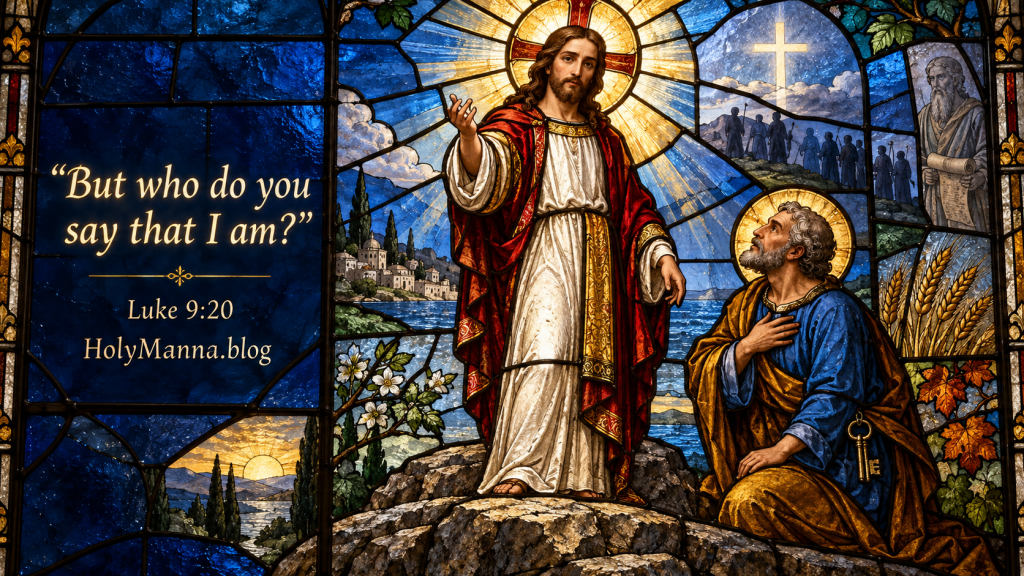
Then he said to them, “But who do you say that I am?”
Peter said in reply, “The Christ of God.”
He rebuked them and directed them not to tell this to anyone.He said, “The Son of Man must suffer greatly
and be rejected by the elders, the chief priests, and the scribes,
and be killed and on the third day be raised.”
Detailed Exegesis
Verse 18: “Once when Jesus was praying in solitude, and the disciples were with him, he asked them, ‘Who do the crowds say that I am?’”
The greatest confession in the Gospel is born inside prayer. Jesus asks about public opinion first, not because He needs a poll, but to surface the difference between hearsay and faith. Crowds can admire; only disciples confess.
Verse 19: “They said in reply, ‘John the Baptist; others, Elijah; still others, “One of the ancient prophets has arisen.”‘”
Every answer is flattering, and every answer is too small. Some echoed Herod’s guilty fear that John had returned; others expected Elijah because Malachi 3:23 promised his coming before the day of the Lord. The crowd could place Jesus in a category, but categories cannot save.
Verse 20: “Then he said to them, ‘But who do you say that I am?’ Peter said in reply, ‘The Christ of God.’”
The question turns personal, and Peter steps forward as spokesman of the Twelve. “The Christ of God” means the Anointed One, the definitive article mattering enormously: not one anointed figure among Israel’s many kings and prophets, but the singular Messiah belonging wholly to God and sent by Him.
Verse 21: “He rebuked them and directed them not to tell this to anyone.”
The command of silence, often called the messianic secret, is not embarrassment but strategy. In an age boiling with expectations of a political, military messiah, the title Christ would be misheard until the Cross could define it. Some truths must be witnessed before they can be preached.
Verse 22: “He said, ‘The Son of Man must suffer greatly and be rejected by the elders, the chief priests, and the scribes, and be killed and on the third day be raised.’”
The little word “must” translates the Greek dei, the language of divine necessity. The elders, chief priests, and scribes were the three chambers of the Sanhedrin, so Jesus names His judges in advance. This is Qoheleth’s appointed time in its ultimate form: a time to die and, on the third day, a time to rise.
Teachings
The Fathers heard in Peter’s confession the faith of the whole Church. Saint Cyril of Alexandria, preaching on this exact passage, wrote: “First before the rest Peter again springs forth, and makes himself the mouthpiece of the whole company, pouring forth the expression of love to God, and giving utterance to a correct and faultless confession of faith in Him, saying, ‘The Christ of God.’ The disciple is unerring: a thoroughly intelligent explainer of the mystery” (Commentary on the Gospel of Luke, Sermon 49). Cyril goes on to note that many in Israel were anointed as kings and prophets, but Peter confesses the one and only Christ who belongs to God the Father alone.
The Catechism binds the confession and the Passion prediction into a single lesson: “Jesus accepted Peter’s profession of faith, which acknowledged him to be the Messiah, by announcing the imminent Passion of the Son of Man” (CCC 440). And it insists that Calvary was no tragedy of circumstance: “Jesus’ violent death was not the result of chance in an unfortunate coincidence of circumstances, but is part of the mystery of God’s plan” (CCC 599). The Cross is the appointed time toward which every season in Qoheleth’s poem was secretly leaning.
Reflection
Sooner or later, borrowed answers about Jesus run out, and His question arrives personally. Answer it this week in prayer, out loud, in your own words, and notice whether your life matches your answer. Practically, imitate the setting of the scene: find ten minutes of genuine solitude before making any significant decision, because Luke shows that clarity about Christ is born in prayer, not in noise. Then accept the second half of the Gospel. Confessing the Christ means embracing His timing, including seasons of suffering that make no sense from the middle. Who do you say that Jesus is, not in theory but in the way you spend your time, money, and attention? Is there a cross in your life right now that you have been calling an accident instead of an appointment?
Every Hour Held in His Hands
Step back and watch the day’s readings become one story. Qoheleth stands in the assembly and sings that every season under heaven has been appointed, while eternity burns quietly in every human heart. David takes up the harp and admits what every honest person knows, that man is a breath and his days a passing shadow, yet he sings it standing on a Rock that cannot be shaken. And then, on a quiet day of prayer, Jesus of Nazareth asks His friends who He is, receives Peter’s confession, and unveils the secret hidden inside all of time: the Son of Man must suffer, be killed, and on the third day be raised.
There it is. The seasons were never spinning aimlessly. Every “time to weep” was leaning toward His tears, every “time to die” toward His Cross, and every “time to dance” toward the morning of the third day. The eternity God wrote on the human heart has a face, and the Rock beneath the passing shadow has a name.
So let this Friday be more than a page on the calendar. Bring the current season, whatever it holds, to the Lord who appointed it, and trust that He can see from beginning to end what no one else can. Speak Peter’s confession slowly and personally, perhaps before the Blessed Sacrament, perhaps in the car before work: the Christ of God. Then live like it is true, because it is. Time is short, the Rock is sure, and the third day has already dawned. The only fitting response is to give Him this hour, and the next, and every season still to come.
Engage With Us!
The conversation does not end here, and every reflection shared helps another reader see these Scriptures with new eyes. Share your thoughts in the comments below, whether a single sentence or the story of a whole season, and take one or more of these questions to prayer first:
- In Ecclesiastes 3:1-11, Qoheleth teaches that God has appointed a time for everything and has placed eternity in the human heart. Which season from his catalogue best describes your life right now, and how might God be inviting you to trust His timing within it?
- In Psalm 144:1-4, David calls the Lord his rock and fortress while admitting that man is a breath and his days a passing shadow. Where in your life are you being invited to move your trust from something passing to the Rock who never changes?
- In Luke 9:18-22, Jesus asks who the crowds say He is, then asks His disciples directly, and Peter confesses Him as the Christ of God. If Jesus asked you that question today, what would your honest answer be, and does your daily life confess the same thing?
- Taken together, today’s readings reveal that every season finds its meaning in God’s appointed time, fulfilled in the suffering, death, and Resurrection of Christ. What is one concrete way you can surrender your calendar, your plans, and your worries to God’s perfect timing this week?
Faith is not lived in theory but in hours and days, the very ones Qoheleth counted and Christ redeemed. Keep showing up, keep praying, keep confessing Him in every season, and do everything with the love and mercy Jesus taught us. Every breath is short, but in His hands, no breath is wasted.
Sacred Heart of Jesus, we trust in You!
Immaculate Heart of Mary, pray for us!
Saint Michael the Archangel, defend us in battle!
Follow us on YouTube, TikTok, Instagram and Facebook for more insights and reflections on living a faith-filled life.


Leave a comment