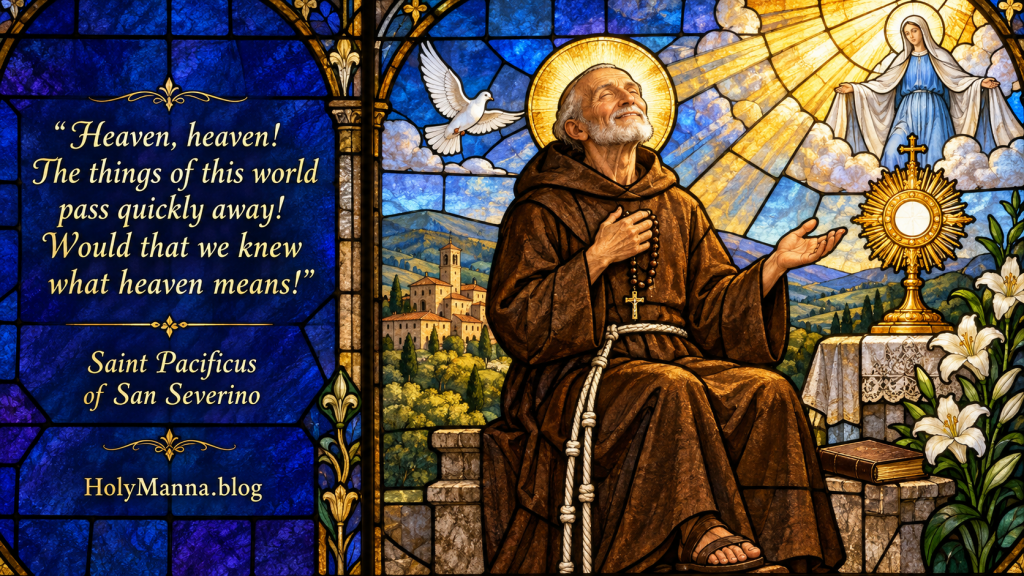
The Peacemaker Who Lost Everything and Never Complained
Some saints change the world by crossing oceans, founding orders, or standing before emperors. Saint Pacificus of San Severino changed it from a small cell in a hillside friary in central Italy, deaf, blind, and lame, praying through the night while the rest of the world slept. He was a Franciscan priest of the strict Observance, a gifted preacher and confessor, a mystic favored with ecstasies and prophecy, and above all a man who suffered nearly 29 years of debilitating illness without a single recorded complaint. His heroism was hidden, and that is exactly why the Church holds him up. When she canonizes a saint, the Church is “solemnly proclaiming that they practiced heroic virtue and lived in fidelity to God’s grace”, recognizing “the power of the Spirit of holiness within her” and proposing the saints “as models and intercessors” (CCC 828). Pacificus is a model for everyone whose cross does not come with an audience: the chronically ill, the caregivers, the overlooked, the ones who keep showing up to pray when their bodies are failing them. The 2004 Roman Martyrology remembers him on September 24th with beautiful economy: “At San Severino in the Marches, Saint Pacificus, priest of the Order of Friars Minor, distinguished for penance, love of solitude, and prayer before the Most Blessed Sacrament.” His hometown of San Severino Marche venerates him as its co-patron, and his shrine still crowns the hill where he lived and died.
An Orphan Who Built Little Altars
He was born Carlo Antonio Divini on March 1st, 1653, in San Severino, a walled town in the March of Ancona, then part of the Papal States, and he was baptized that same day. His parents, Antonio Maria Divini and Mariangela Bruni, came from a noble family known for piety, though the household had suffered serious financial losses; several accounts add that Carlo was the youngest of 13 children. Whatever comfort his early childhood held did not last. When he was only about 3 years old, shortly after receiving an early Confirmation as was common in that era, both of his parents died.
The orphan was taken in by his maternal uncle, Luzizio Bruni, the archdeacon of the cathedral of San Severino. The uncle was cultured and respectable, but he was a rough and severe man with no idea how to raise a grieving child. He put his nephew to the lowest domestic work in the house and allowed the servants to treat the boy with insolence and contempt. People in town remembered that this same child had once been well dressed and carefully attended while his parents lived. According to the memoir of his life published in Rome in 1786 and preserved in Butler’s Lives of the Saints, Carlo carried out every humiliating order with cheerfulness, remembering the sufferings of Jesus on the cross, and he quietly gathered the scraps and leftovers from his uncle’s table to give to the poor who came to the door.
Grace was already at work in ways the household barely noticed. As a small boy he had no taste for ordinary games. Instead he built little altars at home, decorated them with pictures of the saints, and knelt before them in prayer for hours at a time. He frequented the town’s churches daily, assisted at the Divine Office, heard several Masses, and hung on every sermon and catechism lesson, all while remaining so diligent at school that his teachers pointed to him as a model. The Franciscan friars of Santa Maria delle Grazie in San Severino knew him well and saw what was forming in him. At 17, after seeking counsel from his confessors, Carlo asked to enter the Friars Minor of the strict Observance, the branch of the Franciscans known as the Reformati. He received the habit at the friary of Forano on the Feast of the Holy Innocents in December 1670 and took a new name that would prove prophetic: Brother Pacificus, the peaceful one. He made his solemn profession exactly one year later, completed his studies in philosophy and theology, and was ordained a priest on June 4th, 1678. The faithful who attended his first Mass saw him sigh and weep openly at the altar, and that intensity of Eucharistic love never left him.
Preacher, Peacemaker, and Prophet
After ordination, Pacificus spent 3 years, from 1680 to 1683, as a lector teaching philosophy to the younger friars of his province. But he felt called to souls more than to classrooms, and he obtained leave to give himself entirely to preaching and hearing confessions. For the next several years he became a missionary to the forgotten, walking the rough Apennine villages around the Marches, preaching to farmers and shepherds, and sitting for long hours in the confessional. His penitents later declared under oath, in the official processes for his beatification, that they had never felt so much comfort and relief in the sacrament of Penance as when they confessed to Pacificus. When he came across children playing in the cloisters or tending flocks in the countryside, he stopped to teach them acts of faith and contrition. To adults he loved to explain that faith without good works is dead and withers like a plant without water.
He also became the region’s reconciler. Families and factions at odds chose him as their judge and umpire, and the reconciliations he brokered lasted. Butler’s Lives of the Saints records that he came to be called the peacemaker “both in deed and name,” a living echo of the Lord’s promise, “Blessed are the peacemakers, for they will be called children of God” (Matthew 5:9). People of every rank called him “the loving father of the afflicted and sorrowful,” and the beatification processes preserved many sworn attestations that no one ever came to him in anguish without leaving eased and strengthened.
At the center of all of it was the altar. The Church teaches that the Eucharist is “the source and summit of the Christian life” (CCC 1324), and Pacificus lived that sentence literally. He never let a day pass without offering Mass except when illness made it impossible, and he was frequently caught up in prolonged ecstasies during the Holy Sacrifice. Bystanders watched his sighs and tears and were moved to compunction themselves. Prostrate before the Blessed Sacrament, he was heard to cry out from the fullness of his heart, “My God and my all! Who art thou, sweetest Jesus, and who am I, a poor worm of the earth?” He trembled as he finished the memento for the dead at Mass, out of compassion for the souls in purgatory, and he recited the entire Office for the Dead for them every single day. In this he simply lived what the Church has always done, for from the beginning she “has honored the memory of the dead and offered prayers in suffrage for them, above all the Eucharistic sacrifice, so that, thus purified, they may attain the beatific vision of God” (CCC 1032).
God confirmed this hidden holiness with signs. The memoir records that Pacificus used to celebrate Mass at a place called Cimarella, some distance from the friary. On one journey there, rain and melting snow soaked his companion so thoroughly that the man had to dry his habit on arrival, yet not a drop had touched Pacificus. When he later served as Guardian, or superior, of the friary, the community’s poverty produced repeated small miracles of providence. Once the cook ran to tell him there was nothing at all for the friars’ dinner, and Pacificus calmly answered, “Shall we not eat?” Before the dinner hour, benefactors arrived with everything needed. On another occasion the procurator complained that their alms were completely exhausted, and Pacificus replied, “Let us not despond, for God will not fail in the helps which His Divine Providence sends.” The words were scarcely spoken when an unknown man from a distant place presented a large alms that supplied the friary for a long time. He was also known for his refusal to judge his brothers. When someone reported a friar’s conduct as a violation of the rule, Pacificus would answer sweetly, “Who can tell what his motives may have been?”
His gifts of prophecy were attested as well. The most striking documented episode came in the summer of 1721, when the bishop of San Severino visited the aged, blind friar. As the bishop was leaving, Pacificus suddenly called out, “My lord, heaven, heaven! and I shall soon follow you.” Everyone present froze at the words. The bishop, in good health that day, died about 15 days later, and Pacificus followed him within 2 months, exactly as he had said. There is also a story, reported in Italian sources, that Pacificus foretold the terrible earthquakes that devastated central Italy in 1703. That account circulates as a tradition attached to his gift of prophecy rather than as documented history, and it cannot be verified.
Twenty-Nine Years on the Cross
Pacificus was never a martyr, but few martyrdoms last 29 years. Around 1688, when he was about 35 years old and at the height of his preaching apostolate, illness struck him down. Painful ulcerous sores opened on his leg and crippled him. His hearing began to fail until he was deaf. In time his sight dimmed as well, and in the final years of his life he was completely blind. The active missionary who had walked the Apennines could no longer give missions at all. What looks from the outside like the end of a vocation became, in God’s hands, its deepest chapter. The Catholic Encyclopedia summarizes those decades in a single unforgettable line: he “bore his ills with angelic patience, worked several miracles, and was favoured by God with ecstasies.”
The details preserved from the beatification processes make that patience concrete. The ulcers on his legs inspired horror and compassion in everyone who happened to see them, yet he went about nearly barefoot and refused any covering for them. Not a sigh, not a complaint ever escaped his lips. He would allow almost no one to dress his wounds, permitting it only once or twice to a single trusted brother. Despite lameness, deafness, and encroaching blindness, he kept dragging himself to Matins with the community in the middle of the night, and when sickness confined him to bed he kept trying to get up and go to the church until his superiors ordered him to stay put, an order he always obeyed. Astonishingly, his brothers still trusted his judgment and holiness enough to elect him to office. He served as vicar of the San Severino community beginning in 1686 and as Guardian of the friary of Santa Maria delle Grazie from 1692 to 1693, and after years of moving between San Severino and Forano he settled permanently at Santa Maria delle Grazie in 1705, where he remained until his death.
Even in constant pain he refused to soften his penances. He fasted rigorously, kept the Lents of Saint Francis, sometimes mixed ashes into his food, scourged himself, wore hair shirts, and never approached the fire even in the coldest winters, keeping his window open so he could hear the bell calling him to community duties. When a brother whose cell was nearby heard him praying the Our Father aloud through most of the night and urged him to get some rest, Pacificus answered simply, “We must not caress the body,” and went on praying. His superiors, alarmed for his health, restricted his fasting more than once, and here is the detail that separates sanctity from stubbornness: he cheerfully obeyed every time. Because he was deaf, he had to pray aloud to hear his own voice, and the friars were often edified by the ejaculations that echoed from his cell. Once, hearing the sound of music, he burst out, “O what will it be in heaven!” When he received harsh words or sarcasm, he only raised his eyes and said, “Be it so for the love of God.” Heaven was his constant theme. He would exclaim, “Heaven, heaven! The things of this world pass quickly away! Would that we knew what heaven means!”
In his last 3 years, blindness added to deafness made it impossible for him to celebrate Mass, a deprivation that cost this Eucharistic soul more than any physical pain. He answered it by receiving Holy Communion frequently and by being present for every Mass celebrated in the friary church. The Church teaches exactly what Pacificus lived: “The way of perfection passes by way of the Cross. There is no holiness without renunciation and spiritual battle” (CCC 2015). And she teaches why such suffering is not wasted, for by uniting the sick person to Christ, grace consecrates him “to bear fruit by configuration to the Savior’s redemptive Passion” (CCC 1521). Pacificus, offering his decades of pain for sinners and for the souls in purgatory, was living Saint Paul’s mysterious boast: “in my flesh I am filling up what is lacking in the afflictions of Christ on behalf of his body, which is the church” (Colossians 1:24).
His final illness began on September 16th, 1721, when the ulcers on his legs suddenly closed and a violent fever took hold. He knew it was the end he had prophesied 2 months earlier, and he met it with joy. Gathering his last strength, he knelt to recite Saint Bonaventure’s prayer Sacrosanctae et Individuae Trinitati before receiving Viaticum. When his brothers tried to give him a few drops of a restorative for his parched throat, he could not swallow at all, until the infirmarian thought to invite him to drink it in honor of Our Lady, whose feast the Church was celebrating. At the sound of her name he took the whole draught without difficulty, to the astonishment of everyone in the room. Rising once more, unaware in his deafness and blindness that anyone was present, he knelt and recited 3 Ave Marias, adding with singular earnestness, “Let these be, O my God, in satisfaction for my sins.” He received the last absolution with his arms crossed over his breast, and as the community recited the Recommendation of the Soul, at the words “Go forth, O Christian soul,” he bowed his head as if obeying one final command from his superior and gave his soul to God. It was September 24th, 1721, then kept as the feast of Our Lady of Mercy, a fitting departure for a man who had fasted on the vigils of every Marian feast of his life.
A Grave That Would Not Stay Quiet
The people of San Severino knew what they had lost. Enormous crowds turned out for the funeral of the blind friar, and he was buried, according to the humble custom of his community, without a coffin in the friars’ common grave. It did not stay quiet for long. Miracles were soon reported at the grave, and the stream of graces became so steady that in 1725, only 4 years after his death, his body was exhumed and placed in a wooden casket at a side altar of the friary church so the faithful could venerate him. A devotional tradition in Italy adds that when the body was examined it was found incorrupt and even issued fresh blood as if still living. That account appears in popular devotional sources rather than in the historical record, and it cannot be verified.
The Church then did what she always does with a reputation for holiness: she investigated it slowly and seriously. The cause was taken up under Pope Benedict XIV, with sources placing its opening stages between 1740 and 1752, a discrepancy that likely reflects different procedural steps, and it was referred to the Congregation of Rites in 1753. The reporter appointed for the cause was none other than the Cardinal Duke of York, Henry Benedict Stuart, the last of the royal Stuart line. Sworn testimony from those who had known Pacificus, including his penitents and his brother friars, filled the processes with the sayings and episodes quoted throughout this post. Pope Pius VI declared him Blessed, with the solemn beatification celebrated on August 4th, 1786, though Butler’s records the decree as issued in 1785, another small discrepancy between decree and ceremony worth noting honestly. The following year his relics were placed beneath a wax figure in a glass reliquary and moved to a chapel built in his honor. Finally, on May 26th, 1839, Trinity Sunday, Pope Gregory XVI canonized him at Saint Peter’s Basilica in one of the most remarkable canonization ceremonies in modern history, raising to the altars on that single day Saint Alphonsus Liguori, Saint Veronica Giuliani, Saint Francis de Girolamo, Saint John Joseph of the Cross, and Saint Pacificus of San Severino.
His town has never let go of him. Following the canonization, Count Severino Servanzi Collio financed the rebuilding of the church of Santa Maria delle Grazie beginning in 1842, transforming the hilltop friary church where Pacificus lived, served as Guardian, and died into the Sanctuary of San Pacifico. His tomb and relics rest there today in the chapel to the right of the entrance, his statue stands in the cathedral of San Severino Marche, and the street leading to the sanctuary bears his name. The town venerates him as its co-patron, and pilgrims still climb the hill to pray beside the friar who once prayed there through the night. A relic of the saint is also venerated across the ocean in the reliquary chapel of the Basilica of the Sacred Heart at the University of Notre Dame, a quiet sign of how far the fame of a hidden man can travel. None of this would have surprised the Church, and none of it should surprise the reader, because the saints in heaven “do not cease to intercede with the Father for us” and their “fraternal concern is of great help to our weakness” (CCC 956).
What a Blind Friar Saw More Clearly Than Most
It would be easy to admire Saint Pacificus from a safe distance and conclude that his life has nothing to do with ordinary people who cannot fast on sun baked bread or pray through the night. That would miss the point. Strip away the ecstasies and the prophecies, and what remains is a pattern available to everyone: an orphan who answered cruelty with cheerfulness, a sick man who let his limitations redirect his vocation instead of ending it, and a soul who talked about heaven so much that everyone around him started longing for it too.
Start with his suffering, because sooner or later suffering finds everyone. Chronic illness, a diagnosis that will not go away, a body that stops cooperating, a season of loss that stretches into years. The world says such suffering is meaningless and should be escaped at any cost. The Church says something breathtakingly different: illness can become “a path of conversion” and a moment when the person “begins to discern in his illness what is essential in his life” and turns toward God (CCC 1501, CCC 1502). Pacificus did not waste his pain. He aimed it, offering it for the conversion of sinners and the souls in purgatory. When suffering comes to you, do you aim it at anything, or does it simply happen to you? The Catechism, quoting Saint Rose of Lima, puts the stakes plainly: “Apart from the cross there is no other ladder by which we may get to heaven” (CCC 618). The Lord told Saint Paul, “My grace is sufficient for you, for power is made perfect in weakness” (2 Corinthians 12:9), and Pacificus is what that verse looks like stretched across 29 years.
Next, take his name seriously. Pacificus became a peacemaker in an Italy of village feuds and family grudges, and his reconciliations held. Most readers will never arbitrate a feud, but nearly everyone carries one: the sibling not spoken to since the funeral, the group chat gone cold after an argument, the coworker held at arm’s length. His secret was his refusal to judge motives, that gentle question, “Who can tell what his motives may have been?” Is there one relationship where you could ask that question this week instead of assuming the worst? Practically, that might mean sending the first text, apologizing without a scoreboard, or simply refusing to repeat the story that keeps a wound open.
Then there is his trust in Providence. “Shall we not eat?” is a whole spirituality in three words, spoken by a superior staring at an empty pantry. Modern anxiety about money, careers, and the future is not so different from an empty friary larder. Trust does not mean passivity; it means doing the work and then refusing to let fear rule the heart. What is the empty pantry in your life right now, and what would it look like to hand it to God tonight?
Finally, imitate his anchors: the Eucharist and Our Lady. He built his entire life around the Mass, and when he could no longer celebrate it, he attended it. He fasted before Marian feasts, prayed the rosary walking through the streets, and died on a feast of Our Lady with her name unlocking his last act of obedience. The reader does not need to add 29 years of heroic suffering to a calendar. A daily Mass once a week, a rosary on the commute, a real preparation before Communion, a habit of saying with him, “My God and my all!” These are small altars, exactly like the ones a lonely orphan once built in a harsh uncle’s house, and God notices small altars.
Engage With Us!
Saint Pacificus spent nearly three decades unable to hear the voices around him, yet no one who met him ever doubted he was listening to God. HolyManna would love to hear your voice. Share your thoughts and reflections in the comments below, especially if you or someone you love carries a long illness or a hidden cross, because your story may be the encouragement another reader needs today. To help spark that conversation, consider these questions:
- Saint Pacificus offered his 29 years of illness for the conversion of sinners and the souls in purgatory. Who could you offer your next hardship for, by name?
- When his superiors ordered him to eat more and rest more, he obeyed cheerfully. Where in your life is God asking for obedience in something small, and what makes it hard?
- His question, “Who can tell what his motives may have been?”, disarmed judgment before it started. Whose motives have you been assuming lately, and what would change if you stopped?
- Pacificus cried out, “O what will it be in heaven!” at the sound of ordinary music. When was the last time something ordinary made you long for heaven?
- He built little altars as a child and never stopped. What is one small, concrete “altar” you could build into your daily routine this week, such as a rosary, a visit to the Blessed Sacrament, or a fast?
Whatever your answers, do not walk away from Saint Pacificus merely impressed. Walk away changed. The same grace that carried a deaf and blind friar through 29 years of pain with a heart full of heaven is offered to you in every Mass, every confession, and every quiet prayer. Take up your cross with patience, make peace where you can, trust God with the empty pantry, and do everything, absolutely everything, with the love and mercy that Jesus taught us. “Heaven, heaven! The things of this world pass quickly away! Would that we knew what heaven means!”
Saint Pacificus of San Severino, pray for us!
Follow us on YouTube, TikTok, Instagram and Facebook for more insights and reflections on living a faith-filled life.


Leave a comment