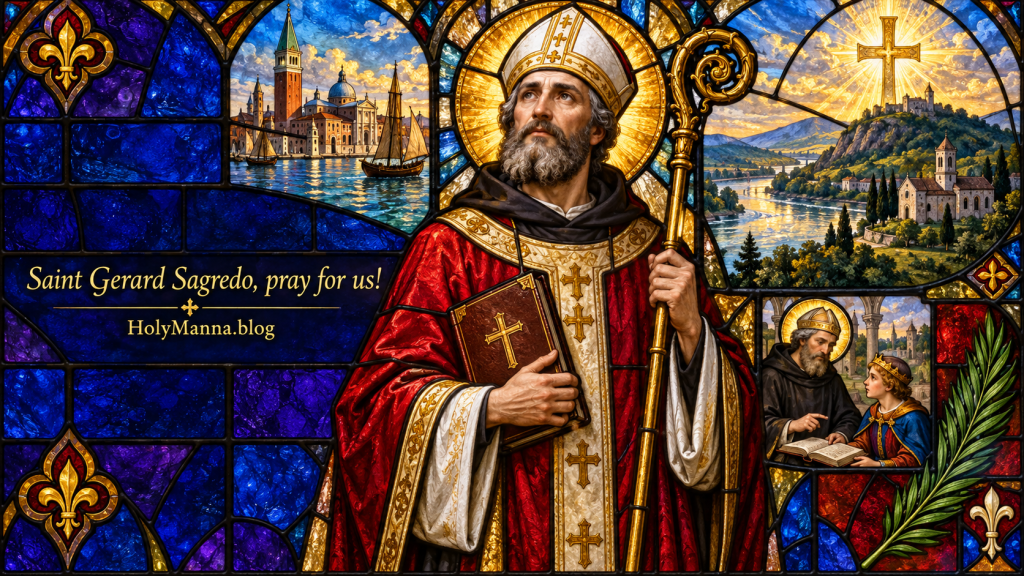
A Venetian Heart Buried in Hungarian Soil
There is a hill in the middle of Budapest that rises steeply above the Danube, and on its face stands a colossal statue of a bishop holding a cross toward the river. Locals pass it every day on their way to work. Tourists photograph it without knowing the name. The hill is called Gellért Hill, and the bishop is Saint Gerard Sagredo, known in Hungarian as Szent Gellért, the man the Church remembers on September 24 as bishop, Benedictine monk, and martyr. He was a Venetian who wanted to see Jerusalem and never got there, because God had a different Jerusalem in mind for him: the souls of a young nation just emerging from paganism.
Gerard is called the Apostle of Hungary, and the title is earned. He was the first Bishop of Csanád, the tutor of a saint, the author of the oldest surviving theological work written in Hungary, a friend and counselor to King Saint Stephen, and finally a martyr, killed by a pagan mob in 1046 and hurled from the very hill that now bears his name. He holds a remarkable set of patronages. He is honored as a co-patron of Hungary and of the city of Budapest, and he is the patron saint of tutors and educators; in Hungary he is also invoked as patron of Catholic schools and teachers, and even of the technical troops of the Hungarian Defence Forces. Venice, his birthplace, venerates him as her proto-martyr, her first son to shed his blood for Christ.
Why should a Catholic in the twenty-first century care about an eleventh century bishop on the far edge of Christendom? Because Gerard’s whole life is a lesson in what the Catechism calls the supreme act of witness. CCC 2473 teaches that “Martyrdom is the supreme witness given to the truth of the faith: it means bearing witness even unto death.” Gerard bore that witness at the end of a life that had already been given away, piece by piece, in teaching, in prayer, in study, and in tireless missionary labor. His story deserves to be told to a friend, slowly, the way good stories are.
A Sick Child, a Storm at Sea, and a Detour That Lasted a Lifetime
Gerard was born in Venice, most likely between the years 977 and 980, though some later accounts place his birth closer to the year 1000. Honesty requires saying up front that nearly everything known about his life comes from medieval accounts written well after his death; the earliest Life, composed around the time of his canonization, has been lost, and the surviving accounts date from the twelfth and fourteenth centuries. Later Venetian tradition attached him to the noble Sagredo family, and other sources name the Morosini family instead; both claims appear only centuries after his lifetime, as great Venetian houses competed for the honor of counting a saint among their kin. So his precise ancestry cannot be established, and that is fine. Heaven keeps better genealogies than Venice does.
Tradition tells a tender story about his childhood. He was baptized with the name George, and at the age of five he fell gravely ill with a fever. His parents, fearing for his life, begged healing through the intercession of Saint George and entrusted the boy to the newly founded Benedictine monastery of San Giorgio Maggiore, on its little island facing Saint Mark’s Square. The child recovered, remained with the monks, and grew up in the rhythm of the psalms. The same tradition holds that his father later died while on pilgrimage, and that the young monk took the name Gerard in his father’s memory. This account comes from the medieval Lives of the saint and cannot be verified as historical fact, but it is how the Church’s memory has lovingly preserved his beginnings.
What is well attested is the quality of his formation. At San Giorgio, Gerard received an outstanding monastic education, studying grammar, music, philosophy, and law, and one venerable reference work reports that he pursued further studies at Bologna and returned to serve his monastery in a position of leadership. He became, by every account, one of the best educated churchmen of his generation.
Then came the turning point, and it looked at first like a failure. Around the year 1020, Gerard set out on pilgrimage to the Holy Land. He wanted to walk where Jesus walked. But a storm at sea forced his ship to break the journey near Istria, on the Adriatic coast, and while he waited and prayed over what to do next, his path bent northward and eastward, through the young Kingdom of Hungary. There King Saint Stephen, the first Christian king of the Magyars, met the learned Venetian monk and would not let him go. Stephen asked Gerard to remain and take charge of the education of his only son and heir, Prince Emeric, known in Hungarian as Imre. Gerard said yes. The pilgrim who had packed for Jerusalem unpacked in Hungary and stayed for the rest of his life.
Think about that for a moment. Gerard’s holiest plan, a pilgrimage to the holiest place on earth, was wrecked by weather. And the wreck was the will of God. Has a storm ever rerouted your plans, and did you ever consider that the detour might be the actual road?
The Tutor, the Hermit, and the Bishop on the Frontier
Gerard’s first great work in Hungary was quiet and hidden: he formed a boy. Prince Emeric, the student, grew into a young man of such purity and prayerfulness that the Church later canonized him alongside his father and his tutor. When a saint teaches, saints can result. Gerard also began to preach throughout the kingdom, and his reputation as an orator spread quickly.
Yet the monk in him never stopped hungering for silence. After his years at court, Gerard withdrew to the forest monastery of Bakonybél, deep in the Bakony hills, where tradition says he lived for seven years as a hermit, given over to fasting, prayer, and writing. Scholars point out that this account, preserved in the twelfth century Life, follows a pattern common in the lives of monastic saints, so the details of the hermitage cannot be verified with precision; what is certain is that Gerard was a contemplative to the marrow, a man who, as an old account puts it, joined the perfection of the episcopal state to the contemplative life, and drew fresh vigor for his pastoral duties from prayer.
The call out of the forest came from the king. In the late 1020s, Stephen defeated Ajtony, the last great chieftain resisting his rule, and in the conquered territory along the Maros River he established a new diocese with its seat at Marosvár, soon called Csanád, in present day Cenad, Romania. The Annals of Pozsony record for the year 1030 that Gerard was ordained bishop, though some sources place the founding of the diocese in 1035; either way, Gerard became the first Bishop of Csanád, charged with nothing less than the Christianization of southeastern Hungary.
He threw himself into it. He founded a monastery and built a cathedral. He established a cathedral school to train priests, and the school flourished so quickly that its teacher, the cantor Walther, was overwhelmed by the number of students; Gerard sent his trusted monk Maurus to Székesfehérvár to recruit another master, and Maurus returned with a German named Henry to serve as lector. Gerard gathered monks from many nations, entrusted mission parishes to them, and raised up native Hungarian clergy, understanding that the faith would only take root when Hungarians themselves could preach it. The medieval accounts say that crowds came to him asking for baptism in the name of the Holy Trinity. The greatest miracle of Gerard’s active life was not a single dramatic wonder; it was the slow, sacramental miracle of a pagan people becoming a Christian nation, which is God’s intervention on the grandest scale. As CCC 852 teaches, quoting Tertullian, missionary paths are watered by sacrifice, for “the blood of martyrs is the seed of Christians.” Gerard sowed with his sweat before he sowed with his blood.
In the midst of all this labor, he wrote. His one surviving work is the Deliberatio supra hymnum trium puerorum, a meditation on the hymn of the three young men in the fiery furnace from Daniel 3, the song that cries out, “Bless the Lord, all you works of the Lord; praise and exalt him above all forever” (Dan 3:57). It is the oldest surviving work of theological literature written in Hungary, preserved in a single eleventh century manuscript, and in it Gerard contrasts the emptiness of merely worldly philosophy with heavenly wisdom. It is a fitting theme for his whole life: three young men who refused to bow to an idol and walked unharmed through fire prefigured a bishop who refused to bow to resurgent paganism and walked through fire of his own.
Two beloved traditions from these years show the warmth of the man. The first is the story of the symphonia Ungarorum. Traveling from Csanád toward the royal court, Gerard stopped overnight at a manor, and in the darkness he heard a servant girl singing to herself as she turned a heavy hand mill, grinding grain for her master. The foreign bishop was enchanted. He called her song the symphonia Ungarorum, the symphony of the Hungarians, and asked that the cheerful hardworking woman be rewarded. Hungarians treasure this story as the earliest recorded reference to their folk music. It comes from the fourteenth century Life of the saint and cannot be verified as history, but it has been told for seven centuries because it rings true to who Gerard was: a man who heard grace in the grinding of a mill.
The second tradition carries even greater weight. The pagan Magyars had revered a great lady of their old religion under the name Boldogasszony, the Blessed Lady. On Gerard’s advice, that ancient name of reverence was transferred to the Virgin Mary, so that the deepest instinct of the Hungarian heart was baptized rather than crushed. King Stephen went on to offer his crown and his country to Mary as patroness of the Hungarians, and Hungary has ever since been called the Regnum Marianum, the Kingdom of Mary. Gerard understood what the Church would later articulate in CCC 971, that “The Church’s devotion to the Blessed Virgin is intrinsic to Christian worship.” A nation that learns to call Mary its Blessed Lady has been given a mother it will never outgrow.
The Hill Above the Danube
Gerard’s hardships did not wait for his martyrdom. His entire episcopate was hardship. He shepherded a frontier diocese where most of the people were pagan and many of the baptized barely understood the faith they professed. He preached at first through interpreters, endured the poverty and danger of constant travel, and lived with monastic austerity even as a bishop. And then, one by one, the pillars of Christian Hungary fell. In 1031, Prince Emeric, his beloved student and the hope of the dynasty, was killed in a hunting accident. In 1038, King Stephen himself died. What followed was chaos: the throne passed to Stephen’s nephew Peter Orseolo, then was seized by Samuel Aba, and the kingdom convulsed with rival claims and simmering pagan resentment.
Gerard did not flatter power. The accounts record that he stood up against both Peter and the usurper Samuel Aba, and tradition holds that he publicly rebuked Aba and refused to take part in crowning rulers whose conduct betrayed the faith. A bishop who will not bless what God does not bless is a dangerous man to tyrants and a treasure to the Church.
In 1046 the storm broke. A violent pagan uprising led by the chieftain Vata swept the country, seeking to erase Christianity and restore the old religion. Priests were hunted, churches were attacked. In the middle of this fury, Gerard set out with two fellow bishops, Bystrik and Buldus, and other companions, traveling toward the Danube crossing at Pest to meet Duke Andrew, who was returning to claim the throne, in the hope of securing peace and protection for the Church. The medieval Life records that on the night before his death, at a place called Diósd, Gerard celebrated Mass and told his companions of a vision, saying that on the next day they would be invited to the supper of the Lamb. Those words come from the later accounts of his life and cannot be verified as his verbatim speech, but the Church has treasured them as the truest summary of a martyr’s hope.
At the crossing beneath the hill then called Kelen Hill, Vata’s mob fell upon the party. What happened next is preserved in accounts that differ in their details, and honesty requires saying so. The most sober reports say Gerard was pelted with stones and then run through with a lance. One tradition says the pagans placed the old bishop on a two wheeled cart, hauled him to the hilltop, and rolled him down the rocky slope, and that finding him still alive at the bottom, they beat him to death and pierced his breast; another version, which appears later and cannot be verified, says he was sealed in a barrel set with spikes before being rolled into the Danube. One account adds that his killers wanted his body destroyed in the river. Across all the tellings, one detail remains constant in the tradition: Gerard died like the first martyr whose ministry of witness he shared, blessing his murderers and echoing the prayer of Saint Stephen in Acts 7:60, “Lord, do not hold this sin against them.” That dying prayer, too, is preserved by the medieval accounts rather than by neutral record, and it cannot be verified; it is told here as the tradition tells it. His companions Bystrik and Buldus likewise received the crown of martyrdom in the uprising.
The Church keeps his feast on September 24, the day tradition assigns to his death in 1046. He was roughly seventy years old, a foreigner who had given his adopted people everything, including, at the last, his blood. The Lord’s own words hang over that hillside: “Blessed are they who are persecuted for the sake of righteousness, for theirs is the kingdom of heaven” (Matthew 5:10). And His promise explains why the killing was not the end: “unless a grain of wheat falls to the ground and dies, it remains just a grain of wheat; but if it dies, it produces much fruit” (John 12:24).
Blood That Would Not Wash Away
The fruit came quickly. The faithful of Pest gathered Gerard’s broken body and buried it in the church of Our Lady at Pest, and from the beginning the people venerated him as a martyr. In 1053 his remains were solemnly transferred to his own cathedral at Csanád, and the medieval accounts report healings and answered prayers at his tomb; these reports come from the hagiographies and cannot be independently verified, but they testify to a living devotion that never faded. One striking tradition holds that the stone on which the martyr’s head was crushed remained stained with his blood, and that for seven years no washing could remove the stain, until the stone was reverently carried to Csanád and kept as a relic. This story cannot be verified.
Then came one of the most beautiful moments in the history of any young Christian nation. In 1083, at the urging of King Saint Ladislaus and with the approval of Pope Gregory VII, Gerard was canonized together with King Saint Stephen and Prince Saint Emeric. The teacher was raised to the altars beside his king and his student, the first saints of Hungary glorified together: the founder, the heir, and the foreign monk who had formed them both in the faith. In 1092 a national synod ordered Gerard’s veneration throughout the kingdom, and his story was later woven into the great medieval collections of the lives of the saints.
His relics tell the story of his two homelands. By 1313 the greater part of his relics had been transferred to Venice, the city of his birth, where the most famous portion rests to this day in the Basilica of Santa Maria e Donato on the island of Murano; Venice honors him each year on February 23, most likely the anniversary of the relics’ arrival, and proudly calls him her proto-martyr. In 2001, in a gesture of communion between his two peoples, a fragment of those relics was returned to Hungary, to the place associated with his first burial. Meanwhile his episcopal see endured through the centuries; after the Ottoman occupation ended, the diocese did not return to the old town of Csanád, and today the diocese of Szeged-Csanád, centered in Szeged, continues his mission and remains the heart of his veneration.
And then there is the hill. Kelen Hill became Gellért Hill, Saint Gerard’s Mount, and it dominates the skyline of Budapest to this day. The monumental statue of the martyr bishop, cross raised over the Danube, stands near the spot where tradition says he was thrown down, so that the city he died beneath now lives beneath him. His name is everywhere in Hungarian life, on churches, schools, streets, even the famous baths and hotel at the foot of his hill, and pilgrims and ordinary commuters alike pass daily under the gaze of the man who helped make their nation Christian. This is what the Catechism means when it teaches about the communion of saints in CCC 956, that the saints in heaven “do not cease to intercede with the Father for us.” Gerard has been interceding for Hungary, and for the whole Church, for nearly a thousand years.
What a Shipwrecked Pilgrim Teaches a Restless Generation
Gerard’s life speaks with surprising directness to anyone between twenty and forty-five who has ever watched a carefully made plan fall apart. He planned Jerusalem and got a storm. He planned a hermitage and got a diocese. He planned a peaceful meeting with a duke and got a martyr’s crown. At every turn, he treated the interruption as an invitation, and the Church now venerates the interruptions as the very shape of his sanctity. When your own plans collapse, do you ask what God is building in the wreckage, or do you only mourn the blueprint?
He also teaches the holiness of teaching. Gerard’s most consequential years may have been the hidden ones spent forming one boy, Prince Emeric, in prayer and virtue. Every parent, catechist, godparent, coach, and mentor shares in that work. CCC 1816 teaches that “The disciple of Christ must not only keep the faith and live on it, but also profess it, confidently bear witness to it, and spread it.” Spreading the faith rarely looks like a stadium; it usually looks like a table, a classroom, a car ride, a patient answer to a hard question. Who has God placed in front of you to form, and are you taking that duty as seriously as Gerard took his prince?
Then there is the mill girl. A tired foreign bishop, far from home, heard a servant singing over her drudgery and recognized something worth honoring. Gerard’s ear for the symphonia Ungarorum is a model for evangelization that begins with delight rather than critique, finding what is already good and true in a culture and lifting it toward God, exactly as he did when the old name Boldogasszony became a title of Our Lady. Do you look at the people and culture around you hunting for what can be baptized, or only for what can be condemned?
Finally, he teaches courage that does not curdle into bitterness. Gerard rebuked kings, resisted usurpers, and faced a murderous mob, yet the tradition remembers him dying with a blessing on his lips. Practical ways to walk in his footsteps this week are close at hand. Pray Daniel 3, the hymn of the three young men that Gerard loved enough to write a book about, and let it teach praise in the furnace. Offer one act of hidden, patient teaching to someone younger in the faith. Refuse one small idol, whether comfort, approval, or ambition, the way Gerard refused to crown what was unworthy. And ask his intercession for teachers, for Hungary, and for every missionary serving far from home.
Engage With Us!
The conversation should not end here. Readers are warmly invited to share their thoughts, favorite moments from Saint Gerard’s story, and their own experiences of God’s holy detours in the comments below. To spark reflection, consider these questions:
- Saint Gerard’s pilgrimage to Jerusalem was interrupted by a storm that led him to his true mission. What interruption in your own life might God be using to redirect you?
- Gerard formed a future saint through years of quiet teaching. Who is God asking you to mentor, encourage, or catechize right now?
- He heard the symphonia Ungarorum, beauty and dignity, in a servant girl’s work song. Where can you find and honor the hidden goodness in the people around you this week?
- Gerard refused to bless rulers who betrayed the faith, at great personal cost. Where might you be tempted to trade conviction for comfort or approval?
- Tradition says he died blessing his killers, echoing the first martyr. Is there anyone you need to forgive so completely that you could pray for their good?
Saint Gerard Sagredo gave up the pilgrimage he wanted for the mission God wanted, and a whole nation received the faith because of it. Let his witness be a summons to hold plans loosely, teach generously, forgive completely, and stand firm when it costs something. Live this day, and every day, with the love and mercy that Jesus taught us, and trust that the God who guided a shipwrecked monk to sainthood is guiding every faithful heart home.
Saint Gerard Sagredo, Apostle of Hungary, pray for us!
Follow us on YouTube, TikTok, Instagram and Facebook for more insights and reflections on living a faith-filled life.


Leave a comment