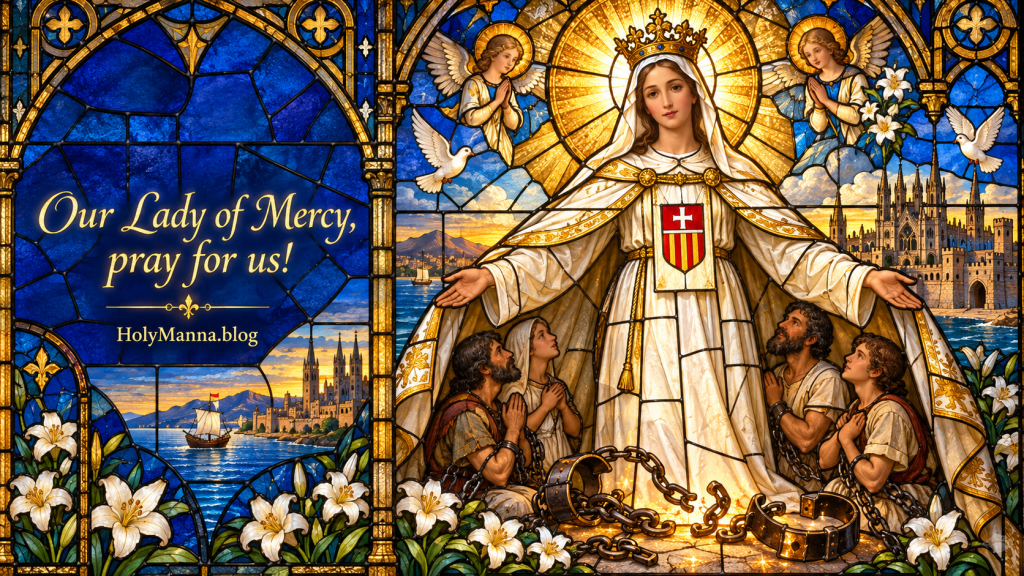
Ransomed by Love
Every September 24th, the Church turns her gaze to one of the most striking titles ever given to the Blessed Virgin Mary: Our Lady of Mercy, known in Spanish as Nuestra Señora de la Merced and in older English usage as Our Lady of Ransom. This celebration is not currently inscribed on the General Roman Calendar; it was removed in the 1969 reform of the liturgical calendar promulgated by Saint Paul VI in Mysterii Paschalis. Yet it remains very much alive. The date stands in the Roman Martyrology, the Mercedarian Order keeps it as a solemnity, and entire nations, from Spain to the Dominican Republic to Peru to Argentina, celebrate it as one of the great Marian days of the year. Colloquially, Catholics around the world still call it her feast day, and the affection behind that phrase is well earned.
What makes this title so central to Marian devotion is what it says about who Mary is and what she does. The Church has sung to her as Mater Misericordiae, Mother of Mercy, since at least the 11th century, when the Salve Regina began rising from monastic choirs: “Hail, holy Queen, Mother of Mercy, our life, our sweetness, and our hope.” Under the title of Mercy, that ancient prayer took flesh in history. In 13th-century Spain, thousands of Christians languished in captivity, torn from their families by raids and wars along the Mediterranean frontier. Into that suffering, Catholic tradition tells of a mother who intervened, inspiring men to sell everything, cross enemy lines, and trade their own freedom for the freedom of strangers. The celebration of Our Lady of Mercy commemorates the birth of the Order of the Blessed Virgin Mary of Mercy, the Mercedarians, and with it a truth the Church never tires of teaching: Mary is the mother who brings her children to the mercy of her Son, whatever chains they wear.
When Mercy Took a Name
To understand this celebration, picture the Iberian Peninsula in the early 13th century. Christian and Moorish kingdoms had been at war for centuries, and along the contested coasts and borderlands, raids were a constant terror. Captured Christians were carried off into slavery in North Africa and Moorish Spain, where many faced brutal conditions and relentless pressure to renounce the faith. Ransoming these captives was one of the most urgent works of charity of the age, and it echoed one of the traditional corporal works of mercy, to ransom the captive, a work the Church still teaches today in the form of visiting and caring for the imprisoned, as CCC 2447 explains: “The works of mercy are charitable actions by which we come to the aid of our neighbor in his spiritual and bodily necessities.”
Into this world stepped Peter Nolasco, a layman of means. Sources differ on the details of his early life; some place his birth around 1182 in Languedoc in present-day France, others in 1189, with some accounts locating his origins near Barcelona. Accounts agree, however, on the essentials: he devoted his fortune to ransoming captives, beginning around 1203, and gathered companions who shared the work. In Barcelona he found powerful allies, among them Saint Raymond of Peñafort, the brilliant Dominican canonist who served as his confessor, and the young King James I of Aragon, later called the Conqueror.
Tradition holds that on August 10th, 1218, the new community was formally constituted in Barcelona under royal patronage as the Royal, Celestial and Military Order of Our Lady of Mercy and the Redemption of Captives. Papal approval followed; Pope Gregory IX confirmed the Order by a bull dated January 17th, 1235, giving it the Rule of Saint Augustine, though some older sources place an earlier confirmation around 1230. The friars wore a white habit and threw themselves into a mission unlike any other. They begged alms across Europe, sailed into hostile ports, and negotiated for the lives of men and women they had never met. In time the Order professed a fourth vow beyond poverty, chastity, and obedience: to remain behind as hostages, and to die if necessary, for a captive in danger of losing the faith. The vow was not theoretical. Mercedarian history counts martyrs such as Saint Serapion, and heroic redeemers such as Saint Raymond Nonnatus and Saint Peter Armengol, along with Saint Maria de Cervelló, the first of the Mercedarian sisters. Peter Nolasco himself died in the 1250s, with sources giving dates from 1256 to 1259, and was canonized by Pope Urban VIII in 1628.
The Vision in the Night
At the heart of the Mercedarian story stands an account of Marian intervention, and honesty requires stating exactly what kind of account it is. According to the tradition handed down within the Order, on the night of August 1st, 1218, the Blessed Virgin appeared separately to Peter Nolasco, to Raymond of Peñafort, and to King James I of Aragon, asking each of them for the foundation of a religious order dedicated to the ransom of Christian captives. When the three compared their experiences, the tradition continues, they recognized the hand of heaven and acted. Some accounts describe Our Lady showing Peter Nolasco the white habit his sons would wear, which is why the Order originally kept its feast on August 1st before the date was later fixed on September 24th.
The Church’s judgment on this account should be stated plainly. This vision belongs to the category of private revelation, and it carries no formal approval of the kind the Church has given to modern apparitions such as Lourdes or Fatima, nor any formal condemnation; there is simply no modern-style canonical judgment on it. The Catechism teaches in CCC 67 that private revelations “do not belong, however, to the deposit of faith,” and that “it is not their role to improve or complete Christ’s definitive Revelation, but to help live more fully by it in a certain period of history.” No Catholic is bound to believe the vision of 1218. It should also be flagged that the earliest surviving documents of the Order do not describe the apparition; the three-visionary narrative comes from later Mercedarian sources, and some Spanish accounts name Berenguer de Palou, the bishop of Barcelona, among the recipients rather than Raymond of Peñafort. These are the kinds of variations historians expect in medieval traditions, and the Church has never seen a need to resolve them.
What the Church has done is more telling. For more than 3 centuries, popes approved the Order born of this story, watched it ransom captives by the thousands, and finally raised its thanksgiving celebration to the universal calendar. Whatever the historical details of that August night, the fruit is beyond dispute: a religious family that lived the Gospel to the point of trading its own freedom for others, under the maternal protection of Mary. In that sense, the celebration honors Mary’s real intercession, the kind Scripture itself displays at Cana, where her words to the servants remain her words to every disciple: “Do whatever he tells you” (John 2:5).
Mater Misericordiae
The theology packed into this title is rich, and it flows directly from the Marian doctrines the Church holds most dear. Mary is the Mother of Mercy first because she is the Mother of Mercy Himself. Jesus Christ is the mercy of God made flesh, and the woman who conceived Him, bore Him, and stood beneath His Cross knows that mercy from the inside. Saint John Paul II made this the centerpiece of section 9 of his encyclical Dives in Misericordia, a section titled simply Mother of Mercy: “Mary, then, is the one who has the deepest knowledge of the mystery of God’s mercy. She knows its price, she knows how great it is. In this sense, we call her the Mother of Mercy: our Lady of Mercy, or Mother of Divine Mercy.” Pope Francis returned to the same wellspring when he proclaimed the Jubilee of Mercy in Misericordiae Vultus 24: “No one has penetrated the profound mystery of the incarnation like Mary. Her entire life was patterned after the presence of mercy made flesh.” In the same passage he wrote that Mary was “prepared by the love of God to be the Ark of the Covenant between God and man.”
The Catechism grounds this maternal role with precision. CCC 963 through 970, drawing on chapter VIII of Lumen Gentium, teach that Mary’s motherhood in the order of grace continues uninterrupted from the Annunciation to her Assumption. CCC 969 quotes the Council directly: “Taken up to heaven she did not lay aside this saving office but by her manifold intercession continues to bring us the gifts of eternal salvation.” For this reason the Church invokes her as Advocate, Helper, Benefactress, and Mediatrix, titles that CCC 970 carefully explains neither add to nor subtract from the unique mediation of Christ, but flow from it and depend entirely upon it. CCC 501 adds that her spiritual motherhood extends to all whom her Son came to save. And when the Church prays, she says so explicitly; CCC 2677 teaches: “By asking Mary to pray for us, we acknowledge ourselves to be poor sinners and we address ourselves to the ‘Mother of Mercy,’ the All-Holy One.”
Mary herself announced this mission in the Magnificat, the great canticle of Luke 1:46-55, singing that “his mercy is on those who fear him from generation to generation” (Luke 1:50). Her Son inaugurated His public ministry by proclaiming the liberation the Mercedarians would later imitate so literally: “The Spirit of the Lord is upon me, because he has anointed me to preach good news to the poor. He has sent me to proclaim release to the captives” (Luke 4:18). And from the Cross He entrusted the beloved disciple, and in him every disciple, to His mother with the words “Behold, your mother!” (John 19:27). The title of Mercy simply names what happens when that motherhood meets human bondage. Paul VI’s Marialis Cultus and John Paul II’s Redemptoris Mater both insist that authentic Marian devotion always leads to Christ, and Our Lady of Mercy is a perfect case study; the Order she inspired did not merely admire her, it ransomed captives because she pointed it to her Son’s own redeeming work.
Shrines, Scapulars, and the Roads of Mercy
Devotion to Our Lady of Mercy grew alongside the Order that bears her name, and it produced a geography of grace that still draws pilgrims today. The mother shrine is the Basílica de la Mare de Déu de la Mercè in Barcelona, home to a venerated image of the Virgin of Mercy dating from the 14th century, carved according to tradition in the circle of the sculptor Pere Moragues. Tradition holds that Barcelona turned to her during a devastating plague of locusts in 1687, and the city council, in gratitude for deliverance, proclaimed her patroness of Barcelona; the patronage of the diocese received formal confirmation from Rome in the 19th century, and the image was solemnly crowned in 1888. Her basilica remains one of the spiritual hearts of Catalonia.
Across the Atlantic, the Mercedarians sailed with the earliest evangelizers of the Americas, and the devotion took root with astonishing depth. In the Dominican Republic, the shrine of Santo Cerro near La Vega stands among the oldest centers of the devotion in the New World, and Our Lady of Mercy is honored as patroness of the nation; pilgrims climb the holy hill every September 24th. In Lima, the Basilica of La Merced houses the image venerated by the whole of Peru. In Ecuador, Bolivia, Argentina, and beyond, churches, towns, and entire provinces carry her name; the city of Mercedes in Argentina and countless parishes across Latin America testify to how completely this Catalan devotion became an American one. Far to the east, the National Shrine Basilica of Our Lady of Ransom at Vallarpadam in Kerala, India, draws great crowds of the faithful, who lovingly call the Virgin there Vallarpadathamma. England, too, holds a special place in this story; Pope Leo XIII extended the celebration to all the dioceses of England, where Our Lady of Ransom was invoked for the conversion of the nation once called the Dowry of Mary, a reminder that ransom from the slavery of sin is the deepest captivity this title addresses.
The devotional life surrounding the title is equally rich. The Mercedarian family includes friars, cloistered and active sisters, and a Third Order of laity, and confraternities of Our Lady of Mercy have gathered the faithful since the 13th century. The white scapular of Our Lady of Mercy, a sacramental associated with the Order, clothes devotees in a small share of the habit tradition says Mary herself showed to Peter Nolasco. As with all sacramentals, the Catechism teaches in CCC 1670 that they prepare the faithful to receive grace and dispose them to cooperate with it; the scapular is not a charm but a commitment worn on the shoulders.
From La Mercè to the Andes
Few Marian titles have shaped whole cultures the way this one has. Barcelona offers the most famous example. Every year around September 24th, the city erupts in La Mercè, its principal festival, when the days surrounding the solemn Mass at the basilica fill with processions of gegants, the towering festival figures of Catalonia, with the breathtaking human towers called castells, and with music and fire runs through the old city. Beneath the pageantry stands the religious core: the people of Barcelona honoring the mother who, they believe, has watched over their city for centuries.
In Latin America the celebration carries the weight of national history. Peru proclaimed her Patroness of the Fields of Peru in 1730 and Patroness of the Arms of the Republic in 1823, and on September 24th, 1921, the centenary of independence, her image in Lima was solemnly crowned and given the title Gran Mariscala del Perú, Grand Marshal of Peru; each year the armed forces render military honors to the Virgin who holds their highest rank. Argentina remembers that on September 24th, 1812, General Manuel Belgrano’s outnumbered patriot army won the pivotal Battle of Tucumán on her very day, a victory he attributed to her intercession. Belgrano placed his command baton in the hands of her image and named her Generala del Ejército, the General of the Army, a gesture the Argentine military still commemorates. Tucumán itself had already named her patroness in 1687. In the Dominican Republic, September 24th is a cherished national celebration, with the great pilgrimage to Santo Cerro at its heart. These honors can sound merely patriotic, but the Church reads them more deeply; nations that have suffered captivity, war, and upheaval instinctively reached for the mother whose very title promises ransom.
The rank of the celebration varies accordingly, and precision matters here. On the current General Roman Calendar, September 24th carries no universal Marian celebration; Our Lady of Mercy is kept according to particular calendars. Within the Mercedarian Order it is a solemnity, the highest liturgical rank. In Barcelona and in many places of Spain and Latin America it is celebrated with patronal solemnity, while elsewhere it survives as a memorial or a devotional commemoration listed in the Roman Martyrology. The variety itself teaches something beautiful: the universal Church holds the treasure, and the local churches wear it each in their own way.
Living Ransom in an Age of New Captivities
What does a 13th-century ransom order have to say to your life in the 21st century? More than you might expect. The Mercedarians answered a specific historical emergency, but the logic of their vow is timeless, because captivity is timeless. You may never be chained in a Mediterranean prison, but you know people who are enslaved all the same: to addiction, to debt, to pornography, to resentment, to anxiety, to sin in its thousand disguises. The Church even confronts literal slavery still, in the scourge of human trafficking that recent popes have denounced relentlessly. Every generation discovers that the Redeemer’s words in Luke 4:18 about release for captives are not a metaphor that expired; they are a mission that continues.
Our Lady of Mercy shows you where that mission begins: in letting yourself be ransomed first. Mary knows the price of mercy, as Dives in Misericordia 9 teaches, because she stood beneath the Cross where the price was paid. The first practical step this celebration asks of you is honest confession, bringing your own chains to the sacrament where her Son breaks them. From there, the Mercedarian pattern becomes surprisingly concrete. The friars gave alms, so examine what portion of your income actually reaches the poor and the imprisoned. They visited the enslaved, so consider prison ministry, or supporting organizations that fight trafficking, or simply refusing to abandon the friend everyone else has written off. They offered their freedom in exchange for others, so ask what comfort, what schedule, what reputation you would actually surrender to free someone else. Christ Himself set the standard of judgment: “I was in prison and you came to me” (Matthew 25:36).
And through it all, the celebration invites you to take Mary as mother in a deliberate, daily way. Pray the Salve Regina slowly this week and mean the words Mother of Mercy. Entrust the most captive person you know to her intercession by name. Her whole role, the Catechism insists in CCC 970, is to bring you to Christ; she is not the ransom, but no one on earth ever cooperated more completely with the One who is.
Engage With Us!
Share your thoughts and reflections in the comments below; stories of Our Lady’s intercession in your own life encourage every reader who finds this page. Consider these questions as you pray with this celebration:
- Where in your life are you still a captive, and have you honestly asked Jesus, through Mary’s intercession, to ransom you there?
- The Mercedarians took a vow to give their very freedom for others. What is one concrete comfort you could surrender this month to lighten someone else’s chains?
- Who in your life is imprisoned, literally or spiritually, and what would it look like for you to visit them the way Christ commands in Matthew 25:36?
- How does calling Mary the Mother of Mercy change the way you approach confession?
- Which devotion connected to this celebration, the Salve Regina, the white scapular, or a pilgrimage, could you adopt as a regular practice?
May Our Lady of Mercy, who has been breaking chains since 1218, wrap her mantle around every reader of this page. Live boldly the mercy you have received, ransom generously, forgive quickly, and keep walking toward her Son. Together, under the guidance of our Blessed Mother, may all grow in faith, hope, and the love that sets captives free.
Our Lady of Mercy, pray for us!
Follow us on YouTube, TikTok, Instagram and Facebook for more insights and reflections on living a faith-filled life.


Leave a comment