Thursday of the Twenty-fifth Week in Ordinary Time – Lectionary: 452
The Vapor and the Refuge
Everyone has felt it: the scroll that never satisfies, the promotion that thrills for a week, the vacation that ends. On this Thursday of the Twenty-fifth Week in Ordinary Time, September 24th, 2026, the Church hands her children one of the most brutally honest books ever written and dares them to sit with it. Qoheleth, the ancient sage the Greeks called Ecclesiastes, looks at the sun, the wind, the rivers, and the endless parade of human generations and pronounces a single verdict: vapor. The Hebrew word hevel, translated “vanity,” literally means a breath, the mist that vanishes from a mirror. Everything “under the sun,” everything sealed inside a purely earthly horizon, evaporates.
Then Moses himself steps forward in Psalm 90, the only psalm the Psalter attributes to him, and turns Qoheleth’s diagnosis into a prayer. Yes, human beings are dust and morning grass. But there is a refuge older than the mountains, and the man who learns to number his days before that eternal God gains something Qoheleth could not find under the sun: wisdom of heart, joy at daybreak, and work that actually lasts.
Finally, The Gospel of Luke offers a warning wrapped in a king. Herod Antipas hears the rumors about Jesus, feels the itch of the question everyone in Galilee is asking, and keeps trying to see Him. Yet curiosity never becomes conversion, and when Herod finally gets his audience with Christ, he receives only silence. The three readings together pose one question to every restless modern heart: will the ache that nothing under the sun can satisfy lead to the eternal God, or just to another scroll, another spectacle, another vapor?
First Reading — Ecclesiastes 1:2-11
The Bravest Book in the Bible Says the Quiet Part Out Loud
Ecclesiastes may be the most startling book a young Catholic can open, because it sounds like something written last night at 2 a.m. by someone doubting everything. The Church, in her wisdom, canonized it anyway. The speaker bears the Hebrew title Qoheleth, “the one who gathers the assembly,” and the opening verse of the book presents him as “son of David, king in Jerusalem,” which tradition has long associated with Solomon. Here is a man who had every pleasure, project, and possession the ancient world offered, performing an audit of it all at the end of life. His conclusion is not despair for its own sake. It is a demolition project, clearing away every false hope so that the heart has nowhere left to rest except God. That is precisely why the Church pairs this reading with Psalm 90 and with Herod’s restless curiosity: Qoheleth names the ache that the rest of the day’s liturgy answers.
Ecclesiastes 1:2-11
Vanity of vanities, says Qoheleth,
vanity of vanities! All things are vanity!
What profit has man from all the labor
which he toils at under the sun?
One generation passes and another comes,
but the world forever stays.
The sun rises and the sun goes down;
then it presses on to the place where it rises.
Blowing now toward the south, then toward the north,
the wind turns again and again, resuming its rounds.
All rivers go to the sea,
yet never does the sea become full.
To the place where they go,
the rivers keep on going.
All speech is labored;
there is nothing one can say.
The eye is not satisfied with seeing
nor is the ear satisfied with hearing.What has been, that will be;
what has been done, that will be done.
Nothing is new under the sun.
Even the thing of which we say, “See, this is new!”
has already existed in the ages that preceded us.
There is no remembrance of the men of old;
nor of those to come will there be any remembrance
among those who come after them.
Detailed Exegesis
Verse 2: “Vanity of vanities, says Qoheleth, vanity of vanities! All things are vanity!”
The phrase “vanity of vanities” is a Hebrew superlative, like “King of kings” or “Holy of holies,” and it means the most fleeting thing conceivable. The word behind it, hevel, means breath or vapor. Qoheleth is not saying creation is worthless; he is saying it is unfixable as a final resting place. Everything under the sun slips through the fingers like mist.
Verse 3: “What profit has man from all the labor which he toils at under the sun?”
The word “profit” comes from the marketplace: what surplus remains after all costs are counted? The phrase “under the sun” appears throughout the book and defines its experiment: life examined within a purely earthly frame, with eternity bracketed out. Within that frame, the honest answer to the question is nothing. This question hangs in the air all day and is finally answered by the psalm’s closing line.
Verse 4: “One generation passes and another comes, but the world forever stays.”
Here is a bitter irony: the impersonal earth outlasts the persons who till it. The stage endures while the actors vanish. Against every ancient dream of dynasty and every modern dream of personal legacy, Qoheleth observes that the world simply shrugs and continues.
Verse 5: “The sun rises and the sun goes down; then it presses on to the place where it rises.”
Even the sun, the ancient world’s greatest symbol of power, is pictured as a laborer on an exhausting circuit, panting back to its starting point only to begin again. Motion without progress: this is nature viewed without its Creator.
Verse 6: “Blowing now toward the south, then toward the north, the wind turns again and again, resuming its rounds.”
The wind, which Scripture elsewhere uses as an image of the Spirit, is here just circulation, a loop with no destination. Qoheleth piles up these cosmic examples to prepare the reader for the human one: if sun and wind gain nothing from their toil, what will man gain from his?
Verse 7: “All rivers go to the sea, yet never does the sea become full. To the place where they go, the rivers keep on going.”
The rivers pour themselves out forever and the sea is never satisfied. It is a perfect image of consumption without fulfillment, and it describes the modern feed as accurately as any ancient watershed: endless input, no fullness.
Verse 8: “All speech is labored; there is nothing one can say. The eye is not satisfied with seeing nor is the ear satisfied with hearing.”
This is the anthropological heart of the passage. Human senses are infinite in appetite and finite in satisfaction. No image is the last image; no song is the last song. Saint Augustine would later give this observation its Christian name: restlessness, the hunger built into a creature made for the infinite God.
Verse 9: “What has been, that will be; what has been done, that will be done. Nothing is new under the sun.”
Note the qualifier: under the sun. Within a closed world, history is a wheel. The Gospel will explode this claim from outside the system, for the Incarnation is the genuinely new thing that no cycle produced. But Qoheleth, writing centuries before Christ, honestly reports what the world looks like without Him.
Verse 10: “Even the thing of which we say, ‘See, this is new!’ has already existed in the ages that preceded us.”
Every generation believes its discoveries, technologies, and scandals are unprecedented. Qoheleth smiles. Novelty is mostly amnesia. The verse is a standing caution against the cult of the new that drives so much modern exhaustion.
Verse 11: “There is no remembrance of the men of old; nor of those to come will there be any remembrance among those who come after them.”
The final blow lands on legacy itself. Fame, the last refuge of the person who has given up on heaven, also evaporates. If being remembered is the goal, the game is lost before it begins. Only a God who remembers can secure a human life.
Teachings
The Church has never read Ecclesiastes as a counsel of despair but as a medicine for misplaced hope. Saint Jerome, who wrote a complete Commentary on Ecclesiastes around A.D. 388, explained in its preface why he first taught this book to the young Roman widow Blesilla: “I read Ecclesiastes to the saintly Blesilla, so that I might provoke her to the contempt of this earthly scene, and to count as nothing all that she saw in the world.” For Jerome, the book is spiritual detox, loosening the grip of passing things so the soul can grasp eternal ones. Saint Gregory of Nyssa preached eight homilies on this book and taught that its whole purpose is to raise the mind above the senses toward the life of virtue. Thomas à Kempis compressed the entire chapter into one line at the very opening of The Imitation of Christ, Book 1, Chapter 1: “Vanity of vanities, and all is vanity, save to love God and to serve Him alone.” The Catechism confirms the diagnosis in CCC 1723: “It teaches us that true happiness is not found in riches or well-being, in human fame or power, or in any human achievement… but in God alone, the source of every good and of all love.” Qoheleth strips away the idols; the Catechism names the treasure the idols were counterfeiting.
Reflection
Ecclesiastes reads like an intervention for a generation raised on metrics, feeds, and personal brands. Try a simple exercise this week: name the one thing currently carrying the weight of your happiness, whether a job title, a relationship status, a follower count, or a savings goal, and ask honestly whether it can bear that weight forever. Then consciously hand that weight to God in prayer, perhaps with the simple words of Thomas à Kempis, loving God and serving Him alone. Practically, this can look like one deliberate act of detachment: skip one purchase and give the money away, fast from the feed for a day, or spend the time instead before the Blessed Sacrament, where the Eternal quietly outlasts every trend. What “vapor” have you been treating as solid ground? If nothing under the sun can fill the eye or the ear, what does that reveal about what your soul was actually made for?
Responsorial Psalm — Psalm 90:1, 3-6, 12-14, 17bc
Moses Turns the Ache Into a Prayer
If Ecclesiastes is the diagnosis, Psalm 90 is the prescription. This is the only psalm in the entire Psalter attributed to Moses, “the man of God,” and it opens the fourth book of the Psalms. The attribution matters: this is the prayer of a man who watched an entire generation die in the wilderness over forty years, who buried his sister and brother, and who himself would see the Promised Land only from a mountaintop. Moses does not dispute a single word of Qoheleth. Human life really is dust, grass, a sigh. But Moses knows something Qoheleth’s experiment excluded: there is Someone above the sun. The psalm’s genius is that it takes every image of transience and sets it against the eternity of God, then dares to ask that eternal God to teach, to return, to fill, and to prosper. The ache becomes an address.
Psalm 90:1, 3-6, 12-14, 17bc
R. (1) In every age, O Lord, you have been our refuge.
You turn man back to dust,
saying, “Return, O children of men.”
For a thousand years in your sight
are as yesterday, now that it is past,
or as a watch of the night.
R. In every age, O Lord, you have been our refuge.
You make an end of them in their sleep;
the next morning they are like the changing grass,
Which at dawn springs up anew,
but by evening wilts and fades.
R. In every age, O Lord, you have been our refuge.
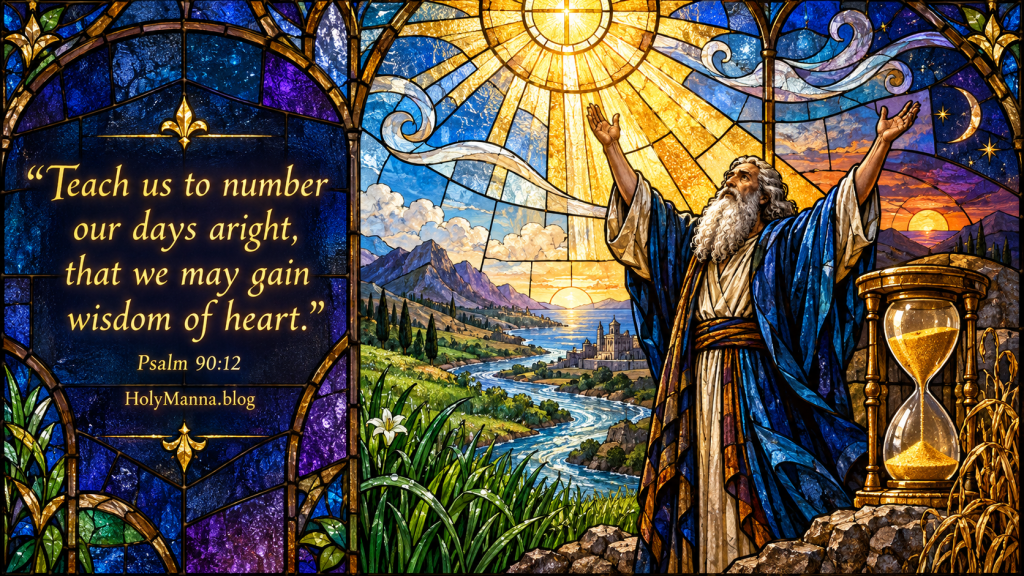
Teach us to number our days aright,
that we may gain wisdom of heart.
Return, O LORD! How long?
Have pity on your servants!
R. In every age, O Lord, you have been our refuge.
Fill us at daybreak with your kindness,
that we may shout for joy and gladness all our days.
Prosper the work of our hands for us!
Prosper the work of our hands!
R. In every age, O Lord, you have been our refuge.
Detailed Exegesis
Refrain and Verse 1: “In every age, O Lord, you have been our refuge.”
The refrain plants the flag before a single lament is spoken. Generations pass, said Qoheleth; yes, answers Moses, and in every one of them God was home. The word “refuge” means dwelling place: not a truth to admire from a distance but an address to live at.
Verse 3: “You turn man back to dust, saying, ‘Return, O children of men.’”
Moses echoes Genesis 3:19, where Adam is told he is dust and to dust he shall return. Yet notice who is speaking in the verse: God Himself says “Return.” Even death is not blind fate but a summons from a Father, which changes everything about how it can be faced.
Verse 4: “For a thousand years in your sight are as yesterday, now that it is past, or as a watch of the night.”
A watch of the night was about four hours, the shift a sentry stood before being relieved. Ten centuries, to God, pass like one shift already forgotten by morning. 2 Peter 3:8 quotes this verse to explain why God’s timeline is not slow but sovereign.
Verses 5 and 6: “You make an end of them in their sleep; the next morning they are like the changing grass, which at dawn springs up anew, but by evening wilts and fades.”
In the Judean climate this is literal: grass that shoots up green after dew is scorched brown by sunset of the same day. It is Qoheleth’s vapor rendered in botany. The prophet Isaiah uses the same image before announcing that the word of the Lord stands forever (Isaiah 40:8).
Verse 12: “Teach us to number our days aright, that we may gain wisdom of heart.”
Here is the hinge of the entire day’s liturgy. Moses does not ask for more days; he asks to count the ones given. Numbering days means living with the end in view, and the fruit is not morbidity but “wisdom of heart,” the practical holiness of a person who wastes nothing on vapor.
Verse 13: “Return, O LORD! How long? Have pity on your servants!”
In verse 3 God told man to return to dust; now Moses boldly asks God to return in mercy. The prayer has the audacity of intimacy. Israel’s greatest intercessor bargains with heaven the way he did after the golden calf, appealing not to human merit but to divine pity.
Verse 14: “Fill us at daybreak with your kindness, that we may shout for joy and gladness all our days.”
The word rendered “kindness” is the Hebrew hesed, God’s covenant love. The request is stunning after all the grass and dust: fill fleeting days with eternal love and even a short life becomes a shout of joy. Satisfaction, which the eye and ear could not find in Ecclesiastes, is found in a Person.
Verse 17bc: “Prosper the work of our hands for us! Prosper the work of our hands!”
The psalm ends by answering Qoheleth’s opening question directly. What profit has man from his labor? Alone, none. But work that God establishes participates in what does not pass. The line is repeated twice, the prayer of every parent, employee, student, and volunteer who wants their toil to mean something forever.
Teachings
This psalm is the biblical root of the great Catholic tradition of memento mori, the loving remembrance of death. The Rule of Saint Benedict, Chapter 4, places among the instruments of good works the instruction to “keep death daily before one’s eyes.” Far from gloomy, Benedict lists it beside loving Christ and rejoicing, because a monk who remembers his mortality stops procrastinating his holiness. The Catechism teaches the same in CCC 1007: “Death is the end of earthly life. Our lives are measured by time, in the course of which we change, grow old and, as with all living beings on earth, death seems like the normal end of life. That aspect of death lends urgency to our lives: remembering our mortality helps us realize that we have only a limited time in which to bring our lives to fulfillment.” It is no accident that the Catechism follows that sentence by quoting Ecclesiastes itself, urging the reader to remember the Creator before the dust returns to the earth. The Church has always prayed Psalm 90 at funerals and in the Liturgy of the Hours precisely because it holds both truths at once: the brevity of man and the refuge of God. Wisdom of heart is born where those two truths meet.
Reflection
Numbering days sounds abstract until it becomes a habit. Consider a concrete practice this week: each night, take two minutes for a brief examen and ask where the day was spent on grass and where it was spent on God. Many young Catholics have rediscovered memento mori through a simple reminder on a desk or phone lock screen; the point is not fear but focus. Then flip the psalm into morning prayer: before opening any app, ask God to fill this daybreak with His kindness and to prosper the work of your hands, whether that work is a spreadsheet, a diaper change, or a night shift. Offered work is prospered work. If you truly numbered your days, what would you stop postponing? What one piece of daily work will you consciously ask God to establish this week?
Holy Gospel — Luke 9:7-9
The Man Who Wanted a Show Instead of a Savior
Three verses, one king, and a warning that lands squarely on the modern heart. Herod Antipas was a son of Herod the Great, ruling Galilee and Perea as tetrarch, a title meaning ruler of a fourth part of a kingdom, from 4 B.C. until A.D. 39. Luke has already introduced him twice: dating the ministry of John the Baptist by his reign (Luke 3:1) and recording that Herod imprisoned John for denouncing his unlawful marriage to Herodias (Luke 3:19-20). By this point in the Gospel, Herod has beheaded John, and now reports about Jesus flood his court just as Jesus sends the Twelve across Galilee. The rumors reflect the era’s electric expectations: Elijah was to return before the day of the Lord (Malachi 3:23-24), and Moses had promised a prophet like himself (Deuteronomy 18:15). Herod, a man who has everything under the sun and a conscience full of blood, becomes the day’s living illustration of Qoheleth’s unsatisfied eye and ear.
Luke 9:7-9
Herod the tetrarch heard about all that was happening,
and he was greatly perplexed because some were saying,
“John has been raised from the dead”;
others were saying, “Elijah has appeared”;
still others, “One of the ancient prophets has arisen.”
But Herod said, “John I beheaded.
Who then is this about whom I hear such things?”
And he kept trying to see him.
Detailed Exegesis
Verse 7: “Herod the tetrarch heard about all that was happening, and he was greatly perplexed because some were saying, ‘John has been raised from the dead.’”
The Greek behind “greatly perplexed” describes a man thoroughly at a loss, unable to find a way through. Power cannot buy clarity. The rumor that John has been raised is especially chilling for Herod, since he silenced John’s voice and now hears it echoing in Galilee. A guilty conscience turns every headline into an accusation.
Verse 8: “Others were saying, ‘Elijah has appeared’; still others, ‘One of the ancient prophets has arisen.’”
The crowd’s guesses are generous but inadequate, and Luke will repeat them verbatim when Jesus asks the disciples who the crowds say He is (Luke 9:18-19). Public opinion can circle the truth without landing on it. Categories from the past, even holy ones, cannot contain the One who is genuinely new; here the closed world of “nothing new under the sun” begins to crack open.
Verse 9: “But Herod said, ‘John I beheaded. Who then is this about whom I hear such things?’ And he kept trying to see him.”
Herod asks the central question of the entire Gospel, the same one the disciples whispered in the boat when Jesus stilled the storm (Luke 8:25), and the one Peter will answer with “The Christ of God” (Luke 9:20). But the same question can be asked two ways: on the knees or from the throne. The final clause is deliberately unresolved: he kept trying to see him. Luke leaves the thread hanging until the Passion, when Herod finally gets his wish: “Herod was very glad to see Jesus… he had been hoping to see him perform some sign” (Luke 23:8). Jesus answers him nothing, Herod clothes Him in mockery, and the man who wanted a show goes down in history having met the Word and heard only silence. Curiosity that refuses repentance eventually loses even its curiosity.
Teachings
Herod’s tragedy is that his restlessness was real and could have saved him. The Catechism, quoting Saint Augustine’s Confessions, names the engine that was driving him in CCC 30: “You are great, O Lord, and greatly to be praised… you have made us for yourself, and our heart is restless until it rests in you.” Herod’s perplexity, his questions, his repeated attempts to see Jesus were the God-shaped hunger of every human heart. But he wanted to see without changing. John the Baptist had already told him what change required, and it cost John his head. The scene teaches what the Church has always insisted: faith is not spectacle consumption. Jesus consistently refused to perform signs for those seeking entertainment rather than conversion, and His silence before Herod is the sobering proof that God will not force Himself on a heart that only wants a show. The contrast with the day’s psalm is exact. Moses prayed, “Fill us at daybreak with your kindness,” and was filled; Herod demanded a sign at his own court and received nothing. The difference was never access or information. Herod had eyewitness reports, proximity, even a personal audience with the Son of God. The difference was posture: the kneeling heart versus the seated one.
Reflection
Herod’s story hits close to home in an age of religious content. It is entirely possible to follow Catholic accounts, stream Catholic podcasts, watch every documentary about the Shroud, and remain Herod: endlessly intrigued, never converted. Curiosity is a grace, but it has an expiration date; it is meant to become an encounter. Take one concrete step this week that moves from watching to meeting: go to a weekday Mass, return to Confession if it has been a while, or sit for fifteen silent minutes with The Gospel of Luke, chapter 9, and let Jesus ask you His own question back. Notice, too, what happened to Herod’s unanswered guilt; buried sin does not disappear, it just makes every rumor of God perplexing. Confession is where perplexity is traded for peace. Is your interest in Jesus leading to obedience, or has it settled into entertainment? What question about Christ have you been asking from the throne that you need to start asking on your knees?
When the Vapor Lifts
Put the three readings side by side and a single story emerges, told in three voices. Qoheleth stands at the end of a life crammed with achievement and admits that the sun, the wind, the rivers, and every human project circle back to where they started. Moses, who buried a generation in the desert, takes that same brutal honesty and turns it toward heaven: teach us to number our days, fill us at daybreak, prosper the work of our hands. And Herod, who could have written his own chapter of Ecclesiastes from inside a palace, shows what happens when the ache is fed spectacle instead of surrender: the question “Who then is this?” dies on the lips of a man who never knelt to ask it.
The Church is not being grim by serving this menu on an ordinary Thursday. She is being honest, the way a good friend is honest. Every heart reading these words knows the vapor: the purchase that stopped satisfying, the milestone that moved, the feed that never fills the eye. The readings do not shame that hunger. They reveal its purpose. The eye is not satisfied with seeing because it was made to see God. The generations pass so that no one mistakes the waiting room for home. In every age, the Lord has been the refuge, and He still is, in the tabernacle of the nearest parish, patient as eternity.
So let today be numbered aright. Trade fifteen minutes of scrolling for fifteen minutes of prayer. Ask God, out loud, to prosper the actual work sitting on the desk. And where curiosity about Jesus has grown comfortable, let it finally become what it was always meant to be: an encounter that changes everything that lasts.
Engage With Us!
Share your reflections in the comments below; hearing how God is working through these readings in real lives encourages the whole HolyManna community. Consider these questions:
- In Ecclesiastes 1:2-11, Qoheleth declares that the eye is not satisfied with seeing nor the ear with hearing. Where do you most feel that unsatisfied ache in your own life, and what might it be pointing you toward?
- In Psalm 90:1, 3-6, 12-14, 17bc, Moses prays for the wisdom to number his days and asks God to prosper the work of his hands. What is one daily task you will begin offering to God this week so that your labor is established by Him?
- In Luke 9:7-9, Herod keeps trying to see Jesus out of curiosity but never repents. In what area of your faith life have you been a spectator, and what one step would turn watching into encountering?
- Taking all the readings together, if everything under the sun passes away and only God remains, what would change about tomorrow if you truly lived like that were true?
Life is short, but it is not small; every fleeting day becomes eternal when it is spent loving the God who is our refuge in every age. Live this day fully, work it faithfully, and do everything with the love and mercy Jesus taught us.
Sacred Heart of Jesus, we trust in You!
Immaculate Heart of Mary, pray for us!
Saint Michael the Archangel, defend us in battle!
Follow us on YouTube, TikTok, Instagram and Facebook for more insights and reflections on living a faith-filled life.


Leave a comment