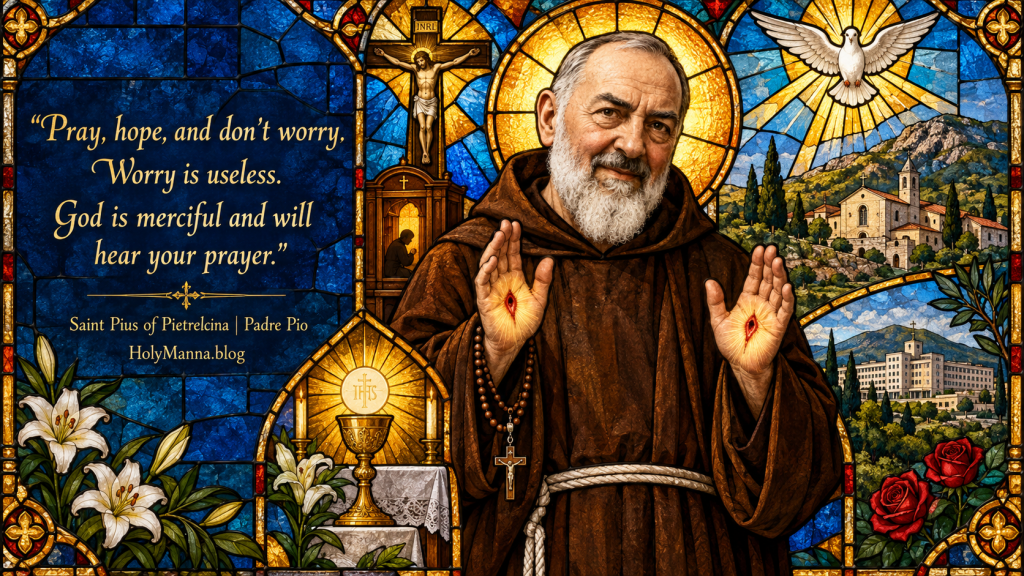
The Friar Who Carried Calvary in His Hands
Every so often, God gives the world a saint so startling that even skeptics cannot look away. Saint Pius of Pietrelcina, known and loved across the globe simply as Padre Pio, is that kind of saint. For fifty years, from September 20th, 1918 until days before his death on September 23rd, 1968, this humble Capuchin friar bore the visible stigmata, the five wounds of the crucified Christ, in his hands, his feet, and his side. He is widely recognized in Catholic sources as the first priest in the history of the Church to carry these visible wounds. Yet the wounds were never the whole story. Padre Pio spent as many as ten to twelve hours a day in the confessional, becoming one of the greatest ministers of God’s mercy the modern Church has known, founded a world class hospital for the suffering, and endured years of suspicion and silencing from within the Church he loved, obeying without bitterness. When Saint John Paul II canonized him on June 16th, 2002, before one of the largest crowds ever gathered in Saint Peter’s Square, the Church confirmed what millions already believed: this man’s entire life was a living homily on the Cross of Jesus Christ.
Saint Pius of Pietrelcina is the patron saint of civil defense volunteers, a patronage granted in 2004 at the petition of the Italian bishops, as well as the patron of adolescents and of his hometown of Pietrelcina. Many of the faithful also invoke him for relief from stress, inspired by his most famous counsel: “Pray, hope, and don’t worry.” His feast, celebrated on September 23rd, the day of his birth into eternal life, is an obligatory memorial for the universal Church, an honor that reflects just how deeply this friar from southern Italy has marked the heart of modern Catholicism. The Catechism teaches that by canonizing certain of the faithful, the Church proclaims the power of the Spirit of holiness within her and sustains the hope of believers by giving them models and intercessors (CCC 828). Padre Pio is both, in abundance.
The Farm Boy Who Talked with Heaven
Francesco Forgione was born on May 25th, 1887, in Pietrelcina, a small farming town in the Province of Benevento in southern Italy. His parents, Grazio Mario Forgione and Maria Giuseppa Di Nunzio, were poor peasant farmers, rich only in faith. The Forgione household prayed the Rosary nightly, fasted in honor of Our Lady, and attended daily Mass when possible. In that soil of ordinary, unglamorous devotion, an extraordinary vocation took root. According to his own later accounts, Francesco consecrated himself to Jesus at the age of 5 and began experiencing visions of Our Lord, Our Lady, and his guardian angel from early childhood. He reportedly assumed, in his innocence, that everyone saw such things. These childhood experiences come from his own testimony and from early biographers rather than from independent documentation, and the Church treats them as credible personal witness rather than established public fact.
What is thoroughly documented is his path to religious life. Drawn to the Capuchin Franciscans after meeting a begging friar named Fra Camillo, the teenage Francesco entered the Capuchin novitiate at Morcone in January 1903, at the age of 15. He received the habit and took the name Fra Pio, commonly said to be in honor of Pope Saint Pius I, whose relic was venerated in Pietrelcina. His father, in an act of sacrificial love that deserves its own remembrance, twice emigrated to America to work as a laborer so that his son could afford the education needed for the priesthood. On August 10th, 1910, at the age of 23, Fra Pio was ordained a priest at the Cathedral of Benevento.
Almost immediately, heaven began to press upon him. In letters to his spiritual directors, letters that survive and were later examined by the Holy See, Padre Pio revealed that visible wounds had first appeared on his body shortly after his novitiate years, especially in one hand. Terrified, he begged the Lord to take away the visible signs, and the visible wounds withdrew, though their pain remained with him. He also described experiencing the pains of the crown of thorns and the scourging on a recurring basis. For nearly a decade, he carried an invisible crucifixion. Chronic and mysterious illnesses wracked his body during these years. He was drafted into the Italian army during the First World War and was eventually discharged on medical grounds. In 1916, his superiors assigned him to the remote friary of Our Lady of Grace in San Giovanni Rotondo, on the Gargano peninsula. He would remain there, with almost no interruption, for the rest of his life. God had planted him, and now God would let the world see what He had been growing in secret.
Fifty Years Marked by the Cross
The defining event of Padre Pio’s life unfolded in two movements in the late summer of 1918. Between August 5th and August 7th, he experienced what mystical theology calls the transverberation, a piercing of the heart signifying union with the suffering Christ, which left him with a painful wound in his side. Then, on the morning of September 20th, 1918, while praying alone in the choir loft after celebrating Mass, Padre Pio received the full visible stigmata. In a letter to his spiritual director, Padre Benedetto, written the following month under obedience, he described the encounter, saying that “I saw before me a mysterious person” similar to the one he had seen on the evening of August 5th, whose hands, feet, and side were dripping blood. When the vision ended, his own hands, feet, and side were pierced and bleeding. Years later, on June 15th, 1921, questioned under oath by Bishop Raffaele Rossi, the apostolic visitor sent by the Holy See, Padre Pio identified the mysterious figure as the crucified Christ Himself. According to the archival records of the former Holy Office, opened at the request of Pope Benedict XVI, Christ invited the friar to share His suffering for the salvation of others with the words “I unite you to my Passion.”
The wounds never healed, never became infected, and never closed until the final week of his life, fifty years later. This is not pious exaggeration; it is a matter of extensive medical record. The Holy See and the Capuchin order sent physicians to examine him, including Dr. Luigi Romanelli, Dr. Amico Bignami, and Dr. Giorgio Festa. Dr. Bignami, a professed skeptic, bandaged and sealed the wounds in the presence of two friar eyewitnesses; after eight days there was no sign of healing, and no natural explanation was ever produced. Witnesses across five decades also reported that the blood from the wounds carried a scent of flowers, the phenomenon tradition calls the odor of sanctity. Reports of this fragrance, like reports of his bilocation and prophecy, rest on the testimony of many witnesses and on hagiographic tradition rather than on the kind of documentation that establishes public historical fact, and they should be received in that spirit.
Why does any of this matter? Because the stigmata were never a spectacle. They were a participation. Saint Paul wrote in Galatians 6:14, “May I never boast except in the cross of our Lord Jesus Christ.” The Catechism teaches that the Cross is the unique sacrifice of Christ, yet He calls His disciples to take up their cross and follow Him, and in fact desires to associate with His redeeming sacrifice those who are its first beneficiaries (CCC 618). It also teaches that by His Passion Christ gave suffering a new meaning, so that it can configure believers to Him and unite them with His redemptive work (CCC 1505). Padre Pio was a living illustration of these paragraphs. At his canonization, Saint John Paul II preached that in Padre Pio the faithful contemplate how gentle the yoke of Christ becomes when it is carried with faithful love, and that sorrows accepted out of love become “a privileged way of holiness.”
Yet ask the pilgrims who flocked to San Giovanni Rotondo what drew them, and most would not say the wounds. They would say the Mass and the confessional. Padre Pio’s Mass often lasted hours, so profound was his absorption in the sacrifice being offered. He used to say, “There is in the Mass the whole of Calvary,” a saying Saint John Paul II himself recalled with reverence. He also declared, in a line beloved across the Catholic world, “It would be easier for the earth to exist without the sun than without the holy sacrifice of the Mass.” The Catechism confirms the theological heart of his conviction: in the Eucharist, the sacrifice of Christ becomes also the sacrifice of the members of His Body, and the lives, sufferings, and prayers of the faithful are united with His total offering (CCC 1368).
Then there was the confessional, where he spent ten, twelve, sometimes more hours a day, hearing by many estimates millions of confessions over his lifetime. Penitents reported that he could read their souls, gently or sometimes bluntly reminding them of sins they had hidden or forgotten. He could be startlingly severe, refusing absolution to those who lacked true contrition, precisely so that they would return in genuine repentance. Saint John Paul II observed that even those treated with apparent severity, once conscious of the gravity of their sins, almost always came back for the peace of sacramental forgiveness. The Catechism teaches that the confessor is the sign and instrument of God’s merciful love for the sinner (CCC 1465), and that the whole power of the sacrament consists in restoring the sinner to God’s grace and joining him with God in an intimate friendship (CCC 1468). Padre Pio guarded that mercy the way a doctor guards strong medicine, never cheapening it, always dispensing it.
Healings were attributed to his prayers throughout his life. One of the best documented episodes involves a future pope. In 1962, Archbishop Karol Wojtyła of Kraków wrote to Padre Pio asking prayers for Dr. Wanda Półtawska, a Polish physician and survivor of Ravensbrück, who was suffering from throat cancer; she was reportedly healed within about two weeks, before scheduled surgery. The correspondence survives, though the healing itself is reported testimony rather than a formally adjudicated miracle. Fifteen years earlier, in 1947, the young Father Wojtyła had traveled to San Giovanni Rotondo and gone to confession to Padre Pio, a fact Saint John Paul II personally confirmed at the canonization when he recalled that he had the privilege in his young years of benefitting from Padre Pio’s availability to penitents. A popular tradition holds that Padre Pio told the young Polish priest he would one day become pope. That tradition cannot be verified, and it is generally considered doubtful even within Catholic scholarship.
Padre Pio’s compassion also took brick and mortar form. Convinced that the sick deserved both the best of medicine and the warmth of faith, he spent decades raising funds for a hospital, and on May 5th, 1956, the Casa Sollievo della Sofferenza, the Home for the Relief of Suffering, opened its doors near the friary. It grew into one of the finest hospitals in Italy and still serves thousands today. He likewise fostered Prayer Groups, encouraged by Pope Pius XII, which now gather hundreds of thousands of members around the world. The Catechism teaches that the prayer of the Church is nourished when believers gather in groups of intercession and praise, for such communities are seedbeds of holiness (CCC 2689), and that intercession for others has been the heartbeat of Christian prayer since Abraham (CCC 2635).
The Crucible of Suspicion and Silence
Padre Pio was never martyred, but he was crucified in slower ways, and remarkably, much of the pain came from within the Church. As his fame exploded in the 1920s, accusations reached Rome: that the wounds were self inflicted, that he was mentally unbalanced, that the crowds around him were fanaticism run wild. The Holy See, rightly cautious about extraordinary claims yet in this case badly served by hostile informants, launched repeated investigations. Restrictions tightened through the 1920s, and from 1931 to 1933 Padre Pio was forbidden all public ministry. He could not hear confessions. He could not celebrate Mass publicly. The priest whose whole life was the altar and the confessional was reduced to offering Mass alone in an interior chapel.
His response is one of the greatest lessons of his life. He did not protest, organize supporters, or speak against his superiors. He obeyed, accepting the will of God speaking through the Church and trusting that God would defend the truth in His own time. And God did. In 1933, Pope Pius XI ordered the restrictions reversed. A remark widely attributed to that pope, that he had not been badly disposed toward Padre Pio but had been badly informed, circulates throughout Catholic literature; it is a reported saying rather than an archival quotation, and it cannot be verified as his exact words. A second wave of suspicion and surveillance came in the early 1960s following another apostolic visitation, and again Padre Pio bowed his head and obeyed. His docility amid injustice was not weakness. The Catechism teaches that progress toward holiness always passes by way of the Cross, for there is no holiness without renunciation and spiritual battle (CCC 2015). Padre Pio fought that battle against the hardest opponent of all, the temptation to bitterness against the Church he loved, and he won.
Alongside institutional trials came physical and spiritual ones. He endured lifelong illness, the constant pain of the wounds, and, according to his letters and the testimony of the friars, terrifying nocturnal assaults that he attributed to the devil, battering him for the souls being won back in the confessional. These accounts rest on his own testimony and that of his brother friars, and the Church, which examined his writings closely in the cause of canonization, found in them heroic virtue rather than delusion. Through it all he kept his humor, his peasant common sense, and his single minded focus. He described himself with disarming simplicity in words Saint John Paul II quoted at the canonization: “I am a poor Franciscan who prays.”
One more wartime story belongs here, one of the most famous traditions attached to his name. During the Second World War, Allied bombing raids devastated the region of Foggia, yet San Giovanni Rotondo was spared. According to a story told after the war by pilots and repeated by generations of devotees, airmen approaching the town saw the figure of a friar in the sky and found themselves unable to release their bombs, and some later identified that friar as Padre Pio when they met him. It is a story cherished by the faithful and connected to his reported gift of bilocation, but it rests on postwar recollections and cannot be verified.
The Mission That Began at the Grave
Padre Pio died in his cell at San Giovanni Rotondo in the early hours of September 23rd, 1968, at the age of 81, just days after the fiftieth anniversary of the stigmata. According to the friars present, his last whispered words were the names “Gesù, Maria,” Jesus and Mary; this detail rests on their eyewitness testimony. When his body was examined, the wounds he had carried for half a century had closed completely, leaving his skin unmarked, a final mystery attested in the medical record. More than 100,000 people attended his funeral. Devotional sources widely attribute to him the saying “My real mission will begin after my death,” along with a promise to stand at the gates of Paradise until all his spiritual children had entered; both sayings come from witness recollection and devotional tradition rather than his published letters, and they cannot be verified as his exact words. Verified or not as quotations, the first one proved prophetic as a description.
The Church proceeded with her customary rigor. Padre Pio was declared Venerable in 1997. For his beatification, the Church examined the case of Consiglia De Martino of Salerno, who in November 1995 suffered a rupture of the thoracic duct, the body’s main lymphatic channel, producing a large swelling near her collarbone that physicians said required urgent surgery. After she and her family invoked Padre Pio, the injury resolved within days without an operation, and the medical consultants of the Congregation for the Causes of Saints judged the healing scientifically inexplicable; a few secondary accounts describe her ailment differently, though the thoracic duct rupture is the standard documented account. Pope John Paul II beatified Padre Pio on May 2nd, 1999, before an immense crowd.
The canonization miracle carried a poetry all its own. In January 2000, Matteo Pio Colella, a young boy in San Giovanni Rotondo whose father was a physician at Padre Pio’s own hospital, fell into a coma from fulminant meningitis, with multiple organs failing. His mother and the friars prayed to Blessed Pio through the night. The boy recovered completely, and the medical board of the Congregation unanimously declared the healing quick, complete, lasting, and scientifically inexplicable, while the theological commission unanimously confirmed it as a miracle obtained through the intercession of Blessed Pio. On June 16th, 2002, Pope John Paul II canonized Saint Pius of Pietrelcina before a crowd of roughly 300,000, among the largest in the history of Saint Peter’s Square, and Matteo, the boy of the miracle, received his First Holy Communion at that very Mass. The pope then inscribed September 23rd on the universal calendar as an obligatory memorial. All of this rests on the Church’s confidence, taught in the Catechism, that the saints in heaven do not cease to intercede for the faithful, and that their fraternal concern is of immense help to human weakness (CCC 956).
Devotion to Padre Pio since his death has become a global river. His body was exhumed on March 3rd, 2008, under the observation of Church and government representatives, and his relics now rest in the Sanctuary of Saint Pius of Pietrelcina at San Giovanni Rotondo, a soaring modern church designed by the architect Renzo Piano. The shrine draws millions of pilgrims every year and is routinely counted among the most visited Catholic shrines in the world. In 2016, at the request of Pope Francis, his relics traveled to Saint Peter’s Basilica for veneration during the Jubilee of Mercy, a fitting journey for history’s great confessor. Beyond Italy, major centers of devotion include the National Centre for Padre Pio in Barto, Pennsylvania, founded by an American mother whose daughter’s healing was attributed to his intercession, and a national shrine in the Philippines. Statues of the bearded friar with covered hands stand in piazzas, parishes, and homes across the world, his Prayer Groups continue to multiply, and surveys in Italy have repeatedly found him among the most invoked intercessors of all.
Praying, Hoping, and Refusing to Worry
What does a stigmatist friar from 1918 have to say to a person scrolling anxiously through life in 2026? Almost everything. Start with his most famous counsel, drawn from his letters: “Pray, hope, and don’t worry.” He added that worry is useless and that God is merciful and will hear every prayer. This is not a motivational poster; it is a summary of the Gospel of providence. The Catechism teaches that Jesus asks for childlike abandonment to the providence of the heavenly Father, who takes care of His children’s smallest needs (CCC 305), and it recalls Christ’s own invitation to filial trust and Saint Peter’s plea to cast every anxiety on God, who cares for His children (CCC 322). Padre Pio lived under investigation, illness, spiritual assault, and constant physical pain, and still he refused to worry. What anxiety are you carrying today that God is waiting for you to hand over to Him?
Consider next his love for the confessional. Modern culture treats guilt as a problem to be managed; Padre Pio treated sin as a wound to be healed by the Divine Physician. He gave his life so that people could hear the words of absolution. If years have passed since a last confession, his witness is a personal invitation, because the mercy he dispensed for twelve hours a day is the same mercy waiting in every parish confessional this Saturday. When was the last time you let God forgive you in the sacrament He gave for exactly that purpose?
Consider his Mass. He would spend hours absorbed in a liturgy many people struggle to sit through for forty five minutes, because he saw what was truly happening on the altar, “the whole of Calvary.” A simple resolution in his honor would be to arrive early for Mass this week, silence the phone, and consciously unite one specific suffering to the offering of Christ, as the Catechism describes the faithful doing in every Eucharist (CCC 1368). Consider also his obedience under injustice. When falsely accused, he did not retaliate; he trusted God with his reputation. Is there a place in your life where God is asking you to respond to unfairness with patience rather than retaliation? And consider the Casa Sollievo della Sofferenza. His mysticism never floated away from human suffering; it built a hospital. Real devotion to Padre Pio might look like visiting a sick relative, volunteering an hour, or simply treating the suffering people nearby as Christ in disguise, with the compassion, resilience, and faith that defined his whole life.
Engage With Us!
HolyManna would love to hear from you, so please share your thoughts, favorite Padre Pio stories, and reflections in the comments below. To help spark that conversation, here are some questions to pray with this week.
- Padre Pio’s counsel was to pray, hope, and not worry. Which of those three comes hardest for you, and what is one concrete step you could take this week to grow in it?
- Padre Pio spent up to twelve hours a day offering God’s mercy in confession. What holds you back from the Sacrament of Reconciliation, and what would it take to return?
- He said that the whole of Calvary is present in the Mass. How might your experience of Sunday Mass change if you truly believed you were standing at the foot of the Cross?
- Padre Pio suffered false accusations from within the Church and responded with silent obedience and trust. How do you respond when you are misunderstood or treated unjustly?
- His love for Christ crucified became a hospital for the suffering. Who in your life is suffering right now, and what is one practical way you can bring them relief this week?
Saint Pius of Pietrelcina shows every generation that holiness is not reserved for the extraordinary; rather, God makes the ordinary extraordinary when a soul says yes without reserve. So go to Mass like it is Calvary, go to confession like mercy is real, pray like a child who is certain of being heard, and carry your crosses with hope. Above all, do everything, the great things and the small, with the love and the mercy that Jesus taught us.
Padre Pio, pray for us!
Follow us on YouTube, TikTok, Instagram and Facebook for more insights and reflections on living a faith-filled life.


Leave a comment