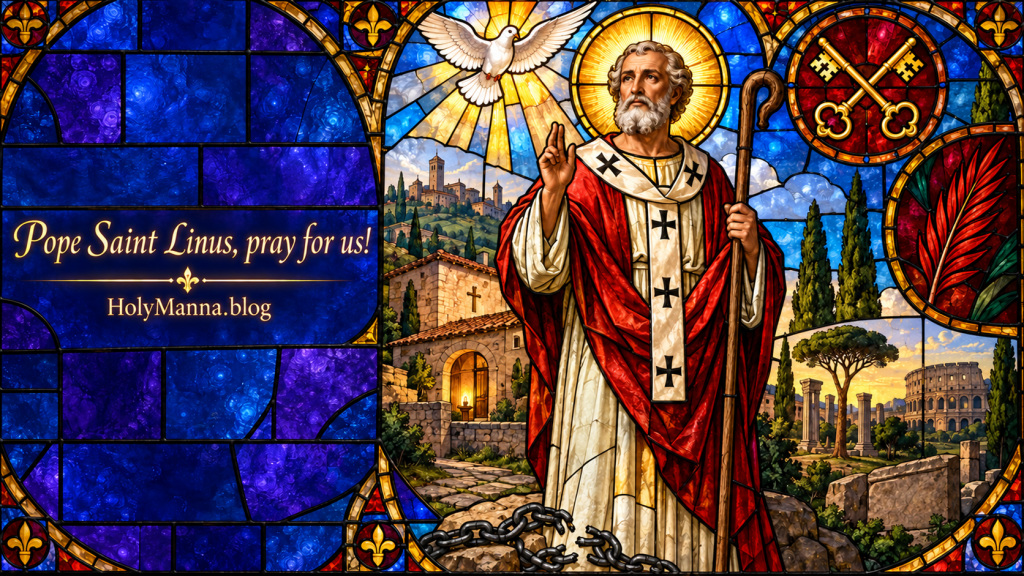
When the Rock Fell, Another Rock Stood
Imagine being the man who had to follow Saint Peter. Peter walked with Jesus, preached at Pentecost, and died upside down on a cross rather than deny his Lord. Then the Church of Rome, grieving and hunted, turned its eyes to one of Peter’s own companions and said, in effect, now it is your turn. That man was Linus, the second pope, the first successor of the Prince of the Apostles, and one of the most quietly consequential figures in all of Christian history.
Saint Linus is honored on September 23. He appears in the pages of the New Testament itself; Saint Paul, writing from his Roman imprisonment near the end of his life, closes his final letter with these words: “Eubulus, Pudens, Linus, Claudia, and all the brothers send greetings” (2 Timothy 4:21). Saint Irenaeus, writing around the year 180 in Against Heresies, tells the Church plainly that this Linus, the friend of Paul, is the same man to whom the apostles handed the Church of Rome: “The blessed apostles, then, having founded and built up the Church, committed into the hands of Linus the office of the episcopate. Of this Linus, Paul makes mention in the Epistles to Timothy” (Against Heresies III, 3, 3).
That single sentence from Irenaeus is one of the great treasures of the early Church, because it shows that the office of Peter did not die with Peter. The Catechism teaches that the apostles “left bishops as their successors” and gave them “their own position of teaching authority” (CCC 77), and that the Church is apostolic precisely because “she continues to be taught, sanctified, and guided by the apostles until Christ’s return, through their successors” (CCC 857). Linus is where that unbroken chain becomes visible for the first time. Every pope since, all the way to the present day, stands in a line that runs through this one man back to Peter and to Christ Himself.
Saint Linus holds no formal title as a great theologian, left behind no verified writings, and built no basilicas. His glory is of a different kind. He is remembered every single day at Catholic altars around the world, because his name is spoken in Eucharistic Prayer I, the ancient Roman Canon of the Mass: “Linus, Cletus, Clement, Sixtus, Cornelius, Cyprian, Lawrence, Chrysogonus, John and Paul, Cosmas and Damian”. Few Christians in history have received an honor like that.
A Son of Tuscany in the Shadow of the Apostles
The honest truth, and this blog will always tell it to you honestly, is that the documented facts of Linus’s early life are few. What history establishes firmly is this: he was a Christian of the first generation, he was in Rome with Saint Paul near the end of Paul’s life, he was known personally to the apostles, and he received the episcopate of Rome from them. The rest comes from later tradition, and it deserves to be told as tradition.
According to the Liber Pontificalis, the ancient book of the popes compiled around the year 530, Linus was born in Volterra, a hilltop town in Tuscany, the son of a man named Herculanus. Volterra has cherished this claim for centuries. A church dedicated to San Lino still stands in the town, built in the sixteenth century at the request of the scholar Raffaello Maffei on the very spot where tradition says the family home of Linus once stood. It is a beautiful thought, a Tuscan boy who grew up amid the old Etruscan walls and ended his life holding the keys of Peter. Yet no source earlier than the Liber Pontificalis mentions Volterra or Herculanus, so this account of his origins cannot be verified.
A separate tradition, appearing centuries later still, connects Linus to the household of Pudens, the Roman Christian greeted alongside him in 2 Timothy 4:21, and even names him a brother of Saints Pudentiana and Praxedes. This too is a story handed down rather than established fact, and it cannot be verified.
What can be said with confidence is that Linus was formed in the most extraordinary school imaginable. He knew Peter. He knew Paul. He heard the Gospel from the mouths of the men who had received it from Christ. The Catechism teaches that “the apostles entrusted the ‘Sacred deposit’ of the faith (the depositum fidei), contained in Sacred Scripture and Tradition, to the whole of the Church” (CCC 84), and Linus stood at the very moment of that entrusting. When the Church of Rome needed a shepherd after Peter’s crucifixion, it did not need to search far. The apostles themselves had already prepared the man.
Shepherd of a Church in Hiding
Consider what Rome looked like when Linus took up the office of bishop, sometime around the year 67. The ancient sources do not agree on the exact dates; his pontificate is variously placed from about 64 or 67 to about 76, 79, or 80. What is certain is the situation he inherited. Nero had blamed the Christians for the great fire of Rome. Peter had been crucified. Paul had been beheaded. Believers had been burned as torches in the imperial gardens and torn apart by beasts for entertainment. The Church of Rome was a community of survivors, worshiping in private homes, grieving its founders, and wondering whether the whole movement would be stamped out within a generation.
Into that fear stepped Linus. He did not steady the Church with armies or eloquence. He steadied it by simply being what Christ, through the apostles, had made him: a bishop, a shepherd, a visible sign that the Church endures. The Catechism teaches that “in order that the mission entrusted to them might be continued after their death, [the apostles] consigned, by will and testament, as it were, to their immediate collaborators the duty of completing and consolidating the work they had begun” (CCC 861), and that through this succession “the apostolic preaching, which is expressed in a special way in the inspired books, was to be preserved in a continuous line of succession until the end of time” (CCC 77). Linus mattered, and matters still, because he proved that the Church is not a personality cult. Peter died, and the Church did not die with him, because the Church was never Peter’s. It was and is Christ’s, who promised, “the gates of the netherworld shall not prevail against it” (The Gospel of Matthew, Mt 16:18).
The Liber Pontificalis records that Linus ordained fifteen bishops and eighteen priests during his years of governance, quietly building up the structure of a Church that would outlast the empire persecuting it. The same source says he issued a decree that women should keep their heads covered in church. Scholars, including those of the Catholic Encyclopedia, judge that this decree was likely attributed to him later, drawn from Saint Paul’s instruction in 1 Corinthians 11:5, so it should be received with caution rather than certainty.
Tradition also remembers Linus as a wonder-worker. The old Roman Breviary says that his faith and holiness were so great that he cast out demons from many possessed persons and even raised the dead to life. These accounts come from later tradition rather than contemporary records, and they cannot be verified. Yet they express something the early Church firmly believed about him: that the power of Christ was alive in this man. The Catechism reminds us that signs and wonders in the lives of the saints are never about the saint; they “strengthen faith in him who does his Father’s works; they bear witness that he is the Son of God” (CCC 548). Whatever wonders God worked through Linus, they pointed past him to the Lord he served.
One tradition even carries Linus far beyond Rome, claiming that before his pontificate Peter sent him into Gaul, where he served as the first bishop of Besançon and preached against the idols of the city. This story appears only in much later sources and cannot be verified.
The Consul’s Daughter and the Price of Deliverance
Was Linus a martyr? Here Manna owes you the same honesty the Church’s own scholars practice. The traditional title “Martyr” comes from the Liber Pontificalis, and for many centuries the liturgy honored him under that title. The most famous account of his death, handed down in tradition, goes like this. A powerful Roman of consular rank named Saturninus had a daughter who was tormented by a demon. Linus, moved with compassion, delivered the girl through the power of Christ, and she came to believe. But her father, far from being grateful, was enraged at his daughter’s conversion and at the growing influence of this Christian bishop. He had Linus seized, imprisoned, and beheaded. This story cannot be verified.
The historical record complicates the picture further, and the Church herself acknowledges it. The Catholic Encyclopedia notes that no persecution of the Roman Church is recorded between Nero and Domitian, the very window in which Linus died, and that Saint Irenaeus, listing the early bishops of Rome, singles out only Telesphorus as a glorious martyr. For this reason, the current Roman Martyrology commemorates Linus on September 23 without the title of martyr, saying: “At Rome, the commemoration of Saint Linus, Pope, to whom, as Saint Irenaeus narrates, the blessed Apostles entrusted the responsibility of the episcopate of the Church founded in the City, and whom the blessed Paul the Apostle mentions as a companion of his”.
Does this make Linus any less worthy of veneration? Not in the slightest. Whether or not the executioner’s sword ever touched his neck, Linus lived his entire episcopate under the sword. He accepted the chair of a man who had just been crucified for sitting in it. He shepherded a community for whom arrest, torture, and death were live possibilities every single day. The Catechism teaches that “martyrdom is the supreme witness given to the truth of the faith” (CCC 2473), and it also teaches that all the faithful are called to witness: “the witness of a Christian life and good works done in a supernatural spirit have great power to draw men to the faith and to God” (CCC 2044). Linus gave that witness in its most demanding form, fidelity unto death in a city that killed his teachers, and the Church has never stopped naming him among her saints because of it.
A Name Spoken Daily at the Altar
Linus died around the years 76 to 80; the ancient sources disagree on the precise date, and September 23, the day of his feast, is the date of death given in the Liber Pontificalis. Tradition holds that he was buried on the Vatican Hill beside Saint Peter himself, the first pope laid to rest near the first pope’s bones. This is entirely plausible, since Peter was certainly buried at the foot of the Vatican Hill, though it cannot be proven from the earliest records. A later tradition adds that in the seventeenth century, during work on the Confession of Saint Peter beneath the great basilica, a tomb marked with the name Linus came to light. Scholars caution that the surviving inscription fragment could be the ending of a longer Roman name, so even this discovery cannot be verified as his resting place.
His truest shrine, though, is not made of stone. It is made of words, spoken daily around the world. When a priest prays the Roman Canon, Eucharistic Prayer I, he asks God’s mercy in communion with the Blessed Virgin Mary, Saint Joseph, the apostles, and then the martyrs and saints of Rome: “Linus, Cletus, Clement, Sixtus, Cornelius, Cyprian, Lawrence, Chrysogonus, John and Paul, Cosmas and Damian and all your Saints”. This prayer is ancient; scholars note that this portion of the Canon is older than the sixth-century Sacramentary of Gelasius. For roughly fifteen centuries and more, the Church has spoken the name of Linus at the altar. The Catechism explains why this matters so much: “it is not merely by the title of example that we cherish the memory of those in heaven; we seek, rather, that by this devotion to the exercise of fraternal charity the union of the whole Church in the Spirit may be strengthened” (CCC 957). Every time his name is spoken, the Church on earth reaches across two thousand years and clasps hands with the Church in heaven.
His cultural footprint endures as well. Volterra keeps him as her own son, with the church of San Lino marking the traditional site of his family home. In the Basilica of Saint Paul Outside the Walls in Rome, his portrait appears second in the great line of papal medallions that rings the nave, right after Peter, a visual sermon on apostolic succession that every pilgrim can read at a glance. His feast remained on the Church’s universal calendar until 1969, and he continues to be commemorated in the Roman Martyrology on September 23. No verified sayings of Saint Linus survive; an ancient letter describing the martyrdoms of Peter and Paul was once attributed to him, but the Church’s scholars recognize it as apocryphal and of a later date.
Following Faithfully When No One Is Watching
Here is the beautiful, uncomfortable truth about Saint Linus: he is the patron saint of everyone who has ever had to follow someone great, and of everyone whose faithfulness will never trend, never be filmed, and never be applauded.
Most Christians will never be Peter. Most will never preach at Pentecost, never write Scripture, never die a death the whole world remembers. Most will be Linus. They will inherit responsibilities from people more celebrated than themselves. They will do essential work that history barely records. They will hold things together, in families, in parishes, in workplaces, during seasons when everything feels fragile and no one says thank you. Linus shows that this hidden fidelity is not a lesser calling. It is the very thing that carried the Church from the apostolic age into every age that followed. The Catechism teaches that “the Church is a communion of saints” in which “the least of our acts done in charity redounds to the profit of all” (CCC 946, CCC 953). The quiet act, done in love, echoes further than anyone can see.
Think about the succession in your own life. Someone handed you the faith. A parent, a grandmother, a friend, a priest, a stranger whose witness cracked your heart open. And someone, whether you realize it or not, is watching how you carry it. Who handed the faith to you, and have you ever thanked God for them by name? Who might God be preparing to receive the faith from your hands?
Consider also the courage of continuing. Linus took up his office at the worst possible moment, when the sensible thing was to hide. There are seasons like that in every life of faith, seasons after a loss, after a scandal, after a failure, when continuing to believe and continuing to serve feels like standing in a doorway everyone else has fled. When your faith has cost you something, did you keep going, and what helped you do it? Is there a place in your life right now where God is asking you simply to remain at your post?
Practical ways to live the lessons of Saint Linus this week are close at hand. Attend a Mass where Eucharistic Prayer I is prayed, listen for his name, and let it remind you that you belong to a Church older than empires. Do one necessary, unglamorous act of service, washing dishes, covering a shift, sitting with someone lonely, and offer it silently to God without telling anyone. Pray for the current successor of Peter, as the Church has always prayed for the man in that chair, from Linus to the present pope. And when you feel small and unrecorded, remember that God’s memory is not like history’s memory; the Lord who counts every hair on your head (The Gospel of Luke, Lk 12:7) has never once lost track of a faithful servant.
Engage With Us!
Saint Linus spent his life holding a door open so that others could walk through it, and HolyManna would love to hear how his story lands in your own. Share your thoughts and reflections in the comments below; this community grows the same way the early Church did, one honest conversation at a time. To help you get started, here are some questions to pray with and to answer.
- Who handed the faith on to you, and what is one concrete way you can honor that gift this week?
- Where in your life are you being called to serve faithfully without recognition, and how does Saint Linus’s hidden fidelity change how you see that work?
- When you hear the names of the ancient saints spoken in Eucharistic Prayer I, what does it stir in you to know you worship in an unbroken line stretching back to the apostles?
- Saint Linus followed Peter at a moment of fear and grief; when has God asked you to step forward at a hard moment, and what happened when you did?
- What is one responsibility you have inherited from someone else, and how can you carry it in a way that points others to Christ?
Do not be discouraged if your faithfulness feels invisible. The second pope’s entire life was nearly invisible to history, and yet his name is on the lips of the Church every single day. God sees. God remembers. Go and live this day, and every day, with the love and mercy that Jesus taught us, holding your post with courage, handing on what you have received, and trusting that the same Lord who kept His Church alive through Linus will keep you as well.
Saint Catherine of Genoa, pray for us!
Follow us on YouTube, TikTok, Instagram and Facebook for more insights and reflections on living a faith-filled life.


Leave a comment