Memorial of Saint Pius of Pietrelcina, Priest – Lectionary: 451
Enough Is a Promise, Not a Number
There is a question that quietly runs underneath almost every anxious thought: will there be enough? Enough money, enough time, enough security, enough love. On September 23rd, 2026, the Memorial of Saint Pius of Pietrelcina, the Church answers that question with three readings that all point in the same direction. God’s Word is enough, and the one who trusts it can finally travel light.
The first reading offers the only petitionary prayer in the entire book of Proverbs, where a sage named Agur asks God for exactly two things: honesty and daily bread, nothing more. The Responsorial Psalm, drawn from the great acrostic love song of Psalm 119, declares that the law of God’s mouth is worth more than thousands of gold and silver pieces and that His word is a lamp for the feet. Then the Gospel of Luke shows Jesus sending the Twelve on their first mission with no walking stick, no sack, no food, no money, and no second tunic. Empty hands, full authority.
The Church places these readings on the feast of a Capuchin friar who took them literally. Padre Pio owned almost nothing, bore the wounds of Christ in his body for fifty years, and spent hour after hour in the confessional dispensing the mercy of God. His most famous counsel, “Pray, hope, and don’t worry,” could serve as the headline over this entire day. What follows is a walk through each reading, asking what it means to let God’s tested Word be sufficient.
First Reading — Proverbs 30:5-9
The Only Prayer in Proverbs Asks for Almost Nothing
The book of Proverbs is mostly advice. Fathers counsel sons, Wisdom calls from the street corners, and short sayings pile up like coins in a jar. Then, near the very end, the book stops advising and starts praying. Chapter 30 preserves the sayings of Agur son of Jakeh, a sage whose collection was gathered into the Solomonic tradition, and tucked inside it is the only petitionary prayer in the whole book. Agur has looked honestly at his own weakness. He knows what wealth does to his memory of God and what desperation does to his integrity, so he asks for the narrow road between them. On the Memorial of a friar vowed to poverty, the Church holds up this prayer as a portrait of the freedom of wanting only what God provides, and it sets the day’s central theme in motion: the Word of God, tested and true, is a shield and a sufficiency for those who take refuge in it.
Proverbs 30:5-9
Every word of God is tested;
he is a shield to those who take refuge in him.
Add nothing to his words,
lest he reprove you, and you will be exposed as a deceiver.Two things I ask of you,
deny them not to me before I die:
Put falsehood and lying far from me,
give me neither poverty nor riches;
provide me only with the food I need;
Lest, being full, I deny you,
saying, “Who is the LORD?”
Or, being in want, I steal,
and profane the name of my God.
Detailed Exegesis
Verse 5: “Every word of God is tested; he is a shield to those who take refuge in him.”
The Hebrew image behind “tested” is metallurgical, the same picture found in Psalm 18:31, where God’s word is refined like silver in a furnace. Scripture has been through the fire of centuries, of suffering, of fulfilled promise, and it has never cracked. The verse then shifts from the word to the God who speaks it: He is a shield. Trusting Scripture is never trusting a book for its own sake; it is taking refuge behind the God whose faithfulness the book records.
Verse 6: “Add nothing to his words, lest he reprove you, and you will be exposed as a deceiver.”
This command echoes Deuteronomy 4:2, where Moses forbids Israel to add to or subtract from what God has commanded, and it finds its final echo in Revelation 22:18-19. Revelation belongs to God, and no human being may edit it. The Catholic Church has always understood herself as the servant and guardian of the Word rather than its author, a principle Dei Verbum 10 teaches when it explains that the Magisterium is not above the Word of God but serves it. Adding to God’s words, whether by false prophecy or convenient distortion, exposes the deceiver in the end.
Verse 7: “Two things I ask of you, deny them not to me before I die:”
Agur prays with the clock running. The phrase “before I die” gives the petition a whole-life horizon; he is naming the two graces he needs for the entire journey, not a favor for the week. That kind of praying forces a person to distill the noise of a thousand wants down to what actually matters.
Verse 8: “Put falsehood and lying far from me, give me neither poverty nor riches; provide me only with the food I need;”
The two petitions arrive, and they are surprisingly modest. First, truthfulness: Agur asks God to keep deceit far from him, knowing that a divided tongue eventually produces a divided heart. Second, moderation: neither poverty nor riches, only an allotted portion of bread, measured out like the manna in Exodus 16 that could not be hoarded overnight. Catholic tradition has long heard in this verse an anticipation of the fourth petition of the Our Father, which the Catechism unfolds in CCC 2828-2837 as an act of filial trust in the Father’s providence.
Verse 9: “Lest, being full, I deny you, saying, ‘Who is the LORD?’ Or, being in want, I steal, and profane the name of my God.”
Here is the spiritual realism that makes Agur a master of the interior life. He asks for moderation not because comfort is bad, but because he knows himself. Abundance breeds forgetfulness, and the full man stops praying; destitution breeds desperation, and the starving man is tempted to steal and drag God’s name through the mud. Agur asks for the amount of bread that keeps his soul awake.
Teachings
The Catechism grounds both of Agur’s petitions in the life of Christ. On truthfulness, it teaches, “The Old Testament attests that God is the source of all truth. His Word is truth. His Law is truth” (CCC 2465), which is why the disciple of Jesus must live in the truth without duplicity. On the danger of riches, the Catechism is just as blunt: “The Lord grieves over the rich, because they find their consolation in the abundance of goods” (CCC 2547). In that same paragraph the Church quotes Saint Augustine, a Doctor of the Church, from his commentary on the Sermon on the Mount: “Let the proud seek and love earthly kingdoms, but blessed are the poor in spirit for theirs is the Kingdom of heaven” (De sermone Domini in monte, cited in CCC 2547). Agur’s prayer and the first Beatitude are singing the same melody centuries apart, and the saint of this Memorial harmonized with both. A Capuchin vowed to poverty in the tradition of Saint Francis, Padre Pio loved to describe himself, as Saint John Paul II recalled at his canonization, with the words, “I am a poor Franciscan who prays” (Homily, June 16th, 2002). A man who owned nearly nothing became one of the richest sources of grace in the twentieth century, which is precisely the paradox Agur’s prayer predicts.
Reflection
Agur’s prayer is short enough to memorize and dangerous enough to change your budget. Try praying it slowly this week, especially the line about “only the food I need,” and notice what resistance rises up in you; that resistance is worth bringing to prayer, and perhaps to confession. A practical step: identify one purchase or habit that functions as hoarded manna, stockpiled out of anxiety rather than need, and offer it to God for a week. Another: practice rigorous honesty in one small area, such as refusing to exaggerate in conversation, since Agur links truthful lips and a trusting heart as a single grace. When you are comfortable and full, does your prayer life quietly shrink? Is there an area of your life where you are asking God for far more than daily bread, and what would it feel like to ask for less?
Responsorial Psalm — Psalm 119:29, 72, 89, 101, 104-105, 163
A Love Song 176 Verses Long
Psalm 119 is the longest chapter in the Bible, a massive acrostic poem of 22 stanzas, one for each letter of the Hebrew alphabet, with eight verses apiece. Its craftsmanship is a sermon in itself: the psalmist took the entire alphabet, the raw material of every word he could ever speak, and used it to praise the Word God speaks, rotating eight near-synonyms, including law, decrees, precepts, statutes, commands, words, promise, and ways, so that revelation is examined like a diamond turned in the light. The verses chosen for this Memorial pick up both threads of Agur’s prayer, hatred of falsehood and freedom from greed, and they anticipate the Gospel by describing the Word as the one piece of equipment a traveler cannot leave behind: a lamp for the feet. The refrain, “Your word, O Lord, is a lamp for my feet”, is the day’s theme in a single line.
Psalm 119:29, 72, 89, 101, 104-105, 163
R. (105) Your word, O Lord, is a lamp for my feet.
Remove from me the way of falsehood,
and favor me with your law.
R. Your word, O Lord, is a lamp for my feet.
The law of your mouth is to me more precious
than thousands of gold and silver pieces.
R. Your word, O Lord, is a lamp for my feet.
Your word, O LORD, endures forever;
it is firm as the heavens.
R. Your word, O Lord, is a lamp for my feet.
From every evil way I withhold my feet,
that I may keep your words.
R. Your word, O Lord, is a lamp for my feet.
Through your precepts I gain discernment;
therefore I hate every false way.
R. Your word, O Lord, is a lamp for my feet.
Falsehood I hate and abhor;
your law I love.
R. Your word, O Lord, is a lamp for my feet.
Detailed Exegesis
Verse 29: “Remove from me the way of falsehood, and favor me with your law.”
The psalmist prays exactly as Agur does, treating deceit not as an occasional slip but as a “way,” an entire road a life can travel down. Only God can remove a road, so the psalmist asks for the law as a replacement route; grace does not merely forbid the false path but favors the soul with a true one.
Verse 72: “The law of your mouth is to me more precious than thousands of gold and silver pieces.”
Notice the tender phrase “the law of your mouth.” For the psalmist, the Torah is not ink but breath, a word still warm from the lips of God, and valuing it above gold and silver is his version of Agur’s “neither poverty nor riches.” A person’s true wealth is whatever he would refuse to sell, and the psalmist’s treasure is the Word.
Verse 89: “Your word, O LORD, endures forever; it is firm as the heavens.”
Every human word has an expiration date, from empires’ decrees to this morning’s headlines. God’s word alone is permanent, fixed like the heavens themselves. Jesus intensifies the claim in Luke 21:33, promising that heaven and earth will pass away while His words will not.
Verse 101: “From every evil way I withhold my feet, that I may keep your words.”
The psalm speaks constantly of feet, paths, and walking because Torah observance was never a purely mental exercise. The psalmist avoids evil not to earn the Word but to keep it, the way a runner avoids injury to keep running. Sin is renounced for the sake of something loved.
Verse 104: “Through your precepts I gain discernment; therefore I hate every false way.”
Here Scripture is described as the school of discernment. A soul soaked in God’s precepts develops instincts, the way a jeweler who handles genuine gold all day detects a counterfeit by touch. Hatred of falsehood is not learned by cataloguing lies but by long familiarity with the truth.
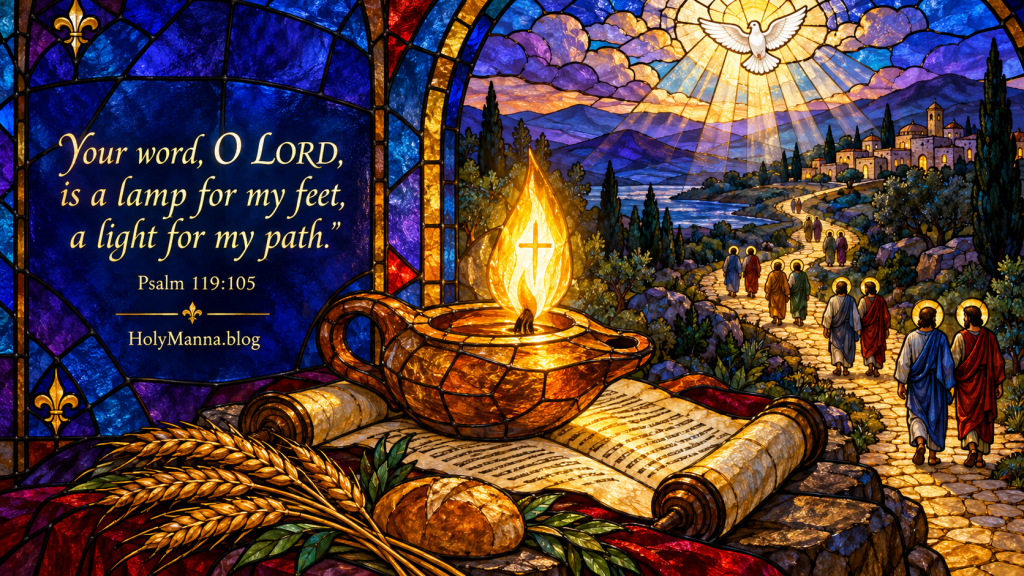
Verse 105: “Your word, O LORD, is a lamp for my feet, a light for my path.”
This is the psalm’s most beloved image and the day’s refrain. An oil lamp in ancient Israel cast light for roughly a single step, not a floodlit highway, so the Word illuminates enough for the next faithful decision, and walking by it requires trust. That is exactly the light the Twelve carry in the Gospel: no provisions for the whole journey, just enough for today.
Verse 163: “Falsehood I hate and abhor; your law I love.”
The selection ends where it began, with falsehood and law set side by side, but the temperature has risen from petition to passion. The psalmist has become the person Agur prayed to be, someone whose affections have been retrained by the Word until honesty is no longer a discipline but a delight.
Teachings
The Catholic Church has enshrined this psalm’s central image in her own teaching on Scripture. The Catechism declares, “The Church has always venerated the divine Scriptures as she venerates the Lord’s Body” (CCC 141), and that very paragraph cites Psalm 119:105 as its proof text, placing the lectern and the altar side by side as two tables from which the faithful are fed. The Second Vatican Council, in its Dogmatic Constitution on Divine Revelation, describes why the Word deserves such love: “In the sacred books, the Father who is in heaven meets His children with great love and speaks with them” (Dei Verbum 21). Reading Scripture is not research; it is a meeting. The Council also insisted that this meeting become a conversation, quoting Saint Ambrose, Doctor of the Church: “We speak to him when we pray; we listen to him when we read the divine oracles” (CCC 2653). And Saint Jerome, the great translator of the Bible, gave the warning that the Catechism still repeats: “Ignorance of the Scriptures is ignorance of Christ” (CCC 133). Padre Pio lived at those two tables, his days revolving around the Mass, which he celebrated with such intensity that it often lasted hours, and around prayer steeped in Scripture. Saint John Paul II recalled his conviction that “prayer is the best weapon we have, a key that opens the heart of God” (Homily, June 16th, 2002), a sentence that reads like a gloss on this entire psalm.
Reflection
The psalmist’s lamp only helps the person who actually walks by it. A concrete way to begin: keep a Bible, or the day’s readings on your phone, in the first place you look each morning, and read one small portion before any headlines reach you, letting the Word be the first voice of the day. Another practice: choose a single verse from today’s psalm, perhaps verse 105 itself, and repeat it slowly at moments of decision, asking God to light the one next step rather than demanding the whole map. Which voice currently shapes your instincts more, the media you consume daily or the Word you were made for? If God’s word is a lamp for your feet, what is the one next step it is lighting for you right now?
Holy Gospel — Luke 9:1-6
Sent Out with Empty Hands and Full Authority
Up to this point in the Gospel of Luke, the Twelve have mostly been watching. They have seen Jesus calm a storm, expel a legion of demons, and raise the daughter of Jairus. Now, in the passage that opens chapter 9, the apprenticeship changes: the Master hands over the tools. This is the first missionary sending of the Twelve, the seed of every mission the Church has ever undertaken, and it comes with a packing list that is really an unpacking list. In the hospitality culture of first-century Galilee, a traveler depended on the welcome of strangers, and Jesus turns that dependence into a spirituality: the men who proclaim that God provides must live as though God provides. On the Memorial of Saint Pius of Pietrelcina, a priest who healed, reconciled, and consoled multitudes while owning nothing, the Gospel shows exactly where his pattern of life came from, and it completes the day’s theme: the Word tested in Proverbs and treasured in the Psalm is now entrusted to messengers who carry nothing else.
Luke 9:1-6
Jesus summoned the Twelve and gave them power and authority
over all demons and to cure diseases,
and he sent them to proclaim the Kingdom of God
and to heal the sick.
He said to them, “Take nothing for the journey,
neither walking stick, nor sack, nor food, nor money,
and let no one take a second tunic.
Whatever house you enter, stay there and leave from there.
And as for those who do not welcome you,
when you leave that town,
shake the dust from your feet in testimony against them.”
Then they set out and went from village to village
proclaiming the Good News and curing diseases everywhere.
Detailed Exegesis
Verse 1: “Jesus summoned the Twelve and gave them power and authority over all demons and to cure diseases,”
Luke pairs two loaded Greek words, dynamis (power) and exousia (authority), a combination Scripture reserves for God’s own prerogative. Jesus does not lend the Twelve a technique; He shares His divine capability. Saint Cyril of Alexandria, Doctor of the Church, marveled at this: “The grace then bestowed upon the holy Apostles is worthy of all admiration; but the bountifulness of the Giver surpasses all praise and admiration: for He gives them, as I said, His own glory” (Commentary on Luke, Sermon 47). No angel can transfer power to another; only God gives from His own fullness.
Verse 2: “and he sent them to proclaim the Kingdom of God and to heal the sick.”
Proclamation and healing travel together, word and deed, because the Kingdom is not merely announced but demonstrated; every healing is a preview of the world the Kingdom brings. The Church has never separated the two, which is why hospitals and pulpits have grown up side by side throughout Christian history.
Verse 3: “He said to them, ‘Take nothing for the journey, neither walking stick, nor sack, nor food, nor money, and let no one take a second tunic.’”
The list is deliberately shocking: even the walking stick, the most basic protection of an ancient traveler, stays home. Jesus is not romanticizing hardship; He is removing every backup plan so that the messengers’ lives preach the same sermon as their lips. Agur asked for only the food he needed, and the Twelve are asked to go one step further and trust God for even that.
Verse 4: “Whatever house you enter, stay there and leave from there.”
The instruction sounds minor but guards the mission’s integrity. An itinerant preacher who upgraded lodgings whenever a wealthier host appeared would quickly turn the Gospel into a business. Staying put expresses contentment, honors the first family to open its door, and roots the message in relationships rather than transactions.
Verse 5: “And as for those who do not welcome you, when you leave that town, shake the dust from your feet in testimony against them.”
Devout Jews returning from Gentile territory would shake pagan dust from their sandals; Jesus adapts the gesture into a solemn testimony. The act is not spite but honesty: the offer of the Kingdom is real, and so are the freedom to refuse it and the consequences of refusal. The messengers are responsible for faithful delivery, not for forcing acceptance, and they are freed to move on without bitterness.
Verse 6: “Then they set out and went from village to village proclaiming the Good News and curing diseases everywhere.”
Luke records no debate, no request for a smaller assignment, no delay for fundraising. They simply set out, and the results follow: the Good News proclaimed and diseases cured everywhere. Obedience unlocked what deliberation would have postponed, and the verse quietly proves the packing list right, since the Twelve return having lacked nothing.
Teachings
The Catechism sees in this scene the foundation of the Church’s mission: “From the beginning of his public life Jesus chose certain men, twelve in number, to be with him and to participate in his mission” (CCC 551). Their healing mandate never expired: “‘Heal the sick!’ The Church has received this charge from the Lord and strives to carry it out by taking care of the sick as well as by accompanying them with her prayer of intercession” (CCC 1509). History keeps producing saints who take Luke 9 at face value. Around the year 1208, Saint Francis of Assisi heard the parallel sending discourse proclaimed at Mass in the chapel of the Portiuncula and, as his early biographer Thomas of Celano recounts, immediately cast aside his shoes, staff, and money pouch to live the text literally. Seven centuries later his Capuchin son, Padre Pio, carried the same charism into the modern world. From September 20th, 1918 until his death on September 23rd, 1968, he bore the visible stigmata in his own flesh, spent ten hours and more each day absolving sinners in the confessional, and in 1956 opened the Casa Sollievo della Sofferenza, the Home for the Relief of Suffering, a hospital that continues the Twelve’s twin mandate of proclaiming and healing. At his canonization, Saint John Paul II taught that the saint’s life proves that “difficulties and sorrows, if accepted out of love, are transformed into a privileged way of holiness”, and he summarized everything in one sentence: “Prayer and charity, this is the most concrete synthesis of Padre Pio’s teaching, which today is offered to everyone” (Homily, June 16th, 2002).
Reflection
Most people will never be asked to leave home without a walking stick, but everyone is asked to identify the second tunic, the backup plan trusted more than God: a savings cushion treated as salvation, a relationship used as an escape hatch, an image managed for approval. You do not necessarily need to discard it, but you do need to dethrone it. A concrete step this week: accept one act of hospitality you would normally refuse out of pride, and let someone else’s generosity preach providence to you. Another: perform one work of mercy that costs you real convenience, since the Kingdom is still proclaimed through deeds. When anxiety about provision rises, borrow Padre Pio’s counsel: “Pray, hope, and don’t worry. Worry is useless. God is merciful and will hear your prayer.” What is the second tunic you quietly pack for every journey, and what would trusting God without it look like? Where is Jesus sending you this week, into which conversation, household, or hidden act of service?
The Saint Who Packed Nothing and Gave Everything
Set the three readings side by side and a single staircase appears. Agur prays for only the food he needs. The psalmist treasures the Word above gold and walks by its lamp one step at a time. The Twelve descend the final stair and hand over everything, stepping onto the road with no provisions except the Word they carry and the God who tests true. Each reading asks the same question at a deeper level: is God’s Word actually enough for you?
Padre Pio answered with his whole life. A poor Franciscan who prayed, he possessed no gold and silver pieces, yet pilgrims still stream to San Giovanni Rotondo because the treasure he did possess has never stopped paying out. He bore the wounds of Christ, absolved sins for hours on end, built a home for the suffering, and told a worried world to pray, hope, and stop worrying. His feast lands on these readings like a signature at the bottom of a letter.
The invitation now passes to the reader. Take Agur’s prayer into the morning, asking for daily bread and an honest heart. Keep the psalmist’s lamp burning by opening the Scriptures before opening anything else. Answer the Gospel’s summons by traveling lighter and trusting the Father who provides for those He sends. The Word of God has been tested for thousands of years and has never broken. It is a shield for those who take refuge in it, a lamp for those who walk by it, and food enough for the whole journey home. Set out today, and see.
Engage With Us!
The conversation does not end with the final paragraph, so share your reflections in the comments below. Every honest response to God’s Word encourages another reader to trust Him a little more. Here are some questions to spark your reflection:
- In Proverbs 30:5-9, Agur asks God for neither poverty nor riches, only the food he needs. What would change in your daily life if you sincerely prayed that prayer this week?
- In Psalm 119:29, 72, 89, 101, 104-105, 163, the psalmist calls God’s word a lamp for his feet and treasures it above thousands of gold and silver pieces. What one habit could help you treasure Scripture that way, starting tomorrow morning?
- In Luke 9:1-6, Jesus sends the Twelve without walking stick, sack, food, money, or a second tunic. What backup plan do you rely on more than God, and how might He be inviting you to loosen your grip on it?
- Taken together, the readings proclaim that God’s tested Word is enough for the whole journey. Where in your life right now do you most need to believe that, and what is one step of trust you can take this week?
Living a life of faith is not about having every provision packed; it is about knowing the One who provides. Walk by the lamp of His Word, ask only for today’s bread, and go wherever He sends you with open hands and a generous heart. Do everything this week with the love and mercy Jesus taught, and, in the words of Padre Pio, pray, hope, and don’t worry.
Sacred Heart of Jesus, we trust in You!
Immaculate Heart of Mary, pray for us!
Saint Michael the Archangel, defend us in battle!
Follow us on YouTube, TikTok, Instagram and Facebook for more insights and reflections on living a faith-filled life.


Leave a comment