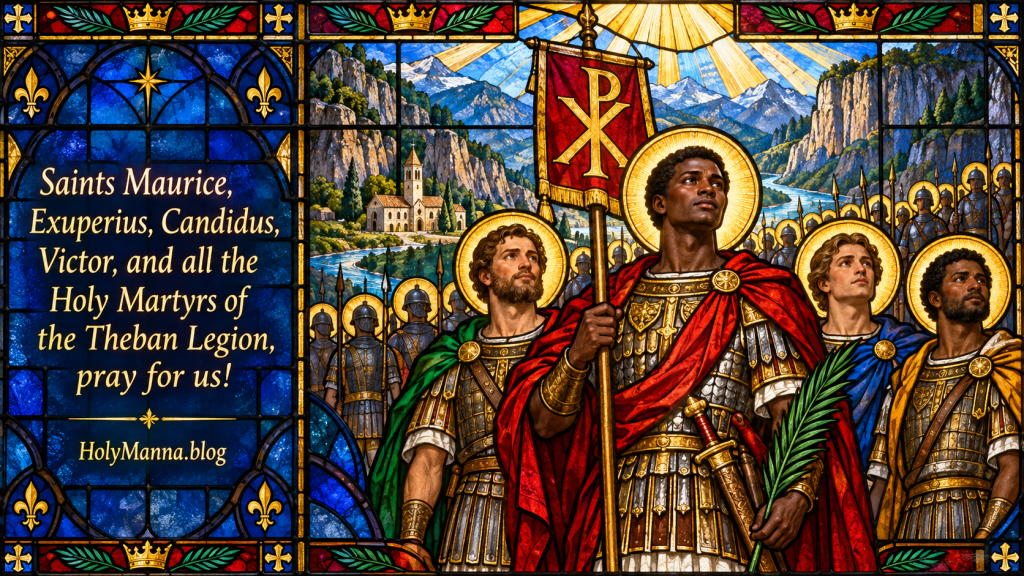
Soldiers of Caesar, Servants of Christ
There are saints who preached to crowds, saints who wrote volumes, and saints who founded orders. And then there are saints who did one thing, at one moment, with such clarity that the Church has never stopped telling the story. The Martyrs of the Theban Legion belong to that second kind. On September 22, the Roman Martyrology commemorates Saints Maurice, Exuperius, Candidus, and Victor, together with their companions, Christian soldiers of the Roman army who were put to death around the year 286 at Agaunum, in what is today the town of Saint-Maurice in the Swiss canton of Valais. Their crime was refusing an imperial order to worship false gods and to shed innocent blood. Their answer to that order, preserved in the earliest account of their martyrdom, has echoed through seventeen centuries: they were the emperor’s soldiers, yes, but they were God’s servants first.
The Church honors them as martyrs in the fullest sense, and The Catechism explains why such a death matters so much: “Martyrdom is the supreme witness given to the truth of the faith: it means bearing witness even unto death” (CCC 2473). These men bore that witness not as individuals hunted down one by one, but as a body of brothers who encouraged each other to stand firm, which makes their story a story about Christian friendship and courage as much as it is a story about death.
Saint Maurice, the commander of the legion, became one of the most beloved patrons of the medieval world. He is the patron of soldiers, infantrymen, armies, and alpine troops, of armorers and swordsmiths, of weavers, dyers, and clothmakers, and he is invoked by those who suffer from gout and cramps. He is the patron of the Pontifical Swiss Guard, the soldiers who protect the Holy Father to this day, as well as of the House of Savoy, the regions of Piedmont and Sardinia, the nation of Austria, and the towns of Saint-Maurice and St. Moritz in Switzerland, the latter of which bears his name. For centuries he was also honored as the special patron of the Holy Roman Emperors. Few saints have been claimed by so many peoples, professions, and princes, and yet the heart of his appeal is simple. He shows every Christian what to do when the world says, worship what we worship or suffer the consequences.
Sons of the Nile, Soldiers of Rome
The story of the Theban Legion begins far from the Alps, in the heat of Upper Egypt. According to the tradition handed down by the Church, the legion was recruited in the Thebaid, the region surrounding the ancient city of Thebes on the Nile. By the late third century, Egypt was one of the great heartlands of Christianity. The faith had taken deep root there, the same soil that would soon produce Saint Anthony of the Desert and the whole monastic movement. The tradition holds that this particular legion was composed of baptized Christian men, soldiers who had learned to hold together two loyalties, service to the empire in all that was lawful, and total obedience to Jesus Christ in everything.
Our earliest and most important source for their story is Saint Eucherius, Bishop of Lyon, who wrote an account called the Passio Acaunensium Martyrum, the Passion of the Martyrs of Agaunum, around the years 434 to 450. Eucherius did not invent his material. He tells his readers that the account came down to him through Saint Theodore, bishop of Octodurum in the Valais, and through Isaac, bishop of Geneva. Theodore is a firmly historical figure who attended the Council of Aquileia in the year 381, which means the veneration of these martyrs is documented within roughly a century of their death, remarkably close by the standards of the ancient world. Eucherius opens his account by declaring that he writes of “the passion of the holy martyrs who have made Agaunum illustrious with their blood.”
Honesty requires saying plainly what is documented and what is not. The existence of a very early cult at Agaunum, the shrine built there by Theodore around the year 370, and the unbroken veneration of these martyrs from the fourth century onward are historical facts. The details of the martyrdom itself, including the number of soldiers involved, rest on the account of Eucherius and the tradition behind it. Later texts give the legion a strength of six thousand six hundred sixty-six men, a figure that is a literary convention rather than a verified count, and some modern scholars have argued that the martyrs were a smaller detachment rather than an entire legion. Sources also vary on the exact year, placing the martyrdom in 285, 286, or 287. None of this touches the substance of what the Church commemorates: that Christian soldiers at Agaunum chose death rather than sin, and that the faithful began honoring them almost immediately.
Of the individual men, the tradition preserves their military ranks more than their family histories. Maurice, called Mauritius in Latin, was the primicerius, the chief officer of the legion, and tradition places his birth at Thebes around the year 250, though nothing certain is known of his parents or upbringing. Candidus held the senior rank described as senator militum, a commander of the troops. Exuperius served as campiductor, a role often described as the standard-bearer or drill-master who carried the ensign and trained the men. Victor, whose feast is joined to theirs, was not a member of the legion at all. He was a veteran soldier, no longer in active service, whose path crossed the story at its darkest hour, as will be told below. These were not clergy, not monks, not scholars. They were working military men, and the Church holds them up precisely because holiness reached them in the ranks of an ordinary profession.
Rendering to Caesar What Is Caesar’s, and Nothing More
It is worth pausing on how these men lived before turning to how they died, because their martyrdom only makes sense in light of the life that preceded it. The tradition describes the Thebans as excellent soldiers who served the empire loyally and well. They did not treat their faith as a reason to despise their duty. They embodied, long before it was written, the balance that The Catechism teaches about the Christian and the state. The Church affirms that citizens owe a genuine duty of service to their country and its legitimate authorities for the sake of the common good (CCC 2239), and these men fulfilled theirs, marching, training, and defending the frontiers.
They were living out the words of the Lord in The Gospel of Matthew, when He was asked about paying taxes to the occupying power: “Render therefore to Caesar the things that are Caesar’s, and to God the things that are God’s” (Mt 22:21). The Theban soldiers understood that a Christian can wear the uniform of an earthly power. What a Christian can never do is hand over to Caesar the things that belong to God, worship, conscience, and obedience to the moral law.
A word of honesty is owed to the reader here. No miracles are recorded of these saints during their lifetimes. There are no accounts of healings worked by Maurice’s hands or wonders performed by Exuperius on the march. Their witness during life was of a quieter and, in some ways, more imitable kind: fidelity. They kept the faith in a pagan army, surrounded by the daily pressures of the imperial cult, the camp sacrifices, the oaths, and the customs of a world that did not know Christ. That hidden, daily faithfulness was the training ground for their final act. This is a great encouragement for the ordinary believer, because The Catechism teaches that all the faithful, whatever their state in life, “all the faithful, whatever their condition or state, though each in his own way, are called by the Lord to that perfection of sanctity by which the Father himself is perfect” (CCC 825). Sanctity did not wait for these men in a monastery. It found them in the barracks. Why should it not find you in an office, a classroom, a hospital ward, or a kitchen? Where, in the ordinary duties of your own life, is God quietly training you for the moment when faithfulness will cost something?
The Two Decimations and the Letter That Shook an Emperor
The crisis came under the Emperor Maximian, who ruled the western half of the empire as co-emperor with Diocletian. According to the account of Eucherius, the Theban Legion was summoned from the East and ordered to cross the Alps into Gaul to help suppress a revolt. The legion made the brutal alpine crossing and encamped at Agaunum, a narrow, dramatic gorge where the Rhone cuts between towering cliffs, while Maximian rested nearby at Octodurum.
There the order came. Eucherius’ account presents it in two dimensions. The soldiers were commanded to join in offering sacrifice to the pagan gods for the success of the campaign, and the campaign itself involved the persecution and killing of innocent Christians. Either demand alone was impossible for a baptized man. Together they forced an absolute choice. The Thebans withdrew from the camp rather than participate, and when Maximian learned of their refusal, he repeated the command with threats.
When the legion still refused, the emperor ordered the punishment that Rome reserved for mutinous units, decimation. Every tenth man was selected by lot and executed by the sword while his brothers watched. The tradition recounts that the soldiers did not resist, and that those chosen died encouraging the others. When the survivors again refused to sacrifice, Maximian ordered a second decimation. Again every tenth man was cut down, and again the legion stood firm.
It was at this point, the account tells us, that the officers held the wavering line of the legion’s soul. Maurice, together with Candidus and Exuperius, moved among the men and reminded them of their comrades already gone to God and of the vows of their baptism, the promise to renounce Satan and to worship God alone. Their exhortation kindled in the whole legion a desire not to escape martyrdom but to be worthy of it.
Then came the moment for which these saints are remembered above all. The legion sent Maximian a reply, and Eucherius records its substance. As the early account preserves it, the soldiers declared: “Emperor, we are your soldiers, but we are also the servants of the true God. To you we owe military service; to Him we owe innocence. From you we have received our wages; from Him we have received life. We cannot obey you by denying God our Creator, who is your Creator as well, whether you acknowledge Him or not. We are ready to follow you against any enemy, but we cannot stain our hands with the blood of the innocent. We took our oath to God before we took our oath to you; you can place no trust in our second oath if we break the first. You order us to hunt down Christians. Behold, we ourselves are Christians. We have arms, and yet we do not resist, for we would rather die innocent than live guilty.” It must be said plainly that this reply comes to us through the Passio of Eucherius, written well over a century after the event, and whether it reproduces an actual letter word for word cannot be verified. What can be said is that it is the earliest voice of the tradition, and that the Church has treasured it ever since as a perfect summary of Christian conscience before unjust power.
That summary is not merely beautiful; it is doctrine. The Catechism teaches: “The citizen is obliged in conscience not to follow the directives of civil authorities when they are contrary to the demands of the moral order, to the fundamental rights of persons or the teachings of the Gospel” (CCC 2242), and in that same article the Church repeats the words of the Apostles in The Acts of the Apostles: “We must obey God rather than men” (Acts 5:29). The Thebans knew nothing of catechisms, but they knew this truth in their bones, and they sealed it with their blood.
Maximian understood that no threat remained. He ordered the entire legion put to death. The account describes the soldiers laying down their arms, offering their necks to the executioners, and being slaughtered where they stood, so many that the ground of Agaunum was covered with the bodies of the martyrs. They had taken to heart the words of the Lord in The Gospel of Matthew: “And do not fear those who kill the body but cannot kill the soul; rather fear him who can destroy both soul and body in hell” (Mt 10:28).
One more martyr was still to come. The tradition recounts that after the massacre, the executioners sat down to feast on the spoils of the dead. A veteran soldier named Victor happened to pass by and was invited to join them. When he asked the reason for the celebration and learned what had been done, he recoiled and refused, and when the soldiers demanded to know whether he too was a Christian, he answered that he was and always would be. They killed him on the spot, and the Church joined his name forever to the legion he never served in life. The Roman Martyrology thus commemorates on this day Maurice, Exuperius, Candidus, and their companion soldiers, together with Victor the veteran, slain for the name of Christ under Maximian. Later tradition, growing over the following centuries, attached the names of other Theban soldiers said to have been martyred at other places in the region, Innocent and Vitalis at Agaunum, Ursus and Victor at Solothurn, Felix and Regula at Zurich, and Gereon at Cologne. These extensions of the story rest on later local traditions rather than on the earliest account, and they should be received as such, but they show how powerfully the witness of Agaunum spread along the roads and rivers of Europe.
Blood That Built an Abbey That Never Stopped Singing
The Church teaches that “the blood of the martyrs is the seed of Christians,” the famous saying of Tertullian which The Catechism quotes in its treatment of martyrdom (CCC 852). Few places on earth prove it like Agaunum.
Around the year 370, Saint Theodore of Octodurum, the first historically known bishop of the region, identified the remains of the martyrs and built a basilica against the cliff at Agaunum to house them. Around that shrine he gathered the local hermits into a common life, planting the seed of a religious community. Eucherius, writing in the fifth century, testifies that in his own day the faithful were already streaming to Agaunum from many provinces of the empire, bringing gifts of gold and silver to honor the martyrs, and he attests that miracles were frequent at the shrine, healings of the sick and deliverance of those afflicted by evil spirits. An appendix attached to the early account tells the story of a workman laboring on Theodore’s basilica, a pagan, who was granted a vision of the holy martyrs in glory and was converted to Christ on the spot. It is a beautiful story and an old one, but it rests on that early account alone and cannot be verified.
Then came a king. On September 22 in the year 515, Saint Sigismund, king of the Burgundians and the first of his line to abandon the Arian heresy for the Catholic faith, founded a great monastery at the tomb of the martyrs. Within a few years the community there instituted something extraordinary, the laus perennis, the perpetual praise. Choirs of monks were organized in rotation so that the chanting of the psalms at the tomb of the Thebans would never cease, day or night. When other monasteries in Gaul later adopted the practice, they described it as being done in imitation of Agaunum. The Abbey of Saint-Maurice d’Agaune still stands and still prays on that very spot today. It celebrated one thousand five hundred years of unbroken life in 2015, which makes it one of the oldest continuously operating monasteries in the Western world. Think about that for a moment. The place where these soldiers died has been a house of prayer, without interruption, through the fall of Rome, the Middle Ages, the Reformation, revolutions, and two world wars. What might God build on the ground of your one act of faithfulness?
The relics of the martyrs radiated outward across Europe. The abbey’s treasury still guards masterpieces of early medieval devotion, including a magnificent embossed silver bust containing the skull of Saint Candidus. In the tenth century, relics of Saint Exuperius were translated to the Abbey of Gembloux in present-day Belgium. In 961, the Emperor Otto I had relics of Saint Maurice translated to the cathedral of Magdeburg in Germany, which became the saint’s great shrine in the north. Maurice became the heavenly patron of the Holy Roman Emperors themselves, and the Sword of Saint Maurice was carried in imperial coronations as part of the empire’s sacred regalia.
The cultural impact of these martyrs is astonishing in its reach. The Alpine town of St. Moritz, known today for winter sport, bears Maurice’s name, as does Saint-Maurice itself and countless churches from Switzerland along the Rhine and into northern Italy. The House of Savoy placed itself under his protection and gave his name to the Order of Saints Maurice and Lazarus, one of Europe’s historic orders of knighthood. In the cathedral of Magdeburg stands a statue of Saint Maurice carved around the year 1240 which depicts him as a Black African knight in armor, one of the earliest realistic portrayals of an African in all of European art. That image, of an Egyptian soldier venerated by German emperors and Swiss monks and Italian princes alike, is a quiet sermon in stone on the truth that the Church professes, that the People of God “is catholic,” taking its citizens from every race and existing in all the nations of the earth (CCC 831). And the patronage endures in a living way: Saint Maurice watches over the Pontifical Swiss Guard, whose men still swear to protect the Pope with their lives, in the very spirit of the Theban oath.
When the World Says Bow, and Heaven Says Stand
What do third-century soldiers have to say to a Christian scrolling through life in the modern world? More than almost anyone.
First, the Thebans teach that faithfulness is a team sport. They did not stand firm as isolated heroes; they stood firm as brothers who reminded one another of their baptism when the pressure mounted. Maurice’s greatest act was not dying; it was encouraging. The Catechism teaches that in the communion of saints, “the least of our acts done in charity redounds to the profit of all” (CCC 953). Every Christian needs companions like Maurice, and every Christian is called to be one. Who in your life strengthens your faith when it wavers, and whose faith are you strengthening? Find those people. Be that person. Join the parish men’s group or women’s group, start the Bible study, send the text that says, praying for you today.
Second, they teach where the line is. The Thebans were not rebels. They obeyed in everything lawful, marched every mile, and fought every legitimate enemy. But when commanded to sin, they refused with respect and without violence, accepting the cost themselves rather than inflicting it on others. That is the pattern The Catechism holds up when it teaches that authority must be exercised within the bounds of the moral order and that conscience must obey God first (CCC 2242). Most believers will never face an executioner, but nearly everyone faces smaller Maximians: the workplace demand to fudge the numbers, the social pressure to stay silent about the faith, the culture’s insistence on approving what God calls sin. The virtue needed there is the one the Thebans displayed at Agaunum, which The Catechism names precisely: “Fortitude is the moral virtue that ensures firmness in difficulties and constancy in the pursuit of the good” (CCC 1808). Fortitude is built in small refusals long before it is tested in great ones. What is the small compromise being asked of you right now, the one that seems too minor to resist? Practice on that.
Third, they teach that ordinary life is the arena of holiness. These men sanctified a military career, one of the most worldly professions imaginable, by carrying Christ into it. The reader can do the same with any honest work, offering each day’s labor to God, keeping a visible sign of faith at the desk, praying before meetings and meals, treating every colleague and customer as Christ. A practical rule of life helps: daily prayer at a fixed time, weekly confession or at least monthly, Sunday Mass without exception, and one concrete act of mercy each day. The Thebans’ final argument to the emperor was that they would rather die innocent than live guilty. Innocence, a clean conscience kept clean by grace and the sacraments, is a treasure worth more than a career, a reputation, or life itself. The Lord’s promise in The Book of Revelation was written for them and for you: “Be faithful unto death, and I will give you the crown of life” (Rev 2:10).
Engage With Us!
The story of the Theban Legion is not finished, because it continues in every believer who chooses God over the pressures of the age. Share your thoughts and reflections in the comments below; this community grows stronger every time someone speaks honestly about the struggle to stay faithful. To help you take these martyrs’ witness to prayer this week, consider the following questions:
- Where in your daily life are you being asked to render to Caesar something that belongs only to God?
- The Theban soldiers strengthened each other’s faith under pressure; who plays that role in your life, and for whom are you playing it?
- Maurice and his men obeyed lawful authority in everything except sin; how do you discern the difference between healthy obedience and sinful compliance?
- The martyrs preferred to die innocent rather than live guilty; what would it look like this week to guard your innocence through confession and prayer?
- An abbey has praised God without ceasing for fifteen centuries on the ground where these men fell; what small, faithful practice could you begin today that might bear fruit long after you?
Take courage from these soldier saints. The same Holy Spirit who steadied a legion in the gorge at Agaunum lives in every baptized soul, and no emperor, employer, or culture is stronger than He is. Stand firm, stand together, and do everything, at work, at home, and in the quiet of your own heart, with the love and mercy that Jesus taught us.
Saints Maurice, Exuperius, Candidus, Victor, and the Holy Martyrs of the Theban Legion, pray for us!
Follow us on YouTube, TikTok, Instagram and Facebook for more insights and reflections on living a faith-filled life.

 Holy Manna!
Leave a comment