The Confessor of Turin
Some saints thunder across history with dramatic conversions, daring missions, or blood shed for the faith. Saint Ignatius of Santhià, whose feast the Church celebrates on September 22, is a different kind of saint, and in many ways a more approachable one. He was a priest who gave up a comfortable and promising career to become a simple Capuchin friar, and who then spent the better part of his life doing one thing with extraordinary love: sitting in a confessional and reconciling sinners to God. The people of eighteenth century Piedmont called him the “father of sinners and the lost,” a title recorded in the Vatican’s official biography for his canonization, because no soul was too far gone, too tangled, or too ashamed for him to receive with the mercy of Christ.
The Church teaches that the saints are not distant heroes but living members of the one Body of Christ, and that “the Church is holy, though having sinners in her midst, because she herself has no other life but the life of grace” is the very reality the saints make visible (CCC 827 treats this mystery of holiness and sin coexisting in the Church, while CCC 828 explains that by canonizing certain of the faithful the Church recognizes the power of the Spirit of holiness within her and sustains the hope of believers by proposing the saints as models and intercessors). Saint Ignatius of Santhià is exactly such a model, especially for anyone who has ever wondered whether God could still want them after their worst failures.
He holds patronages that fit his life perfectly. He is honored as the patron of chaplains, a nod to his heroic service among wounded soldiers in the military hospitals of Piedmont, and as the patron of his hometown of Santhià, which still marks the house where he was born. His traditional attributes in sacred art are the Capuchin habit and the Rosary, the two simplest possible signs of a life given entirely to God.
A Career Surrendered
The future saint was born Lorenzo Maurizio Belvisotti on June 5, 1686, in Santhià, a town in the Vercelli area of Piedmont in northern Italy. He was the fourth of six children in the well off family of Pietro Paolo Belvisotti and Maria Elisabetta Balocco. His childhood was marked early by loss; according to the Vatican’s biography prepared for his canonization, his father died when Lorenzo was only seven years old. His mother, left to guide the family, entrusted his education to a pious and learned priest who was a relative of the family, Don Bartolomeo Quallio. It was under this good priest’s care that the boy’s vocation began to take shape, a reminder of how much one faithful mentor can matter in a young person’s life.
Feeling called to the priesthood, Lorenzo went to Vercelli in 1706 for his studies in philosophy and theology, and in the autumn of 1710, at the age of twenty four, he was ordained a diocesan priest. By every worldly measure, his path was set and it was bright. He served as chaplain and instructor to the noble Avogadro family, joined the Jesuits in preaching popular missions, and gained a reputation as a gifted preacher of retreats. Honors began to arrive. His native Santhià wanted him as canon rector of its prestigious collegiate church, and the Avogadro family, which held rights of patronage over the parish of Casanova Elvo, named him its pastor. A man could build a very respectable life on such foundations.
And yet, approaching thirty, Father Lorenzo was restless. Catholic accounts of his life preserve his own explanation. When his provincial minister later objected to him abandoning such a fruitful ministry, asking why he would destroy so good a career, he answered: “Father, my heart finds no repose in these successes. I heard a voice repeat in the depth of my heart, ‘If you want to find peace, you must do the will of God through obedience.’” On May 24, 1716, he renounced both appointments and entered the novitiate of the Capuchin Friars Minor at Chieri, taking the religious name Ignatius. Devotional sources hold that he chose the name in honor of Saint Ignatius of Loyola, whose spiritual sons had shaped his early priesthood, though the Vatican biography does not state the reason. One Catholic account even recalls that he slipped away early one morning for Turin to pursue his Capuchin dream, so determined was he not to be talked out of it.
The cost was real. The Vatican biography notes plainly that he suffered from the criticism of his family and his parish, who could not understand why a successful priest would embrace the poverty and austerity of the Capuchins. This is worth pausing on, because it speaks directly to anyone discerning a call today. Sometimes the people who love you most will be the last to understand what God is asking of you. The Catechism teaches that “to obey in faith is to submit freely to the word that has been heard, because its truth is guaranteed by God, who is Truth itself” (CCC 144), and Ignatius lived that obedience of faith at the price of misunderstanding and disapproval. In the Capuchin Order, the Vatican biography tells us, he finally found the inner peace he had been searching for in the simplicity of Franciscan life.
Has God ever asked something of you that the people around you could not understand?
The Hidden Years
On May 24, 1717, exactly one year after entering, Brother Ignatius made his religious profession. The Vatican biography describes what followed with a striking image: from that day he was like putty in the hands of his superiors. He was sent from friary to friary across the Savoy region, serving as sacristan at Saluzzo in 1717 and later in Turin, happy to be moved around out of obedience and honored simply to serve his brothers. The official biography says he was completely at “God’s disposition.” Devotional sources add a humbling detail from his novitiate: the accomplished thirty year old priest was placed under the direction of a novice master half his age, and he accepted it without complaint. That detail comes from popular accounts rather than the official biography, but it fits everything else the documented record shows about the man.
In 1727 he was assigned to the friary of the Monte dei Cappuccini, the Capuchin hill overlooking Turin, as prefect of the sacristy and confessor for the laity. It did not take long, the Vatican biography records, before religious, priests, ordinary faithful, and the most hardened sinners began streaming to the friary to confess to him and to seek his spiritual direction. In this ministry, the biography says, he showed a fatherly concern for others and the spiritual wisdom that is learned at the foot of the Crucified One.
In 1731 obedience moved him again, this time to the friary of Mondovì, where he was made master of novices and vicar of the community. He held the novitiate for roughly fourteen years, and the description of his method has lost none of its freshness. His formation rested on two pillars: loving the novices with a divine love, and teaching by example more than by words. He was available at all hours of the day and night for any novice in need, and he knew each one of them personally, making their formation his top priority. Capuchin accounts add that when someone once suggested his pointed exhortations were aimed at particular friars, he replied: “I speak about everyone and no one. What I say I read in the Crucifix.” His words, one Capuchin biography observes, were small sparks from the great fire that blazed within his soul, and the friars saw in him one of those great ones in the kingdom of God who first do and then teach.
There is a lesson here for every parent, teacher, manager, and mentor reading this. Ignatius did not form souls primarily by lectures. He formed them by being watchable. The Catechism reminds us that “the disciple of Christ must not only keep the faith and live on it, but also profess it, confidently bear witness to it, and spread it” (CCC 1816), and witness begins with a life that matches the words.
The Confessional as a Battlefield of Mercy
Why does Saint Ignatius of Santhià matter, and why should you remember him? Because he took the sacrament most Catholics avoid and made it the doorway through which thousands found their way home to God. When Pope John Paul II canonized him on Pentecost Sunday, May 19, 2002, he preached on the Risen Christ’s words, “Receive the Holy Spirit: whose sins you shall forgive, they are forgiven” (Jn 20:22-23), and said of the new saint that this Capuchin priest lived uniquely the mission of forgiving sins and of guiding men and women on the paths of evangelical perfection. In the Piedmont of his time, the Holy Father said, Ignatius was father, confessor, counsellor, and teacher of many, priests, religious, and lay people alike, who sought his wise and enlightened guidance.
The Church teaches that in the Sacrament of Penance the priest is the sign and instrument of God’s merciful love for the sinner, and that “when he celebrates the sacrament of Penance, the priest is fulfilling the ministry of the Good Shepherd who seeks the lost sheep” (CCC 1465). Ignatius fulfilled that ministry so visibly that the nicknames people gave him became part of his story. Capuchin sources record that the marquis Roero di Cortanze, who used to visit him, called him the “rascal hunter,” while others called him “the refuge of rascals.” The same sources note that everyone understood what falling into his net really meant: it meant falling into the merciful embrace of God. For more than twenty years he was the most sought after confessor in Turin, an effective healer of those who had strayed, esteemed by great churchmen such as Cardinal Carlo Vittorio Amadeo delle Lanze and Archbishop Giovanni Battista Roero of Turin, and beloved by the poor.
His charity reached beyond the confessional. The Vatican biography records that he visited the sick in their homes and begged for money and food for the needy. Capuchin accounts describe how the nobility of Turin considered it an honor to collaborate with him as ministers of divine Providence, funding the relief he carried to the poor. Though he never held the official office of preacher, when obedience required him to teach Sunday catechism to the lay friars and to preach the community retreats at the Monte, his teaching drew even superiors, theology professors, and professional preachers, attracted, as one account puts it, by the spirit that spoke in him.
And then there are the wonders. Capuchin tradition recounts that the blessings Father Ignatius gave to the sick, whether given in person in their garrets, requested by processions of suffering people who climbed the hill to the Monte, or even sent by letter, produced amazing and instant healings, often at the sound of the midday Angelus bell. This tradition of Angelus hour healings is preserved by his own order as part of the living memory of his holiness rather than as a set of formally adjudicated miracles, and it cannot be independently verified today. It is told here as the cherished tradition that it is. What is certain from the official record is that he was held in high esteem, in the words of the Capuchin necrology, both for the virtues he exercised to a heroic degree and for the wonders he performed.
When was the last time you brought your own wounds, spiritual or otherwise, to Christ in the Sacrament of Reconciliation?
Blindness, War, and Plague
Saint Ignatius of Santhià was not a martyr, but his path was anything but easy, and the hardships of his later years reveal the steel beneath his gentleness.
The first great trial struck in 1744, at the height of his fruitful work forming novices. The Vatican biography records that he was afflicted by a mysterious eye ailment that led to near blindness, forcing him to leave the novitiate at Mondovì and return to Turin. For a man whose whole life was reading souls, reading Scripture, and celebrating the sacraments, the loss of his sight must have been a crucifixion of its own. He was, the biography says, partially cured, enough to return to active ministry, though the ailment remains unexplained in the sources. One Capuchin account remarks that he was not amazed by the illness, reasoning simply that someone has to carry that cross. The Church has always understood suffering borne in union with Christ this way; the Catechism teaches that by his Passion Christ “gives a new meaning to suffering: it can henceforth configure us to him and unite us with his redemptive Passion” (CCC 1505).
The second trial was war. Between 1743 and 1746 the War of the Austrian Succession tore through Piedmont, as the armies of the Kingdom of Sardinia-Piedmont fought invading Franco-Hispanic forces. With the fighting came floods of wounded soldiers and a deadly epidemic. King Charles Emmanuel III asked the Capuchins to provide medical and spiritual care in the military hospitals, and Father Ignatius, nearly sixty and only recently recovered from near blindness, was made head chaplain. For two years he served in the hospitals of Asti, Vinovo, and Alessandria, and Capuchin accounts add that he had the military hospital moved to wherever the field of battle was, so that the wounded would never be far from care. The Vatican biography describes his service as an example of tireless activity and piety, serving and healing in a spirit of genuine evangelical love. It was dangerous work; the same Capuchin accounts record that several of his brother friars died in the epidemics. This heroic chaplaincy is the reason he is invoked today as a patron of chaplains, and it embodied what the Church calls the works of mercy, “charitable actions by which we come to the aid of our neighbor in his spiritual and bodily necessities” (CCC 2447).
The final chapter of his life was a long, hidden fidelity. When peace returned to Piedmont, he went back to the Monte dei Cappuccini and remained there about twenty four years as spiritual director and confessor, growing old in the same small round of duties: the confessional, the sick, the poor, the friars. Even his death became a lesson. Capuchin sources preserve his words to the Father Guardian during his final agony: “Father Guardian, it is read of certain saints that they trembled when faced with death. I instead feel so calm that I am afraid I trust too much. Please give me the charity of your counsel!” Reassured by his superior, he died as the commendation of the dying was prayed over him. The sources differ slightly on the date: the Vatican’s English biography gives September 21, 1770, while Capuchin sources describe him dying as midnight rang on September 22, 1770, the date on which his feast is kept. The midnight hour explains how both dates entered the record. He was eighty four years old and had spent fifty four years as a Capuchin.
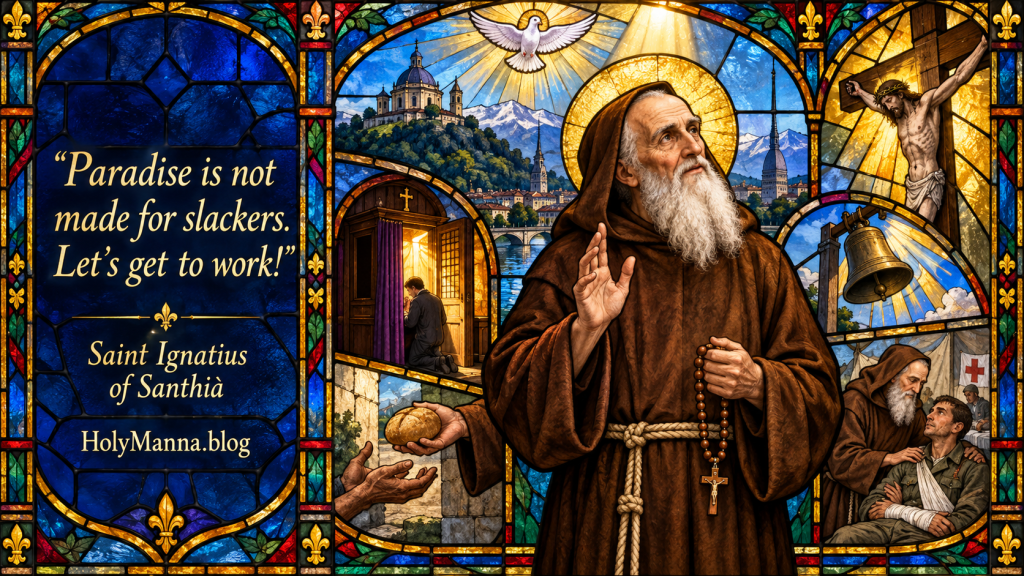
He had a saying that sums up how he faced every one of these trials, recorded in the Vatican’s official biography as words he often repeated: “Paradise is not made for slackers. Let’s get to work!”
The Hill That Never Emptied
Death did not end the crowds on Capuchin Hill; it multiplied them. Capuchin sources record that the fame of his holiness and the many miracles attributed to his intercession hastened his cause: the apostolic process was introduced in 1782, only twelve years after his death, and on March 17, 1827, Pope Leo XII proclaimed the heroic degree of his virtues, declaring him Venerable.
The formal miracles came in due course. Two healings attributed to his intercession were investigated by diocesan tribunals and ratified on October 19, 1963, and on that basis Pope Saint Paul VI beatified him in Saint Peter’s Basilica on April 17, 1966. A third miracle was investigated beginning in 1993, ratified on June 3, 1994, and approved by Pope Saint John Paul II on December 20, 2001. On May 19, 2002, the Solemnity of Pentecost, John Paul II canonized him in Saint Peter’s Square alongside four other holy men and women. The published sources consulted for this post confirm that these miracles were medically and canonically examined and approved, but they do not publish the personal details of the healings, so out of respect for accuracy none are invented here. Alongside these approved miracles, the broader Capuchin tradition of ongoing healings and favors received through his intercession, continuous from the eighteenth century onward, is part of his devotional legacy; those individual stories, like the Angelus bell healings of his lifetime, cannot be verified today and are honored as tradition.
The Church is confident in asking the saints to intercede for us because, as the Catechism teaches, the saints “do not cease to intercede with the Father for us, as they proffer the merits which they acquired on earth through the one mediator between God and men, Christ Jesus” (CCC 956). Pilgrims still act on that confidence. Saint Ignatius’s body rests under the altar of the left side chapel in the Church of Santa Maria al Monte dei Cappuccini in Turin, where the faithful venerate his relics, and relics are venerated as well in the collegiate church of his native Santhià, the very church whose rectorship he once declined. In Santhià itself, a plaque at number 112 of the main street marks the house where he was born and spent his youth, and the town honors him as its patron. His memory remains vital in his order; the Capuchin Minister General marked the two hundred fiftieth anniversary of his death in 2020 with a letter to the whole order. At the canonization celebrations, John Paul II told the pilgrims from Piedmont that the chronicles remember Ignatius as always caring and available to the great numbers who flocked to him, listening to their problems and making himself their daily minister of God’s pardon. And in his canonization homily the pope added words that read like a mission statement for this saint’s continuing work from heaven: even today he continues to remind everyone of the values of poverty, simplicity, and authentic Christian life.
Getting to Work on Holiness
What does an eighteenth century Capuchin confessor have to say to a Catholic in 2026 juggling work, family, screens, and stress? A surprising amount.
First, he teaches that peace is found in God’s will, not in success. Lorenzo Belvisotti had the eighteenth century equivalent of a thriving career and still confessed that his heart found no repose in it. He found peace only when he obeyed the voice calling him to something smaller in the world’s eyes and greater in God’s. The Catechism describes this beautifully: “The way of perfection passes by way of the Cross. There is no holiness without renunciation and spiritual battle” (CCC 2015). Is there an area of your life where you are chasing repose in success rather than in the will of God?
Second, he teaches the power of the confessional. If a whole region could be renewed because one priest made himself endlessly available for confession, then the sacrament itself must be a furnace of grace. The Church calls confession the sacrament of conversion, of forgiveness, and of Reconciliation, teaching that through it sinners are reconciled with God and with the Church (CCC 1423-1424 lays out these names and their meaning, and CCC 1468 teaches that its whole power consists in restoring us to God’s grace and joining us with him in an intimate friendship). A practical resolution in his honor would be simple: go to confession this month, and if fear or shame has kept you away for years, remember the refuge of rascals and go anyway. What is really keeping you from the confessional?
Third, he teaches mercy without exceptions. Ignatius earned the title father of sinners and the lost because he never treated any penitent as a lost cause. You can imitate this without a Roman collar. Be the person in your family, your parish, or your group chat who refuses to write anyone off, who welcomes back the friend who disappeared, who speaks about everyone and no one, and who reads what to say in the Crucifix.
Fourth, he teaches hidden faithfulness. Sacristan, novice master, chaplain, confessor: none of these are glamorous roles, and he spent over half a century in them. Holiness for most people looks like this, a long obedience in small duties done with great love. Fold the laundry, answer the email, drive the carpool, visit the sick relative, and do it all at God’s disposition.
Finally, he teaches diligence in the spiritual life. His most famous saying deserves a place on your desk or your mirror: “Paradise is not made for slackers. Let’s get to work!” Pick one concrete practice this week, a daily Rosary in honor of the friar who carried one, an Angelus prayed at noon in memory of the healings tradition associates with that bell, or a single act of generosity to the poor done quietly, the way he begged bread for the needy of Turin.
Which of these lessons is God pressing on your heart today, and what one small step will you take before this week ends?
Engage With Us!
Saint Ignatius of Santhià spent his life listening to people, so it is only fitting that this reflection ends by listening to you. Share your thoughts and reflections in the comments below; your story of God’s mercy might be exactly what another reader needs today. Here are some questions to get the conversation started.
- Saint Ignatius gave up a promising career because his heart found no rest in success. Where in your own life is God inviting you to trade worldly security for deeper peace?
- He was called the father of sinners and the lost. Who in your life needs you to be a refuge of mercy right now, and what would that look like in practice?
- When did the Sacrament of Reconciliation last change something real in your life, and what would help you return to it more often?
- Ignatius served the wounded and the plague stricken at real personal risk. What act of costly, hands on charity is within your reach this month?
- His motto was that paradise is not made for slackers. What is one spiritual habit you have been putting off that you can finally get to work on this week?
May the witness of Saint Ignatius of Santhià remind you that no one is beyond the reach of God’s mercy, least of all you. Live your faith boldly and humbly, seek the Lord in the sacraments, serve the poor and the suffering who cross your path, and do everything, in the words and the spirit of the Gospel, with the love and mercy that Jesus taught us.
Saint Ignatius of Santhià, father of sinners and the lost, pray for us!
Follow us on YouTube, TikTok, Instagram and Facebook for more insights and reflections on living a faith-filled life.

 Holy Manna!
Leave a comment