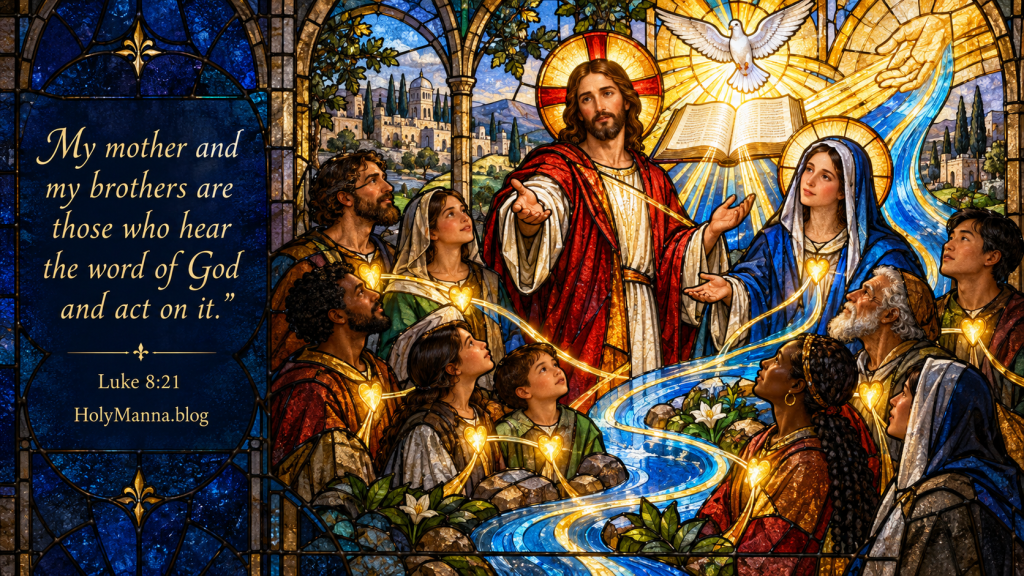
Tuesday of the Twenty-fifth Week in Ordinary Time – Lectionary: 450
The Heart God Is Looking For
Somewhere between the to-do list and the third cup of coffee, a quiet question waits for every believer: does God actually have my heart, or just my schedule? Today’s readings press that question gently but firmly. The Church sets before the faithful a proverb collection, a love song to God’s law, and a three-verse Gospel scene, and all of them circle one truth: God is after the heart, not the performance.
In the Book of Proverbs, Israel’s sages insist that even a king’s heart is like an irrigation stream in the hand of the LORD, and that “to do what is right and just is more acceptable to the LORD than sacrifice.” Israel’s wisdom tradition never separated worship from character; a sacrifice offered by a man who shuts his ear to the poor is noise, not prayer. The Responsorial Psalm answers with the only sane response to such a God: Psalm 119, the longest psalm in the Bible, an acrostic masterpiece in which the psalmist begs, “Give me discernment, that I may observe your law and keep it with all my heart.” Then Jesus, in the Gospel of Luke, gathers it all into a single sentence that still stuns two thousand years later: his mother and his brothers are “those who hear the word of God and act on it.”
Hearing and doing. Heart and hands. That is the whole day. The readings do not ask for more religious activity; they ask for a surrendered heart that lets God direct the stream. What follows walks through each reading and asks what it would look like to hand that heart over today.
First Reading — Proverbs 21:1-6, 10-13
When God Holds the King’s Heart
The Book of Proverbs gathers the distilled wisdom of Israel, much of it associated with Solomon and the royal court, polished across generations of teachers forming young men for public life. Chapter 21 sits in the great collection of short, two-line sayings that dominate chapters 10 through 22, most of them built on sharp contrasts: the wise and the foolish, the just and the wicked, the diligent and the lazy. Israel’s wisdom carries a signature no pagan court could match: everything, even the throne, sits under the sovereignty of the LORD. Today’s selection opens with the most powerful man in the ancient world, the king, and calmly announces that his heart is a channel of water in God’s hand. It then descends from the palace to the marketplace and the doorstep, testing hearts, motives, money, and mercy. The passage fits the day’s central theme perfectly, because it strips away every external credential and leaves only the question of the heart.
Proverbs 21:1-6, 10-13
Like a stream is the king’s heart in the hand of the LORD;
wherever it pleases him, he directs it.All the ways of a man may be right in his own eyes,
but it is the LORD who proves hearts.To do what is right and just
is more acceptable to the LORD than sacrifice.Haughty eyes and a proud heart–
the tillage of the wicked is sin.The plans of the diligent are sure of profit,
but all rash haste leads certainly to poverty.Whoever makes a fortune by a lying tongue
is chasing a bubble over deadly snares.The soul of the wicked man desires evil;
his neighbor finds no pity in his eyes.When the arrogant man is punished, the simple are the wiser;
when the wise man is instructed, he gains knowledge.The just man appraises the house of the wicked:
there is one who brings down the wicked to ruin.He who shuts his ear to the cry of the poor
will himself also call and not be heard.
Detailed Exegesis
Verse 1: “Like a stream is the king’s heart in the hand of the LORD; wherever it pleases him, he directs it.” Ancient farmers channeled water through irrigation canals, redirecting the flow with a simple cut of the bank. The sage claims that God steers even the sovereign will of a king that easily. The Catechism cites this very verse when it teaches that divine providence is concrete and immediate, declaring in CCC 303 that “God cares for all, from the least things to the great events of the world and its history.” No ruler, election, or empire escapes his hand.
Verse 2: “All the ways of a man may be right in his own eyes, but it is the LORD who proves hearts.” Self-justification is the oldest human reflex. The verb “proves” evokes a refiner assaying metal for purity. People grade themselves on intentions; God tests the actual alloy of the heart, which is why regular examination of conscience matters so much.
Verse 3: “To do what is right and just is more acceptable to the LORD than sacrifice.” This is the thesis of the whole passage, echoing Samuel’s rebuke of Saul and the prophet Hosea’s cry, “For it is loyalty that I desire, not sacrifice” (Hosea 6:6). God instituted sacrifice, yet worship divorced from justice disgusts him. Ritual is meant to express a converted life, never replace one.
Verse 4: “Haughty eyes and a proud heart: the tillage of the wicked is sin.” The image is agricultural. Just as a farmer’s field yields grain, the “field” the wicked man cultivates, watered by pride, yields only sin. Pride is not one fault among many; it is the soil from which the rest grow, which is why the Church names it first among the capital sins.
Verse 5: “The plans of the diligent are sure of profit, but all rash haste leads certainly to poverty.” Wisdom blesses patient, honest labor and warns against the get-rich-quick spirit; diligence is faithfulness in small things, lived out day by day.
Verse 6: “Whoever makes a fortune by a lying tongue is chasing a bubble over deadly snares.” Wealth built on deceit is as fragile as vapor and as dangerous as a trap; the con artist chases something that pops while the ground beneath him gives way.
Verse 10: “The soul of the wicked man desires evil; his neighbor finds no pity in his eyes.” Sin corrupts desire itself. The frightening progression is that evil stops being a lapse and becomes an appetite, and the first casualty is always the neighbor, who becomes invisible.
Verse 11: “When the arrogant man is punished, the simple are the wiser; when the wise man is instructed, he gains knowledge.” There are two schools of learning: watching consequences fall on the proud, or humbly receiving instruction. The wise man needs no disaster; correction alone is enough.
Verse 12: “The just man appraises the house of the wicked: there is one who brings down the wicked to ruin.” The “one” who brings down the wicked is God himself, the Just One. Prosperity built on wickedness looks solid from the street, but heaven has already done the inspection.
Verse 13: “He who shuts his ear to the cry of the poor will himself also call and not be heard.” The passage lands on mercy. Deafness to the poor produces deafness in heaven; the measure a man uses is measured back to him. This verse anticipates the parable of the rich man and Lazarus and seeds the Church’s entire teaching on the works of mercy.
Teachings
The Church has never allowed verse 13 to remain a poetic flourish. CCC 2443 teaches that “God blesses those who come to the aid of the poor and rebukes those who turn away from them.” Saint John Chrysostom, the golden-mouthed Doctor of the Church, preached on the rich man and Lazarus with words the Catechism preserves in CCC 2446: “Not to enable the poor to share in our goods is to steal from them and deprive them of life. The goods we possess are not ours, but theirs.” The Church made this concrete, teaching in CCC 2447 that “the works of mercy are charitable actions by which we come to the aid of our neighbor in his spiritual and bodily necessities.” On verse 3, CCC 2100 teaches that “outward sacrifice, to be genuine, must be the expression of spiritual sacrifice,” citing the psalmist’s broken and contrite heart. This is why the faithful confess their sins and exchange peace before approaching the altar: the Mass itself unites justice, reconciliation, and sacrifice in one act of worship.
Reflection
Proverbs refuses to let anyone hide behind religious activity. It asks about the heart behind the sacrifice, the honesty behind the income, the ears behind the prayers. A practical way to live this reading is to pick one verse and let it audit a single area of life this week: verse 5 for finances, or verse 13 for generosity toward the cry that has been easy to scroll past. A concrete step could be as simple as setting up one recurring gift to a Catholic charity, or finally answering the request for help that has been sitting unanswered. Another step is a nightly examination of conscience using verse 2, asking God to prove the heart before self-justification gets there first. Which of these ten verses lands closest to home right now, and what would it cost to obey it? When the poor cry out in this city, does that cry actually reach your ears, or has comfort quietly muted it?
Responsorial Psalm — Psalm 119:1, 27, 30, 34-35, 44
Falling in Love with the Law
Psalm 119 is the cathedral of the Psalter: 176 verses arranged as an alphabetic acrostic, 22 stanzas of 8 lines, one stanza for every letter of the Hebrew alphabet, as if to say that God’s law covers life from A to Z. Nearly every verse uses one of eight beloved synonyms for that law: precepts, ordinances, commands, statutes, decrees, words, promises, and the law itself. Composed in the spirituality that flourished after the Babylonian exile, when Israel discovered that God’s word was the one treasure no empire could burn, the psalm treats the law not as a cage but as a homeland. Saint Augustine loved it so much that he preached 32 homilies on it in his Expositions of the Psalms, admitting he had delayed the task for years because its simplicity concealed such depth. Today’s verses, chosen to answer Proverbs, turn the sage’s warning into a prayer: if the LORD proves hearts, then the only wise move is to hand the heart over and ask him to guide it. The refrain says it all: Guide me, Lord, in the way of your commands.
Psalm 119:1, 27, 30, 34-35, 44
R. (35) Guide me, Lord, in the way of your commands.
Blessed are they whose way is blameless,
who walk in the law of the LORD.
R. Guide me, Lord, in the way of your commands.
Make me understand the way of your precepts,
and I will meditate on your wondrous deeds.
R. Guide me, Lord, in the way of your commands.
The way of truth I have chosen;
I have set your ordinances before me.
R. Guide me, Lord, in the way of your commands.
Give me discernment, that I may observe your law
and keep it with all my heart.
R. Guide me, Lord, in the way of your commands.
Lead me in the path of your commands,
for in it I delight.
R. Guide me, Lord, in the way of your commands.
And I will keep your law continually,
forever and ever.
R. Guide me, Lord, in the way of your commands.
Detailed Exegesis
Verse 1: “Blessed are they whose way is blameless, who walk in the law of the LORD.” The psalm opens exactly like Psalm 1, with a beatitude. Blessedness, real happiness, is not a mood but a road. “Walk” frames the moral life as a journey taken step by step, long before Jesus called himself the Way and his followers were known as disciples of the Way.
Verse 27: “Make me understand the way of your precepts, and I will meditate on your wondrous deeds.” Understanding is begged for, not achieved. Notice the order: God grants understanding first, and meditation follows as gratitude. This is the pattern of grace preceding effort that runs through all Catholic teaching on prayer.
Verse 30: “The way of truth I have chosen; I have set your ordinances before me.” Grace never cancels freedom. After asking God to act, the psalmist announces his own decision. Faith is a chosen allegiance, renewed daily, like setting a compass on the table before the day’s travel begins.
Verse 34: “Give me discernment, that I may observe your law and keep it with all my heart.” Here the psalm meets Proverbs head-on. Half-hearted obedience is the disease; a whole heart is the cure, and even that must be requested as a gift. The Church recognizes this gift in the Holy Spirit’s work, since CCC 1831 teaches that “the seven gifts of the Holy Spirit are wisdom, understanding, counsel, fortitude, knowledge, piety, and fear of the Lord.”
Verse 35: “Lead me in the path of your commands, for in it I delight.” This verse, the day’s refrain, contains the psalm’s secret: delight. The psalmist does not grit his teeth at God’s commands; he enjoys them, the way a musician enjoys the scales that set him free to play.
Verse 44: “And I will keep your law continually, forever and ever.” The selection closes with a vow that outruns this life. “Forever and ever” only makes sense if obedience blossoms into eternity, where keeping God’s word and beholding God’s face become the same act.
Teachings
The Catholic reading of this psalm passes through Christ. The law the psalmist adores finds its fulfillment in the New Law, which CCC 1966 defines with breathtaking simplicity: “The New Law is the grace of the Holy Spirit given to the faithful through faith in Christ.” In other words, what the psalmist begged for from the outside, understanding, discernment, delight, the baptized receive from the inside, poured into the heart by the Spirit. Saint Augustine, Doctor of Grace, spent his 32 homilies on this psalm showing that every plea in it, “make me understand,” “give me discernment,” “lead me,” proves that keeping the law is itself a grace to be prayed for rather than a trophy to be earned. The psalm also quietly teaches the practice the Church calls lectio divina: the psalmist reads, meditates, prays, and delights, the exact rhythm of reading, meditation, prayer, and contemplation that monks would later formalize and that any believer can practice with ten minutes and an open Bible.
Reflection
The psalmist prays six verses, and five of them are requests. That ratio is worth imitating. Before opening the Scriptures, before Mass, before a hard decision, the simplest and most powerful prayer is the refrain itself: Guide me, Lord, in the way of your commands. A concrete practice for this week is to take that one line as a morning offering, said before checking the phone, so the first navigation request of the day goes to God instead of an app. Another step is to choose a single stanza of Psalm 119 each day and read it slowly at lunch, letting one verse become the afternoon’s companion. Delight grows by exposure; nobody delights in a law they never read. When God’s commandments come to mind, is the honest first reaction delight, duty, or dread? What one habit could turn Scripture from an occasional visit into a daily walk?
Holy Gospel — Luke 8:19-21
The Family That Hears and Does
Three verses, one thunderclap. Saint Luke places this scene immediately after the parable of the sower and the saying about the lamp, so the reader arrives already thinking about seed, soil, and hearing. Now the teaching gets a living illustration. In the ancient Mediterranean world, family was everything: identity, security, honor, and duty all flowed through blood. A rabbi’s mother and brothers arriving to see him would normally trump any crowd, yet Jesus overturns that entire social order in one sentence, announcing a new family founded on obedient hearing of God’s word. Luke tells the story far more gently than Mark 3, omitting any hint of tension, because for Luke the punchline is not who is excluded but who is included, and the first person included is Mary herself. From the annunciation onward, Luke has painted her as the model hearer and doer of the word. The scene thus gathers the whole day: Proverbs demanded a proven heart, the psalm begged for a guided one, and Jesus now reveals the reward, nothing less than belonging to his own household.
Luke 8:19-21
The mother of Jesus and his brothers came to him
but were unable to join him because of the crowd.
He was told, “Your mother and your brothers are standing outside
and they wish to see you.”
He said to them in reply, “My mother and my brothers
are those who hear the word of God and act on it.”
Detailed Exegesis
Verse 19: “The mother of Jesus and his brothers came to him but were unable to join him because of the crowd.” The crowd is the physical image of how many people now press toward Jesus, a preview of the worldwide family about to be defined. The “brothers” reflect the broad Semitic use of kinship language for close relatives, and the Church has always read the term this way. CCC 500 teaches that these “are close relations of Jesus, according to an Old Testament expression,” noting that James and Joseph are sons of another Mary, so the perpetual virginity of Our Lady stands untouched by this verse.
Verse 20: “He was told, ‘Your mother and your brothers are standing outside and they wish to see you.’” Standing outside is Luke’s quiet geography lesson. Physical proximity to Jesus, even blood relation to Jesus, does not by itself put a person “inside.” The message reaches him through the crowd, setting up the question every listener must answer: what actually moves someone from outside to inside?
Verse 21: “He said to them in reply, ‘My mother and my brothers are those who hear the word of God and act on it.’” This is no rejection of Mary; it is her coronation by her Son’s own criterion. Luke shows her hearing and doing from the first page, answering the angel, “Behold, I am the handmaid of the Lord. May it be done to me according to your word” (Luke 1:38), then keeping all these things in her heart, then standing with the apostles at Pentecost. Jesus opens his family to anyone who will do what his mother did. Saint James gives the same teaching its negative warning: “Be doers of the word and not hearers only, deluding yourselves” (James 1:22). Hearing without doing is self-deception; hearing with doing is kinship with God.
Teachings
Saint Augustine drew the definitive conclusion, preserved by the Church in CCC 506: “Mary is more blessed because she embraces faith in Christ than because she conceives the flesh of Christ.” Her greatest glory is not biology but obedience, which is wonderful news, because biology cannot be imitated and obedience can. The Second Vatican Council taught in Lumen Gentium 58 that “the Blessed Virgin advanced in her pilgrimage of faith, and faithfully persevered in her union with her Son unto the cross,” citing this very scene as a moment when Jesus praised those who hear and keep God’s word as Mary was already doing. Saint Gregory the Great pushed the mystery one thrilling step further in his Homily 3 on the Gospels, preaching that a person who is Christ’s brother and sister through belief “becomes his mother by preaching,” because such a person brings forth the Lord Jesus by carrying him into the heart of whoever listens. Every catechist, every parent teaching a child to pray, every friend who shares the Gospel over coffee is, in Gregory’s daring image, giving birth to Christ in another soul. Adoption into this family begins at Baptism and is lived out every time the word heard at Mass becomes action by Monday morning.
Reflection
The question this Gospel leaves behind is disarmingly practical: what did God’s word say most recently, and has anything been done about it? A concrete way to live these verses is to leave every Sunday Mass with one action item drawn from the readings, written in a phone note or on a receipt, and completed before the following Sunday. Another is to imitate Mary’s twofold habit from Luke 2:19: keep the word by memorizing one verse a week, and ponder it during a daily walk or commute. For those drawn to Saint Gregory’s image, the step is bolder: bring Christ to birth in someone else by sharing one thing God has done, out loud, with one person this week. When Jesus describes his true relatives, does that description honestly fit your last seven days? Who in your life is waiting, perhaps without knowing it, for you to become Christ’s mother by speaking his word to them?
Where the Stream Is Flowing
Put the three readings side by side and a single story emerges. Proverbs pulls back the curtain on reality: every heart, from the king’s on down, runs like a stream through the hand of the LORD, and what he wants flowing through it is not the smoke of sacrifice but justice, honesty, humility, and mercy for the poor. The psalmist, overhearing all this, does the only reasonable thing and hands the channel over, begging, “Lead me in the path of your commands, for in it I delight.” Then Jesus stands up in a crowded house and reveals what God does with a heart like that: he adopts it. “My mother and my brothers are those who hear the word of God and act on it.”
That is the astonishing arc of one ordinary Tuesday. The distance between a proverb about irrigation ditches and a seat at Christ’s family table turns out to be a single surrendered heart. Mary walked that distance first, from “May it be done to me according to your word” to the foot of the Cross, and she walks it now with every believer who tries to follow.
So the invitation today is wonderfully concrete. Hear the word: open the readings and let them prove the heart the way the LORD proves hearts. Then act on it: answer the cry of one poor person, tell the truth in one hard conversation, obey in one small matter before sunset. Streams move and grace flows. And somewhere in the middle of an unremarkable week, the God who directs the hearts of kings bends low, points to a heart that heard and obeyed, and says the most beautiful sentence imaginable: this one is family.
Engage With Us!
The conversation does not end here; it moves to the comments below. Share which reading struck the deepest chord today, what God seems to be saying through it, and how it might change the rest of this week. Someone else’s reflection may be exactly the encouragement another reader needs, and every honest comment helps build the family Jesus described. To get things started, here are a few questions to pray with:
- In Proverbs 21:1-6, 10-13, the sage warns that whoever shuts his ear to the cry of the poor will himself call and not be heard. Whose cry is God asking you to hear this week, and what is one concrete act of mercy you can offer in response?
- In Psalm 119:1, 27, 30, 34-35, 44, the psalmist prays for discernment to keep God’s law with his whole heart. What part of your heart is still held back from God, and what would it take to hand it over?
- In Luke 8:19-21, Jesus says his mother and brothers are those who hear the word of God and act on it. What is one word from God you have heard recently but not yet acted on, and what will acting on it look like?
- Taken together, today’s readings insist that God desires a surrendered, obedient heart more than any sacrifice. Where is God currently redirecting the stream of your heart, and are you letting him?
Living faith is exactly that: living. It breathes in the word at Mass and breathes out mercy at home, at work, and on the street. Keep hearing, keep doing, and keep showing up with the love and mercy Jesus taught, and the family resemblance will take care of itself. God bless, and see you in the comments.
Sacred Heart of Jesus, we trust in You!
Immaculate Heart of Mary, pray for us!
Saint Michael the Archangel, defend us in battle!
Follow us on YouTube, TikTok, Instagram and Facebook for more insights and reflections on living a faith-filled life.

 Holy Manna!
Leave a comment