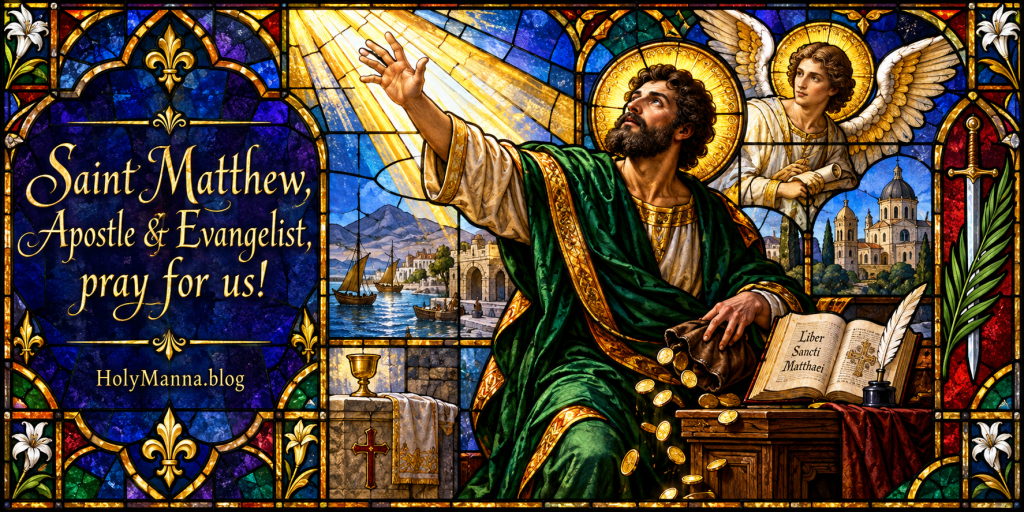
The Tax Collector Who Wrote a Gospel
Every September 21st, the Catholic Church celebrates the Feast of Saint Matthew, Apostle and Evangelist, one of the twelve men Jesus chose to carry His Gospel to the ends of the earth. Matthew holds a place in Christian tradition that almost no other saint can claim. He walked with Jesus, ate with Him, heard the Sermon on the Mount with his own ears, and then, moved by the Holy Spirit, handed the Church one of the four Gospels, the inspired accounts that the Catechism calls “the heart of all the Scriptures because they are our principal source for the life and teaching of the Incarnate Word, our Savior” (CCC 125). The Gospel that bears his name stands first in the New Testament, and it was the Gospel most quoted by the early Church Fathers.
Yet what makes Matthew so beloved is not his resume. It is his starting point. Before he was an apostle, Matthew was a tax collector, a man his own neighbors considered a traitor and a thief. His story is the story of what happens when the mercy of God looks directly at a person the world has already written off. That is why his feast still preaches. It tells every reader that no past disqualifies a soul from the call of Christ.
Saint Matthew is the patron saint of accountants, bankers, bookkeepers, tax collectors, customs officers, and financial professionals, a patronage drawn straight from the customs booth where Jesus found him. He is also the principal patron of the city of Salerno in Italy, where his relics rest to this day. In sacred art he is represented by the winged man, one of the four living creatures, because his Gospel opens with the human genealogy of Jesus Christ, a point noted by Saint Jerome in his commentary tradition on the evangelists.
The Two Words That Changed Everything
Matthew’s origins are known to readers through the Gospels themselves. He lived and worked in Capernaum, the fishing town on the northern shore of the Sea of Galilee that served as the home base of Jesus’ public ministry. The Gospel of Mark and The Gospel of Luke call him Levi, with Mark adding that he was “the son of Alphaeus” (Mk 2:14), while the first Gospel calls him Matthew, a name that comes from the Hebrew Mattityahu and means gift of the LORD. The constant tradition of the Church, following the Fathers, identifies Levi and Matthew as the same man. Many saints and scholars have understood Matthew as the name he carried after his call, in the same pattern by which Simon became Peter. A man who had spent his life collecting payments received, in exchange, a name that proclaimed him a gift freely given by God.
His profession tells readers almost everything about his social world. Matthew was a telones, a customs official stationed at Capernaum along the great trade road that linked Damascus to the Mediterranean coast. He collected duties and tolls on goods moving through the territory of Herod Antipas. In the eyes of his fellow Jews, this made him a collaborator with a pagan occupying power and, in the common assumption of the day, an extortioner, since tax collectors routinely enriched themselves by demanding more than was owed. Tax collectors were grouped in everyday speech with public sinners. Devout Jews avoided their tables and their company. Matthew was, in short, wealthy, comfortable, and despised.
The work also required real skills. A customs officer had to read, write, keep accounts, and operate in both Aramaic and Greek. Providence wastes nothing. The very training that made Matthew useful to Herod’s treasury would one day serve the Church, when the tax man’s pen took up the story of the Messiah.
Then came the moment that Christians have never stopped painting, preaching, and pondering. Matthew himself records it in a single verse of striking humility: “As Jesus passed on from there, he saw a man called Matthew sitting at the tax office; and he said to him, ‘Follow me.’ And he rose and followed him” (Mt 9:9). No negotiation, no probation, no list of conditions. The Gospel of Luke adds one detail that measures the depth of the response: “And he left everything, and rose and followed him” (Lk 5:28). The fishermen among the apostles could, and later did, return to their boats. A customs officer who abandoned his post walked away from his income, his standing with Rome’s clients, and his entire way of life in a single motion. There was no going back to the booth.
What happened next reveals the heart of the new disciple. Matthew threw a banquet at his own house and filled it with the only friends a tax collector had, other tax collectors and public sinners, and he seated Jesus among them. When the Pharisees objected, Jesus answered with words that Matthew treasured enough to record in full: “Those who are well have no need of a physician, but those who are sick. Go and learn what this means, ‘I desire mercy, and not sacrifice.’ For I came not to call the righteous, but sinners” (Mt 9:12-13). The Catechism points to exactly this scene when it teaches that Jesus invites sinners to the table of the kingdom and awaits their conversion: “Jesus invites sinners to the table of the kingdom: ‘I came not to call the righteous, but sinners’” (CCC 545). It adds elsewhere that Jesus scandalized His critics precisely by behaving toward sinners with the mercy of God Himself (CCC 589). Matthew’s dinner party was the first fruit of his conversion: a man newly found by mercy immediately set a table so that his friends could be found too.
One more detail deserves attention, because it shows the kind of man grace made of him. When Matthew lists the twelve apostles in his own Gospel, he alone attaches a label to his own name: “Thomas and Matthew the tax collector” (Mt 10:3). The other evangelists politely omit it. Matthew keeps it. He wanted the whole Church, forever, to know exactly what Christ had called and what mercy had done.
From Counting Coins to Counting Generations
Matthew matters to the Church first because Christ chose him as one of the Twelve, the men Jesus appointed to be with Him and to be sent out to preach. The Catechism teaches that the apostles are the foundation stones of the Church: “the Church is apostolic because she is founded on the apostles” and remains “taught, sanctified, and guided by the apostles until Christ’s return” (CCC 857). Matthew stood inside the events on which the faith rests. He heard the Beatitudes preached. He was in the boat in the storm. He received the Eucharist from the Lord’s own hands at the Last Supper, fled in the darkness of Gethsemane like the others, and then saw the risen Christ and received the great commission on the mountain in Galilee. Every reader who professes the Creed leans on the testimony of this man and his brother apostles.
The Gospels record no miracle worked by Matthew individually and by name during the Lord’s public ministry, and honesty requires saying so plainly. But Scripture does record that miraculous power was given to all Twelve together. Matthew himself writes: “And he called to him his twelve disciples and gave them authority over unclean spirits, to cast them out, and to heal every disease and every infirmity” (Mt 10:1). Matthew was sent out on mission with that authority, preaching that the kingdom of heaven was at hand, healing the sick and driving out demons alongside his companions. After Pentecost, The Acts of the Apostles shows the apostolic band as a whole working “many wonders and signs” (Acts 2:43), and Matthew was numbered among them, present in the upper room when the Holy Spirit descended (Acts 1:13).
His singular gift to the Church, however, came through his pen. The earliest surviving testimony about the Gospels comes from Papias, bishop of Hierapolis, writing around the year 125 and preserved by the historian Eusebius: “Matthew collected the oracles in the Hebrew language, and each interpreted them as best he could” (Eusebius, Church History 3.39.16). A generation later, Saint Irenaeus of Lyons wrote: “Matthew also issued a written Gospel among the Hebrews in their own dialect, while Peter and Paul were preaching at Rome and laying the foundations of the Church” (Against Heresies 3.1.1). Scholars continue to discuss how this early Hebrew or Aramaic composition relates to the Greek text of the Gospel the Church reads today, and Catholic readers can hold that open question honestly. What the Church teaches with confidence is the apostolic origin of the four Gospels, which “hand on what Jesus, the Son of God, while he lived among men, really did and taught for their eternal salvation” (CCC 126, quoting Dei Verbum).
Consider what that Gospel contains, and why the early Church loved it above all others. The Gospel of Matthew opens by counting the generations from Abraham to David to Christ, a genealogy only a man comfortable with careful records would have compiled, presenting Jesus as the fulfillment of every promise made to Israel. It gathers the Lord’s teaching into five great discourses, beginning with the Sermon on the Mount and the Beatitudes. It is the only Gospel in which the word church appears on the lips of Jesus, at Caesarea Philippi, “you are Peter, and on this rock I will build my church” (Mt 16:18), and again in His teaching on fraternal correction (Mt 18:17). Again and again it pauses to show a prophecy fulfilled. And it is framed, beginning to end, by a single promise: the child is named “Emmanuel (which means, God with us)” (Mt 1:23), and the risen Lord’s final words are “I am with you always, to the close of the age” (Mt 28:20). The tax collector turned out to be the great accountant of fulfillment, tallying the promises of God and showing every one of them paid in Christ.
One surprising personal detail survives from the early centuries. Clement of Alexandria, writing before the year 215, records that “Matthew the apostle partook of seeds and nuts and vegetables, without flesh” (Paedagogus 2.1). The man who once feasted on the profits of the customs booth ended his days in voluntary austerity. Readers should remember and emulate Matthew because he shows conversion as a complete reorientation, not a single emotional moment. He gave Christ his past by leaving the booth, his present by his preaching and his penance, and his future by his Gospel and his blood.
A Sword at the Altar
The New Testament falls silent about Matthew after Pentecost, and the early Church fills in the picture with a mixture of solid testimony and later tradition, which honest telling must keep distinct.
The most reliable early strand holds that Matthew first spent years preaching to his fellow Jews in the Holy Land, which fits perfectly with a Gospel written for an audience steeped in the Law and the Prophets. After that, ancient writers send him in different directions. The dominant Western tradition holds that he carried the faith to a land the sources call Ethiopia, while other early accounts name Persia, Parthia, or Pontus. These reports cannot be fully harmonized, and it is more honest to say that Matthew went east to the nations than to insist on a single itinerary. What every strand agrees on is that he obeyed the commission he himself recorded: “Go therefore and make disciples of all nations, baptizing them in the name of the Father and of the Son and of the Holy Spirit” (Mt 28:19).
Whatever his road, the hardships of an apostle in the first century were constant and crushing. He traveled without wealth he had long since abandoned, preached a crucified Messiah to audiences that ranged from indifferent to violent, and lived under the same threat that took the lives of nearly all his brother apostles. For a man who had once known the comfort of steady income and a fine house in Capernaum, this poverty and danger were themselves a long martyrdom of daily fidelity.
The traditional account of his death comes from an ancient passion narrative that the Church has never treated as Scripture, and it is told here as the tradition it is. According to this story, Matthew’s preaching in Ethiopia was opposed by two sorcerers, Zaroes and Arfaxat, whose power he overcame in the name of Christ. He then raised the king’s son from the dead, and the astonished King Egippus believed and was baptized with his household. The king’s daughter, Iphigenia, chose to consecrate her virginity to Christ and gathered other consecrated women around her. When Egippus died, his successor Hirtacus desired to marry Iphigenia and demanded that Matthew persuade her. Instead, the apostle publicly taught that a soul consecrated to the King of heaven could not be handed to an earthly king. Enraged, Hirtacus sent a soldier who struck Matthew down with a sword at the altar, immediately after he had celebrated Mass. This story cannot be verified.
Two things, however, can be said with confidence. First, the Church’s ancient liturgy venerates Matthew as a martyr; the Roman Martyrology commemorates his apostolic labors and his martyrdom, and the priest wears red on his feast. Second, even in antiquity there was some divergence, since one early writer quoted by Clement of Alexandria implies that Matthew died a natural death, a conflict the sources never resolve. Whether his witness ended in blood at an altar or in a long life poured out drop by drop, Matthew gave the testimony the Catechism calls supreme: “Martyrdom is the supreme witness given to the truth of the faith: it means bearing witness even unto death” (CCC 2473). The image of the apostle slain at the altar has never left the Catholic imagination, because it says something true regardless of its historical details: the man who was called at a table of money ended at the table of the Eucharist, and he would not trade it for his life.
Manna from a Tomb
Devotion to Saint Matthew after his death spread wherever his Gospel was read, which is to say everywhere. His book itself is his greatest posthumous work; through it, the tax collector of Capernaum has catechized every generation of Christians for two thousand years, and the Catechism still quotes his Gospel constantly, from the Beatitudes to the Our Father to the judgment of the nations.
The story of his relics belongs partly to tradition and partly to documented history. Tradition holds that his body was brought from the East and came to rest at Velia in Lucania, in southern Italy, where it lay for centuries. This early stage of the journey cannot be verified. From the tenth century onward the record firms up considerably: in the year 954, his relics were solemnly translated to Salerno, an event the local church has commemorated ever since. Over that tomb rose the great Cathedral of San Matteo, consecrated in the 1080s by Pope Saint Gregory VII, the reforming pope who died in exile in Salerno in 1085 and is himself buried in the same cathedral. To this day, pilgrims descend into the crypt to pray at the apostle’s tomb beneath a canopy of baroque splendor.
Salerno’s devotion to its patron is a living national treasure of southern Italy. Every September 21st the city keeps its patronal festival, and the silver statue of Saint Matthew is carried in procession through streets packed with the faithful, accompanied by the statues of the city’s early martyrs. Sailors, civic officials, and ordinary families walk together behind the apostle. A cherished local tradition holds that in 1544, when the corsair Barbarossa threatened Salerno from the sea, the people invoked Saint Matthew and a sudden storm scattered the fleet, sparing the city; Salerno has credited its patron with that deliverance ever since. This story cannot be verified.
Another tradition touches the tomb itself. For centuries, the faithful of Salerno have spoken of the manna of Saint Matthew, a liquid said at times to exude from his relics, gathered with reverence as a sign of the apostle’s nearness. Similar phenomena are reported at the tombs of a small number of saints, and the Church has never issued a formal judgment establishing this one. This tradition cannot be verified. Yet even as a tradition it preaches something the Catechism affirms about all the saints in glory: “They do not cease to intercede with the Father for us… So by their fraternal concern is our weakness greatly helped” (CCC 956). Believers who ask Saint Matthew’s intercession, whether for honesty at work, courage in conversion, or love of the Scriptures, are doing exactly what the communion of saints invites (CCC 946-948).
Matthew’s cultural reach goes far beyond Salerno. His symbol, the winged man, gazes out from illuminated manuscripts like the great Gospel books of the early Middle Ages and from the facades of cathedrals across the world. In Rome, in the Contarelli Chapel of the church of San Luigi dei Francesi, Caravaggio’s three canvases of the saint, above all The Calling of Saint Matthew, have drawn millions to stand in the dark and watch a beam of painted light fall on a startled tax collector. And in modern times his feast marked a papal vocation. Pope Francis traced the awakening of his own call to the priesthood to a confession he made as a seventeen year old on September 21st, 1953, the feast of Saint Matthew, and he took as his motto words from Saint Bede the Venerable’s homily on Matthew’s call, read by the whole Church in the Office of Readings for this feast: “Jesus saw a man called Matthew sitting at the tax office, and he said to him: Follow me. Jesus saw Matthew, not merely in the usual sense, but more significantly with his merciful understanding of men… He saw the tax collector and, because he saw him through the eyes of mercy and chose him, he said to him: Follow me” (Saint Bede the Venerable, Homily 21). Miserando atque eligendo, by having mercy and by choosing. Sixteen centuries after his death, the tax collector of Capernaum was still shaping the Church at its highest office.
What Jesus Sees When He Looks at You
Matthew’s life presses one question on every reader before all others: when Jesus looks at you, do you believe He sees you the way He saw the man in the tax booth, with mercy and with a call? Saint Bede’s insight is not a poetic flourish; it is the Gospel’s own logic. Jesus did not wait for Matthew to become respectable. He called him in the middle of his compromises, and the call itself created the new man. The Catechism teaches that “the Gospel is the revelation in Jesus Christ of God’s mercy to sinners” (CCC 1846). Matthew is that sentence with a face.
His story also teaches that conversion has a cost and a speed. Matthew rose. He did not schedule a follow-up meeting with the Lord or ask to finish out the tax season. Readers can imitate that promptness in small, concrete ways. When conscience prompts a return to Confession after years away, go this week, not someday; Matthew would recognize the terror and the relief of that first honest accounting, and the sacrament of Penance is where the Physician still receives the sick (CCC 1446). When a habit, a grudge, or an income stream cannot coexist with following Christ, leave it at the booth. What is the one thing you know you would have to leave behind if Jesus said “Follow me” to you today?
Matthew’s banquet offers a second practical program. His first act as a disciple was hospitality aimed at the people the religious world avoided. Readers can do the same at their own tables: invite the coworker everyone gossips about, the family member who left the Church, the friend who thinks he is too far gone. Evangelization for Matthew began with dinner. Who is one person you could welcome to your table this month so that they might encounter the mercy that found you?
Finally, Matthew hands every reader his Gospel and asks that it be read. A simple resolution honors him best: read The Gospel of Matthew slowly, a chapter a day for four weeks, beginning with the Sermon on the Mount, and let the Lord’s own words do their work. The Catechism urges exactly this familiarity, recalling Saint Jerome’s warning that “Ignorance of the Scriptures is ignorance of Christ” (CCC 133). The man who left everything to follow Jesus wrote it all down so that others could follow too. Compassion for the outsider, resilience under contempt, promptness in obedience, and love for the Word of God: these are Matthew’s virtues, and they fit inside any ordinary life, at any desk, in any booth.
Engage With Us!
Saint Matthew’s story belongs to everyone who has ever wondered whether their past put them beyond the reach of God, and HolyManna would love to hear how it lands in your life. Share your thoughts and reflections in the comments below, and consider praying with these questions this week.
- When Jesus looks at you “through the eyes of mercy,” what do you believe He sees, and what might He be choosing you for?
- Matthew “rose and followed him” immediately. What invitation from God have you been postponing, and what would it take to rise today?
- Matthew’s first act as a disciple was to host sinners at his table with Jesus. Who in your life needs a seat at your table, and when will you offer it?
- Matthew kept the label “the tax collector” beside his own name as a memorial of mercy. How could remembering your own story of forgiveness make you more merciful toward others?
- Which chapter of “The Gospel of Matthew” will you commit to reading this week, and how will you let it shape one decision?
Saint Matthew heard two words and gave the rest of his life in answer. The same voice still passes by every desk, every booth, every ordinary Tuesday, and it still says, “Follow me” (Mt 9:9). Rise and follow. Live this day, and every day, with the love and mercy that Jesus taught us, and let the mercy that found a tax collector in Capernaum make of your life a gift of God.
Saint Matthew, Apostle and Evangelist, pray for us!
Follow us on YouTube, TikTok, Instagram and Facebook for more insights and reflections on living a faith-filled life.

 Holy Manna!
Leave a comment