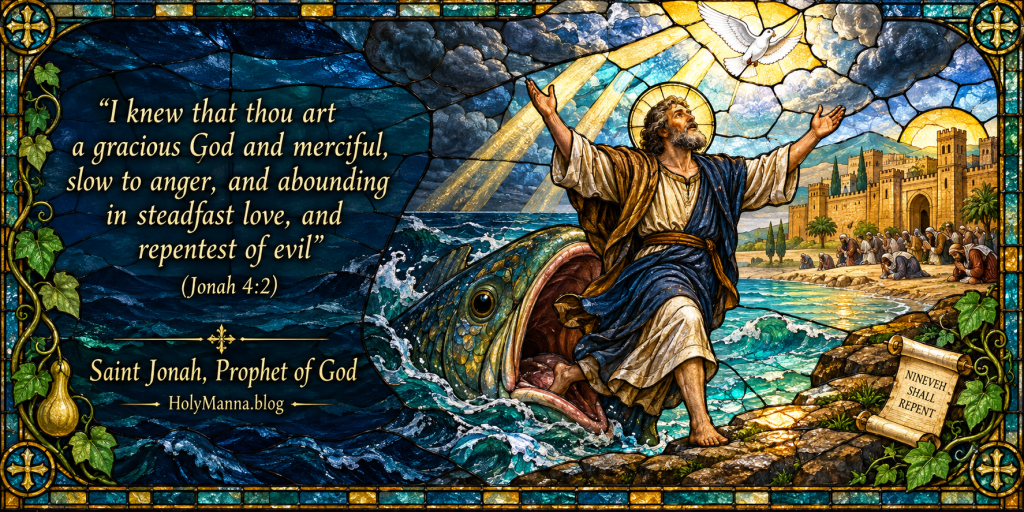
The Runaway Prophet
Every year on September 21st, tucked quietly into the Roman Martyrology just after the Feast of Saint Matthew, the Church remembers a saint who spent a good part of his recorded life running away from God. Saint Jonah, son of Amittai, is one of the Twelve Minor Prophets of the Old Testament, and his name in Hebrew means “dove.” He is the prophet of the great fish, the prophet of Nineveh’s repentance, and, most importantly for Christians, the prophet whom Jesus Himself chose as the sign of His own death and Resurrection. When the scribes and Pharisees demanded a sign, the Lord answered, “no sign shall be given to it except the sign of the prophet Jonah” (Matthew 12:39). That single sentence lifted an obscure Galilean prophet into the very center of the Gospel.
Jonah is a strange kind of saint. He did not die a martyr. He worked no healings with his hands. He is remembered, honestly and without embarrassment, as the man who heard God’s call and booked passage in the opposite direction. And yet the Church venerates him, because his story is not finally about his weakness; it is about the mercy of a God who pursues His prophet through storm and sea, and who pursues a violent pagan city all the way to repentance. The Catechism teaches that the Old Testament prepares for the New and that its people, events, and figures are read by the Church as real anticipations of Christ (CCC 128 to 130). Few figures anticipate Christ as vividly as Jonah, three days in the deep and then restored to the land of the living. His commemoration is a yearly invitation to stop running, to trust that God’s mercy is wider than any grudge, and to remember that the Lord’s patience extends even to His most reluctant messengers.
A Prophet from Galilee Before Galilee Was Famous
Unlike some figures in the prophetic books, Jonah is firmly anchored in the recorded history of Israel. The Second Book of Kings notes that during the reign of King Jeroboam II, in the 8th century before Christ, the borders of Israel were restored “according to the word of the LORD, the God of Israel, which he spoke by his servant Jonah the son of Amittai, the prophet, who was from Gath-hepher” (2 Kings 14:25). This one verse tells the reader three precious things. Jonah was a real prophet with a public ministry in the Northern Kingdom of Israel. He served during a period of national expansion and prosperity under Jeroboam II. And he came from Gath-hepher, a small town in the territory of Zebulun in Lower Galilee, only a few miles from the place that would one day be called Nazareth.
That last detail deserves a pause. Centuries later, the enemies of Jesus would sneer that no prophet arises from Galilee. The Church has long noticed the irony, because Jonah did. The Lord of history had already planted a prophet in the hills of Galilee long before He planted His own childhood there. Jonah stands in the prophetic line of the north; he came after the great days of Elijah and Elisha, and his early ministry, the one mentioned in 2 Kings, was actually a message of good news, the restoration of Israel’s borders. Nothing certain is known of his family beyond his father’s name, Amittai, which is related to the Hebrew word for truth.
There is one ancient tradition about his origins that is worth telling, so long as it is told as a tradition. The early Christian work known as the Lives of the Prophets, along with later writers, held that Jonah was the son of the widow of Zarephath, the boy whom the prophet Elijah raised from the dead in 1 Kings 17. If that were true, the man who spent three days in the belly of the fish would already have known, in his own body, what it is to be given back from death. It is a beautiful and fitting thought, and generations of the faithful have cherished it, but it is a tradition and it cannot be verified.
Jonah’s deepening, his real conversion, did not come at the start of his ministry but in the middle of it, and it came the hard way. God spoke a second kind of word to him, not a comfortable prophecy for his own nation but a command to carry a warning to the enemy: “Arise, go to Nineveh, that great city, and cry against it; for their wickedness has come up before me” (Jonah 1:2). Nineveh was the great city of Assyria, the empire whose cruelty was a byword across the ancient world and whose armies were the standing terror of Israel. Jonah heard the command clearly. And The Book of Jonah records his response with devastating simplicity: “But Jonah rose to flee to Tarshish from the presence of the LORD” (Jonah 1:3). Tarshish lay in the far west, in the exact opposite direction. The Catechism observes soberly that man, though made to live in communion with God, can forget, reject, or flee from His call (CCC 29). Jonah is Scripture’s most famous illustration of that flight, and the rest of his story is the account of how God refused to accept his resignation.
A Storm, a Fish, and the Greatest Revival of the Old Testament
Jonah boarded a ship at Joppa, paid his fare, and went below deck to sleep, as if a man could nap his way out of a vocation. God, Scripture says, hurled a great wind upon the sea. The pagan sailors, terrified, each cried to his own god and threw the cargo overboard, while the prophet of the true God slept in the hold. When the lot fell on Jonah and the sailors demanded to know who he was, he gave an answer that is almost comic in its self-contradiction, confessing faith in the very God he was fleeing: “I am a Hebrew; and I fear the LORD, the God of heaven, who made the sea and the dry land” (Jonah 1:9). Then came the first flash of the saint hidden inside the runaway. Jonah did not let the crew perish for his sin. He said, “Take me up and throw me into the sea; then the sea will quiet down for you; for I know it is because of me that this great tempest has come upon you” (Jonah 1:12). The sailors resisted, rowed hard, and finally, praying for forgiveness, cast him into the water. The sea instantly ceased its raging, and those pagan sailors feared the Lord, offered sacrifice, and made vows. Even in his disobedience, Jonah’s presence brought a boatload of Gentiles to the worship of the true God. That calming of the storm at the cost of one man in the water is the first miracle of his story, and the sailors’ conversion is its first fruit.
Then comes the wonder for which everyone knows him. “And the LORD appointed a great fish to swallow up Jonah; and Jonah was in the belly of the fish three days and three nights” (Jonah 1:17). The Bible does not present the fish as a punishment. It presents it as a rescue. A drowning man was caught, carried, and kept alive by a creature appointed by God for exactly that purpose. From inside that impossible chapel, Jonah finally prayed, and his prayer, preserved in Jonah 2, reads like a psalm from the threshold of death: “I called to the LORD, out of my distress, and he answered me; out of the belly of Sheol I cried, and thou didst hear my voice” (Jonah 2:2). The prayer ends with the whole theology of the book in five words: “Deliverance belongs to the LORD!” (Jonah 2:9). And the fish, at God’s command, returned Jonah to dry land.
Given a second chance, Jonah obeyed. He walked into Nineveh, an enormous city, and preached what may be the shortest recorded sermon in Scripture: “Yet forty days, and Nineveh shall be overthrown!” (Jonah 3:4). What happened next has no parallel in the Old Testament. “And the people of Nineveh believed God; they proclaimed a fast, and put on sackcloth, from the greatest of them to the least of them” (Jonah 3:5). The king himself came down from his throne, covered himself with sackcloth, sat in ashes, and decreed a fast for man and beast alike, commanding everyone to turn from violence and cry mightily to God. An entire pagan capital, the seat of the most feared empire on earth, repented at the word of one foreign preacher. God saw their deeds, and He relented from the destruction He had threatened. The Church recognizes in Nineveh’s response the very shape of true penance that she still teaches: interior conversion of heart expressed outwardly in fasting, prayer, and works of repentance (CCC 1430 to 1431, 1434). This is why the Church places Jonah 3 on the lips of the faithful at Mass in the first week of Lent, and why Jesus could say, “The men of Nineveh will arise at the judgment with this generation and condemn it; for they repented at the preaching of Jonah, and behold, something greater than Jonah is here” (Matthew 12:41). The reader should remember Jonah, and emulate him, precisely because God accomplished all of this through a flawed, resistant, second-chance man. His life is proof that God’s plans do not depend on perfect instruments, and that no one’s past disobedience disqualifies them from future mission.
Swallowed by the Deep and Wrestling with Mercy
Jonah was never martyred, and his hardships were not prisons or executioners. His sufferings came in two forms, and both cut deep: the terrors he passed through in his flight, and the harder, quieter battle inside his own heart.
The first hardship was the sea itself. It is easy, at the distance of centuries and children’s picture books, to forget what the second chapter of his book actually describes. Jonah went down into darkness. “The waters closed in over me, the deep was round about me; weeds were wrapped about my head” (Jonah 2:5). He describes descending to the roots of the mountains, to the land whose bars closed upon him forever. This is the prayer of a man who genuinely died to every human hope of survival and was preserved only by a direct act of God. His deliverance after three days is presented by Scripture not as luck but as divine protection in its most dramatic form, and it is exactly this miraculous preservation that Jesus seized upon: “For as Jonah was three days and three nights in the belly of the whale, so will the Son of man be three days and three nights in the heart of the earth” (Matthew 12:40). The Church confesses that Christ’s Resurrection fulfilled the promises of the Old Testament (CCC 652 to 653), and Jonah’s rescue from the deep is the Old Testament’s clearest sketch of that fulfillment.
The second hardship was interior, and The Book of Jonah is brutally honest about it. When God spared Nineveh, Jonah was not relieved. He was furious. His anger produced one of the most remarkable confessions in the Bible, in which the prophet complains about God’s goodness: “I knew that thou art a gracious God and merciful, slow to anger, and abounding in steadfast love, and repentest of evil” (Jonah 4:2). Jonah had fled in the first place, he admits, because he suspected God would forgive, and he did not want Assyria forgiven. Israel had suffered too much at Assyrian hands. Jonah wanted justice for his people, and God kept insisting on mercy for everyone. Here the reader meets the real battlefield of Jonah’s sanctity, which was not the sea but his own resentment.
God’s response to His sulking prophet is one of the most tender lessons in Scripture. As Jonah sat outside the city hoping to watch it burn, God appointed a plant to grow up and shade his head, and Jonah was very glad. Then God appointed a worm to kill the plant, and a scorching east wind, until Jonah begged to die. And God asked him, in effect, whether it was right to pity a plant that cost him nothing while begrudging pity to a city full of souls: “And should not I pity Nineveh, that great city, in which there are more than a hundred and twenty thousand persons who do not know their right hand from their left, and also much cattle?” (Jonah 4:11). The book ends on that question, unanswered, hanging in the air for Jonah and for every reader since. The Catechism teaches that God’s very name revealed to Israel is “a God merciful and gracious, slow to anger, and abounding in steadfast love and faithfulness” (Exodus 34:6; CCC 210 to 211), and that the Gospel is the revelation of God’s mercy to sinners (CCC 1846). Jonah’s final hardship was learning to love that mercy even when it landed on his enemies; and the fact that his book exists at all, told against its own author’s pride, suggests he learned it.
The Sign That Outlived the Prophet
Scripture says nothing about how or where Jonah died, and no miracles of healing are recorded at his tomb in Catholic sources; anything asserted along those lines would be invention, and it will not be found here. Yet it is fair to say that few Old Testament saints have had a greater impact after death, because Jonah’s greatest sign was fulfilled centuries after he was buried, on the third day, in a garden tomb outside Jerusalem. Jesus staked His credibility on the sign of Jonah, and when He rose, Jonah’s three days in the deep became forever the Church’s shorthand for the Resurrection.
The early Christians understood this instinctively. In the Roman catacombs, where the persecuted Church buried her dead, Jonah appears more often than any other Old Testament figure. Painted cycles show him thrown to the sea creature, delivered from its mouth, and resting under his plant, images of the soul carried through death into rest. The same scenes were carved on Christian sarcophagi, including the famous Jonah sarcophagus preserved today in the Vatican Museums. For believers facing martyrdom, Jonah was not a children’s tale; he was a promise in stone that the deep does not get the last word.
His memory also shaped the Church’s calendar and penitential life. The Latin Church commemorates him each September 21st; the traditional Roman Martyrology announces, “In the land of Saar, the holy prophet Jonas, who was buried in Geth”, and the 2004 Martyrologium Romanum likewise commemorates Saint Jonah the prophet, son of Amittai, on this date. The Byzantine churches honor him on September 21st or 22nd. Most striking of all, the Chaldean Catholic Church, together with the Syriac and Coptic traditions, still keeps the three-day Fast of Nineveh in the weeks before Lent, a living echo of the fast the Ninevites proclaimed at Jonah’s preaching, observed to this day by Catholics of the East.
As for his tomb, the traditions conflict, and honesty requires saying so. One ancient tradition, reflected in the Martyrology, places his burial at Gath-hepher in Galilee, his hometown, where a tomb was shown to pilgrims from antiquity; Saint Jerome, who wrote a full Commentary on Jonah around the year 396, knew of the site. A second and very famous tradition places his tomb at Nebi Yunus, “the Prophet Jonah,” on a mound of ancient Nineveh in Mosul, Iraq, as if the city he saved had claimed him for its own. A third claim exists at Halhul, near Hebron. None of these burial traditions can be verified. The Nineveh tradition, however, wrote itself into modern history in a painful way: on July 24th, 2014, ISIS militants blew up the shrine of Nebi Yunus, an act of destruction mourned by Christians and Muslims alike, and later excavations of the ruined mound uncovered an Assyrian royal palace beneath the shrine. Even in destruction, Jonah’s site bore witness to the real, historical Nineveh to which the prophet was sent. Saint Augustine, for his part, had defended the truth of Jonah’s story against pagan mockery already in his Letter 102, and the Church has gone on reading the book at Mass ever since, in Lent and in Ordinary Time, because a story God wrote into history that carefully is a story He means His people to keep hearing.
When God Calls and the Ticket Says Tarshish
Jonah’s life reads differently once a person admits how much of it feels familiar. Almost everyone has a Nineveh, some person, task, or act of forgiveness that God is clearly asking for, and almost everyone has a Tarshish, the respectable busyness sailed toward instead. Jonah’s story insists on two truths at once. God does not shrug when His call is refused; He sends the storm, the sleepless conscience, the disruption that will not let the runaway rest. And God does not discard the one who ran; the same voice that said “Arise, go” the first time says it a second time, without a word of reproach. Where in life right now is the ship headed for Tarshish, and what would it cost to turn around?
The Ninevites offer their own lesson. They heard one blunt sentence of warning and responded with total seriousness: fasting, sackcloth, and a genuine turning from violence. The Church still proposes exactly these remedies, conversion of heart expressed through prayer, fasting, and almsgiving (CCC 1434), and still places Nineveh before the faithful every Lent. Jesus warned that the men of Nineveh would rise at the judgment and condemn a generation that heard something greater than Jonah and did nothing. A practical response might be as simple as returning to the Sacrament of Reconciliation this month, taking on one small weekly fast for the conversion of a specific person, or finally having the conversation that repentance requires. When was the last time a warning from God, through Scripture, a homily, or a friend, was met with Nineveh’s urgency rather than polite delay?
And then there is the plant. Jonah cared more about his own comfort and his own grievance than about a hundred and twenty thousand souls, and God, patiently, refused to leave him there. His unfinished question at the end of the book is addressed to every reader who has ever secretly hoped an enemy would not be forgiven. Mercy received must become mercy extended. Is there anyone whose repentance would honestly be unwelcome, and what would it take to pray sincerely for that person’s salvation this week? Living Jonah’s lesson means choosing compassion over resentment, resilience over despair in the deep places, and trust that God can still use a messenger with a checkered past, because He plainly prefers it that way.
Engage With Us!
Saint Jonah’s story has been provoking honest self-examination for well over two thousand years, and it still works. Readers are warmly invited to share their thoughts, struggles, and reflections in the comments below; someone else’s Tarshish story might be exactly the encouragement another reader needs today. To help the conversation begin, here are a few questions to pray with:
- What is the “Nineveh” God is asking you to face right now, and what does your “Tarshish” look like?
- Jonah prayed his most honest prayer from the belly of the fish; when has a low point in your life become the place where you finally turned back to God?
- The Ninevites responded to one sentence of preaching with fasting and total conversion; what concrete act of penance could you take up before this week ends?
- Is there a person or group you struggle to want God to forgive, and how might you begin praying for their good?
- Jesus called Himself “something greater than Jonah”; how does seeing Jonah’s three days in the deep as a sign of the Resurrection change the way you face your own trials?
However far anyone has run, the God of Jonah is already appointing the means of rescue, and His second call is as gentle as His first. Live this day as a citizen of Nineveh on the day it believed: quick to repent, quick to hope, and quick to show others the same patience God shows His runaways. Go forward in faith, and do everything with the love and mercy that Jesus taught.
Saint Jonah, Prophet of God, pray for us!
Follow us on YouTube, TikTok, Instagram and Facebook for more insights and reflections on living a faith-filled life.

 Holy Manna!
Leave a comment