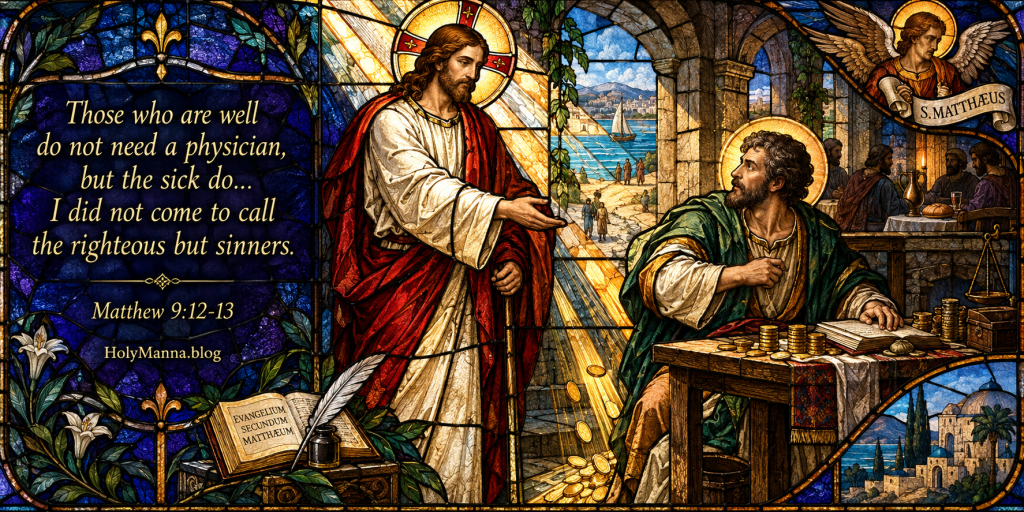
Feast of Saint Matthew, Apostle and Evangelist – Lectionary: 643
The Day a Tax Collector Became a Gospel
Imagine a man so despised by his neighbors that his testimony was not accepted in court, and then imagine that man writing the most widely read account of Jesus Christ in history. That is the story the Church celebrates on September 21st, the Feast of Saint Matthew, Apostle and Evangelist. The readings for this feast form a single, breathtaking arc. In the Gospel, Jesus passes a customs post in Capernaum, looks at a collaborator and public sinner, and speaks two words that remake a life: “Follow me.” In the First Reading, Paul, himself a former persecutor turned prisoner for the Lord, explains what that call produces, a Church where Christ gives “some as Apostles, others as prophets, others as evangelists” to build up one Body. And in the Responsorial Psalm, the Church sings where that call ultimately leads: “Through all the earth their voice resounds, and to the ends of the world, their message.”
The central theme uniting these readings is that mercy calls, and the called become messengers. Matthew’s world would have said his story was over; tax collectors in first-century Galilee were considered traitors who bought the right to squeeze their own people for Rome and its client rulers. Yet Jesus does not wait for Matthew to clean himself up. He calls him mid-shame, mid-ledger, mid-sin. Saint Bede the Venerable taught that Jesus saw him miserando atque eligendo, by having mercy and by choosing. That gaze turned a customs officer into an evangelist whose message has now reached every corner of the earth. This feast asks whether that same gaze might be resting, right now, on someone reading these words.
First Reading — Ephesians 4:1-7, 11-13
A Prisoner Writes About Freedom
There is something wonderfully upside-down about this reading. Paul writes from Roman custody, likely chained to a guard around the year 60 AD, yet he speaks not of his own suffering but of unity, gifts, and the glorious maturity of the Church. The Letter to the Ephesians spends its first three chapters unveiling God’s eternal plan to unite all things in Christ, and here at the start of chapter 4 Paul pivots to the practical question every believer must answer: how should a person live who has received such a call? On the Feast of Saint Matthew, the Church selects this passage because verse 11 names the two titles Matthew bears, Apostle and evangelist, and reveals that such men are not self-appointed heroes but gifts Christ Himself gives to His Church.
Ephesians 4:1-7, 11-13
Brothers and sisters:
I, a prisoner for the Lord,
urge you to live in a manner worthy of the call you have received,
with all humility and gentleness, with patience,
bearing with one another through love,
striving to preserve the unity of the Spirit
through the bond of peace:
one Body and one Spirit,
as you were also called to the one hope of your call;
one Lord, one faith, one baptism;
one God and Father of all,
who is over all and through all and in all.But grace was given to each of us
according to the measure of Christ’s gift.And he gave some as Apostles, others as prophets,
others as evangelists, others as pastors and teachers,
to equip the holy ones for the work of ministry,
for building up the Body of Christ,
until we all attain to the unity of faith
and knowledge of the Son of God, to mature manhood,
to the extent of the full stature of Christ.
Detailed Exegesis
Verse 1: “I, a prisoner for the Lord, urge you to live in a manner worthy of the call you have received.”
Paul identifies himself not as a prisoner of Rome but a prisoner for the Lord, reframing his chains as belonging to Christ’s plan. The Greek word for “call,” klesis, is the root of the word for Church, ekklesia, the assembly of the called. Every baptized person has received this call, and worthiness here means living in a way that corresponds to so great a gift.
Verse 2: “with all humility and gentleness, with patience, bearing with one another through love.”
Notice what comes first in the life of the called: not achievement but humility. In the Greco-Roman world humility was considered a weakness fit for slaves; Paul makes it the foundation of Christian community, because a Church of forgiven sinners can only hold together through mutual forbearance.
Verse 3: “striving to preserve the unity of the Spirit through the bond of peace.”
Unity is not something believers create; it is something the Spirit gives and believers must strive to preserve. Peace is described as a bond, almost a chain, a deliberate echo of the chains Paul himself wears.
Verses 4 and 5: “one Body and one Spirit, as you were also called to the one hope of your call; one Lord, one faith, one baptism.”
These verses read like an early creed, and in a real sense they are. The sevenfold “one” builds like a drumbeat toward God Himself, grounding the Church’s unity not in human agreement but in the very oneness of God.
Verse 6: “one God and Father of all, who is over all and through all and in all.”
The list culminates in the Father, whose sovereignty (over all), providence (through all), and indwelling presence (in all) hold the whole Body together.
Verse 7: “But grace was given to each of us according to the measure of Christ’s gift.”
Unity does not mean uniformity. Each member receives a particular measure of grace, personally apportioned by Christ, which prepares the turn to the diversity of ministries.
Verse 11: “And he gave some as Apostles, others as prophets, others as evangelists, others as pastors and teachers.”
Christ Himself gives these ministries; no one seizes them. Matthew stands in this verse twice, as Apostle and as evangelist, one of only two men, alongside Saint John, to bear both titles.
Verse 12: “to equip the holy ones for the work of ministry, for building up the Body of Christ.”
The ordained and charismatic ministries exist to equip all the faithful. The gifts serve the Body, never the ego of the gifted.
Verse 13: “until we all attain to the unity of faith and knowledge of the Son of God, to mature manhood, to the extent of the full stature of Christ.”
The goal is staggering: the whole Church growing together into the full measure of Christ Himself, a maturity no individual reaches alone.
Teachings
The Catechism of the Catholic Church takes up Paul’s sevenfold confession almost word for word when it summarizes the first mark of the Church. CCC 866 teaches, “The Church is one: she acknowledges one Lord, confesses one faith, is born of one Baptism, forms only one Body, is given life by the one Spirit, for the sake of one hope, at whose fulfillment all divisions will be overcome.” This is why Catholics profess belief in one, holy, catholic, and apostolic Church every Sunday; the unity Paul begged the Ephesians to preserve is a permanent, God-given property of the Church, wounded by human division but never destroyed. History bears out the pattern of verse 11 as well. The Apostles Christ gave did equip the holy ones: Matthew equipped the early Jewish-Christian communities with his Gospel, and according to the second-century testimony of Papias of Hierapolis, preserved by the historian Eusebius, Matthew compiled the sayings of the Lord for precisely this purpose of handing on the faith.
Reflection
This reading dismantles the idea that faith is a private hobby. Every baptized person has received a call and a measure of grace meant for building up others. A practical way to live this reading is to name one concrete gift, perhaps hospitality, teaching, patience with difficult people, or skill with words, and deliberately place it at the service of a parish, a family member, or a struggling friend this week. Another is to become a preserver of unity, refusing to pass along the gossip, the parish faction talk, or the online outrage that tears at the Body of Christ. What gift has Christ measured out to you that is currently sitting unused? Is there one relationship in your parish or family where you could actively strive to preserve unity this week, with humility, gentleness, and patience?
Responsorial Psalm — Psalm 19:2-5
The Sermon the Sky Has Been Preaching Forever
Psalm 19 opens with one of the most beloved images in all of Scripture: creation itself as a preacher. Attributed to David, this hymn observes that the heavens never stop declaring the glory of their Maker, in a speech without words that reaches every human being on earth. The Church places this psalm on the feasts of Apostles for a beautiful reason. In Romans 10:18, Paul quotes verse 5 and applies it to the Apostles’ preaching: “Their voice has gone forth to all the earth, and their words to the ends of the world.” Following Paul’s lead, the Fathers, including Saint Augustine in his commentary on the Psalms, saw in “the heavens” an image of the Apostles themselves, luminous messengers whose proclamation now blankets the globe the way the stars blanket the night. On Matthew’s feast, the psalm becomes almost autobiographical: the Gospel he wrote at a desk in the first century is read aloud today in every language on earth.
Psalm 19:2-5
R. (5) Their message goes out through all the earth.
The heavens declare the glory of God;
and the firmament proclaims his handiwork.
Day pours out the word to day,
and night to night imparts knowledge.
R. Their message goes out through all the earth.
Not a word nor a discourse
whose voice is not heard;
Through all the earth their voice resounds,
and to the ends of the world, their message.
R. Their message goes out through all the earth.
Detailed Exegesis
Verse 2: “The heavens declare the glory of God; and the firmament proclaims his handiwork.”
Creation is not silent scenery; it is testimony. The visible order, beauty, and vastness of the sky point beyond themselves to a Creator, which is why the Church teaches that God can be known with certainty through the things He has made.
Verse 3: “Day pours out the word to day, and night to night imparts knowledge.”
The proclamation never pauses. Each sunrise hands the message to the next, each night to the following night, an unbroken relay of praise that mirrors how the faith itself is handed on from generation to generation.
Verse 4: “Not a word nor a discourse whose voice is not heard.”
The paradox at the heart of the psalm: creation’s speech is wordless, yet universally understood. No language barrier, no border, and no era can shut it out.
Verse 5: “Through all the earth their voice resounds, and to the ends of the world, their message.”
This is the verse the Church sings as the day’s refrain and the verse Paul places on the lips of the Apostles. What creation does by its beauty, the Apostles do by their preaching, and Matthew’s Gospel is living proof that the message truly has reached the ends of the world.
Teachings
Paul’s use of this psalm is itself the oldest commentary on it. In Romans 10:18, asking whether Israel has truly heard the Gospel, he answers, “Certainly they did; for ‘Their voice has gone forth to all the earth, and their words to the ends of the world.’” The Apostle deliberately takes the psalm’s cosmic language and applies it to apostolic preaching, teaching that the Gospel’s reach is meant to be as universal as the sky. Saint Augustine developed this same reading in his monumental commentary on the Psalms, teaching that the heavens which declare God’s glory signify the preachers of the word, through whom the knowledge of God spreads across the nations. The history of Matthew’s own Gospel confirms it: written for a largely Jewish-Christian audience in the first century, it became the Church’s most frequently quoted Gospel among the Fathers and remains proclaimed daily on every continent.
Reflection
This psalm invites a double examination. First, it asks whether the noise of modern life has drowned out creation’s sermon; a person can scroll past a hundred sunsets without once letting one lift the heart to God. A simple practice is to step outside once a day, look up, and let the sky do what it was made to do. Second, the psalm asks something bolder: since the baptized share in the Church’s apostolic mission, each believer is meant to be part of that voice resounding through the earth. When was the last time the beauty of creation actually moved you to praise God rather than just to take a photo? If your daily words were part of the message going out to the world, what message would people say you are proclaiming?
Holy Gospel — Matthew 9:9-13
Two Words at a Toll Booth
Capernaum sat on the Via Maris, the great trade road linking Damascus to the Mediterranean, and where trade roads ran, toll booths followed. At one of them sat Matthew, collecting customs duties for Herod Antipas within a system backed by Rome. To his neighbors this made him a traitor who profited from occupation, and to the religious authorities it made him ritually suspect and socially untouchable, lumped permanently into the phrase “tax collectors and sinners.” What happens next is so startling that Matthew records it about himself, in his own Gospel, without softening a single detail. Jesus walks by, looks at him, and calls him. This scene, later immortalized in Caravaggio’s painting The Calling of Saint Matthew, where a beam of light cuts through a dark room toward a stunned man at a money table, is the heart of the feast and the clearest window in all the Gospels into how mercy actually works.
Matthew 9:9-13
As Jesus passed by,
he saw a man named Matthew sitting at the customs post.
He said to him, “Follow me.”
And he got up and followed him.
While he was at table in his house,
many tax collectors and sinners came
and sat with Jesus and his disciples.
The Pharisees saw this and said to his disciples,
“Why does your teacher eat with tax collectors and sinners?”
He heard this and said,
“Those who are well do not need a physician, but the sick do.
Go and learn the meaning of the words,
I desire mercy, not sacrifice.
I did not come to call the righteous but sinners.”
Detailed Exegesis
Verse 9: “As Jesus passed by, he saw a man named Matthew sitting at the customs post. He said to him, ‘Follow me.’ And he got up and followed him.”
Everything hinges on that word “saw.” Saint Bede taught that Jesus saw Matthew not merely with bodily eyes but with the gaze of mercy, and that this seeing was itself the choosing. Matthew’s response is instant and total; a fisherman could return to his nets, but a tax collector who abandoned his post could never get it back. The name Matthew means “gift of God,” a detail that reads like quiet gratitude from the evangelist himself, whom Mark and Luke call Levi.
Verse 10: “While he was at table in his house, many tax collectors and sinners came and sat with Jesus and his disciples.”
Matthew’s first act as a disciple is to throw a dinner and invite the only friends a tax collector had, other outcasts. In the ancient world, sharing a table meant sharing fellowship and, in a real sense, identity. Jesus does not merely tolerate these guests; He reclines among them.
Verse 11: “The Pharisees saw this and said to his disciples, ‘Why does your teacher eat with tax collectors and sinners?’”
The Pharisees, devoted to ritual purity, cannot fathom a holy teacher risking defilement by such company. Notice they do not ask Jesus directly; they work on the disciples, the way scandal usually travels, sideways and behind backs.
Verse 12: “He heard this and said, ‘Those who are well do not need a physician, but the sick do.’”
Jesus answers with the image the Church has cherished ever since: the Divine Physician. A doctor who avoids the sick is useless, and a savior who avoids sinners would be no savior at all. The statement also carries a quiet warning, since the Pharisees’ real illness is believing themselves well.
Verse 13: “Go and learn the meaning of the words, I desire mercy, not sacrifice. I did not come to call the righteous but sinners.”
Jesus sends Israel’s Scripture experts back to school, quoting Hosea 6:6, where God declares, “For it is loyalty that I desire, not sacrifice, and knowledge of God rather than burnt offerings.” Sacrifice without mercy is performance, not worship. The final line states the entire mission of Christ in one sentence, and Matthew, sitting at that very table, is its living proof.
Teachings
The Church’s greatest commentary on this scene comes from Saint Bede the Venerable, whose eighth-century homily on this Gospel is read in the Office of Readings for this feast. Bede taught, “He saw the tax collector and, because he saw him through the eyes of mercy and chose him, he said to him: Follow me.” From this line comes the Latin phrase miserando atque eligendo, by having mercy and by choosing, which Pope Francis took as his episcopal and papal motto after experiencing a profound call to religious life on this very feast in 1953. Bede also marveled at the fruit of the call, teaching, “There is no reason for surprise that the tax collector abandoned earthly wealth as soon as the Lord commanded him.” The Catechism enshrines this Gospel’s logic in CCC 588, which teaches, “Jesus scandalized the Pharisees by eating with tax collectors and sinners as familiarly as with themselves.” And CCC 545 completes the picture: “Jesus invites sinners to the table of the kingdom: ‘I came not to call the righteous, but sinners.’ He invites them to that conversion without which one cannot enter the kingdom, but shows them in word and deed his Father’s boundless mercy for them and the vast ‘joy in heaven over one sinner who repents’. The supreme proof of his love will be the sacrifice of his own life ‘for the forgiveness of sins’.” Tradition holds that Matthew went on to preach in lands such as Ethiopia or Persia, though the details of his later ministry and death are not established with certainty.
Reflection
The most dangerous prayer in this Gospel is the one the Pharisees never prayed: admitting to being among the sick. Mercy cannot heal a person who insists on being well. A concrete way to live this reading is to make a good Confession soon, bringing to the Divine Physician the very thing that feels most disqualifying, because that is precisely what Jesus looks at with mercy and chooses. Another is to imitate Matthew’s dinner party by intentionally welcoming someone the respectable crowd overlooks, a coworker everyone avoids, a family member frozen out by old wounds, a friend who left the Church and expects judgment. When Jesus looks at you at your own customs post, the place of your compromise or shame, do you believe He sees you with the eyes of mercy? Who are the “tax collectors and sinners” in your life that Jesus may be asking you to share a table with?
The Gaze That Is Still Passing By
Every element of this feast tells one story. A man sits at a customs post, defined by his worst decisions, and Jesus passes by and sees him with mercy. Two words later, Matthew is on his feet, and within hours his dinner table is crowded with sinners meeting the Divine Physician. Paul explains what that moment became: Christ gave “some as Apostles” and “others as evangelists” to build up His one Body, and Matthew became both. The psalm sings the final result, a message resounding “through all the earth” and “to the ends of the world.” One gaze of mercy at a toll booth became a Gospel proclaimed on every continent, two thousand years later, this very morning.
Here is the astonishing part: that gaze has not stopped passing by. The same Jesus who saw Matthew miserando atque eligendo, by having mercy and by choosing, still walks past every desk, every kitchen table, every hospital bed, and every heart that has quietly concluded its story is over. He still says “Follow me” to people mid-shame and mid-mess, and He still delights to turn the least likely into His messengers. The call is not reserved for the twelve; through baptism, every believer has received a call worthy of being lived, a measure of grace, and a place at the table of the kingdom.
So take the step Matthew took. Get up. Go to Confession and let the Physician treat what is actually sick. Receive the Eucharist as a sinner welcomed to the table, not a righteous person rewarded. Then let the message resound, in words, in kindness, in a life that makes people wonder what happened. Saint Matthew, Apostle and Evangelist, pray for us, that mercy received may become mercy proclaimed to the ends of the world.
Engage With Us!
The conversation does not end here, and hearing how these readings landed in real lives is a gift to this whole community. Share your reflections in the comments below, whether it is a thought, a struggle, or a story of a moment when mercy found you at your own customs post. Someone else almost certainly needs to read it.
Here are some questions to pray with this week:
- In Ephesians 4:1-7, 11-13, Paul urges believers to live in a manner worthy of their call, with humility, gentleness, and patience. Which of those three virtues is hardest for you right now, and what would practicing it look like in one specific relationship this week?
- In Psalm 19:2-5, creation proclaims God’s glory in a voice that resounds through all the earth. Where do you most easily hear God speaking, in nature, in Scripture, in silence, or in other people, and how could you make more room for that voice?
- In Matthew 9:9-13, Jesus tells the Pharisees, “I desire mercy, not sacrifice,” and calls Matthew from the customs post. Is there an area of your life where you have been offering God performance instead of letting Him heal you, and what would it mean to hand it over?
- Taking all the readings together, mercy calls sinners and sends them out as messengers. If Jesus is calling you, right where you sit today, to carry His mercy to one particular person, who comes to mind?
Whatever this week holds, remember that the Lord who saw Matthew sees you with those same eyes of mercy. Follow Him one step at a time, and do everything, the ordinary and the difficult alike, with the love and mercy Jesus taught us.
Sacred Heart of Jesus, we trust in You!
Immaculate Heart of Mary, pray for us!
Saint Michael the Archangel, defend us in battle!
Follow us on YouTube, TikTok, Instagram and Facebook for more insights and reflections on living a faith-filled life.

 Holy Manna!
Leave a comment