Seeds Sown in Blood
On September 20th, the Church celebrates one of the most remarkable families of saints on the entire calendar: Saints Andrew Kim Tae-gŏn, Paul Chŏng Ha-sang, and their 101 companions, the canonized Martyrs of Korea. Their story begins with something almost unheard of in the history of evangelization. The Catholic faith did not arrive in Korea carried by foreign missionaries. It arrived carried by books. In the late 1700s, Korean Confucian scholars encountered Catholic writings brought back from China, studied them, believed them, and acted on them. In 1784, one of those scholars, Yi Seung-hun, traveled to Beijing, was baptized with the name Peter, and returned home to baptize others. For roughly a decade, a growing Christian community lived, prayed, catechized, and grew in Korea without a single priest, without a single Mass, and without a single missionary on its soil. When the first priest, a Chinese missionary named Father James Zhou Wen-mo, finally slipped into the country in 1795, he found thousands of Catholics waiting for him. By the time he was martyred in 1801, the community numbered around 10,000 souls.
The Catechism teaches that “the disciple of Christ must not only keep the faith and live on it, but also profess it, confidently bear witness to it, and spread it” (CCC 1816), and it adds in the same paragraph that “service of and witness to the faith are necessary for salvation.” The Korean laity lived that teaching before they ever heard it formally taught. And when the Joseon kingdom answered their faith with a century of savage persecution, they lived the rest of that same paragraph too, which speaks of witness even in the face of death. Out of an estimated 10,000 Korean Catholics who died for Christ before religious freedom arrived in 1884, the Church has canonized 103 by name. At their head stand a young priest and a middle-aged lay catechist. Andrew Kim Tae-gŏn, the first native Korean priest, is the patron saint of Korean clergy. Paul Chŏng Ha-sang, together with the whole company of the Korean Martyrs, is venerated as a patron of Korea itself. Pope Saint John Paul II canonized all 103 together in Seoul on May 6th, 1984, marking the 200th anniversary of that first Korean baptism.
Two Boys of the Joseon Kingdom
Andrew Kim Tae-gŏn was born on August 21st, 1821, in the village of Solmoe in Dangjin, in the Chungcheong region of Joseon Korea. Some accounts give the year as 1822, though 1821 is the date carried by the standard references. His family belonged to the Korean nobility, and it was a family already soaked in the blood of witness. His great-grandfather had died for the faith, several of his uncles were executed for refusing to deny Christ, and his own father, Ignatius Kim, would be martyred in the great persecution of 1839 and beatified in 1925. Andrew grew up knowing exactly what it cost to be Catholic in Korea, and he chose it anyway. He was baptized at the age of 15, and shortly afterward he was selected for something no Korean had ever done. He left his homeland and traveled roughly 1,200 miles to the seminary in Macau to study for the priesthood, since no seminary could exist inside a kingdom where Christianity was a capital crime. After years of formation, he was ordained in Shanghai in 1845 by Bishop Jean-Joseph Ferréol of the Paris Foreign Missions Society, becoming the first native Korean Catholic priest in history.
Paul Chŏng Ha-sang was born a generation earlier, in 1794 or 1795, the sources conflicting on the exact year. His pedigree was extraordinary on both sides of the ledger. His father was Augustine Chŏng Yak-jong, one of the great lay pillars of the infant Korean Church, and his uncle was Chŏng Yak-yong, known as Dasan, one of the most celebrated Korean philosophers of the age. When Paul was only seven years old, the persecution of 1801 took both his father and his older brother as martyrs. His mother, Cecilia Yu So-sa, was spared along with the surviving children, and the family withdrew into rural poverty and disgrace. A boy who watched his father and brother die for the faith might be forgiven for quietly abandoning it. Paul did the opposite. He grew up determined to give the Korean Church the two things it lacked: priests and a shepherd.
A Priest at Sea and a Catechist at Court
Neither of these men worked wonders in the ordinary sense. No healings, apparitions, or thaumaturgic miracles are documented from their lifetimes, and honesty requires saying so plainly. What the record shows instead is something the Church regards just as highly: heroic faith, and the unmistakable hand of God’s providence working through fragile human instruments. The Catechism teaches that “the Church recognizes the power of the Spirit of holiness within her and sustains the hope of believers by proposing the saints to them as models and intercessors” (CCC 828), and the model these two men propose is the miracle of perseverance.
Consider what Paul Chŏng Ha-sang accomplished as a layman with no rank, no wealth, and a family name stained by execution. He took work as the servant of a government interpreter for one reason: the position allowed him to cross the border into China, which was otherwise sealed. Again and again he made the brutal winter journey to Beijing, where he pleaded with the bishop to send priests to Korea. He went further still. Through the bishop of Beijing, Paul wrote directly to the Pope, begging that a vicariate be established for Korea so that his people would never again be orphaned of the sacraments. Vatican News records that in 1825 Pope Gregory XVI granted what Paul had requested, and other sources place the formal erection of the Apostolic Vicariate of Korea in 1831; either way, the fruit of a servant’s petitions was a bishop for his nation. Bishop Laurent-Marie-Joseph Imbert entered Korea secretly in 1837, hid by day, and ministered by night. He found Paul so talented, zealous, and virtuous that he personally taught him Latin and theology and was preparing to ordain him as a priest when the storm of 1839 broke. Paul also composed a written defense of the Catholic faith addressed to the government, an apologia he would later hand to his own judge. A lay catechist, formed in a Church without institutions, produced a document so persuasive that his persecutor conceded its truth. The Catechism teaches that lay people “have the right and duty, individually or grouped in associations, to work so that the divine message of salvation may be known and accepted by all men throughout the earth” (CCC 900), and it is difficult to imagine a purer fulfillment of that duty than Paul’s life.
Andrew Kim’s brief ministry was equally shaped by providence. After his ordination in Shanghai in 1845, he faced the problem that had defined the Korean Church from its birth: how to get shepherds across a sealed border. Andrew’s answer was the sea. He helped acquire a small wooden boat, named the Raphael after the archangel who guides travelers, and set out from Shanghai for Korea carrying Bishop Ferréol and Father Antoine Daveluy. The little vessel was battered by storms on the crossing and by any natural measure should not have survived, yet it delivered its bishop safely to Korean soil. That documented voyage is not a formal miracle, but generations of Korean Catholics have rightly seen God’s protection in it. Once home, Father Andrew threw himself into the most dangerous work available. He ministered to hidden communities of the faithful, and he undertook the charting of the Korean coastline, mapping safe landing points so that more missionaries could be smuggled in by fishing boat. He was a priest for barely one year, and he spent that year drawing maps that could get him killed, so that others could bring the sacraments to his people. His famous exhortation to his flock explains why: “We have received baptism, entrance into the Church, and the honor of being called Christians. Yet what good will this do us if we are Christians in name only and not in fact?” That single question is the key to his whole life, and it remains one of the most quoted sentences ever written by a Korean saint.
The Executioner’s Sword and the Last Letter
The Joseon dynasty unleashed three great persecutions against the Church in 1839, 1846, and 1866, and the 103 canonized martyrs died between 1839 and the persecutions’ end, with some sources extending the span to 1867. The Gihae persecution of 1839 claimed Paul Chŏng Ha-sang. Arrested with the leadership of the Korean Church, Paul stood before his judge and handed him the written defense of the faith he had prepared. The judge read it and answered with a sentence that captures the whole tragedy of the era: “You are right in what you have written; but the king forbids this religion, it is your duty to renounce it.” Paul’s reply was as short as his life’s work was long: “I have told you that I am a Christian, and will be one until my death.” He was subjected to torture and then executed on September 22nd, 1839, at the age of 44 or 45, dying, according to the accounts, bound upon a cross. That same persecution consumed nearly his entire remaining family. His mother, Cecilia Yu So-sa, died of the injuries inflicted by repeated whippings, and his sister Elizabeth was also martyred. Bishop Imbert, who had hoped to ordain Paul, was executed in the same wave at the age of 43, alongside his missionary priests.
Seven years later came Father Andrew Kim’s turn. In June of 1846, while arranging with Chinese fishermen to bring more French missionaries into the country along the routes he had charted, Andrew was arrested. He was taken to the central prison in Seoul and charged as the ringleader of a heretical sect and a traitor to his country. He was tortured, and every effort was made to break him into renouncing Christ and denouncing his fellow Christians. He withstood it all. From his cell, on August 26th, 1846, he wrote to his bishop with the serenity of a man already looking past the sword: “I urge you to remain steadfast in faith, so that at last we will all reach heaven and there rejoice together.” He also wrote a final exhortation to his scattered flock, a letter so luminous that the Church now reads it in the Liturgy of the Hours on his feast. In it he told his people: “Our Lord Jesus, coming down here, himself suffered pains beyond counting: by his Passion he founded the Church and by the passion of his faithful he makes it grow. The powers of this world may well oppress it and attack it, but they will never have victory over it.”
On September 16th, 1846, Father Andrew Kim Tae-gŏn was led to Saenamteo, the execution ground on the banks of the Han River near Seoul. He was 25 years old and had been a priest for barely more than a year. The accounts of his death record that before the executioner’s blade fell, he turned to the assembled crowd and cried out: “This is my last hour of life, listen to me attentively: if I have held communication with foreigners, it has been for my religion and my God. It is for Him that I die. My immortal life is on the point of beginning. Become Christians if you wish to be happy after death, because God has eternal chastisements in store for those who have refused to know Him.” Then he was beheaded. The Catechism defines exactly what happened on that riverbank: “Martyrdom is the supreme witness given to the truth of the faith: it means bearing witness even unto death” (CCC 2473). His bishop never recovered from the loss. Before Bishop Ferréol himself died of exhaustion in 1853, he asked to be buried beside his young priest, saying: “You will never know how sad I was to lose this young native priest. I have loved him as a father loved his son; it is a consolation for me to think of his eternal happiness.”
The companions who share this feast make the martyrdom of Korea impossible to reduce to two names. They were overwhelmingly laypeople: 47 women and 45 men, married and unmarried, children and elderly, alongside a handful of bishops and priests of the Paris Foreign Missions Society. Columba Kim, an unmarried woman of 26, was pierced with heated instruments and seared with burning coals; she and her sister Agnes were stripped and confined for two days in a cell with condemned criminals, yet were left untouched, and when Columba protested the indignity, the authorities ceased subjecting women to it. Both sisters were beheaded. Peter Ryou, a boy of only 13, endured tortures that tore his flesh so severely that the accounts say he pulled off pieces and threw them at his judges; he was killed by strangulation. And there is Protase Chŏng, a 41-year-old nobleman, whose story may be the most humanly relatable of all: under torture he apostatized and was set free. He then came back, confessed the faith he had denied, and was tortured to death. The Church canonized him too, because the mercy of God is larger than a moment of broken courage.
From Saenamteo to the Whole Church
The martyrs of Korea have no ancient catalog of posthumous healings and relic-wonders of the kind attached to many older saints, and this post will not invent one. Their beatifications proceeded in waves, 79 martyrs beatified by Pope Pius XI in 1925 and 24 more by Pope Paul VI in 1968, and their canonization as martyrs rested on the supreme witness of martyrdom itself rather than on a dossier of attested miracles. Yet to say that God has worked no wonders through them after death would be to miss the most staggering wonder in plain sight: the Church they died for did not merely survive, it exploded. When persecution ended in 1884, Korea’s Catholics were a hunted remnant. Today South Korea counts roughly 11 percent of its population as Catholic within a nearly 30 percent Christian population, sends missionaries across the world, and possesses the fourth largest number of canonized saints of any nation on earth. The Catechism quotes Tertullian’s ancient axiom to explain this pattern: “the blood of martyrs is the seed of Christians” (CCC 852). Korea is the modern proof.
The veneration of these saints has reshaped the very geography of the country. Solmoe, the little village where Andrew was born, is now the Solmoe Shrine, often called the cradle of Korean Catholicism. Saenamteo, the killing ground by the Han River where Andrew was beheaded, is a memorial church and place of pilgrimage. Above the river in Seoul rises the Jeoldusan Martyrs’ Shrine, built on the bluff where hundreds of Catholics were executed in the persecution of 1866; its name means “beheading mountain,” and the relics of many of the martyrs are venerated there. The canonization itself became a historic event in the life of the universal Church: on May 6th, 1984, Pope Saint John Paul II broke with centuries of custom and celebrated the canonization not in Rome but in Seoul, before more than a million Koreans, on the 200th anniversary of the nation’s first baptism. Thirty years later, in 2014, Pope Francis traveled to Korea, prayed at the shrines of the martyrs, and beatified 124 additional early Korean martyrs, led by Paul Yun Ji-chung, extending the Church’s recognition back to the very first generation of Korean believers. The Catechism teaches that the saints in glory remain bound to the faithful on earth in one living communion: “Being more closely united to Christ, those who dwell in heaven fix the whole Church more firmly in holiness… They do not cease to intercede with the Father for us” (CCC 956). Korean Catholics, and increasingly Catholics everywhere, live inside that communion with these martyrs, invoking them by name at every September 20th Memorial in the universal calendar.
Faith in Fact, Not in Name Only
The question Saint Andrew Kim asked his flock from a prison cell refuses to stay in the 19th century. “What good will this do us if we are Christians in name only and not in fact?” Most readers of this post will never face an executioner. But every reader faces, daily, the quiet pressure to keep faith private, convenient, and unspoken, which is simply persecution with better manners. The Korean Martyrs answer that pressure from three directions at once.
First, they teach that no one is too small to build the Church. Korea was evangelized by laypeople reading books, by a servant walking to Beijing, by fishermen hiding priests in boats. The Catechism insists that this is not an anomaly but the design: the laity are called “to illuminate and order all temporal things with which they are closely associated” so that these “may always be effected in Christ” (CCC 898). A parent catechizing children at the kitchen table, a young professional who does not hide the ashes on Ash Wednesday, a friend who invites a lapsed friend back to Mass, all of these stand in the direct lineage of Paul Chŏng Ha-sang. Where has God placed you that no priest can reach, and what would it look like to be His catechist there?
Second, they teach perseverance measured in decades, not moods. Paul served the Church for nearly 40 years knowing how his father’s story had ended and how his own likely would. Andrew traveled 1,200 miles and studied for the better part of a decade for a priesthood he was permitted to exercise for one single year, and he did not consider the exchange a loss. In an age that abandons commitments the moment they stop producing visible results, the martyrs propose a different arithmetic, the one Andrew announced at the river: “My immortal life is on the point of beginning.” What commitment in your own life, to prayer, to a vocation, to a person, is God asking you to keep even when the results are hidden from you?
Third, they teach mercy toward the fallen, beginning with ourselves. Protase Chŏng denied Christ under torture, and he is a canonized saint, because he got back up. The Catechism teaches that “there is no offense, however serious, that the Church cannot forgive” (CCC 982). Whatever denial, compromise, or long silence sits in a reader’s past, the road back that Protase walked remains open, and it runs through the confessional. Is there a place in your life where you have quietly apostatized in small ways, and what would returning look like this week?
A practical rule of life drawn from these saints might look like this. Begin each morning this week by praying one line of Andrew’s letter, asking to be a Christian in fact and not in name only. Choose one visible act of faith in a public or professional setting where faith usually stays hidden. Make one sacrifice of comfort for the sake of someone else’s access to the sacraments, whether that means driving a neighbor to Mass, supporting missionary work, or simply inviting someone to come along on Sunday. And if it has been long enough that the date is hard to remember, go to Confession, as Protase went back to his judges, and let the immortal life begin again.
Engage With Us!
The martyrs of Korea have been telling their story for nearly two centuries, and now the conversation belongs to you. Share your thoughts and reflections in the comments below; this community grows the same way the Korean Church grew, one believer speaking honestly to another. To help you begin, here are some questions for prayer and discussion.
- Saint Andrew asked what good baptism does for those who are Christians in name only and not in fact. Where in your life is your faith still “in name only,” and what one concrete step could change that this month?
- The Korean Church was founded and sustained by laypeople for years without a single priest. What responsibility for evangelization have you been leaving to clergy that God may be entrusting to you?
- Paul Chŏng Ha-sang spent decades quietly petitioning for priests and a bishop he might never see. What long, hidden work of faithfulness is God inviting you to take up without any guarantee of seeing its fruit?
- Protase Chŏng denied the faith under torture, repented, and returned to die a saint. How does his story change the way you think about your own past failures and the Sacrament of Reconciliation?
- Andrew declared at his execution that his immortal life was on the point of beginning. If you truly believed that sentence about your own life, what would you stop fearing, and what would you start doing?
The Korean Martyrs were ordinary people, servants and fishermen, mothers and teenagers, who decided that Jesus Christ was worth everything, and heaven now holds 103 of them by name. You are invited into the same decision, made not once at a riverbank but daily, in small acts of courage, perseverance, and mercy. Live your faith in fact and not in name only, hold fast when the results are hidden, get back up when you fall, and do everything with the love and mercy that Jesus taught us, so that at last, in Saint Andrew’s words, “we will all reach heaven and there rejoice together.”
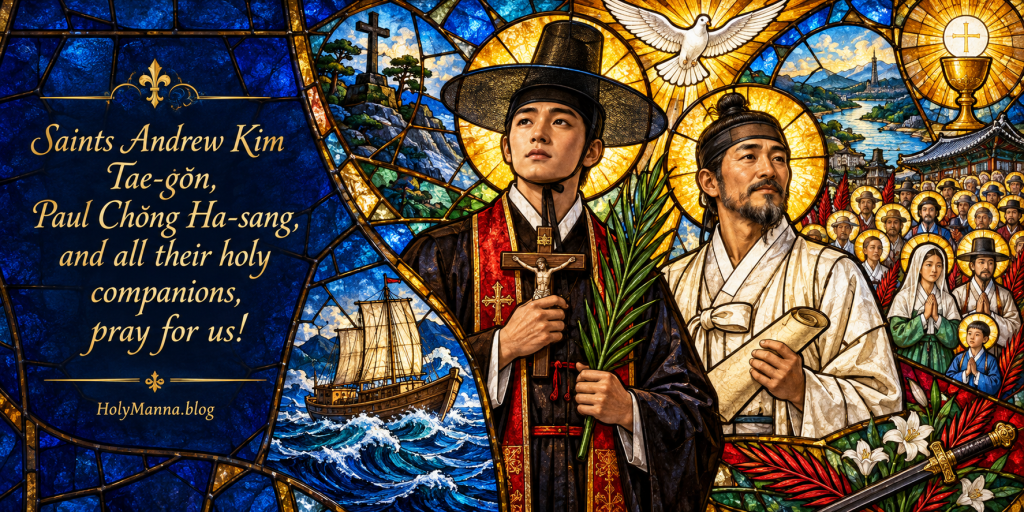
Saints Andrew Kim Tae-gŏn, Paul Chŏng Ha-sang, and all the great Martyrs of Korea, pray for us!
Follow us on YouTube, TikTok, Instagram and Facebook for more insights and reflections on living a faith-filled life.

 Holy Manna!
Leave a comment