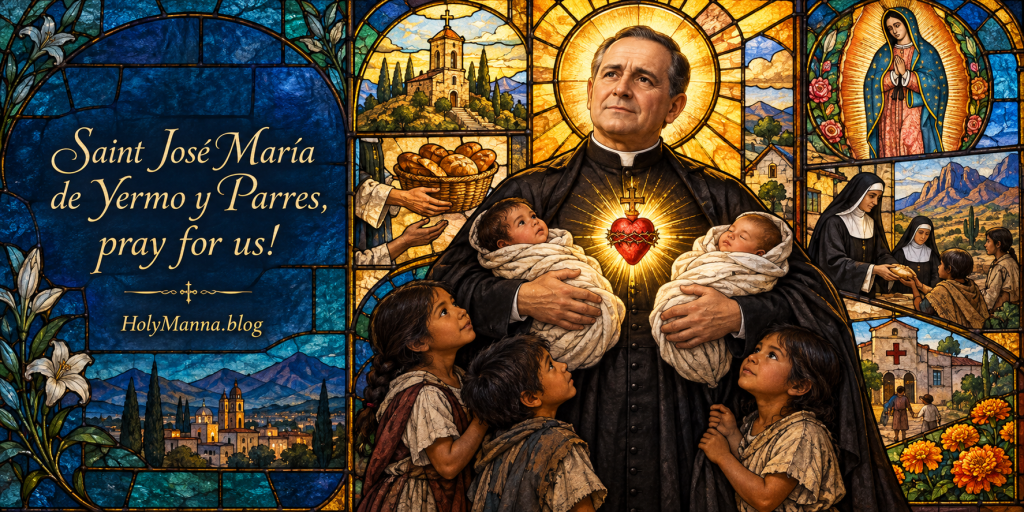
The Giant of Charity
Some saints are remembered for a lifetime of steady, quiet fidelity. Others are remembered for a single moment when God broke into their ordinary day and demanded everything. Saint José María de Yermo y Parres, celebrated on September 20th, is remembered for both. He was a Mexican diocesan priest of the late 19th century, an eloquent preacher, a man of noble birth and refined education, who was walking to a poor little church on the edge of León, Guanajuato, when he stumbled upon a scene so horrifying that it rewrote the rest of his life. Out of that moment came the Servants of the Sacred Heart of Jesus and of the Poor, a religious congregation that still serves the abandoned across Mexico and around the world today. Out of that moment came schools, hospitals, orphanages, homes for the elderly, a rescue home for women, and a mission to the indigenous Tarahumara people of northern Mexico. Out of that moment came a title given to him by a governor of his own day, the “Giant of Charity,” and a crown given to him by the Church herself when Saint John Paul II canonized him during the Great Jubilee on May 21st, 2000. His story is a witness to what the Catechism of the Catholic Church calls the greatest of the virtues, for CCC 1822 teaches that charity is the theological virtue by which the Christian loves God above all things and his neighbor as himself for the love of God. Father Yermo did not merely teach that definition; he bled for it.
A Motherless Child in the Hands of Providence
José María de Yermo y Parres was born on November 10th, 1851, at the Hacienda de Jalmolonga in the municipality of Malinalco, in the State of Mexico. His father, Manuel de Yermo y Soviñas, was a respected lawyer, and his mother was María Josefa Parres. The family was of noble origins and comfortable means, yet sorrow arrived almost immediately. María Josefa died only 50 days after giving birth to her son. José María would grow up never knowing his mother’s face, raised instead by his devoted father and his aunt Carmen, who together gave him a thoroughly Christian upbringing. It is worth pausing on this detail. The man who would one day gather abandoned children into his arms was himself, in a real sense, a child marked by loss from his first weeks of life. God wastes nothing, and the Catechism reminds the faithful in CCC 305 that Jesus asks for childlike abandonment to the providence of the heavenly Father who takes care of his children’s smallest needs. The orphaned heart of José María was being prepared, from the cradle, to become a father to orphans.
His education matched his family’s standing. He was first taught by private tutors, and then from 1861 to 1867 he studied under the priests of the Congregation of the Mission, the spiritual sons of Saint Vincent de Paul, known in Mexico as the Vincentians or Paúles. He excelled so brilliantly that Emperor Maximilian awarded him a medal for academic excellence. Yet academic honors were not what stirred his soul. Very early he discovered a vocation to the priesthood, and at only 16 years of age he left his father’s house to enter the Congregation of the Mission in Mexico City. The Vincentian charism of service to the poor left a permanent imprint on him; as a young man in 1873 he even founded a youth group called the “Angel of Purity,” an early sign of his zeal for forming souls.
Then came the crisis. The official Vatican biography records that José María passed through a strong vocational crisis and left the Vincentian religious family. How easy it would have been for a proud young man of noble blood to walk away from the whole idea of priesthood after such a wound. He did not. He picked up his vocation again and continued toward Holy Orders as a diocesan seminarian in the Diocese of León, Guanajuato, where he was ordained a priest on August 24th, 1879. His story already carries a lesson for anyone whose path to God has not been a straight line: a crisis is not the same thing as an ending. The Catechism teaches in CCC 2013 that all the faithful are called to the fullness of Christian life and to the perfection of charity, and that call survives every detour.
The Hill of Calvary Becomes a Hill of Mercy
The young Father Yermo’s first years of priesthood were fruitful and full of apostolic zeal. He was an eloquent orator, he promoted catechesis among the young, and he carried out important responsibilities in the diocesan curia with great care, until illness forced him to resign those posts. Vincentian sources also report that, out of concern for his brother priests, he founded the first ecclesiastical review in Mexico, called El Reproductor Eclesiástico Mexicano, to instruct and inform the clergy. He was, by every worldly measure, a rising churchman.
Then God humbled him. A new bishop entrusted him with the care of two small churches on the poor periphery of León, El Calvario and El Santo Niño. The Vatican biography is remarkably candid about what this did to him: the appointment was a hard blow that shook him profoundly in his pride. A gifted preacher and curial official was now the caretaker of two humble chapels on the outskirts of town. Yet Father Yermo made a decision that changed everything that followed. He chose to follow Christ in obedience and to suffer the humiliation silently. The Catechism teaches in CCC 1548 that the ordained priest acts in the person of Christ the Head, and Christ the Head is also Christ the obedient Servant. It was precisely this obedience that placed Father Yermo on the road where God was waiting for him.
One day, while making his way to the church of El Calvario, he came suddenly upon a terrible scene. Pigs were devouring 2 abandoned newborn infants. This is not a pious embellishment; it is recorded in the official Vatican biography prepared for his canonization. Shaken to his core, Father Yermo felt himself directly questioned by God. In a country of stark inequality, where the poor of the Porfirian era could be discarded like refuse, he had seen with his own eyes what abandonment actually means. His burning heart conceived a response: a house of welcome for the abandoned and the needy. He sought and obtained the authorization of his bishop, and on December 13th, 1885, followed by 4 courageous young women, he inaugurated the Asilo del Sagrado Corazón, the Shelter of the Sacred Heart, at the top of the hill of El Calvario. That same day marked the birth of a new religious family, the Servants of the Sacred Heart of Jesus and of the Poor.
The name of the congregation is itself a catechesis. Saint John Paul II observed at the canonization that the name unites the two great loves of the founder, the Heart of Christ and the poor, and he described the saint’s spirituality as centered in that Heart, saying that in reflecting on Christ’s infinite love for men he desired to imitate him by “making charity the rule of his life”. Devotion to the Sacred Heart is no mere sentiment; the Catechism explains in CCC 478 that Jesus knew and loved each person during his life and agony, and that his Heart, pierced for the sins of the world, is the sign and symbol of that love. Father Yermo simply took that love seriously and organized his entire existence around it.
What followed was an explosion of works of mercy. In a life that lasted only 52 years, he founded schools, hospitals, rest homes for the elderly, orphanages, and a well organized house dedicated to the rehabilitation and dignity of women in distress. Governor General Manuel Gonzáles of Guanajuato was so astonished by the scale of it that he called the priest the “Giant of Charity,” while the people around him called him the “Apostle of Charity.” Before his death there were foundations in Mérida, Teziutlán, Tulancingo, Córdoba, Ocotlán, Guadalajara, Irapuato, and Chihuahua, along with the first mission house among the Tarahumara. It should be said honestly that the reliable sources do not record thaumaturgic wonders worked by Father Yermo during his lifetime, no multiplications of bread or sudden healings at his hands. His miracle during life was of the kind the Catechism describes in CCC 2447, which defines the works of mercy as “charitable actions by which we come to the aid of our neighbor” in his spiritual and bodily necessities. That a sickly parish priest with no fortune of his own could feed, teach, shelter, and heal thousands, while founding and governing a religious congregation, is itself a testimony to God’s intervention through a surrendered soul. He lived what Our Lord promises in The Gospel of Matthew, where Christ declares, “whatever you did for one of these least brothers of mine, you did for me” (Mt 25:40).
Calumny, Illness, and the Long Obedience
Saint José María was not a martyr, but no one should imagine that his path was gentle. The Vatican biography describes his life after the foundation as a long and constant climb of self-giving that knew sacrifice and self-denial, joy and suffering, peace and confusion, poverty and misery, praise and calumny, friendship and betrayal, obedience and humiliation. That is the Vatican’s own summary, and it is sobering. Nearly every hardship that can befall a founder befell him.
His health was fragile from his early priesthood, when illness forced him out of his curial positions, and it remained a lifelong companion. His pride was purified again and again, first by the humiliating assignment to the peripheral chapels, then by the endless begging, improvising, and dependence on Providence that his growing works demanded. He also tasted the peculiar suffering of the slandered. Devotional Mexican sources report that after the congregation’s center of gravity moved to the city of Puebla, Father Yermo endured serious calumnies and misunderstandings, and that the Archbishop of Puebla, the Venerable Ramón Ibarra y González, for a time withdrew him from the spiritual direction of his own sisters, until the situation was clarified and he was restored to guiding his daughters. This episode is reported in devotional accounts rather than in the official Vatican biography, so it should be received with that caution, but it is fully consistent with the Vatican’s own mention of calumnies and betrayals in his life. To be separated, even temporarily, from the religious family he had founded, and to accept it in obedience, may have been the heaviest cross of all.
Through all of it he never retaliated and never quit. The Catechism teaches in CCC 2448 that human misery in its many forms elicited the compassion of Christ the Savior, who willed to identify himself with the least of his brethren, and Father Yermo seems to have understood that his own miseries could be joined to that same Christ. His trust in Providence was, in the words Saint John Paul II spoke to Mexican pilgrims the day after the canonization, a life of prayer, sacrifice, and heroic charity that invites Christians to follow Christ by forgetting themselves and accepting the Cross when necessary. In his final years, rather than resting, he took on the most demanding project of his life, bringing his religious family to the difficult mission among the Tarahumara indigenous people of the mountains of northern Mexico, a work of evangelization and human promotion at the far margins of Mexican society. Worn out by labor and illness, Father Yermo died in the city of Puebla de los Ángeles on September 20th, 1904, at 52 years of age. A cherished devotional account relates that when he was told the end was near he rejoiced, knowing he was going to the Lord who had never failed him, and that he asked for the Marian hymn “María, Estrella de los Mares” to be sung as he passed to eternity. That deathbed story comes from devotional tradition and cannot be independently verified.
A Sanctity That Spread Like Wildfire
The Vatican biography records that his fame of holiness spread rapidly among the people of God, who turned to him asking for his intercession almost immediately after his death. In the decades that followed, the formal processes of the Church did their patient work. His cause advanced through the Congregation for the Causes of Saints, and a miracle attributed to his intercession was approved by Pope John Paul II on April 26th, 1990. Just days later, on May 6th, 1990, the pope beatified him in the most Mexican place imaginable, the Basilica of Our Lady of Guadalupe in Mexico City, and preached that in this new Blessed the features of the Good Shepherd shone forth, declaring that “the priesthood was the center of his life and priestly holiness his goal”.
A second miracle attributed to his intercession was then examined for canonization. The process for that miracle was conducted in May 1998, validated on June 26th, 1998, approved by the medical board on November 19th, 1998, by the theologians on May 7th, 1999, and by the Congregation for the Causes of Saints on October 5th, 1999, with Pope John Paul II giving final approval on December 20th, 1999. Honesty requires a plain statement here: the accessible sources record the formal approval of both miracles but do not publish the medical details of the healings involved, so those details cannot be narrated, and nothing will be invented to fill the gap. What can be said with certainty is that the Church, after rigorous scientific and theological scrutiny, judged that God had twice intervened miraculously through the intercession of Father Yermo.
On May 21st, 2000, in Saint Peter’s Square during the Jubilee pilgrimage of Mexicans, Saint John Paul II canonized José María de Yermo y Parres together with Saint Cristóbal Magallanes and his 24 companion martyrs and Saint María de Jesús Sacramentado Venegas, in a celebration that felt like a national feast for the Church in Mexico. Pilgrims and bishops came in great numbers, and the pope entrusted them all to Our Lady of Guadalupe, to whom the new saint had been tenderly devoted. Devotional sources recall his joy at the Pontifical Coronation of the Guadalupan image in 1895, and relate that an image of the Virgin of Tepeyac presided at the head of his bed; that detail likewise rests on devotional tradition and cannot be verified.
His mortal remains rest today beneath the main altar of the convent chapel of his congregation in Puebla, where the faithful continue to venerate him and seek his intercession. His truest living relic, however, is the congregation itself. The Servants of the Sacred Heart of Jesus and of the Poor continued to grow after his death, extending the first Tarahumara mission into schools for the Rarámuri people and spreading through Mexico and beyond, with houses in the United States, Guatemala, Nicaragua, Colombia, Venezuela, Chile, Italy, and Kenya, where the sisters run schools, orphanages, hospitals, and missions in the spirit of their founder. In Mexico he remains a beloved national figure of Catholic social charity, honored in the Roman Martyrology on September 20th, the day of his birth into heaven, while liturgical calendars in Mexico celebrate his memorial on September 19th, since September 20th on the universal calendar belongs to the memorial of Saints Andrew Kim Tae-gŏn, Paul Chŏng Ha-sang, and their companions. The Catechism teaches in CCC 828 that by canonizing certain of the faithful the Church recognizes the power of the Spirit of holiness within her and sustains the hope of believers by giving them models and intercessors. Saint José María is exactly that for the modern Church: a model for anyone who wants to love the poor, and an intercessor for everyone who has ever felt discarded.
When God Interrupts the Walk Home
The life of Saint José María de Yermo y Parres presses one uncomfortable question on every believer: what happens when God interrupts an ordinary day with someone else’s suffering? Father Yermo was not looking for a mission on that road to El Calvario. He was a humiliated priest trudging to a small assignment he had not wanted. God met him precisely there, in the middle of an obedience that stung. Perhaps that is the first lesson. The place of humiliation, the job that feels beneath one’s gifts, the season that feels like a demotion, can be exactly the place where God is preparing an encounter that gives life its true meaning. Where in life right now does obedience sting, and could that very place be the road where God is waiting?
The second lesson is that charity begins with refusing to look away. Father Yermo could have hurried past the horror, said a prayer, and gone home. Instead he let the suffering of the smallest and most discarded human beings pierce him, and then he acted. The Catechism insists in CCC 2449 that the Church’s love for the poor is part of her constant tradition, inspired by the Gospel of the Beatitudes and by the example of Jesus in his concern for the poor. Every reader passes abandoned people in some form: the coworker nobody talks to, the elderly neighbor nobody visits, the homeless man at the intersection, the family member everyone has quietly given up on. Who are the abandoned ones along the ordinary routes of daily life, and what would it cost to stop for them this week?
The third lesson is perseverance under fire. Father Yermo was slandered, betrayed, and even removed for a time from guiding the very sisters he had founded, and he answered with patience rather than bitterness. In an age when a single online insult can consume a person’s peace for days, his silent endurance is almost shocking. Practical steps flow naturally from his example. A person can choose one concrete work of mercy and commit to it monthly, whether serving at a parish food pantry, supporting a crisis pregnancy center, or visiting a nursing home. A person can consecrate difficult work to the Sacred Heart each morning, asking that charity, not resentment, be the rule of the day. A person can respond to the next calumny or slight with deliberate silence and a prayer for the offender. And a person can imitate his devotion by keeping an image of Our Lady close, letting her lead the heart to her Son as she led Father Yermo. When criticism or slander comes, is the first instinct self-defense, or could it become trust in the God who sees everything?
Engage With Us!
Saint José María de Yermo y Parres shows what happens when one man lets the Sacred Heart of Jesus set the rule of his life, and his story deserves to be talked about, so readers are warmly invited to share their thoughts, experiences, and reflections in the comments below. To spark that conversation, here are some questions to pray with and answer:
- Father Yermo’s mission was born from an obedience that wounded his pride. What is one act of obedience, at work, at home, or in the parish, that God might be asking of you right now?
- He refused to walk past the suffering he encountered on the road. What suffering have you been walking past, and what is one concrete step you could take toward it this week?
- He endured calumny and betrayal without abandoning his mission. How do you typically respond when you are misjudged, and what would responding like a saint look like?
- His congregation began with just 4 young women and a borrowed hillside. What small beginning in your own life might God want to grow into something far bigger than you can imagine?
- Father Yermo found the guide for his whole spirituality in the Heart of Christ. What practice could help you draw closer to the Sacred Heart this month?
However God answers those questions, the invitation of Saint José María de Yermo y Parres is the same invitation Christ makes to every generation: love in deed and in truth, not in words alone. Let his witness stir up courage to serve the poor, patience to endure the cross, and confidence that no act of charity is ever wasted. Go out this week and do everything, the small things and the hard things alike, with the love and mercy that Jesus taught us.
Saint José María de Yermo y Parres, Giant of Charity, pray for us!
Follow us on YouTube, TikTok, Instagram and Facebook for more insights and reflections on living a faith-filled life.

 Holy Manna!
Leave a comment