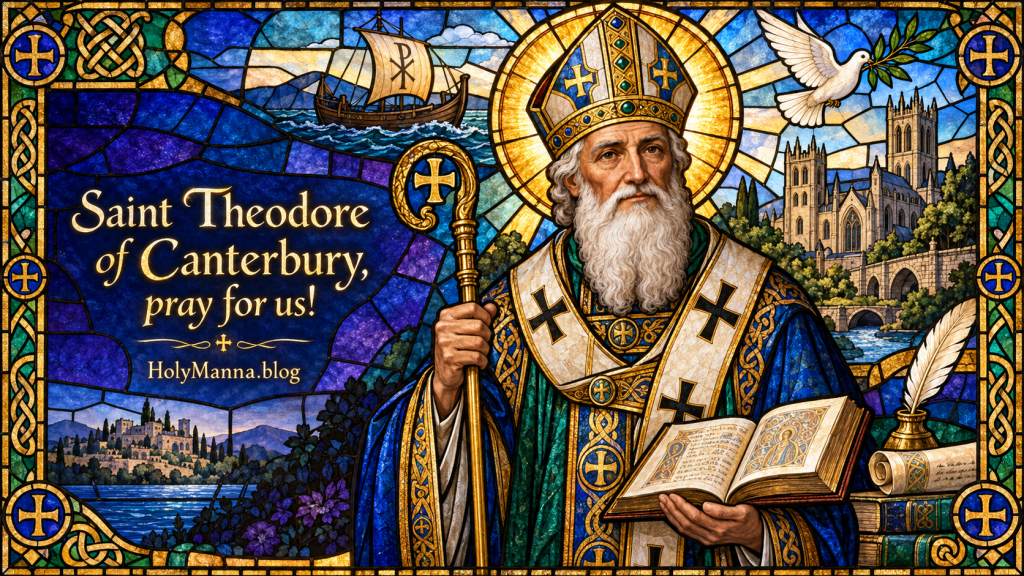
The 66 Year Old Beginner Who Built a Church
Every September 19th, the Church remembers a saint who proves that God is never finished with anyone, no matter their age, and that holiness does not always look like visions and wonders. Sometimes holiness looks like a tired old man on horseback, riding from diocese to diocese, patiently putting a broken Church back together. Saint Theodore of Canterbury, also known as Theodore of Tarsus, was the 7th Archbishop of Canterbury, and he remains one of the most consequential bishops in the entire history of the Church in England. The Roman Martyrology honors him with a single, beautiful line for this day: “At Canterbury, the holy Bishop, Theodore, who was sent to England by Pope Vitalian and was renowned for learning and holiness.”
What makes Theodore so remarkable is the sheer improbability of his story. He was a Greek monk from the far eastern edge of the Christian world, born in the very city that gave the Church Saint Paul. He did not become a bishop until he was 66 years old, an age when most people in the seventh century had long since died. Yet in the 22 years that followed, he accomplished what no one before him had managed: he took the scattered, quarreling, disorganized churches of the Anglo-Saxon kingdoms and united them into one body under one shepherd. Saint Bede the Venerable, a Doctor of the Church and the great historian of the English people, gave Theodore the verdict that has followed him through the centuries in Ecclesiastical History of the English People: “This was the first archbishop whom all the English Church consented to obey.”
Theodore was not a martyr, and no miracles are attributed to him in the historical record. His sanctity was of a quieter kind: the sanctity of obedience, of learning placed at the service of the Gospel, of order built patiently for the good of souls. The Church teaches that the saints are canonized because they “practiced heroic virtue and lived in fidelity to God’s grace” (CCC 828), and Theodore’s heroism was the heroism of a lifetime of faithfulness poured out in his final decades. His life is a word of hope for anyone who feels that their best years are behind them, or that their gifts are too ordinary for God to use.
From the City of Saint Paul to the Heart of the Empire
Theodore was born around the year 602 in Tarsus, in the region of Cilicia in what is now southern Turkey. Tarsus was no ordinary hometown. It was the birthplace of Saint Paul, the Apostle to the Gentiles, and Theodore would have grown up walking the same streets Paul had walked roughly 600 years earlier. It is a striking providence that the man who would one day carry the Gospel to the edge of the known world came from the same city as the Apostle who first carried it across the Roman Empire.
His early life unfolded against a backdrop of violence and upheaval. During Theodore’s youth, Cilicia was ravaged by Persian invasions, and in 660 Tarsus itself fell to the Arab conquests. Theodore fled westward, first to Constantinople, the glittering capital of the Byzantine Empire. The details of his formation are not fully documented, but the sources say he studied at Athens at some point, and that he became an accomplished scholar of Greek and Latin, of literature, philosophy, and law. He embraced the monastic life and wore the Eastern tonsure of the Greek monks. Somewhere along the way, this refugee scholar made his way to Rome, where by the year 667 he was living quietly in a monastery, an aging monk of about 65 who had never even been ordained a subdeacon. By every human measure, his story was nearly over.
Then God intervened, in the way God so often does, through the death of someone else’s plans. The kings of Northumbria and Kent had sent an English priest named Wighard to Rome to be consecrated as the new Archbishop of Canterbury. Wighard died in Rome before he could be consecrated. Pope Saint Vitalian now had to find a shepherd for the distant English Church himself. He first asked Hadrian, a learned African abbot of a monastery near Naples, who humbly declined and proposed a monk named Andrew; Andrew was judged too physically frail for the task. Hadrian then pointed the Pope to his friend, the Greek monk from Tarsus. Theodore was 66 years old.
Pope Vitalian agreed on one condition: Hadrian must accompany Theodore to England as his companion and helper. There is even a charming, well documented detail from Bede: Theodore had to wait four months before his consecration so that his hair could grow out from the Eastern tonsure and be cut in the Roman fashion. He was consecrated in Rome on March 26th, 668, and set out for England with Hadrian and with Saint Benedict Biscop, the future founding abbot of Wearmouth and Jarrow. The journey itself took a full year. Traveling through Gaul, the party was delayed when the Frankish official Ebroin detained Hadrian on suspicion of being a secret envoy of the Byzantine emperor. Theodore finally arrived in Canterbury on May 27th, 669, an old man stepping into a young and chaotic Church.
The Shepherd Who Put a Church in Order
What Theodore found in England would have discouraged a man half his age. The Church there was barely organized at all. The missionaries who had evangelized the island, some from Rome and some from the Celtic tradition, had worked largely independently of one another. Dioceses were enormous, their boundaries shifting with the fortunes of warring kingdoms. Several sees sat vacant. Practices differed from region to region, including the dating of Easter itself. There was no real center, no unity, no common life.
Theodore’s response was not to lament but to act. Together with Hadrian, whom he appointed abbot of the monastery of Saints Peter and Paul in Canterbury, he undertook a visitation of the whole of England, the first archbishop ever to survey the entire English Church in person. He filled the empty sees. At Rochester he ordained a bishop named Putta. And in one of the most beloved episodes of his life, recorded by Bede, he encountered Saint Chad, a holy monk whose episcopal consecration had been performed irregularly. When Theodore questioned the validity of his ordination, Chad answered with words that have echoed through the centuries: “If you know that I have not duly received episcopal ordination, I willingly resign the office, for I never thought myself worthy of it; but, though unworthy, for obedience sake I submitted, when bidden to undertake it.” Bede records that Theodore was so moved by this humility that he refused to let Chad resign, and instead himself “completed his ordination after the Catholic manner.” He later appointed Chad bishop for the kingdom of Mercia. Bede adds a tender detail: because Chad insisted on traveling everywhere on foot like the apostles, Theodore, knowing him to be a holy man, commanded him to ride on horseback for long journeys, and with his own hands lifted the reluctant saint into the saddle. In that one image, the reader can see the whole of Theodore’s genius: firm about order, gentle with persons.
In 673, Theodore summoned the Synod of Hertford, the first council in which the whole English Church acted as one body. Some sources date it to 672, and honesty requires noting that small discrepancy, but its significance is beyond dispute. The synod issued canons on the proper calculation of Easter, on bishops remaining within their own dioceses, on monks not wandering without permission, on the regular convening of future synods, and on the sanctity of marriage. Historians have observed that in gathering all the English churches into one assembly, Theodore achieved a national unity that the English kingdoms themselves would not reach politically for nearly three centuries. The Church led, and the nation followed. This is exactly what the Catechism describes when it teaches that bishops, as successors of the apostles, are constituted pastors so that the Church’s mission may continue in every generation (CCC 861 to 862), and that each bishop serves as a visible source of unity for the Church entrusted to him (CCC 886). Theodore did not invent that office; he simply lived it with extraordinary fidelity, and Scripture explains why such order matters, for God “is not the God of disorder but of peace” (1 Corinthians 14:33).
Theodore’s second great synod met at Hatfield, probably on September 17th, 679, though some older sources give 680. There the assembled bishops of England formally professed the orthodox faith of the five ecumenical councils and rejected the Monothelite heresy, which falsely claimed that Christ had only one will. Thanks to Theodore, a Church at the far edge of the world stood publicly and precisely with the faith of the apostles concerning who Jesus Christ truly is, fully God and fully man, with a divine will and a human will in perfect harmony (CCC 475).
Two more fruits of his episcopate deserve special attention. First, with Hadrian he founded the famous school at Canterbury, where Greek and Latin, Scripture, sacred music, and many other disciplines were taught. Bede writes that the two masters gathered a crowd of disciples and that “rivers of wholesome knowledge daily flowed from them” to water the hearts of their hearers. Canterbury became a beacon of learning whose light reached scholars across the island, and Bede famously judged the era with the words: “Nor were there ever happier times since the English came into Britain.” Second, Theodore’s name is forever attached to the Penitential of Theodore, a collection of his disciplinary decisions compiled by others after his death. This remarkable document, a kind of medicine chest for souls, prescribed penances suited to particular sins and helped spread the practice of private, individual confession through England, Ireland, and the Continent. In it one can see an early flowering of what the Church teaches today, that “those who approach the sacrament of Penance obtain pardon from God’s mercy” (CCC 1422) and that the confession of sins to a priest is an essential part of that healing encounter (CCC 1456). Theodore treated sin the way a Greek physician treated illness, with a remedy measured to the wound and with mercy always aimed at salvation.
Here honesty about the record matters, because content integrity is part of honoring a saint. No miracles are attributed to Theodore during his lifetime in the historical sources, and no contemporary biography of him was ever written. His wonders were of another order: vacant churches filled, feuding traditions reconciled, heresy repelled, penitents restored, and a generation of scholars formed. The reader should not think less of him for it. God’s intervention through Theodore was real and enduring; it simply wore the humble clothing of administration, teaching, and peace.
Storms, Rivals, and the Long Road of Peace
Theodore was never martyred, and he was granted a peaceful death, but his 22 years in office were anything but easy, and his hardships deserve to be told in full. Consider first what obedience cost him at the start. At 66, he surrendered the quiet monastic life he loved and undertook a grueling year long journey to a cold, rainy island at the end of the earth, among peoples whose languages and customs were utterly foreign to him. He would serve there for more than two decades and never see his homeland again. In his final years, the sources record, he was afflicted with increasingly frequent infirmities of old age, yet he governed to the end.
His greatest trial, however, came from within the Church. Theodore was convinced that England’s massive dioceses had to be subdivided so that bishops could actually shepherd their people. In 678 he moved to divide the enormous diocese of Northumbria, which was governed from York by Saint Wilfrid, one of the most forceful personalities of the age. Wilfrid objected to the manner of the division and did something no English bishop had ever done: he appealed to Rome. The dispute between these two strong willed saints dragged on for years and caused Theodore real anguish. Yet notice what did not happen. There was no schism, no rebellion against the Pope, no breaking of communion. Both men, whatever their disagreement, submitted their cause to the See of Peter, living out what the Catechism teaches, that the Roman Pontiff is the perpetual and visible source and foundation of the unity of the Church (CCC 882). And the story ends in grace: in 686, in what the sources record as the last public act of his long life, the aged Theodore reconciled with Wilfrid, acknowledged the wrong done to him, and wrote to the king of Northumbria urging Wilfrid’s restoration. The old archbishop refused to carry a grudge into eternity.
Theodore also suffered the hardships of a peacemaker in a violent age. In 679, war erupted between King Ecgfrith of Northumbria and King Æthelred of Mercia, and in a battle near the river Trent the young Northumbrian prince Ælfwine was killed. By the customs of the time, his death demanded a war of blood vengeance that could have drowned both kingdoms. Bede records that it was Theodore’s mediation, relying on God’s help, that extinguished the fire. A settlement was reached, compensation was paid in place of further bloodshed, and peace held between the kings for years afterward. An elderly Greek monk, with no army and no wealth, stopped a war with nothing but moral authority and patient diplomacy. In him the reader sees the beatitude lived out, for Scripture promises, “Blessed are the peacemakers, for they will be called children of God” (Matthew 5:9), and the Catechism reminds the faithful that peace is not merely the absence of war but the work of justice and the effect of charity (CCC 2304).
An Incorrupt Witness and a Quiet Glory
Theodore died in Canterbury on September 19th, 690. The sources give his age as 87 or 88, a small discrepancy consistent with a birth around 602, and it should be flagged rather than smoothed over. He had governed the English Church for 22 years. He was buried, fittingly, in the monastery church of Saints Peter and Paul in Canterbury, later renamed St. Augustine’s Abbey, close to the tomb of Saint Augustine of Canterbury himself, the first archbishop. The first organizer of the English Church was laid beside its first apostle. A long poetic epitaph was inscribed upon his tomb, of which Bede preserved eight verses in his history, praising the holy prelate who now enjoyed the vision of God.
Just as no miracles are recorded during his life, the historical record attributes no miracles of healing or intervention to Theodore after his death, and no early collection of wonders grew up around his tomb. This is stated plainly because it is true, and because his veneration never depended on such accounts. The evidence of his sanctity was immediate and organic. He appears in the personal calendar of Saint Willibrord, compiled within living memory of Theodore’s death, which shows that the faithful honored him as a saint almost at once. The Church’s ancient practice of venerating such holy men and women flows from her faith in the communion of saints, in which those who have died in God’s grace intercede for those still on pilgrimage (CCC 946 to 948, 956).
One story from centuries later belongs here, told as the tradition it is. In 1091, when the monks of St. Augustine’s Abbey translated the remains of their early saints into the rebuilt abbey church, the monastic accounts of that translation report that Theodore’s body was found incorrupt, whole after 400 years in the earth. It is a moving account, cherished in Canterbury’s memory, but it rests on the report of the medieval monastic sources surrounding the translation, and it cannot be verified.
Theodore’s true relics, in a sense, are everywhere in the English speaking Church. The diocesan structure of England, the tradition of national synods, the practice of regular private confession spread by his Penitential, and the scholarly tradition of Canterbury all trace back to him. In modern times, scholars have even recovered notes from his Canterbury classroom, biblical commentaries preserving the actual teaching of Theodore and Hadrian, giving the Church today an astonishing window into a seventh century school. The ruins of St. Augustine’s Abbey, where he was buried, now form part of a World Heritage site visited by pilgrims and travelers from around the globe. And in an age longing for Christian unity, Theodore stands as a living bridge: a Greek from the East, sent by the Pope of Rome, sanctifying the Church of the English, honored to this day by Catholics, Orthodox, and Anglicans alike, a small icon of the Church’s catholicity, which the Catechism describes as her mission to the whole human race in every land and age (CCC 830 to 831).
What a Late Beginning Teaches a Restless Heart
Theodore’s life speaks with surprising force to people in their twenties, thirties, and forties today, and perhaps most of all to anyone who fears they have started too late. He was 66 when God called him to the greatest work of his life. Everything before that, the classical education, the languages, the monastic discipline, the long years of obscurity, turned out to be preparation for a mission he never saw coming. The Psalmist sings of the righteous that “they shall bear fruit even in old age” (Psalm 92:15), and Theodore is the proof. Is there a dream or a calling you have quietly buried because you decided you were too old, too far behind, or too ordinary for God to use?
His story also rebukes the modern temptation to treat structure and order as enemies of the spirit. Theodore’s holiness was expressed in canons, synods, diocesan boundaries, and penitential discipline, and through those unglamorous instruments countless souls received the sacraments, heard the Gospel, and found peace. The reader might apply this concretely: bring order to the interior life. Set a fixed time for daily prayer and guard it. Return to the sacrament of Reconciliation regularly, monthly if possible, remembering that the whole tradition of frequent private confession that Theodore helped spread exists for one purpose, the healing mercy of Jesus Christ (CCC 1422, 1458). What is one concrete structure, a scheduled prayer time, a standing confession date, a weekly examination of conscience, that you could put in place this month?
Theodore teaches, too, the art of being firm about truth and gentle with people. He corrected Saint Chad’s ordination without hesitation, yet honored his humility, kept him a bishop, and lifted him onto a horse with his own hands. He fought Wilfrid over policy for years, then sought him out to make peace before death. He stopped a war between kings. In a culture that rewards outrage, the Catholic is called to something harder and holier: to speak truth without contempt and to pursue reconciliation without surrendering conviction, bearing witness as the Catechism urges, in every circumstance of life (CCC 2044). Is there a strained relationship in your life where you could be the one, like Theodore, to make the first move toward peace?
Finally, let his honesty about miracles console anyone whose faith feels unspectacular. Theodore worked no recorded wonders. He simply did his duty with excellence, decade after decade, and the Church he served still stands. Most Christians will never see a miracle with their eyes; all Christians can organize their days around God, serve the people in front of them, and leave a quiet legacy of order, learning, and peace.
Engage With Us!
Saint Theodore of Canterbury waited a lifetime for his mission, and then gave everything he had to it. His story has crossed 13 centuries to reach you today, and the conversation should not end here. Share your thoughts, your questions, and your own reflections on this remarkable saint in the comments below; someone else may need exactly the insight God has given you. To guide your reflection, consider these questions:
- Theodore was 66 when his true mission began. What talent, experience, or hidden preparation in your own life might God be waiting to use in a way you have not yet imagined?
- Saint Chad’s humble obedience moved Theodore to mercy. When correction comes your way, do you respond with defensiveness or with humility, and what would change if you chose humility first?
- Theodore restored unity to a divided Church through patience, synods, and structure. Where in your family, parish, or workplace could you be an instrument of unity this week?
- His Penitential helped spread the gift of private confession. When did you last receive the sacrament of Reconciliation, and what keeps you from making it a regular habit?
- Theodore stopped a war through peacemaking rooted in God’s help. Who in your life needs you to lay down a grudge and extend the first word of peace?
May the witness of Saint Theodore of Canterbury stir something lasting in every heart that reads his story. It is never too late to answer God’s call, never too small a task to do with excellence for His glory, and never too broken a situation for His peace to mend. Go forward this day resolved to live your faith with order, humility, and courage, and to do everything, the great things and the hidden things alike, with the love and mercy that Jesus taught us.
Saint Theodore of Canterbury, pray for us!
Follow us on YouTube, TikTok, Instagram and Facebook for more insights and reflections on living a faith-filled life.

 Holy Manna!
Leave a comment