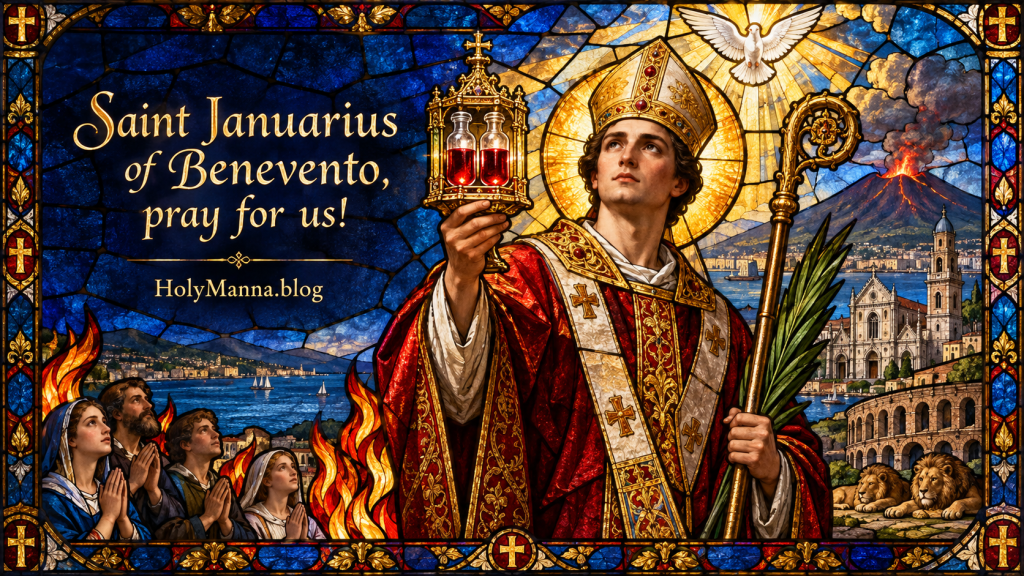
The Bishop Whose Blood Still Speaks
Every year on September 19th, two cities on opposite sides of the Atlantic hold their breath for the same man. In Naples, thousands pack the Cathedral and the streets around it, waiting for word from the Chapel of the Treasure. In New York City’s Little Italy, the Feast of San Gennaro fills Mulberry Street with processions, food, and prayer, a celebration that has run since 1926. The man they honor is Saint Januarius of Benevento, a bishop beheaded for the faith around the year 305, during the most ferocious persecution the early Church ever endured.
Here is the remarkable thing. Almost nothing about his life can be documented with historical certainty, and yet his cult is among the oldest, most continuous, and most passionate in the entire Catholic world. His image, crowned with a halo, appears in frescoes from the 5th century in the Naples catacombs that now bear his name. He was already being invoked by name when Saint Paulinus of Nola lay dying in 431. And for more than 6 centuries, the faithful have witnessed something that science has never explained: a sealed ampoule of his dried blood repeatedly turning to liquid before their eyes.
Saint Januarius is the principal patron of Naples. He is also the patron of blood banks and blood donors, and he is invoked as a protector against eruptions of Mount Vesuvius, the volcano that looms over his city. His witness matters because it puts flesh on what The Catechism teaches about martyrdom: “Martyrdom is the supreme witness given to the truth of the faith: it means bearing witness even unto death” (CCC 2473). Januarius bore that witness, and 17 centuries later, his people have not stopped answering it with love.
A Shepherd Formed in the Shadow of Empire
The honest place to begin is with honesty itself. The ancient accounts of Januarius, including the Acts of Bologna and the Vatican Acts, were written long after his death, and scholars, including the Bollandists who have studied the lives of the saints for centuries, agree that they are late and unreliable in their details. The Church has never pretended otherwise. What the accounts do prove, by their very number and spread, is how deeply loved this martyr was from the earliest centuries.
According to tradition, Januarius was born in the second half of the 3rd century, either in Naples or in Benevento; the sources disagree, and both cities have claimed him. Benevento sat about 150 miles southeast of Rome along the Appian Way, a proud old city of Campania. One tradition holds that he came from a wealthy aristocratic family, that he was ordained a priest at the age of 15, and that he became a bishop at the astonishing age of 20. These details come from the late accounts and cannot be verified. A precise birth date of April 21st, 232 circulates online, but it appears without any credible source and should not be trusted.
What the tradition consistently affirms is his character. As Bishop of Benevento, Januarius shepherded his flock with zeal and generosity, and he was esteemed not only by Christians but by pagans as well, won over by his charity and the integrity of his conduct. That detail rings true to everything the Church knows about how the Gospel spread in those centuries. Long before Christianity was legal, it was attractive, because Christians loved in a way the world could not explain. The Catechism describes the bishop’s office in words that fit the portrait tradition paints of Januarius: the bishop is to be a true shepherd who governs “by the example of his way of life” as much as by authority (CCC 894, drawing on Lumen Gentium).
Januarius did not have a dramatic conversion story like Saint Paul or Saint Augustine. He belonged instead to that great company of saints whose conversion was a lifetime of daily fidelity, deepened by responsibility and tested, finally, by fire. His formation took place in a Church that lived under the constant possibility of persecution, where becoming a priest, let alone a bishop, meant volunteering to be first in line when the empire turned hostile. He accepted that office anyway. That acceptance was itself an act of faith.
The Bishop Who Went Toward the Danger
To understand why Januarius matters, the reader has to understand the moment he lived in. In 303 and 304, the Emperor Diocletian issued a series of edicts that launched what history calls the Great Persecution, the most systematic attempt the Roman Empire ever made to destroy the Church. Churches were demolished, Scriptures were burned, clergy were arrested, and Christians who refused to sacrifice to the gods faced torture, forced labor, and death. This single persecution gave the Church some of her most famous martyrs: Saint Agnes, Saint Lucy, Saint Sebastian, Saint George, Saints Cosmas and Damian, and the bishop of Benevento.
The defining act of Januarius’s life, according to the ancient tradition, was breathtakingly simple. When members of his flock and brother clergy were arrested for the faith, he went to visit them in prison. The traditional account tells it this way: Januarius traveled to Pozzuoli, on the bay west of Naples, accompanied by Festus, a deacon, and Desiderius, a lector, to strengthen the faithful there. On the way he learned that his friend Sossius, the deacon of Miseno, had been seized by order of the governor, along with Proculus, deacon of Pozzuoli, and two laymen, Eutyches and Acutius. The sources even disagree about the persecutor’s name; some accounts name the governor Dracontius, while the older Breviary account names a certain Timotheus as the official who condemned the martyrs. The conflict in the record is worth stating plainly rather than smoothing over.
Whatever the persecutor’s name, the heart of the story is constant. A bishop, knowing full well what visiting imprisoned Christians would cost him, went anyway, because a shepherd does not abandon his sheep. He was recognized, arrested, and condemned alongside the very prisoners he had come to comfort. The Lord Himself had said, “I was in prison and you came to me” (The Gospel of Matthew, Mt 25:36), and Januarius took those words at face value, with his life as the payment.
No verified miracles from his lifetime survive in the historical record; the wonders attached to his name belong to the account of his martyrdom and to the centuries after his death. But the tradition of his life offers something just as instructive as a miracle. It shows a man whose faith was not a private comfort but a public responsibility, exercised with courage precisely when courage was most expensive. The Catechism calls this virtue fortitude, “the moral virtue that ensures firmness in difficulties and constancy in the pursuit of the good”, the virtue that “enables one to conquer fear, even fear of death” (CCC 1808). That is the virtue the reader should remember Januarius for, and the one worth emulating long before any question of blood and ampoules arises.
Fire, Beasts, and the Sword at Pozzuoli
The traditional account of the martyrdom, preserved in the old lessons of the Breviary and in the late Acts, is dramatic, and it must be told for what it is: a cherished tradition of the Church, not documented history. The account holds that Januarius was first thrown into a fiery furnace, but the flames would not touch him. He and his companions were then condemned to the wild beasts and exposed in the amphitheater at Pozzuoli, yet the animals, described in the old passio as bears, refused to attack them. The persecutor declared that this was sorcery and ordered the martyrs beheaded, and at that moment he was struck blind. Januarius, in an act that distills the whole Gospel, prayed for the man who had just sentenced him and cured his blindness. The account adds that some 5,000 people were converted to Christ by these signs before the sentence was finally carried out. None of these episodes can be verified, and they are presented here as the tradition of the Church rather than as established fact.
What is held with far more confidence is the ending. Around the year 305, near the volcanic Solfatara outside Pozzuoli, Januarius was beheaded together with his companions: Festus, Desiderius, Sossius, Proculus, Eutyches, and Acutius. The Church commemorates them with him. He would have been a young man still, and the tradition that he died young has always been part of his memory in Naples.
Consider what his final days actually looked like, stripped of every embellishment. A bishop watched the machinery of the most powerful empire on earth turn against him for the crime of visiting prisoners. He did not recant. He did not negotiate. He did not curse his judges; the tradition insists he blessed one. He simply held fast to Christ until the sword fell. The early Church treasured exactly this kind of death because it was the most credible sermon ever preached. The Catechism explains why: the martyr “bears witness to Christ who died and rose, to whom he is united by charity” and “endures death through an act of fortitude” (CCC 2473). The Breviary lesson adds a touching detail about what happened next: the cities of the Campanian coast competed to obtain the martyrs’ bodies for honorable burial, each wanting these friends of God as advocates before Him. Naples would eventually win that holy competition, and it would never let go.
The Blood That Would Not Stay Silent
The story of Saint Januarius after his death is longer, stranger, and more publicly witnessed than the story of his life. His relics traveled. In the early 5th century, the Neapolitan bishop John is said to have brought the martyr’s remains from their resting place near Pozzuoli into the catacombs at Capodimonte in Naples, catacombs known ever since as the Catacombs of San Gennaro, where his 5th-century image still looks out from the walls. In the 9th century the relics were carried off to Benevento, and later they rested at the sanctuary of Montevergine, before returning at last, in 1497, to Naples, where they have remained beneath the Cathedral ever since.
Alongside his bones, Naples guards something else: two sealed glass ampoules containing a dark, dried mass held by ancient tradition to be the blood of the martyr, collected by a devout woman at the time of his death according to the traditional story, which itself cannot be verified. What happens with those ampoules is one of the most famous recurring phenomena in the Catholic world. The first documented liquefaction, recorded in the medieval chronicle known as the Chronicon Siculum, took place on August 17th, 1389, shortly after a severe famine. From the solid, apparently dry mass fixed to one side of the reliquary, the contents become liquid, sometimes bubbling and covering the whole glass, in full view of the assembled faithful.
The liquefaction is now awaited three times each year, on dates woven into the saint’s own story: on the Saturday before the first Sunday of May, connected with the transfer of his relics; on September 19th, the anniversary of his martyrdom and his feast; and on December 16th, which commemorates the terrifying eruption of Vesuvius in 1631, when the relics of Januarius were carried in procession and the eruption ceased. That deliverance sealed his role as protector of Naples against the volcano. An older tradition also tells of an eruption in the 5th century halted after the people invoked him; that story cannot be verified. The reader should also know what the Church actually says about all this. The Holy See has never issued a formal pronouncement declaring the liquefaction a miracle; ecclesiastical authorities in Naples have preferred to call it a prodigious event, scientifically unexplained, and the sealed ampoules have never been opened for analysis. The Church’s caution here is itself a lesson in integrity. Catholics are not required to believe in the liquefaction, but they are invited, as The Catechism teaches, to honor the relics of the saints as part of the Church’s authentic popular piety (CCC 1674), and to trust that the saints in glory truly intercede for those on earth: the saints “do not cease to intercede with the Father for us”, and “their intercession is their most exalted service to God’s plan” (CCC 956).
Neapolitan devotion has long read the blood as a barometer. When it fails to liquefy, the city grows uneasy; the failure in 1980 was followed by the Irpinia earthquake that killed about 2,900 people, and the blood also famously remained solid in December of 2016. The Church has never endorsed reading these events as omens, and the abbot of the chapel responded to the 2016 failure by telling the faithful, in words worth quoting, “We must not think of disasters and calamities. We are men of faith, and we must pray.” Popes have their own history with the relic. The blood did not liquefy for Pope John Paul II or for Pope Benedict XVI during their visits. But on March 21st, 2015, as Pope Francis venerated and kissed the reliquary in the Cathedral of Naples, Cardinal Crescenzio Sepe examined the ampoule and announced, “His blood has half-liquefied,” the first such event in a papal presence since Blessed Pius IX in 1848. Pope Francis, with typical humor and typical seriousness underneath it, replied that “it means the saint loves us halfway,” and added, “We all have to convert a little more so that he loves us more.” Reports from the visit of Pope Leo to Naples indicate that the liquefaction occurred in his presence as well, received by the city as a sign of blessing.
The saint’s cultural footprint is enormous. Pope Sixtus V canonized Januarius in 1586, giving formal recognition to a cult already more than a millennium old, and his Memorial stands on the General Roman Calendar on September 19th; he is venerated by the Eastern Orthodox and Armenian churches as well. In 1527, plague-stricken Naples made a solemn civic vow to the saint, and out of that vow grew the Chapel of the Treasure of San Gennaro and its astonishing collection of votive art and jewels, guarded to this day by a lay Deputation rather than by the Church, a unique arrangement born of the city’s covenant with its patron. Pope Francis added a golden chalice of his own to that treasury. And every September, the Feast of San Gennaro transforms Little Italy in Manhattan, centered on the Church of the Most Precious Blood, carrying the devotion of Neapolitan immigrants into its second century on American soil. Regarding sayings of the saint himself, no verified quotations of Saint Januarius survive, and the faithful should be wary of words attributed to him online.
What a 4th Century Martyr Says to a 21st Century Heart
It would be easy to file Saint Januarius away as a curiosity, the saint of the strange blood relic. That would miss the point of everything Naples has been trying to say for 17 centuries. The blood matters because the man mattered, and the man mattered because of Whom he loved unto death.
Start with the act that cost him his life. Januarius was arrested because he visited prisoners. Not because he led an uprising, not because he sought out a dramatic confrontation, but because he performed a corporal work of mercy that the Lord Himself commanded. There is a whole spirituality in that. Most people will never face a Roman sword, but everyone faces daily decisions about whether to show up for the suffering when showing up carries a cost: the sick relative who is exhausting to care for, the friend whose grief is awkward to sit with, the coworker whose defense is unpopular to make. Is there someone in your life right now whom you have avoided because their suffering is inconvenient to you? Januarius’s whole legacy began with the decision not to avoid.
Then there is his response to his persecutor. The tradition holds that he healed the blindness of the very man who condemned him. Whether or not that episode can be verified, the Church preserved it because it captures what Christian forgiveness actually looks like: not a feeling, but an act of mercy toward someone who has done real harm. Jesus taught, “Love your enemies and pray for those who persecute you” (The Gospel of Matthew, Mt 5:44), and The Catechism insists that this love of enemies is not optional decoration but the heart of the Gospel’s newness (CCC 2844). Who is the person you would least like to pray for, and what would happen in your heart if you prayed for them tonight?
Finally, there is the blood itself, and what it points to. Devotees of San Gennaro have long seen in the liquefaction a picture of hope, blood that behaves as if it belongs to a body still awaiting resurrection. Whatever one makes of the phenomenon, the theology underneath it is simply the Creed: the communion of saints, the forgiveness of sins, the resurrection of the body, and life everlasting. The Church teaches that the faithful departed who live in Christ are not far from those still on pilgrimage; the union of the pilgrim Church with the saints in glory “is in no way interrupted” but “reinforced by an exchange of spiritual goods” (CCC 955). Naples does not gather in the Cathedral to watch a chemistry experiment. Naples gathers to visit a friend who is alive in God.
Practical ways to weave his witness into daily life are within anyone’s reach. Perform one concrete work of mercy this week for someone imprisoned in any sense: by illness, by loneliness, by addiction, by actual incarceration. Give blood, an act of quiet generosity that the Church has attached to this saint’s patronage, and offer it for someone who needs prayers. Pray for one enemy by name. And ask Saint Januarius for the grace of fortitude, the courage to be visibly, publicly faithful in a culture that increasingly prefers faith to stay invisible. “Be faithful unto death, and I will give you the crown of life” (The Book of Revelation, Rev 2:10). That promise was made to martyrs, and it is made to you.
Engage With Us!
Saint Januarius has been drawing crowds for 1,700 years, and the conversation about his witness is still going. Share your thoughts and reflections in the comments below; stories of how the saints have carried you through hard seasons are always welcome here, and they encourage more readers than you know. To spark that reflection, consider these questions:
- Januarius was arrested for visiting prisoners. What would it cost you to accompany someone who is suffering right now, and are you willing to pay it?
- The tradition says he healed the man who condemned him. Is there someone who has wronged you for whom you could begin praying this week?
- Naples has trusted its patron through plagues, earthquakes, and eruptions. Where in your own life do you most need to hand your fear over to God?
- The Church honors the liquefaction with both devotion and honest restraint, never forcing belief. How do you hold together faith and healthy questions in your own spiritual life?
- Januarius became a shepherd knowing it made him a target. Where is God asking you to lead, serve, or witness even though it feels risky?
Sainthood was never reserved for the extraordinary; it is the ordinary made faithful. Januarius simply kept showing up, for his flock, for his friends in prison, and finally for his Lord, and God has kept his memory burning ever since. Let his courage put a little iron in your own soul this week. Live your faith out loud, forgive quickly, serve the forgotten, and do everything, in every corner of your life, with the love and mercy that Jesus taught us.
Saint Januarius of Beneveto, pray for us!
Follow us on YouTube, TikTok, Instagram and Facebook for more insights and reflections on living a faith-filled life.

 Holy Manna!
Leave a comment