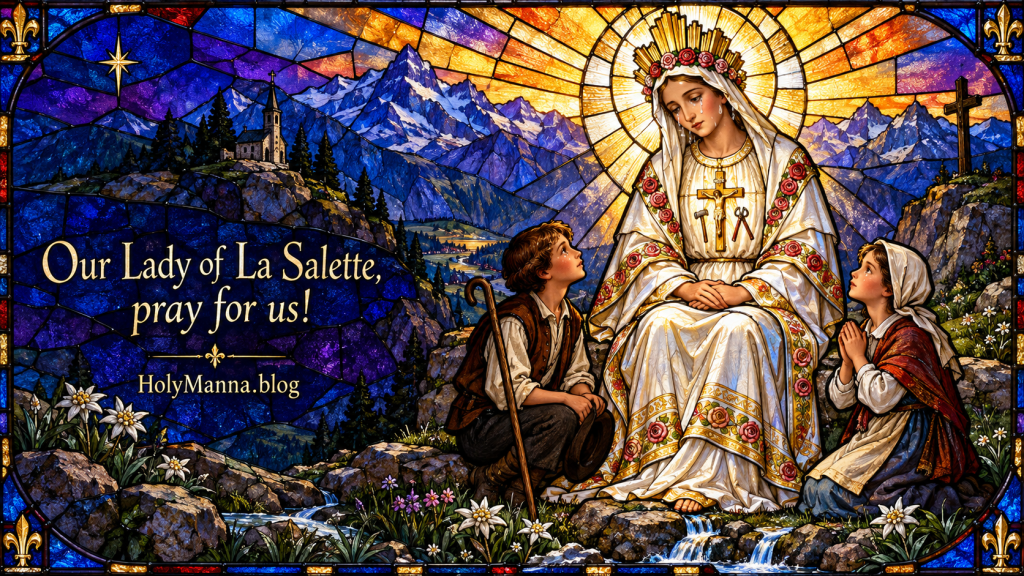
The Weeping Mother of the Alps
Every September 19th, the Church pauses to remember one of the most striking Marian encounters in modern history: the apparition of Our Lady of La Salette. High in the French Alps, on a lonely mountainside far from any cathedral or royal court, the Mother of God appeared to two poor shepherd children. She did not come in triumph. She came in tears. Seated on a stone with her face in her hands, weeping over the sins of her people, she delivered a message of warning, mercy, and hope that still pierces hearts nearly two centuries later.
On the General Roman Calendar, September 19th belongs formally to the Optional Memorial of Saint Januarius, bishop and martyr, and Our Lady of La Salette is kept as a commemoration. Yet in the Diocese of Grenoble, where the apparition took place, and among the Missionaries and Sisters of Our Lady of La Salette, the day is celebrated with the fullness of a titular celebration, and the faithful around the world mark this feast day with pilgrimages, processions, and prayer. Whatever its rank on paper, the day carries enormous weight in the story of Marian devotion, because La Salette stands among the first formally approved Marian apparitions of the modern era, examined for 5 full years before the Church declared it worthy of belief.
Why does this celebration matter so much? Because at La Salette, heaven revealed the heart of a mother. Mary did not appear to condemn. She appeared to plead, to warn, and to intercede, showing the Church what the Catechism teaches about her ongoing mission: that her motherhood in the order of grace continues without interruption until the eternal fulfillment of all the elect (CCC 968 to 970). The weeping Virgin of La Salette became known as Our Lady Reconciler of Sinners, and her message of conversion and reconciliation remains as urgent today as it was in 1846.
Two Shepherd Children and a Lady in Tears
The story begins on Saturday afternoon, September 19th, 1846, in the mountain pastures above the tiny village of La Salette, in the Isère region of southeastern France. Two children were tending livestock for their employers: Maximin Giraud, an 11-year-old boy known for his restless energy, and Mélanie Calvat, a quiet 14-year-old girl from a desperately poor family who had been sent out to work at the age of 7. Her family name appears in the historical records both as Calvat and as Mathieu; Calvat is the form most commonly used. The two children barely knew each other, had little formal education, and could scarcely recite their catechism.
France in 1846 was a nation with a wounded soul. The Revolution had terrorized the Church within living memory. The wars of Napoleon had drained the country of blood and treasure. Secular philosophies were rising, political turmoil was brewing across Europe, and in the mountain parishes around La Salette, the faith had grown cold. Fewer and fewer people attended Sunday Mass, the sacraments were neglected, and casual blasphemy had replaced prayer in the mouths of working men. Hunger stalked the countryside as well; the potato blight and failed harvests of the mid 1840s were pushing families toward famine.
Into this weary world, on an ordinary Saturday, came an extraordinary grace. After a midday rest near a small dried-up spring, the children awoke and noticed a globe of brilliant light on the slope below them. The light opened, and within it they saw a woman seated on a stone, her elbows on her knees and her face buried in her hands, weeping. She rose, and the children later described her as radiantly beautiful, clothed in light, wearing a crucifix on her breast flanked by a hammer and pincers, the instruments of the Passion. Roses adorned her, and tears flowed down her face the entire time she spoke.
She called the frightened children to come near and not be afraid, then spoke to them first in French and then in their own local dialect, so that these two uneducated shepherds could understand every word. When she finished her message, she moved up the slope and vanished into the light. The children hurried home and reported what they had seen, first to their employers and soon to the parish priest, who wept upon hearing their account. Word spread through the valleys with astonishing speed, and the mountain of La Salette would never be lonely again.
The Message, the Secrets, and the Judgment of the Church
What did the Beautiful Lady say? Her words were a mother’s lament over a people drifting away from her Son. In the rendering handed down by the shrine and Catholic tradition, she said: “If My people will not obey, I shall be compelled to loose My Son’s arm. It is so heavy and so pressing that I can no longer restrain it.” She grieved above all over 2 wounds: the profanation of Sunday and the abuse of the Lord’s name. “God has appointed you six days for working. The seventh He has reserved for Himself, but no one gives it to Him,” she told the children, and she wept over those who used the name of her Son in cursing. She spoke of the failed harvests already ravaging France, connecting the suffering of the people to their hardness of heart, yet she promised abundance and mercy if her people would be converted. She entrusted a personal secret to each child, and she closed by commissioning these 2 little shepherds to make her message known to all her people.
The Church did not rush to judgment, and that patience is one of the great strengths of this celebration. Bishop Philibert de Bruillard of Grenoble opened a rigorous investigation that lasted 5 full years. The children were separated, interrogated repeatedly, and even subjected to attempts to confuse or discredit them, yet their accounts held firm. Investigators also weighed the fruits of the event: pilgrims were converting, confessions were multiplying, Sunday observance was returning, and a spring at the apparition site, dry before that day, had begun to flow continuously, with healings soon attributed to its waters. Finally, on September 19th, 1851, exactly 5 years after the apparition, Bishop de Bruillard issued his solemn mandate declaring that the apparition “bore in itself all the marks of truth and that the faithful are justified in believing it to be certain and indubitable.” In 1855 his successor, Bishop Ginoulhiac, confirmed the judgment after a new inquiry with the memorable words: “The task of the shepherds is complete; that of the Church begins.”
Honesty requires a careful word about the secrets. The secrets that Maximin and Mélanie wrote down in 1851 were sent to Pope Pius IX, and their contents were never fully published by the Church. Decades later, Mélanie published a greatly expanded version of her secret at Lecce in 1879, and that text, along with its later reprints, was condemned by the Holy Office, with a formal decree recorded in the Acta Apostolicae Sedis in 1923. The approval of 1851 covers the apparition and its public message of conversion, not the later apocalyptic expansions. Readers should also remember what the Church teaches about all such events: La Salette is a private revelation, and private revelations are never binding on the faithful. As the Catechism explains, “It is not their role to improve or complete Christ’s definitive Revelation, but to help live more fully by it in a certain period of history” (CCC 67). The approved message of La Salette does exactly that. It adds nothing to the Gospel; it begs a forgetful generation to live the Gospel.
Tears That Teach Doctrine
The image of the weeping Virgin is not sentimental decoration. It is a window into everything the Church believes about Mary. The Catechism teaches that Mary is “clearly the mother of the members of Christ” because she cooperated in charity in the birth of the faithful into the Church (CCC 963). At La Salette her maternal heart is on full display: she weeps because her children are wounding themselves through sin, and she intercedes because a mother cannot stand idle while her family suffers. The Catechism, quoting Lumen Gentium 62, states that “Taken up to heaven she did not lay aside this saving office but by her manifold intercession continues to bring us the gifts of eternal salvation” (CCC 969). The Lady of the mountain, pleading without ceasing before her Son on behalf of a stubborn people, is a living picture of that paragraph.
Her tears also flow from the mystery of her union with Christ crucified. The crucifix she wore at La Salette, surrounded by the hammer and pincers of the Passion, recalls Simeon’s prophecy in The Gospel of Luke: “and a sword will pierce through your own soul also” (Luke 2:35). Mary, preserved from all sin by the grace of the Immaculate Conception (CCC 491), ever virgin (CCC 499), and assumed body and soul into heavenly glory (CCC 966), is not distant from human sorrow. Precisely because she is sinless, she feels the horror of sin more keenly than anyone. Her weeping at La Salette echoes her standing at the foot of the Cross, where Jesus gave her to the beloved disciple with the words recorded in The Gospel of John: “Woman, behold, your son!” and “Behold, your mother!” (John 19:26 to 27). The Church has always read that scene as the moment her motherhood extended to all disciples (CCC 964, 968).
The content of the message is equally doctrinal. Her grief over Sunday neglect is a maternal echo of the Third Commandment, “Remember the sabbath day, to keep it holy” (Exodus 20:8), which the Church applies to the Lord’s Day: the faithful are obliged to participate in the Mass on Sundays and holy days, and to rest from work that impedes the worship owed to God (CCC 2180, 2185). Her sorrow over cursing reflects the Second Commandment, for “Respect for his name is an expression of the respect owed to the mystery of God himself” (CCC 2144), and blasphemy is gravely opposed to that respect (CCC 2148). Her call to conversion anticipates the Catechism’s teaching that interior repentance is a radical reorientation of the whole life back toward God (CCC 1431), expressed concretely through fasting, prayer, and almsgiving (CCC 1434).
The popes have confirmed this reading. Saint John Paul II, writing to the Bishop of Grenoble on May 6th, 1996 for the 150th anniversary, honored Mary at La Salette under the title Our Lady Reconciler of Sinners and declared: “La Salette is a message of hope, for our hope is nourished by the intercession of her who is the Mother of mankind.” Addressing the Missionaries of Our Lady of La Salette in Rome on May 4th, 2000, he placed their work at the heart of the Church’s ministry of reconciliation, entrusted them to “the Virgin Mary, Our Lady of Reconciliation,” and urged them: “do not be afraid to bear witness that Christ came to share our humanity so that we might share in his divinity.” His encyclical Redemptoris Mater and Saint Paul VI’s Marialis Cultus both insist that authentic Marian devotion always leads to Christ, and La Salette proves the point: every tear the Lady shed pointed to her Son, and every word she spoke called her people back to Him.
The Mountain That Became a Sanctuary
The transformation of that remote alpine slope into one of the great pilgrimage sites of Europe began almost immediately. Pilgrims started climbing the mountain within weeks of the apparition, drinking from the new spring and praying on the spot where the Lady had wept. In May 1852, Bishop de Bruillard announced the foundation of a sanctuary on the mountain and laid the cornerstone of a church that would in time be raised to the dignity of a minor basilica. In the same letter he established a body of priests dedicated to serving the pilgrims, the beginning of the Missionaries of Our Lady of La Salette, a religious congregation whose entire charism flows from the apparition’s message of reconciliation. A congregation of sisters, the Sisters of Our Lady of La Salette, later grew from the same root.
Today the Sanctuary of Our Lady of La Salette sits nearly 6,000 feet up in the Alps, reachable by a winding mountain road, surrounded by peaks and silence. Pilgrims come, in the words of those who serve there, to seek light and reconciliation with God, confiding their doubts, fears, and sufferings to a mother. The rhythm of the pilgrimage season includes the Rosary, vigils, and evening torchlight processions that trace luminous paths across the mountainside where the Lady once walked. Statues on the site mark the 3 moments of the apparition: the weeping Virgin seated on the stone, the Lady standing in conversation with the children, and her departure up the slope. The spring still flows, and while healings have been attributed to its waters since 1846, the shrine has always insisted that the greatest miracle of La Salette was spiritual: a real conversion of the people, who returned to Mass, to confession, to Sunday rest, and to prayer.
Devotion to Our Lady of La Salette also has its own treasury of prayers and practices. Pilgrims and devotees invoke her as Our Lady Reconciler of Sinners, and a beloved invocation asks Our Lady of La Salette, Reconciler of Sinners, to pray without ceasing for those who have recourse to her. Great souls have drawn from this well; Saint Peter Julian Eymard, the apostle of the Eucharist, held La Salette in profound religious significance from the moment he first heard reports of the event, which unfolded in his own lifetime and his own corner of France. The scapular of Our Lady of La Salette and confraternities of reconciliation have carried the devotion into parishes far from the Alps, always with the same purpose: to lead sinners back to the mercy of Jesus Christ, above all in the Sacrament of Penance, where the Church continues Christ’s own work of reconciliation (CCC 1442).
From an Alpine Village to All Her People
The Lady of La Salette asked 2 children to make her message known to all her people, and the Church took her literally. The Missionaries of Our Lady of La Salette carried the message far beyond France, and by the Jubilee Year 2000 Saint John Paul II could thank them for expanding their apostolate into India and Eastern Europe, with foundations planned in Indonesia and Myanmar. Today the La Salette family serves on multiple continents, preaching reconciliation in parishes, shrines, and missions.
In the United States, the best known center of the devotion is the Shrine of La Salette in Attleboro, Massachusetts, famous for its annual Christmas Festival of Lights, when hundreds of thousands of lights turn the shrine grounds into a wordless sermon about the Light that darkness cannot overcome. In the Philippines, devotion to Our Lady of La Salette has taken deep root, and she is honored as patroness of Silang in Cavite, where her feast is kept with processions and communal celebration in true Filipino fashion. In France, the sanctuary continues to draw pilgrims from around the world, with Masses and devotions offered in multiple languages during the pilgrimage season, and the anniversary of the apparition each September remains the summit of the shrine’s year.
The cultural reach of La Salette also shows in quieter ways. The image of the weeping Madonna, seated with her face in her hands, has become one of the most recognizable forms of Marian art, reproduced in statues, icons, and stained glass across the world. Hymns to the Beautiful Lady of the mountain are sung in French, English, Tagalog, Polish, and many other tongues. Perhaps most remarkably, La Salette shaped the century that followed it. Coming 12 years before Lourdes and 71 years before Fatima, it opened an era in which the Mother of God repeatedly visited her children with calls to prayer and penance, and the themes she introduced on that alpine slope, tears over sin, insistence on conversion, tenderness toward the poor, and secrets entrusted to little ones, would echo at the apparitions that followed. The Church’s careful 5-year investigation at La Salette also helped model the sober discernment that the Church continues to apply to reported apparitions today, always testing the spirits and judging the tree by its fruits.
Letting Her Tears Change You
So what does a weeping Mother in the French Alps have to do with your life right now? Everything, honestly. The 2 sorrows that drew her tears in 1846 are not antique problems. Think about how easily Sunday becomes just another day for errands, brunch, and catching up on work, with Mass squeezed out or squeezed in. Think about how casually the name of Jesus Christ is thrown around in frustration, in jokes, in movies, in your own moments of anger. Our Lady of La Salette is not asking you to feel vaguely guilty about any of this. She is asking you to change, because she knows what sin costs and she knows what her Son’s mercy can do.
Start with Sunday. Decide this week that the Lord’s Day will actually belong to the Lord: Mass first, unhurried, maybe even arriving early enough to pray. Then guard some real rest, a meal with people you love, an hour without a screen, a walk where you can actually think. The Catechism calls Sunday a day of grace and rest from work (CCC 2184 to 2185), and your soul is starving for exactly that. Next, take custody of your tongue. If the holy Name has become a reflex in your speech, replace the reflex: every time you catch yourself, turn it into a short prayer of praise instead. That small discipline, practiced for a month, will change more in you than you expect.
Then go deeper, because La Salette is ultimately about reconciliation. Is there a confession you have been putting off for months or years? The Lady wept so that you would go. Her whole message funnels toward the confessional, where her Son is waiting, not with the heavy arm the children heard about, but with open ones. Is there a person you need to forgive, or to ask forgiveness from, a parent, a sibling, an old friend? Reconciliation with God and reconciliation with each other travel together. And when your own tears come, in grief, in anxiety, in failure, remember that the Mother of God is not embarrassed by tears. She wept on that mountain to show you that heaven takes your sorrows seriously, and that sorrow offered to God becomes intercession. Bring your tears to her, and let her bring them to Jesus, just as she brought the needs of Cana to Him with the simple instruction recorded in The Gospel of John: “Do whatever he tells you” (John 2:5).
Engage With Us!
The Beautiful Lady of La Salette commissioned 2 shepherd children to pass her message on, and now that mission passes to you. Share your thoughts and reflections in the comments below; your story of conversion, of a hard confession finally made, or of a Sunday reclaimed for God might be exactly the encouragement another reader needs today.
- When you honestly examine your Sundays, do they belong to God, and what one concrete change could you make this week to keep the Lord’s Day holy?
- Our Lady wept over careless and blasphemous speech; how do you speak about God, and about other people, when no one is holding you accountable?
- Is there a sin, a wound, or a broken relationship that you have been carrying instead of bringing to the Sacrament of Reconciliation, and what is really holding you back?
- Mary’s tears show that love grieves over sin without giving up on the sinner; who in your life needs you to love them with that same patient, hopeful persistence?
- If the Blessed Mother appeared on a mountainside in your own region today, what do you think she would weep over, and what would she ask of you personally?
Take heart, friends. The same Mother who wept at La Salette also promised mercy and abundance to a people who would return to her Son, and that promise stands for you. Keep praying, keep going to Mass, keep returning to confession, and keep letting grace reorder your days. Live a life of faith with courage and joy, and let us grow together in faith under the guidance of our Blessed Mother.
Our Lady of La Salette, Reconciler of Sinners, pray for us!
Follow us on YouTube, TikTok, Instagram and Facebook for more insights and reflections on living a faith-filled life.

 Holy Manna!
Leave a comment