Saturday of the Twenty-fourth Week in Ordinary Time – Lectionary: 448
When God Buries Something, He Is Planting It
Every farmer knows a secret that looks like a contradiction: nothing grows until it is buried. The readings for Saturday, September 19th, the Twenty-fourth Week in Ordinary Time, turn entirely on that secret. In the First Reading, St. Paul answers the Corinthians who scoffed at the resurrection of the body. His answer is a seed. What is sown corruptible, weak, and dishonorable is raised incorruptible, powerful, and glorious, because the God who buried Adam’s race in the earth intends to raise it in the image of the heavenly Man, Jesus Christ. The Responsorial Psalm gives that hope a voice. David, cornered by enemies in Gath, sings that God has rescued him from death so that he may walk “in the presence of God, in the light of the living.” Then the Gospel brings the seed image full circle. Jesus, the divine Sower, scatters the word of God across every kind of heart: the hardened path, the shallow rock, the thorn-choked field, and the rich soil that bears fruit a hundredfold through perseverance.
Corinth was a proudly Greek city that considered the body a prison to escape, and Galilee was farm country where every listener had watched seed disappear into dark ground. Both audiences needed the same truth. God does not waste what He buries. He plants it. The word buried in a generous heart, the trust buried in a season of fear, and the body buried in a grave are all seeds awaiting harvest. Today’s liturgy asks only one thing: become the soil where God’s seed can die, take root, and rise.
First Reading — 1 Corinthians 15:35-37, 42-49
The Answer to Death Is Buried in a Seed
Corinth in the mid-first century was a boomtown of commerce, philosophy, and pride, and its Greek intellectual culture had little patience for the resurrection of the body. The soul’s immortality, yes; the flesh rising, never. When Paul preached the resurrection at Athens, some sneered (Acts 17:32), and that same sneer had crept into the Corinthian church. So in 1 Corinthians 15, the longest sustained teaching on the resurrection in all of Scripture, Paul stakes everything on it: if Christ is not raised, faith is in vain. Today’s passage answers the skeptic’s practical objection, how can a decomposed body possibly return, with an image every Corinthian understood from the surrounding farmland: the seed. This is where the day’s central theme is born, because Paul insists that burial is not the end of the body’s story but the planting of it.
1 Corinthians 15:35-37, 42-49
Brothers and sisters:
Someone may say, “How are the dead raised?
With what kind of body will they come back?”You fool!
What you sow is not brought to life unless it dies.
And what you sow is not the body that is to be
but a bare kernel of wheat, perhaps, or of some other kind.So also is the resurrection of the dead.
It is sown corruptible; it is raised incorruptible.
It is sown dishonorable; it is raised glorious.
It is sown weak; it is raised powerful.
It is sown a natural body; it is raised a spiritual body.
If there is a natural body, there is also a spiritual one.So, too, it is written,
“The first man, Adam, became a living being,”
the last Adam a life-giving spirit.
But the spiritual was not first;
rather the natural and then the spiritual.
The first man was from the earth, earthly;
the second man, from heaven.
As was the earthly one, so also are the earthly,
and as is the heavenly one, so also are the heavenly.
Just as we have borne the image of the earthly one,
we shall also bear the image of the heavenly one.
Detailed Exegesis
Verse 35: “Someone may say, ‘How are the dead raised? With what kind of body will they come back?’”
Paul voices the objection honestly. The question is not wicked in itself; it is the question of every mourner at a graveside. The error lies in assuming that what cannot be imagined cannot be done by God, the same error the Sadducees made when Jesus told them they knew “neither the scriptures nor the power of God” (Matthew 22:29).
Verse 36: “You fool! What you sow is not brought to life unless it dies.”
The sharp rebuke echoes the biblical meaning of the fool, the one who leaves God out of the calculation (Psalm 14:1). Then comes the stunning reversal: death is not the obstacle to resurrection but its precondition. Jesus taught the same law of the Kingdom: unless the grain of wheat falls to the ground and dies, it remains alone, but if it dies it bears much fruit (John 12:24).
Verse 37: “And what you sow is not the body that is to be but a bare kernel of wheat, perhaps, or of some other kind.”
A dry kernel looks nothing like the golden stalk it becomes, yet the two are one continuous life. So the risen body will be truly one’s own body, gloriously transformed rather than replaced.
Verse 42: “So also is the resurrection of the dead. It is sown corruptible; it is raised incorruptible.”
Paul now applies the analogy in four hammer strokes. The first contrast targets decay itself. The body that decomposes will be raised beyond the reach of corruption, sharing in the victory of Christ, the firstfruits of those who have fallen asleep.
Verse 43: “It is sown dishonorable; it is raised glorious. It is sown weak; it is raised powerful.”
Nothing is less dignified than a corpse, and nothing weaker. Yet God’s pattern is to raise glory out of humiliation, just as the crucified body of Jesus, stripped and pierced, became the radiant body of Easter morning.
Verse 44: “It is sown a natural body; it is raised a spiritual body. If there is a natural body, there is also a spiritual one.”
A spiritual body is not a ghost. It is a real body wholly animated and transfigured by the Holy Spirit, as the risen Jesus proved when He ate baked fish before His disciples (Luke 24:42-43).
Verse 45: “So, too, it is written, ‘The first man, Adam, became a living being,’ the last Adam a life-giving spirit.”
Paul quotes Genesis 2:7 and unveils his great typology. Adam received life; Christ, the last Adam, gives it. One man opened the door to the grave, and one Man opened it back out.
Verse 46: “But the spiritual was not first; rather the natural and then the spiritual.”
God’s plan moves forward, not backward. The natural life of Eden was always meant to blossom into something greater, and grace does not abolish nature but perfects and elevates it.
Verse 47: “The first man was from the earth, earthly; the second man, from heaven.”
The name Adam itself recalls adamah, the Hebrew word for ground. Humanity’s origin is dust, but its destiny arrives from above in the Incarnation, when the Son of God took that very dust to Himself.
Verse 48: “As was the earthly one, so also are the earthly, and as is the heavenly one, so also are the heavenly.”
Everyone belongs to a lineage. All inherit Adam’s mortality by birth; the baptized inherit Christ’s immortality by rebirth, becoming members of His Body and sharers in His destiny.
Verse 49: “Just as we have borne the image of the earthly one, we shall also bear the image of the heavenly one.”
The passage closes with pure promise. The image of God, wounded in Adam, will shine complete in the redeemed, conformed at last to the image of the Son.
Teachings
The Church has staked her life on this passage from the beginning. Around the year 208, Tertullian opened his treatise On the Resurrection of the Flesh with the declaration, “The resurrection of the dead is the Christian’s trust. By it we are believers.” The Catechism cites today’s very verses when it teaches how the dead will rise. CCC 999 explains that in Christ “all of them will rise again with their own bodies which they now bear,” but transformed into “a spiritual body.” Then CCC 1000 adds, “This ‘how’ exceeds our imagination and understanding; it is accessible only to faith. Yet our participation in the Eucharist already gives us a foretaste of Christ’s transfiguration of our bodies.” In that same paragraph the Catechism hands the microphone to St. Irenaeus of Lyons, the second-century Father who wrote, “Just as bread that comes from the earth, after God’s blessing has been invoked upon it, is no longer ordinary bread, but Eucharist, formed of two things, the one earthly and the other heavenly: so too our bodies, which partake of the Eucharist, are no longer corruptible, but possess the hope of resurrection.” Every Communion is a seed of Easter planted in mortal flesh.
Reflection
This reading changes how you treat your body and how you grieve your dead. Your body is not a shell to escape; it is a seed God intends to raise. Honor it this week through chastity, rest, and moderation, treating it as 1 Corinthians 6:19 calls it, a temple of the Holy Spirit. Visit a cemetery and pray for the dead there, remembering that every grave is a furrow in God’s field. Receive the Eucharist with fresh awe, knowing it plants incorruptibility in you. When you look at your own weakness, aging, or illness, can you see a kernel waiting for harvest? Whose death do you need to entrust again to the last Adam, who is a life-giving spirit?
Responsorial Psalm — Psalm 56:10c-14
Singing About Resurrection Before Anyone Knew the Word
Psalm 56 carries one of the most dramatic backstories in the Psalter. Its superscription ties it to the day David, fleeing Saul, was seized by the Philistines in Gath and escaped only by feigning madness (1 Samuel 21:11-16). Surrounded by enemies in a foreign city, David composed not a complaint but a declaration of trust. The Church places this psalm between Paul’s teaching on resurrection and the Parable of the Sower because it supplies the missing voice: what the seed sounds like while it waits in the dark ground. David has been rescued from death so that he may walk “in the light of the living,” a phrase the liturgy reads as an early glimmer of the resurrection hope Paul will proclaim in full.
Psalm 56:10c-14
R. (14) I will walk in the presence of God, in the light of the living.
Now I know that God is with me.
In God, in whose promise I glory,
in God I trust without fear;
what can flesh do against me?
R. I will walk in the presence of God, in the light of the living.
I am bound, O God, by vows to you;
your thank offerings I will fulfill.
For you have rescued me from death,
my feet, too, from stumbling;
that I may walk before God in the light of the living.
R. I will walk in the presence of God, in the light of the living.
Detailed Exegesis
Verse 10c: “Now I know that God is with me.”
The turning point of the whole psalm arrives in one line. David’s circumstances have not changed; his certainty has. Faith is not the absence of danger but the presence of God within it, the same assurance given to Israel in Isaiah 41:10.
Verses 11 and 12: “In God, in whose promise I glory, in God I trust without fear; what can flesh do against me?”
David glories not in his cleverness at Gath but in God’s promise. The rhetorical question does not deny that flesh can wound or kill; it denies that flesh can touch what matters. St. Paul will echo it in Romans 8:31, asking who can be against those whom God is for.
Verse 13: “I am bound, O God, by vows to you; your thank offerings I will fulfill.”
Gratitude in Israel was never merely a feeling; it was liturgy. David promises the todah, the thanksgiving sacrifice offered in public worship. Trust rescued becomes worship owed, and the Church sees in the todah a foreshadowing of the Eucharist, the perfect sacrifice of thanksgiving.
Verse 14: “For you have rescued me from death, my feet, too, from stumbling; that I may walk before God in the light of the living.”
The psalm ends where the day’s readings converge. God saves not simply from something but for something: a life walked in His presence. Read in the light of Christ, the “light of the living” stretches beyond survival in this world to the unending life of the world to come.
Teachings
The Catechism teaches that believing in God means exactly the trust David models under threat. CCC 227 states that faith means “trusting God in every circumstance, even in adversity,” and it offers as the perfect expression of this trust the famous prayer found in the breviary of St. Teresa of Jesus, Doctor of the Church: “Let nothing trouble you / Let nothing frighten you / Everything passes / God never changes / Patience / Obtains all / Whoever has God / Wants for nothing / God alone is enough.” Teresa wrote those lines in sixteenth-century Spain amid opposition, illness, and exhausting reform work, which makes her prayer a direct descendant of David’s song in Gath. Both discovered that the soul anchored in God can be surrounded and still be free.
Reflection
Everyone has a Gath, a place where circumstances close in and options run out. This psalm hands you a script for that place. Begin tomorrow morning by praying verse 10c aloud, “Now I know that God is with me,” before checking a single notification. Keep one vow of thanksgiving this week, perhaps attending one extra daily Mass as your own todah offering. When anxiety spikes, ask David’s question honestly: what can flesh actually do against a soul held by God? And what would change in your week if you truly walked every hour of it in the presence of God, in the light of the living?
Holy Gospel — Luke 8:4-15
The Sower Who Wastes Nothing, Not Even the Ground That Failed
Crowds were now streaming to Jesus from town after town across Galilee, and He met them with a story drawn from their own hillsides. Galilean farmers sowed by broadcasting, flinging seed across the field before plowing it under, which meant seed genuinely landed on footpaths, on the thin soil covering limestone shelves, and among dormant thorns. Nobody in that crowd heard an abstraction; they heard their Tuesday. Yet the Parable of the Sower is really the parable of the soils, and it is one of the very few parables Jesus interprets Himself, which tells every reader how much He wants it understood. Coming after Paul’s buried seed and David’s rescued trust, the parable completes the day’s theme: God sows the word of eternal life generously, and the harvest depends on the heart that receives it.
Luke 8:4-15
When a large crowd gathered, with people from one town after another
journeying to Jesus, he spoke in a parable.
“A sower went out to sow his seed.
And as he sowed, some seed fell on the path and was trampled,
and the birds of the sky ate it up.
Some seed fell on rocky ground, and when it grew,
it withered for lack of moisture.
Some seed fell among thorns,
and the thorns grew with it and choked it.
And some seed fell on good soil, and when it grew,
it produced fruit a hundredfold.”
After saying this, he called out,
“Whoever has ears to hear ought to hear.”Then his disciples asked him
what the meaning of this parable might be.
He answered,
“Knowledge of the mysteries of the Kingdom of God
has been granted to you;
but to the rest, they are made known through parables
so that they may look but not see, and hear but not understand.“This is the meaning of the parable.
The seed is the word of God.
Those on the path are the ones who have heard,
but the Devil comes and takes away the word from their hearts
that they may not believe and be saved.
Those on rocky ground are the ones who, when they hear,
receive the word with joy, but they have no root;
they believe only for a time and fall away in time of temptation.
As for the seed that fell among thorns,
they are the ones who have heard, but as they go along,
they are choked by the anxieties and riches and pleasures of life,
and they fail to produce mature fruit.
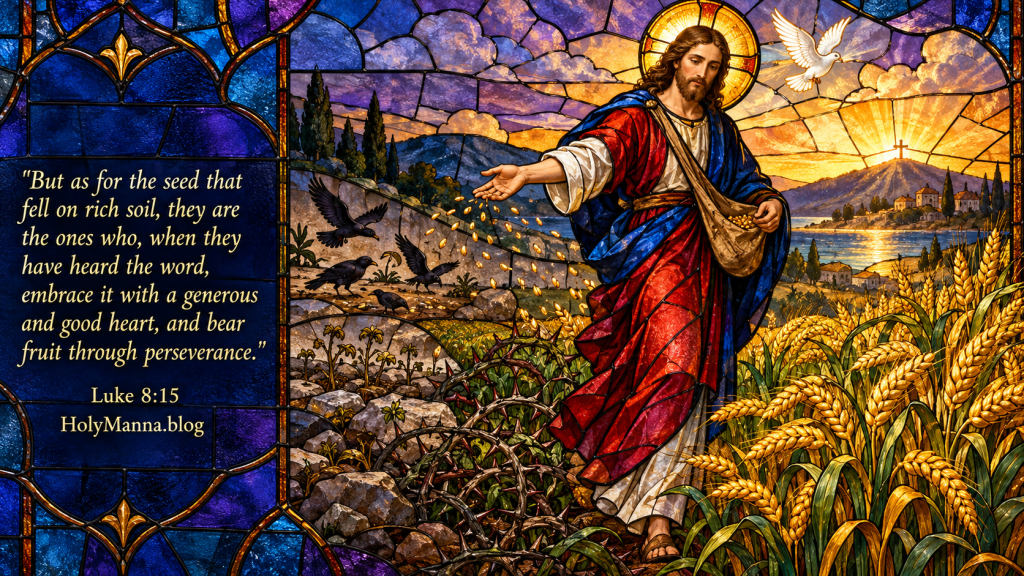
But as for the seed that fell on rich soil,
they are the ones who, when they have heard the word,
embrace it with a generous and good heart,
and bear fruit through perseverance.”
Detailed Exegesis
Verse 4: “When a large crowd gathered, with people from one town after another journeying to Jesus, he spoke in a parable.”
Luke notes the crowd’s size and variety deliberately. The parable is about them, a living field of listening hearts, some hard, some shallow, some crowded, some ready.
Verse 5: “A sower went out to sow his seed. And as he sowed, some seed fell on the path and was trampled, and the birds of the sky ate it up.”
The sower scatters with almost reckless generosity, even where failure seems certain. Such is the extravagance of God, who lets His word fall on every heart without prejudging it.
Verse 6: “Some seed fell on rocky ground, and when it grew, it withered for lack of moisture.”
Much of Galilee sits on limestone barely covered by soil. Seed there sprouts fast because it cannot go deep, and it dies fast for the same reason. Speed without depth is a warning, not a virtue.
Verse 7: “Some seed fell among thorns, and the thorns grew with it and choked it.”
The thorns are not dramatic enemies but competing growth. The seed is not attacked; it is crowded out, which is how most faith is lost.
Verse 8: “And some seed fell on good soil, and when it grew, it produced fruit a hundredfold.” After saying this, he called out, “Whoever has ears to hear ought to hear.”
A hundredfold return was fantastically abundant for ancient agriculture, recalling the blessing on Isaac in Genesis 26:12. The closing cry makes clear that hearing is a moral act, a choice of the will.
Verse 9: “Then his disciples asked him what the meaning of this parable might be.”
The disciples model the only correct response to a mystery: draw closer and ask. The good soil begins with a question brought to Jesus.
Verse 10: “He answered, ‘Knowledge of the mysteries of the Kingdom of God has been granted to you; but to the rest, they are made known through parables so that they may look but not see, and hear but not understand.’”
Jesus echoes Isaiah 6:9. Parables reveal and conceal at once; they reward humility and remain opaque to pride. Understanding is granted, a grace received rather than an achievement claimed.
Verse 11: “This is the meaning of the parable. The seed is the word of God.”
The seed’s power is intrinsic and divine. Nothing is wrong with the seed in any of the four cases; the entire drama lies in the ground.
Verse 12: “Those on the path are the ones who have heard, but the Devil comes and takes away the word from their hearts that they may not believe and be saved.”
Luke names the Devil plainly. A heart hardened by repeated trampling, by cynicism and distraction, leaves the word exposed on the surface where the enemy can snatch it before it ever penetrates.
Verse 13: “Those on rocky ground are the ones who, when they hear, receive the word with joy, but they have no root; they believe only for a time and fall away in time of temptation.”
Emotion at a retreat or a moving liturgy is real, but joy without roots cannot survive testing. Roots grow in hidden, unglamorous soil: daily prayer, regular confession, fidelity when no one applauds.
Verse 14: “As for the seed that fell among thorns, they are the ones who have heard, but as they go along, they are choked by the anxieties and riches and pleasures of life, and they fail to produce mature fruit.”
Jesus lists three thorns that read like a modern calendar: anxiety, wealth, and pleasure. None is condemned as evil in itself; each becomes deadly when it grows unpruned beside the word.
Verse 15: “But as for the seed that fell on rich soil, they are the ones who, when they have heard the word, embrace it with a generous and good heart, and bear fruit through perseverance.”
Luke alone adds the final word, perseverance. Fruit is not produced in a moment of enthusiasm but through long fidelity, season after season, which ties the parable back to Paul: what is sown in patience is raised in glory.
Teachings
The Catechism reads this parable as a question aimed at every soul. CCC 546 teaches that “the parables are like mirrors for man: will he be hard soil or good earth for the word?” St. Cyril of Alexandria, the fifth-century Doctor of the Church, preached on this exact passage in his Commentary on Luke, Sermon 41, and identified the Sower without hesitation: “For He verily is the Sower of all that is good, and we are His husbandry: and by Him and from Him is the whole harvest of spiritual fruits.” On perseverance, the note Luke adds at the parable’s end, CCC 162 teaches, “To live, grow, and persevere in the faith until the end we must nourish it with the word of God; we must beg the Lord to increase our faith.” The soil, in other words, can be worked. Hard ground can be broken by repentance, shallow ground deepened by prayer, and thorns cleared by detachment, because the Sower is also the Gardener of souls.
Reflection
The honest question this Gospel asks is not which soil you were but which soil you are becoming. Try a simple soil test this week. Where the word bounces off you, break the ground with an examination of conscience and, if needed, the Sacrament of Reconciliation. Where your faith runs on feelings, sink a root by committing to 15 minutes of Scripture daily, beginning with this very parable. Where thorns crowd in, name your top anxiety and hand it to God each night before sleep. Which of the three thorns, anxiety, riches, or pleasure, is currently choking the word in your life? And what would a hundredfold harvest look like in your family, parish, or workplace if you let the word fully grow?
The Harvest Always Belongs to God
Step back and the whole day becomes one field. Paul stands at the edge of it and points to the buried kernel, promising that what is sown corruptible will be raised incorruptible, because the last Adam is a life-giving spirit. David walks through the middle of it, hunted and afraid, yet singing that God has rescued him from death so that he may walk “in the presence of God, in the light of the living.” And Jesus stands at the center of the field as the Sower Himself, casting the word of God with a generosity that spends seed even on paths and rocks, because His mercy refuses to write off any ground in advance.
The message for September 19th is wonderfully simple. God buries things in order to raise them. He buries His word in ordinary hearts, buries His grace in ordinary bread, and will one day receive mortal bodies into the earth like seed into a furrow, all with the harvest already in view. The only question left open is the one the Catechism poses: hard soil or good earth?
So do one small act of farming today. Read these passages slowly tonight, pull one thorn of anxiety out by handing it to God in prayer, and receive the next Eucharist as St. Irenaeus described it, a pledge planted in the body that it will rise. The Sower has already gone out. The seed has already left His hand. Let it fall deep, let it die to itself in you, and then watch what the God of the harvest can do with a single generous heart that perseveres.
Engage With Us!
The comments below are open soil, so share what the Lord stirred in your heart today, whether a consolation, a question, or a resolution. Reflections from readers often become the very encouragement someone else needs, and this community grows the way every harvest does, one seed at a time.
- In 1 Corinthians 15:35-37, 42-49, St. Paul teaches that the body is sown corruptible and raised incorruptible. How does believing in the resurrection of your own body change the way you treat your health, your sufferings, and the graves of those you love?
- In Psalm 56:10c-14, David declares his trust in God while surrounded by enemies in Gath. What is the “Gath” in your life right now, and what would it mean to pray “Now I know that God is with me” from inside it?
- In Luke 8:4-15, Jesus names the path, the rock, the thorns, and the rich soil. Which soil best describes your heart this season, and what is one concrete step you can take this week to become better ground for the word?
- Taking all the readings together, where is God asking you to let something be buried, a fear, a comfort, or an old way of living, so that He can raise something glorious from it?
Keep sowing, friends. A life of faith is not built in a single dramatic moment but in quiet perseverance, seed by seed and season by season. Do everything this week with the love and mercy Jesus taught us, and trust the Sower with the harvest.
Sacred Heart of Jesus, we trust in You!
Immaculate Heart of Mary, pray for us!
Saint Michael the Archangel, defend us in battle!
Follow us on YouTube, TikTok, Instagram and Facebook for more insights and reflections on living a faith-filled life.

 Holy Manna!
Leave a comment