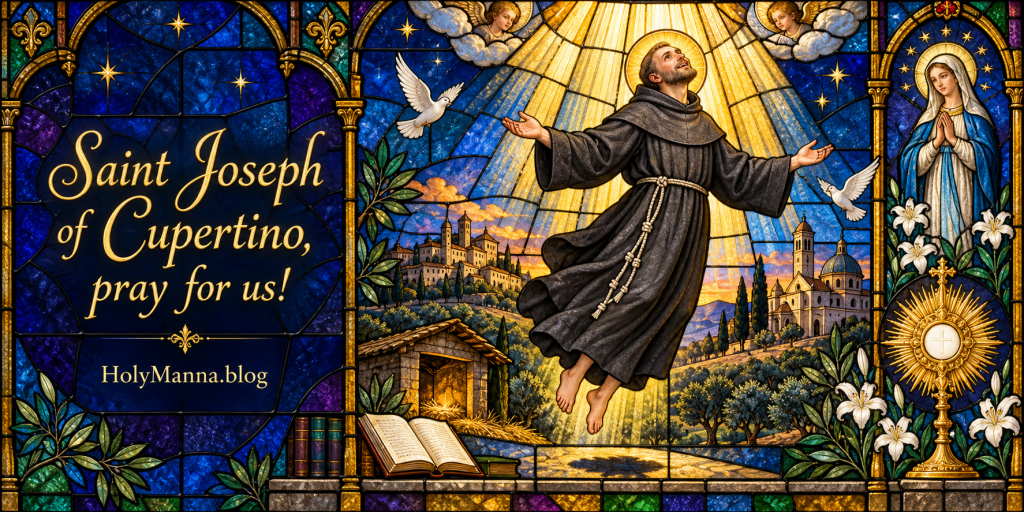
The Flying Friar
Every family has that one relative nobody quite knows what to do with. The Church has one too, and she canonized him. Saint Joseph of Cupertino, a Conventual Franciscan priest of the seventeenth century, was dismissed as a boy too dull to learn a trade, too absent minded to hold a job, and too clumsy to wash dishes in a friary. Yet during the official investigation that preceded his canonization, witnesses under oath attested to seventy separate instances in which this supposedly useless man rose bodily into the air while lost in the love of God. He is remembered today as the Flying Friar, and the Church celebrates him on September 18th, the day he entered eternal life in 1663.
His story is one of the most striking illustrations in all of Church history of Saint Paul’s words: “God chose the foolish of the world to shame the wise, and God chose the weak of the world to shame the strong” (1 Corinthians 1:27). The Catechism teaches that by canonizing certain of the faithful, the Church “recognizes the power of the Spirit of holiness within her and sustains the hope of believers by proposing the saints to them as models and intercessors” (CCC 828). Joseph is a model precisely for those who feel they have nothing to offer, and an intercessor with a remarkably practical portfolio. He is the patron of aviators, pilots, air travelers, and astronauts because of his flights, and the patron of students, test takers, and people with learning disabilities because of the astonishing way God carried him through his own examinations. He is also the patron of his two hometowns, Copertino, where he was born, and Osimo, where he died.
A Stable Birth and a Slow Start
Giuseppe Maria Desa was born on June 17th, 1603, in Copertino, a small town in the heel of Italy, then part of the Kingdom of Naples. His beginnings could hardly have been humbler. His father, Felice Desa, was a poor carpenter drowning in debt who had fled from his creditors, and the family home was seized just as his mother, Francesca Panara, came to term. She gave birth to Joseph in a shed behind the house. Catholics have long noticed the resemblance to Bethlehem, and the friars who preserve his birthplace in Copertino still show pilgrims the little stable where he entered the world.
His childhood was hard in nearly every way. His father died while Joseph was young, and his widowed mother, worn down by poverty, treated him with severity and, by the accounts of his early biographers, regarded him as a burden. He was sickly as a boy, and one story handed down in Copertino tells that a painful ulcer, which no physician could cure, was healed when a hermit applied oil from the lamp burning before an image of Our Lady of Grace. It is a beautiful story of Our Lady’s care for a forgotten child, but it survives through devotional tradition rather than documented record, and it cannot be verified.
What is well documented is that Joseph struggled profoundly. He was forgetful, distractible, and hot tempered, and he would wander through town with his mouth hanging open, which earned him the cruel nickname Boccaperta, the gaper. An apprenticeship to a shoemaker went nowhere. Yet beneath the awkwardness something else was stirring. From about the age of eight he began to experience sudden absorptions in God, moments when the thought of heavenly things simply carried him away and he could not be roused. The neighbors saw a defective boy. God saw a heart uncluttered enough to be filled entirely with Himself.
At seventeen Joseph sought to enter religious life. The Conventual Franciscans turned him away for lack of education. The Capuchins near Taranto accepted him as a lay brother in 1620, but after about eight months they dismissed him; his ecstasies came upon him without warning, he dropped dishes and forgot tasks, and the community judged him unfit. He later spoke of the day they took his habit away as the most painful of his life. He returned home to scorn, and his mother, mostly to be rid of him, arranged for him to serve at the small Conventual friary of La Grottella near Copertino as a stable boy.
The stable was where everything turned. Caring for the friars’ animals, Joseph grew in humility, prayerfulness, and quiet charity, and the community that had once rejected him watched him with growing wonder. In 1625 the Conventual Franciscans admitted him to the Order as a candidate for the priesthood, and the boy nobody wanted put on the habit of Saint Francis for good.
Seventy Flights and One Undivided Heart
Joseph’s studies were an ordeal. He read with great difficulty and wrote worse, and he could not expound the Sunday Gospels to his professors’ satisfaction. One single verse, however, unlocked him. On the words of The Gospel of Luke, “Blessed is the womb that carried you” (Luke 11:27), he could preach with an eloquence that came from somewhere far beyond books, because his love for the Blessed Mother was the deepest current of his soul.
Then came the examinations, and one of the most cherished ordination stories in Catholic memory. When Joseph appeared before the bishop for the diaconate, the bishop opened the New Testament at random, and his eye fell on that very verse, “Beatus venter qui te portavit”, the one text Joseph knew. He spoke on it so richly that the diaconate could not be denied him. In 1628, at his examination for the priesthood, the examiner questioned the first candidates, found them so well prepared that he was satisfied, and passed the remainder without questioning, Joseph among them. The Church has never taught that this was mere luck. Generations of Catholics have seen in it the providence of a God who chooses His priests as He wills, and it is exactly why anxious students the world over still ask Father Joseph to pray for them the night before an exam.
Once ordained, Joseph gave himself to a life of staggering penance. He fasted rigorously, kept seven Lents of forty days each year by long custom of the region, wore a hair shirt and iron chains, and referred to his own body, in the old Franciscan way, as the ass, the stubborn beast of burden that had to be disciplined so the soul could run free. The Catechism explains the logic of such a life: “The way of perfection passes by way of the Cross. There is no holiness without renunciation and spiritual battle” (CCC 2015). Joseph’s austerities were never a rejection of the body; they were the training of a man whose whole being was straining toward God.
And then his body began, quite literally, to follow his soul upward. Around 1630, during a procession for the feast of Saint Francis, Joseph suddenly rose into the air above the crowd. It was the first of the flights that would define his public life. The canonization process later recorded seventy such instances under sworn testimony, which makes Joseph one of the most thoroughly documented mystics in the history of the Church. The mere mention of Jesus or Mary could send him into ecstasy. One Christmas evening, when shepherds came to the church with pipes and songs to honor the newborn Christ, Joseph began to dance for joy and was lifted like a bird to the high altar, where he remained for some fifteen minutes amid the burning candles without disturbing a single flame or singeing his habit. On a Holy Thursday night he flew toward the tabernacle to adore the Blessed Sacrament, and only the command of his superior brought him down. Obedience, it was noted again and again, was the one cord that could always pull him back to earth.
The most famous flight of all took place in Rome. Brought before Pope Urban VIII, Joseph bent to kiss the feet of the Vicar of Christ, was overcome with reverence, and rose into the air before the astonished pope, descending only when the Minister General of his Order commanded it. A tradition also tells that the Lutheran Duke John Frederick of Brunswick witnessed Joseph levitate at Mass in Assisi and was so shaken that he later entered the Catholic Church; the duke’s conversion is historical fact, and the connection to Joseph is the constant account of the Franciscan sources, though the scene itself rests on tradition and cannot be independently verified. Another beloved Copertino story says that Joseph once flew to lift a massive Calvary cross into place after ten workmen had struggled with it in vain. That story too comes down as tradition and cannot be verified.
What did all this mean? The Church has never made levitation the point. A Jesuit who was permitted to speak with Joseph put his finger on the real marvel, saying, as recorded in Butler’s Lives of the Saints, “He is very intensely united to God and his heart is more disposed to this union than gunpowder is to ignition by the tiniest spark”. The flights were the visible overflow of an interior fire. The Catechism describes contemplation as “a gaze of faith, fixed on Jesus” (CCC 2715), and teaches that miracles and signs are given to “strengthen faith in the One who does his Father’s works” (CCC 548). Joseph’s gaze was so fixed that gravity itself seemed to lose its argument. Alongside the wonders, he heard confessions with tireless patience, guided countless souls to genuine conversion, showed a tenderness toward animals that his brothers compared to Saint Francis himself, and read hearts with a gentle accuracy that drew sinners back to the sacraments.
Grounded by the Church He Loved
If Joseph’s story were only flights and wonders, he would be a curiosity. What makes him a saint is what he suffered, and how.
His gift became his cross. Crowds mobbed him wherever he went, some seeking God, many seeking a spectacle, and pious souvenir hunters tore pieces from his habit. His superiors, prudently wary of public disorder and of the man’s own humility, imposed restrictions that would have crushed a lesser spirit. For roughly the last thirty five years of his priesthood, Joseph was forbidden to celebrate Mass publicly, to sing in choir, to walk in processions, or even to eat with his brothers in the refectory. The priest whose Masses had drawn half of southern Italy said Mass alone in a private chapel, year after year.
Worse followed. As Joseph traveled in the province of Bari, enemies denounced him to the Inquisition at Naples, accusing him of drawing crowds after himself like a false messiah and trading on the credulity of the simple. On October 21st, 1638, Joseph was summoned before the inquisitors and detained for several weeks of examination. He answered with such transparent innocence and humility that the examiners found nothing to censure and exonerated him. Rather than release him to the crowds, the authorities sent him to Rome and then, in 1639, to the Sacro Convento in Assisi, the great friary that guards the tomb of Saint Francis. There he would live for about nine years, and there the city eventually made him an honorary citizen.
Assisi was not a soft landing. It was in those years that Joseph passed through a long dark night of the soul. The consolations that had carried him since boyhood dried up, ecstasy gave way to desolation, and he was assailed by temptations and by the terrible feeling that God had abandoned him. The Catechism speaks directly to this trial of prayer, teaching that dryness is the moment “when the heart is separated from God, with no taste for thoughts, memories, and feelings, even spiritual ones”, and that it calls for sheer faith clinging to Jesus in His own agony and tomb (CCC 2731). Joseph prayed on in the dark, and the darkness eventually lifted; his brothers testified that he emerged humbler and more radiant than before.
The final chapter of his hardships came not from enemies but from the highest authority in the Church. Pope Innocent X, still concerned about the crowds, ordered Joseph moved in 1653 to a remote Capuchin friary at Pietrarubbia, and when pilgrims found him even there, to another at Fossombrone, under conditions approaching secrecy. Joseph, who had been rejected by the Capuchins as a young man, now lived among them as a virtual prisoner, cut off from his own Order, forbidden to write or receive letters or to speak with visitors. In 1657 Pope Alexander VII allowed him to return to his Conventual brothers, but at the friary of Osimo he remained in strict seclusion, permitted to speak only with the bishop, the vicar general, his fellow religious, and physicians.
Here is the astonishing thing: Joseph never once rebelled. He did not complain to sympathizers, organize a defense, or nurse a grievance. He obeyed. He had long since learned what the Catechism would later state so plainly: “Humility is the foundation of prayer” (CCC 2559). When the Church he loved treated him as a problem to be managed, he treated the Church as the mother she is, trusting that God could reach him in a locked friary just as easily as on a crowded feast day. Joseph was not a martyr; he was a confessor, a man whose long, hidden endurance was its own slow martyrdom of the heart.
In August of 1663 his final illness came. On the feast of the Assumption, the acts of his canonization record, he experienced ecstasies surpassing anything in his life, as if the Mother he had preached about at his examination were coming to collect him. He insisted on hearing Mass and receiving Communion as long as he possibly could, and he received the anointing of the sick. His early biographers record that, sensing the end, he said that the ass had at last begun to climb the mountain, his old playful name for the body now carrying him up to God; the saying survives through those biographers rather than any written text of his own. He died at Osimo on September 18th, 1663, at sixty years of age.
A Legacy That Still Takes Wing
Devotion to Joseph began at his tomb almost immediately, and the healings and favors attributed to his intercession were examined with the Church’s customary rigor. The process of beatification gathered the sworn testimony of eyewitnesses to his levitations and virtues, and it is worth savoring one detail: the future Pope Benedict XIV, serving earlier in his career in the office popularly called the Devil’s Advocate, scrutinized the evidence himself, and it was that same Benedict XIV who beatified Joseph on February 24th, 1753, citing the unimpeachable quality of the testimony. Pope Clement XIII canonized him on July 16th, 1767. Miracles of healing attributed to his intercession were formally approved in those processes, and pilgrims to his shrine have reported graces and cures across the centuries since; the individual stories vary in documentation, and where they cannot be verified they are best received as the grateful testimony of the faithful rather than established fact. The Church’s confidence rests on what she teaches about all the saints, that “being more closely united to Christ, those who dwell in heaven fix the whole Church more firmly in holiness… They do not cease to intercede with the Father for us” (CCC 956).
His body rests in the Basilica of Saint Joseph of Copertino in Osimo, a former church of Saint Francis transformed into a baroque sanctuary in his honor, where pilgrims venerate his relics and visit the small rooms where he spent his last years. In Copertino itself, the faithful can still pray in the stable where he was born, see the baptismal font where he became a child of God, and visit the sanctuary the town raised to its most famous son. Pilgrims stream to both towns every September.
His cultural reach is delightfully wide for a man once written off as useless. When human beings finally took to the air, Catholic aviators adopted the friar who had flown three centuries early, and devotion to him spread among pilots and airmen, later extending to astronauts. Students remain his largest constituency; every exam season, novenas to Saint Joseph of Cupertino circulate through universities and seminaries on every continent. One caution belongs here, because it circulates endlessly online: the popular examination prayer that begins by recalling how he was asked only the questions he knew is a prayer addressed to him by later devotees, not a prayer he wrote, and it should never be quoted as his own words. His life even reached the movies in 1962, when The Reluctant Saint brought the story of the flying friar to a worldwide audience. His feast is kept on September 18th in the Roman Martyrology and on the calendars of the Franciscan family and his local churches.
What the Gaper Teaches the Gifted
Joseph of Cupertino is dangerously easy to admire and surprisingly uncomfortable to imitate, because his life dismantles the things this generation is trained to trust: credentials, competence, productivity, reputation. He had none of them. What he had was an undivided heart, and God did more through that one heart than through armies of the impressive. Jesus Himself prayed, “I give praise to you, Father, Lord of heaven and earth, for although you have hidden these things from the wise and the learned you have revealed them to the childlike” (Matthew 11:25). Joseph is that prayer with a face.
His story speaks first to anyone who has ever felt like the slow one in the room. The boy called the gaper became the patron of students not because God made him clever but because God made him faithful, and faithfulness turned out to be enough. The Catechism echoes Saint Paul in teaching that God’s “power is made perfect in weakness” (CCC 273, quoting 2 Corinthians 12:9). Whatever weakness you carry, academic, social, emotional, or spiritual, is not a disqualification from holiness. It may be the very opening through which grace intends to enter. Where in your life have you quietly decided that you are not good enough for God to use?
His story speaks just as sharply to the gifted, because Joseph shows what to do when even good things are taken away. He lost his public Mass, his brothers’ table, his freedom, and at Assisi even the felt presence of God, and he responded with obedience and trust rather than bitterness. There is a lesson here for every season of dryness, every closed door, every authority that seems unfair. When God feels absent from your prayer, do you keep showing up, as Joseph did, or do you quietly walk away?
Practically, his lessons land in ordinary places. Begin the day by offering God your weakest area, by name, and asking Him to be strong precisely there. Before any test, interview, or hard conversation, ask Saint Joseph of Cupertino to pray for you, then prepare as well as you honestly can, since he never treated providence as an excuse for laziness. Fast from one small comfort each week to train the stubborn ass of the body, as he did in his far more heroic way. Guard a daily pocket of silent adoration, even ten minutes, because the flights all began with a gaze fixed on Jesus. And when you are overlooked, mocked, or managed unfairly, answer with the quiet humility that made a stable boy a saint. What one comfort could you surrender this week so that your heart sits a little lighter for God?
Engage With Us!
The HolyManna community would love to hear from you, so share your thoughts and reflections on Saint Joseph of Cupertino in the comments below. His life raises questions worth sitting with, and these can help start the conversation.
- Joseph was rejected by his family, his town, and even two religious communities before God’s plan unfolded. How have past rejections in your life prepared you for something God wanted to give you?
- Joseph obeyed his superiors even when their restrictions seemed harsh and unfair. Where is God asking you to trust legitimate authority, in the Church, at work, or at home, even when it costs you?
- Joseph’s ecstasies began with a heart utterly captivated by Jesus and Mary. What captivates most of your attention in an average day, and what would it take to fix your gaze more firmly on Christ?
- The gaper became the patron of students. What weakness of yours might God be waiting to transform into your greatest avenue of grace?
- Joseph endured years of spiritual dryness without abandoning prayer. What practical anchor, such as daily Mass, the Rosary, or adoration, could hold you steady in your own dry seasons?
Take heart from the friar who could not keep his feet on the ground because his heart was already home. Live this week with his humility, his obedience, and his childlike trust, and do everything, from the exam to the errand to the encounter with a difficult person, with the love and mercy that Jesus taught us.
Saint Joseph of Cupertino, pray for us!
Follow us on YouTube, TikTok, Instagram and Facebook for more insights and reflections on living a faith-filled life.

 Holy Manna!
Leave a comment