The Bishop Who Carried the Kings Home
Walk through the old southern quarter of Milan today and you will find a church whose bell tower does not end in a cross. It ends in a star. That single detail, glinting above the rooftops of one of Europe’s busiest cities, is the visual signature of a fourth-century bishop most Catholics have never heard of, Saint Eustorgius I, whose feast the Church keeps on September 18. Eustorgius governed the see of Milan from the year 343 until about 349, in the turbulent generation between the Council of Nicaea and the episcopate of the great Saint Ambrose. He was, by every surviving account, a faithful and orthodox shepherd in an age when orthodoxy was costly. Saint Athanasius, the towering champion of the divinity of Christ, spoke of him as a “defender of the faith” and counted him among the opponents of the Arian heresy, and Saint Ambrose himself honored his predecessor with the venerable title of “confessor.” The Roman Martyrology commemorates him on this day at Milan as a bishop commended by the testimony of blessed Ambrose.
Yet what has carried the name of Eustorgius across seventeen centuries is not primarily his synods or his church building, real as those were. It is a treasure he is said to have carried on the back of an ox cart: the relics of the Magi, the wise men from the East who knelt before the infant Christ. The story of how those relics came to Milan, how they were seized and taken to Cologne, and how a small portion finally came home again, is one of the most remarkable relic sagas in the history of the Church. Eustorgius stands at its beginning, a bishop whose entire legacy is bound up with pointing beyond himself to the newborn King. The Catechism reminds every believer that “the communion of saints is the Church” (CCC 946), and Eustorgius belongs to that communion as a man remembered not for his own words, but for the treasure he guarded and the faith he refused to surrender.
From Greece to the See of Milan
The documented facts of Eustorgius’s early life are few, and honesty requires saying so plainly. According to the tradition preserved in Milan, Eustorgius was a noble Greek, born around the year 275 somewhere in the Greek-speaking eastern half of the Roman Empire. Nothing certain is known of his family, his formation, or the circumstances that brought him west to Milan. What the tradition does record is that before his election he served as a legate of the city of Milan, a role of trust and diplomacy that suggests a man of education, standing, and proven character.
Milan in those decades was no provincial backwater. Since the reforms of Diocletian, it had served as one of the great imperial capitals of the West, a city where emperors resided, armies mustered, and the affairs of the empire were decided. It was in Milan, in the year 313, that Constantine and Licinius agreed to the policy of toleration remembered as the Edict of Milan, which ended the age of the great persecutions. A generation later, when the bishop Protasius died in 343, the Church of Milan chose Eustorgius to succeed him. To be bishop of such a city was to stand at the crossroads of Church and empire, and the Catechism explains why the office mattered so much: “the bishops have by divine institution taken the place of the apostles as pastors of the Church” (CCC 862). Eustorgius did not inherit a ceremonial dignity. He inherited the apostolic responsibility for the souls of an imperial capital at the precise moment when the greatest doctrinal storm in the early Church’s history was breaking over the West.
Tradition adds that after his election, Eustorgius traveled to Constantinople so that the emperor could confirm his election, a journey entirely plausible for the bishop of an imperial city in that era. It was on this journey, the tradition says, that he received the gift that would define his memory forever. That story belongs to a later section, but it is worth pausing on the simple historical picture first: a Greek by origin, a servant of his adopted city, elected by its Church, confirmed in the East, and returning home to shepherd his people. Whatever else is uncertain, the Church of Milan itself never doubted the holiness of the man. A song from the fifth or sixth century already speaks of him as a famous holy man, his name was inscribed in the venerable Ambrosian Rite, and by the fourteenth century no fewer than five churches in Milan bore his name.
A Confessor in an Age of Confusion
Why should a modern reader remember a bishop from whom not a single sermon or letter survives? Because the two most credible witnesses of his century thought him worth remembering, and they were witnesses who did not hand out praise lightly. Saint Athanasius of Alexandria spent his life, through five exiles, defending the truth that the Son of God is truly God, and when he named the bishops of the West who stood with the true faith against Arianism, Eustorgius of Milan was among them, called a “defender of the faith.” Saint Ambrose, who took up the same fight in Milan a generation later, called Eustorgius a “confessor,” the Church’s ancient title for one who suffered for the faith without being put to death. In the early Church that word was not a decoration. It meant that a man had confessed Christ under pressure and paid a price for it.
The pressure of that age was the Arian crisis. The priest Arius had taught that the Son of God was a creature, exalted above all others but not eternal and not truly God. The Council of Nicaea in 325 rejected this definitively, confessing that the Son is “begotten, not made, of the same substance as the Father” (CCC 465). But the council did not end the battle. Through the middle decades of the fourth century, emperors and court bishops worked relentlessly to undo Nicaea, and the sees of the West came under enormous pressure to compromise. This was the world in which Eustorgius shepherded Milan. Holding the Nicene line in an imperial capital, under the eyes of an imperial court increasingly sympathetic to the Arian party, required exactly the quiet, immovable fidelity that the titles given him by Athanasius and Ambrose imply. The Catechism teaches that every Christian is bound to this same fidelity, for the duty of witness belongs to all the baptized, and “witness is a transmission of the faith in words and deeds” (CCC 2472). Eustorgius transmitted the faith whole and entire to the Church that would later produce Ambrose and baptize Augustine. That transmission is his miracle of governance, even if no wonder tales attach to it.
The concrete record of his episcopate, though brief, confirms a working, building, teaching bishop. He held two synods, one in the years 345 to 346 and another in 347 to 348, gathering his clergy to order the life of the Church at the very time when doctrinal clarity mattered most. He also began the construction of churches and basilicas in Milan, giving the growing Christian community of the capital the sacred spaces its worship required. No miracles worked by Eustorgius during his lifetime are recorded in the historical sources, and this post will not invent any. What the sources do preserve is one great story, and it deserves to be told the way Milan has told it for centuries.
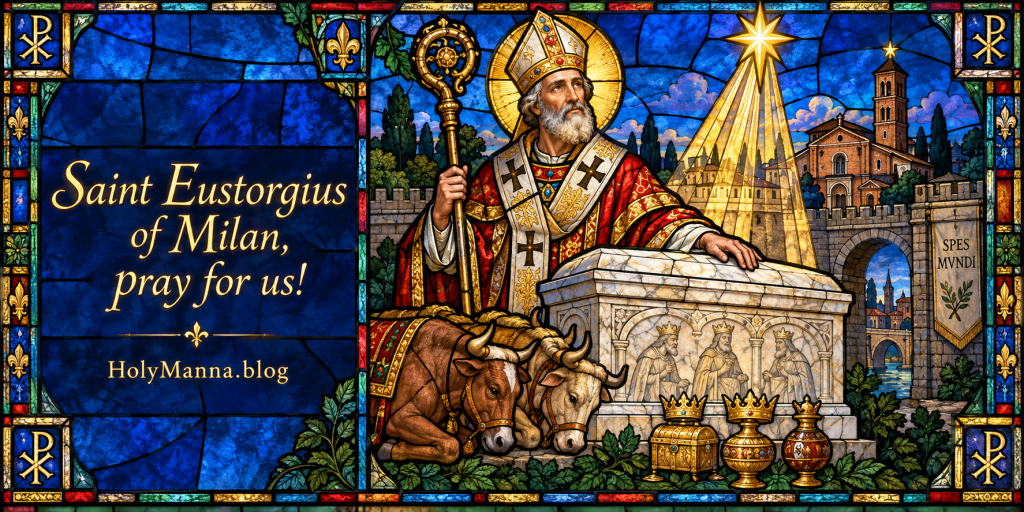
According to the tradition, when Eustorgius traveled to Constantinople to have his election confirmed, the emperor gave him an astonishing gift: the relics of the Three Magi, the wise men of The Gospel of Matthew, which were said to have been discovered by Saint Helena, the mother of Constantine, and brought by her to Constantinople. The traditions differ on which emperor made the gift, some naming Constans and others Constantius II, and the story itself is first written down in a legendary Life of Eustorgius composed in the twelfth century, some eight hundred years after the events it describes. The tradition continues that Eustorgius placed the relics in a massive marble sarcophagus and set out for Milan with the great stone chest drawn by oxen. When the cart reached the gates of Milan at the Porta Ticinese, the exhausted oxen halted and could not be made to advance another step. Eustorgius read the moment as a sign from God, and on that very spot he built the church where the Magi would rest, the church that still bears his name, the Basilica of Sant’Eustorgio. This beloved story is a tradition handed down by the Church of Milan rather than an established historical fact, and it cannot be verified.
What can be said with confidence is more modest but still striking. The basilica itself was probably founded in the fourth century, and when an ancient pillar was removed during works in 1764, a Christian burial was discovered beneath it containing coins of the emperor Constans, the son of Constantine the Great. Archaeology thus quietly confirms that Christians were burying their dead on that ground in the very generation of Eustorgius, even though it cannot confirm the journey of the Magi’s relics. The Church has always been able to hold both truths at once: reverence for a venerable tradition, and honesty about what history can and cannot prove.
Standing Firm Against the Arian Storm
Eustorgius was not a martyr. He died in peace in Milan, on September 18 around the year 349, and the Church honors him as a confessor rather than a martyr. But it would be a mistake to imagine his episcopate as tranquil. The middle of the fourth century was one of the most dangerous times in history to be an orthodox bishop, precisely because the danger no longer came from pagan persecutors but from within the Christian empire itself. Emperors summoned councils, deposed bishops, and sent soldiers to install compliant replacements. To confess the full divinity of Christ, as Nicaea had defined it, was to risk everything a bishop had.
The proof of how real that danger was in Milan came immediately after Eustorgius’s death. His successor, Saint Dionysius, refused at a council held in Milan in 355 to condemn Saint Athanasius as the Arian party demanded. The emperor Constantius II responded by mistreating the faithful bishops, exiling Dionysius to distant Cappadocia, and installing the Arian Auxentius on the throne of Milan. Dionysius died in exile, and Milan groaned under a heretical bishop for two decades until God raised up Ambrose. This is the storm that was already gathering throughout Eustorgius’s episcopate. When Athanasius called him a “defender of the faith,” he was describing a man who held his see loyal to Nicaea while the imperial weather turned against Nicaea, and who handed on to Dionysius a Church still orthodox enough to resist even at the cost of exile.
There is a hidden hardship here that speaks powerfully to the present day. Eustorgius’s fight was not dramatic. There were no lions, no pyres, no public trials that history remembers. His endurance took the form of years of steady governance, of synods held and clergy formed and churches built, of a thousand small refusals to bend the truth for convenience. The Catechism describes exactly this kind of fidelity when it teaches that all the faithful are called to bear witness to the truth: “the duty of Christians to take part in the life of the Church impels them to act as witnesses of the Gospel and of the obligations that flow from it” (CCC 2472). Most Christians will never face martyrdom. Nearly all will face the slow pressure to compromise, the fatigue of holding a position that the surrounding culture finds inconvenient, the temptation to purchase peace at the price of truth. Eustorgius endured that pressure for six years at the center of imperial power and never gave way. That is why Ambrose, who knew what that fight cost, reached for the word “confessor.”
The Kings Depart and Return
After his death, Eustorgius was buried, according to the memory of the Milanese Church, in the cemetery on the grounds of his own basilica, which lay outside the Roman walls along the road to Pavia. His relics rest today in the main altar of the Basilica of Sant’Eustorgio, where the faithful have venerated him for centuries. No collection of specific posthumous healing miracles attributed to his intercession has come down in the sources, and none will be invented here. Instead, God gave this humble bishop a different kind of afterlife in the memory of the Church, one bound up entirely with the relics he is said to have carried home.
For roughly eight centuries, the tradition holds, the great marble sarcophagus of the Magi rested in Sant’Eustorgio, and the basilica became an important stop for pilgrims traveling to Rome or to the Holy Land, drawn by the presence of the men who had first sought Christ by the light of a star. Then came catastrophe. In the twelfth century the emperor Frederick Barbarossa besieged and sacked Milan. The tradition recounts that the devoted faithful, fearing the holy remains would be violated, hid them in the nearby church of San Giorgio in Palazzo within the city walls, but Rainald von Dassel, Archbishop of Cologne and Barbarossa’s imperial chancellor, uncovered the ruse in 1164, took possession of the bodies of the Magi, and carried them across the Alps to Cologne. The details of the hiding and discovery belong to tradition and cannot be verified, though the transfer of the relics to Cologne in 1164 is itself well attested history.
What happened next reshaped a city. In Cologne the relics were enclosed in a magnificent golden reliquary crafted by the goldsmith Nicholas of Verdun, the celebrated Shrine of the Three Kings, and the flood of pilgrims who came to venerate them helped inspire the building of Cologne Cathedral, one of the largest and most glorious Gothic churches ever raised. To this day the shrine of the Magi stands behind the high altar of that cathedral. It is a strange and humbling thought that one of the greatest buildings in Christendom traces its origin, through Barbarossa’s plunder, back to an ox cart that halted at the gates of Milan.
Milan never forgot its loss. For more than seven centuries the Milanese preserved the empty sarcophagus of the Magi in Sant’Eustorgio as a silent witness. Finally, in 1903 and 1904, through the intervention of Blessed Cardinal Andrea Ferrari, Archbishop of Milan, and the consent of the Archbishop of Cologne, fragments of the bones and garments of the Magi were returned to Milan. They rest today in the Three Kings altar of Sant’Eustorgio, beside the ancient empty sarcophagus, a reunion of relic and reliquary after seven hundred and forty years. Every year on January 6, the Solemnity of the Epiphany, Milan celebrates its bond with the Magi in the Corteo dei Magi, a joyful costumed procession that winds from the cathedral of Milan to the Basilica of Sant’Eustorgio, reenacting the journey of the wise men to Bethlehem. And above it all, the bell tower of the basilica still carries its star instead of a cross, so that the skyline of Milan itself preaches the story. From the thirteenth century the basilica also became the principal Milanese home of the Dominican Order, and its fifteenth-century Portinari Chapel remains one of the artistic jewels of the city.
The Church has never asked the faithful to stake their faith on the authenticity of these relics, and this post does not do so either. What the Church does teach is that the veneration of relics is a legitimate and fruitful expression of Christian devotion. The Catechism lists among the forms of popular piety that nourish the life of faith “the veneration of relics, visits to sanctuaries, pilgrimages, processions” (CCC 1674). And the deeper meaning of the Magi themselves is defined with luminous clarity: “The Epiphany is the manifestation of Jesus as Messiah of Israel, Son of God and Saviour of the world” (CCC 528). Whatever rests in the golden shrine of Cologne and the altar of Milan, the wise men of The Gospel of Matthew are utterly real, the first of the nations to seek and adore the Christ, and every pilgrim who has ever knelt at Sant’Eustorgio or Cologne Cathedral has joined their journey.
Carrying Treasure You Did Not Earn
The life of Saint Eustorgius offers a lesson that lands with particular force on believers today: the holiest thing a Christian may ever do is faithfully carry a treasure that is not his own. Eustorgius did not write the Creed of Nicaea. He did not discover the relics of the Magi. He did not build the golden shrine or the Gothic cathedral. His sanctity consisted in receiving what was entrusted to him, the true faith and, tradition says, a precious treasure of the Church, and in guarding it, carrying it, and handing it on intact. That is, in miniature, the vocation of every Catholic. The faith each believer holds was carried to them across centuries by people exactly like Eustorgius, most of them nameless, all of them faithful.
Consider the wise men whose memory he guarded. The Gospel of Matthew records their question and their worship: “Where is the newborn king of the Jews? We saw his star at its rising and have come to do him homage” (Mt 2:2), and when they found the child with Mary his mother, “they prostrated themselves and did him homage. Then they opened their treasures and offered him gifts of gold, frankincense, and myrrh” (Mt 2:11). The Magi teach that seeking Christ is worth any journey, and Eustorgius teaches that carrying Christ to others is worth any burden. When was the last time you went out of your way, genuinely out of your way, to seek Jesus? And what treasure has been placed in your hands, your faith, your family, your parish, your knowledge of the truth, that God is asking you to carry faithfully rather than admire from a distance?
There is also the quieter lesson of the confessor. Eustorgius held the line on the divinity of Christ in an era when the powerful wanted that truth softened. Most believers today will recognize the pattern: not open persecution, but steady pressure to trim the faith into something more comfortable. The way of Eustorgius is not loud argument but immovable fidelity, expressed in ordinary, repeatable acts. Go to Mass every Sunday without exception. Learn the faith well enough to explain it gently, starting with the Catechism itself, which the Church gives precisely so that believers can know what they believe. Keep Epiphany generously, perhaps with the beautiful tradition of blessing the home with chalk. Venerate the saints and ask their intercession, confident, as the Church teaches, that “the communion of saints is the Church” (CCC 946). And when the moment comes to choose between convenience and truth, remember the oxen at the Porta Ticinese, and stop where God tells you to stop, even if the world insists you keep moving. Is there one place in your life right now where God is asking you to stand still and build, instead of moving on?
Engage With Us!
HolyManna would love to hear from you, so please share your thoughts and reflections on Saint Eustorgius in the comments below. Did you know the story of the Magi’s relics before today? Has a visit to a shrine, a basilica, or a pilgrimage site ever deepened your own faith? To help spark the conversation, here are some questions to pray with and to discuss.
- Saint Eustorgius is remembered as a faithful carrier of treasures he did not create. What treasure of faith has been handed to you, and how are you carrying it forward for the next generation?
- Saint Athanasius called Eustorgius a defender of the faith during the Arian crisis. Where in your daily life do you feel pressure to soften or hide what the Church teaches, and what would quiet, charitable firmness look like there?
- The Magi crossed deserts to kneel before the infant Jesus. What is one concrete journey, a first confession in years, a daily Rosary, a visit to the Blessed Sacrament, that you sense Christ inviting you to make this month?
- The oxen stopped at the gates of Milan, and Eustorgius built a church on that spot. Where might God be telling you to stop striving and start building where you already are?
- The relics of the Magi were lost to Milan for centuries and then partially restored. Is there something in your own faith life that was lost for a long time and that God is now inviting you to reclaim?
Saint Eustorgius reminds every believer that heaven is not reserved for the famous. It is full of faithful men and women who simply guarded what they were given and pointed, like a star on a bell tower, to the King. May you live this week with that same steady fidelity, seeking Jesus like the Magi, standing firm like the confessors, and doing everything, at home, at work, and in your parish, with the love and mercy that Jesus taught us.
Saint Eustorgius of Milan, pray for us!
Follow us on YouTube, TikTok, Instagram and Facebook for more insights and reflections on living a faith-filled life.

 Holy Manna!
Leave a comment