Friday of the Twenty-fourth Week in Ordinary Time – Lectionary: 447
The Hinge of History
Some questions can wait until tomorrow. This one cannot. On September 18th, 2026, Friday of the Twenty-fourth Week in Ordinary Time, the Church places before her people the single claim on which everything else depends: Jesus Christ has been raised from the dead, bodily, historically, and forever. The readings for Lectionary 447 circle this claim from three directions. In the First Reading from 1 Corinthians 15, Saint Paul confronts believers in the sophisticated Greek city of Corinth who had begun to doubt that the dead could rise. His answer is a chain of iron logic: pull out the Resurrection and the whole house of faith collapses into rubble. In Psalm 17, an ancient prayer of David reaches forward across a thousand years toward a hope Israel could barely name yet, the hope of waking from death and being content in the presence of God. And in the Gospel from Luke 8, the scene turns quiet and almost domestic: Jesus walking dusty Galilean roads, accompanied by the Twelve and by a band of women, Mary Magdalene among them, who paid the bills of the Kingdom out of their own purses. The connection is not accidental. The woman delivered of seven demons, who followed Jesus town to town and funded His mission, became the first human being to see Him risen. The central theme of the day is this: everything stands or falls on the Resurrection, and the ones who walk the road with Jesus, serving Him with what they have, are the ones who wake to see His face.
First Reading — 1 Corinthians 15:12-20
The Argument That Holds Up the Whole House
Corinth in the mid-50s was a booming Greek port city, wealthy, cosmopolitan, and intellectually proud. Greek philosophy could accept an immortal soul drifting free of the body, but a corpse rising from a grave struck many as embarrassing nonsense. Saint Paul had already tasted that scorn in Athens, where the philosophers sneered the moment he mentioned the resurrection of the dead, as Acts 17:32 records. Now the same skepticism had seeped into the Church itself. Some Corinthian Christians apparently accepted that Christ rose while denying that anyone else would. In 1 Corinthians 15, the longest sustained teaching on the Resurrection in all of Scripture, Paul dismantles that halfway position piece by piece. This passage sits at the heart of the day’s theme because it names the stakes without flinching: either the tomb is empty or the faith is.
1 Corinthians 15:12-20
Brothers and sisters:
If Christ is preached as raised from the dead,
how can some among you say there is no resurrection of the dead?
If there is no resurrection of the dead,
then neither has Christ been raised.
And if Christ has not been raised, then empty too is our preaching;
empty, too, your faith.
Then we are also false witnesses to God,
because we testified against God that he raised Christ,
whom he did not raise if in fact the dead are not raised.
For if the dead are not raised, neither has Christ been raised,
and if Christ has not been raised, your faith is vain;
you are still in your sins.
Then those who have fallen asleep in Christ have perished.
If for this life only we have hoped in Christ,
we are the most pitiable people of all.But now Christ has been raised from the dead,
the firstfruits of those who have fallen asleep.
Detailed Exegesis
Verse 12: “If Christ is preached as raised from the dead, how can some among you say there is no resurrection of the dead?”
Paul opens with the contradiction the Corinthians had not noticed in themselves. They had received the apostolic preaching, the kerygma, which announced a risen Christ, yet some now denied resurrection as a category. Paul insists that Christ’s rising and humanity’s rising are one reality, not two separable ideas.
Verse 13: “If there is no resurrection of the dead, then neither has Christ been raised.”
The logic cuts both ways. Christ is not an exception to the human story; He is its head. If dead bodies simply cannot rise, then His did not either, and the Corinthians must own that conclusion.
Verse 14: “And if Christ has not been raised, then empty too is our preaching; empty, too, your faith.”
The Greek word here, kenos, means hollow, void, without content. Paul refuses to treat Christianity as a lovely philosophy that survives the loss of its central fact. Without the Resurrection, apostolic preaching becomes noise and faith becomes a vessel with nothing inside.
Verse 15: “Then we are also false witnesses to God, because we testified against God that he raised Christ, whom he did not raise if in fact the dead are not raised.”
Paul raises the moral stakes. The apostles did not preach an idea; they testified to an event. If the event never happened, they are not merely mistaken teachers but perjurers against God Himself, guilty of attributing to Him an act He never performed.
Verse 16: “For if the dead are not raised, neither has Christ been raised,”
The repetition is deliberate. Paul hammers the same nail because the Corinthians kept trying to hold two incompatible beliefs at once. Repetition here is mercy: he will not let them look away.
Verse 17: “and if Christ has not been raised, your faith is vain; you are still in your sins.”
Now the consequence turns personal. The Resurrection is God’s public verdict that the Cross truly atoned, as Romans 4:25 teaches that Jesus was raised for humanity’s justification. A dead Christ leaves every sin exactly where it was.
Verse 18: “Then those who have fallen asleep in Christ have perished.”
Christians called death “falling asleep” precisely because they expected a waking. Paul forces the Corinthians to look at their own dead, the parents and spouses and children buried in hope, and admit that without the Resurrection those beloved dead are simply gone.
Verse 19: “If for this life only we have hoped in Christ, we are the most pitiable people of all.”
Corinthian Christians endured mockery, exclusion, and danger for their faith. If it all ends at the grave, they suffered for nothing, and pity, not admiration, is what they deserve. Paul will not accept a Christianity reduced to good advice for this life only.
Verse 20: “But now Christ has been raised from the dead, the firstfruits of those who have fallen asleep.”
After eight verses of grim hypotheticals, the trumpet sounds. “But now” turns the whole argument on its hinge. “Firstfruits” recalls the offering of Leviticus 23:10, the first sheaf of the harvest presented to God as the pledge that the whole field would follow. Christ risen is not a solitary marvel; He is the first sheaf of a harvest that includes every believer.
Teachings
The Church has never treated the Resurrection as optional. The Catechism of the Catholic Church states in CCC 651: “The Resurrection above all constitutes the confirmation of all Christ’s works and teachings. All truths, even those most inaccessible to human reason, find their justification if, by his Resurrection, Christ has given the definitive proof of his divine authority, which he had promised.” The same conviction reaches back to the earliest centuries. CCC 991 teaches: “Belief in the resurrection of the dead has been an essential element of the Christian faith from its beginnings. ‘The confidence of Christians is the resurrection of the dead; believing this we live.’” That inner quotation belongs to Tertullian, writing around the year 200, which shows how quickly the Church recognized that this doctrine carries all the others. The most jubilant echo of verse 20 comes from the East. The famous Paschal Homily attributed to Saint John Chrysostom, proclaimed at Easter for over 1500 years, ends with these words: “O Death, where is your sting? O Hell, where is your victory? Christ is risen, and you are overthrown. Christ is risen, and the demons are fallen. Christ is risen, and the angels rejoice. Christ is risen, and life reigns. Christ is risen, and not one dead remains in the grave. For Christ, being risen from the dead, is become the first fruits of those who have fallen asleep.” The golden-tongued preacher simply set Paul’s verse to music.
Reflection
This reading asks for honesty. Plenty of people, including baptized ones, quietly treat the Resurrection as a symbol of springtime and fresh starts. Paul would call that hollow. Try a simple practice this week: pray the Apostles’ Creed slowly, pausing at “on the third day he rose again from the dead,” and let the words be a fact you stake your life on rather than a line you recite. If someone you love has died, visit their grave or hold their photo and say verse 20 aloud over them, because “firstfruits” means their story is not finished. Do you believe the Resurrection happened, or do you believe it matters? What would change in your daily decisions if you lived as though death has truly been defeated? Who in your life needs to hear that their beloved dead have not perished?
Responsorial Psalm — Psalm 17:1bcd, 6-8b, 15
A Prayer for the Long Night
Psalm 17 carries the ancient title “A prayer of David,” and its situation fits the years when David fled from Saul, hunted through the wilderness by enemies he had never wronged. It is a night prayer of the innocent, pleading a just case before God as before a judge, asking for shelter until morning. The Church places it beside 1 Corinthians 15 because of its astonishing final verse. Centuries before Israel possessed a clear doctrine of resurrection, David prayed about waking from sleep into the presence of God, satisfied at last by the sight of His face. The Fathers of the Church heard in that verse a seed of Easter planted deep in the Old Testament, and the day’s refrain draws it out: “Lord, when your glory appears, my joy will be full.”
Psalm 17:1bcd, 6-8b, 15
R. (15b) Lord, when your glory appears, my joy will be full.
Hear, O LORD, a just suit;
attend to my outcry;
hearken to my prayer from lips without deceit.
R. Lord, when your glory appears, my joy will be full.
I call upon you, for you will answer me, O God;
incline your ear to me; hear my word.
Show your wondrous mercies,
O savior of those who flee
from their foes to refuge at your right hand.
R. Lord, when your glory appears, my joy will be full.
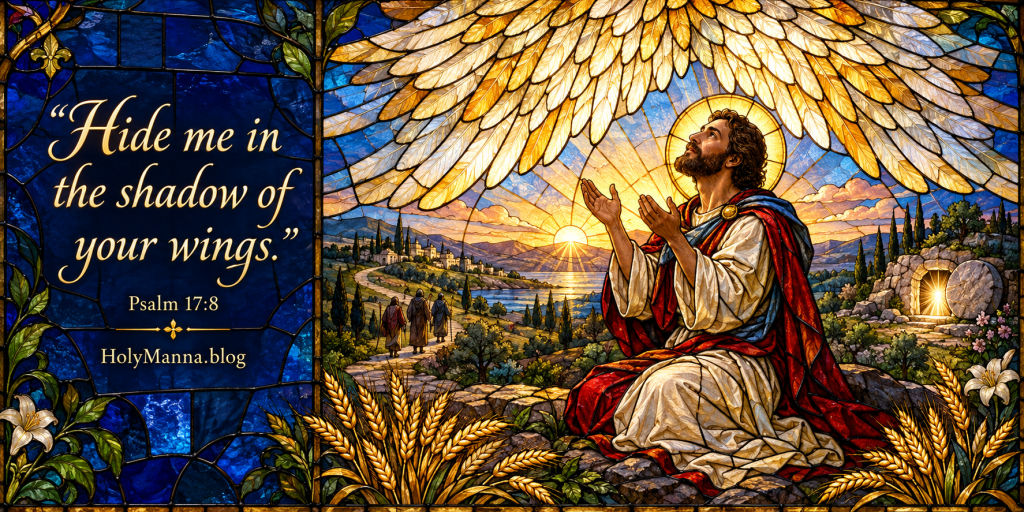
Hide me in the shadow of your wings,
But I in justice shall behold your face;
on waking, I shall be content in your presence.
R. Lord, when your glory appears, my joy will be full.
Detailed Exegesis
Verse 1bcd: “Hear, O LORD, a just suit; attend to my outcry; hearken to my prayer from lips without deceit.”
David approaches God with legal language, presenting his cause like a case before the divine court. “Lips without deceit” is not a boast of sinlessness but a claim of sincerity: this prayer hides nothing. Honest prayer, the kind that brings the real self before God, is the doorway of the whole psalm.
Verse 6: “I call upon you, for you will answer me, O God; incline your ear to me; hear my word.”
Notice the confidence tucked inside the plea. David calls precisely because he already trusts that God answers. The image of God inclining His ear, bending down like a parent to a small child, reveals a God who is not distant royalty but attentive love.
Verse 7: “Show your wondrous mercies, O savior of those who flee from their foes to refuge at your right hand.”
The Hebrew behind “wondrous mercies” involves hesed, God’s covenant loyalty, the stubborn faithful love that never lets go. The right hand is the place of power and honor, and David asks to shelter there, a fugitive granted asylum in the throne room itself.
Verse 8b: “Hide me in the shadow of your wings,”
This beloved image works on two levels. It evokes a mother bird gathering her chicks, the same tenderness Jesus claimed for Himself over Jerusalem in Matthew 23:37, and it evokes the wings of the cherubim stretched over the Ark of the Covenant, the most sacred place in Israel. To hide under God’s wings is to be both cherished and consecrated.
Verse 15: “But I in justice shall behold your face; on waking, I shall be content in your presence.”
Here the psalm leaps beyond its own century. The wicked in this psalm find their satisfaction in this life; David expects his satisfaction on “waking.” At minimum he means waking from a night of danger, but the Church has always heard more: waking from the sleep of death to see God face to face. What Paul argues in Corinth, David glimpses in the dark.
Teachings
The Church calls the destiny hidden in verse 15 the beatific vision. The Catechism of the Catholic Church defines it in CCC 1028: “Because of his transcendence, God cannot be seen as he is, unless he himself opens up his mystery to man’s immediate contemplation and gives him the capacity for it. The Church calls this contemplation of God in his heavenly glory ‘the beatific vision.’” And CCC 1023 describes those who reach it: “Those who die in God’s grace and friendship and are perfectly purified live for ever with Christ. They are like God for ever, for they ‘see him as he is,’ face to face.” Saint Augustine, who knew what it was to search for satisfaction in everything except God, condensed the entire psalm’s longing into the most famous sentence of his Confessions: “You have made us for yourself, O Lord, and our heart is restless until it rests in you.” Every restless craving, every ache that no purchase or achievement ever quiets, is verse 15 in disguise, the soul homesick for a Face it has not yet seen.
Reflection
Psalm 17 is a school of night prayer. Before sleep tonight, borrow David’s words: ask God to hide you in the shadow of His wings, name the enemies you are fleeing, whether people, anxieties, or temptations, and end with verse 15 as an act of hope. Parents can pray verse 8 over sleeping children, one of the oldest instincts of Christian family life. This psalm also reframes the daily grind. If final contentment comes only from beholding God’s face, then no disappointment here is final, and no success here is enough. Where do you look for contentment before you look to God? When was the last time you prayed with complete honesty, from lips without deceit? What would it mean to fall asleep tonight genuinely trusting that you will wake, one day, in the presence of God?
Holy Gospel — Luke 8:1-3
The Company on the Road
These three quiet verses appear only in The Gospel of Luke, and they open a window onto the daily reality of Jesus’ ministry that no other Evangelist provides. Jesus did not wait for crowds to come to Him; He walked town to town through Galilee, an itinerant preacher with no salary, no property, and no institutional backing. Somebody had to buy the bread. Luke names the ones who did, and the answer would have raised eyebrows in the first century: women. A rabbi traveling with female disciples was startlingly countercultural in a world where many teachers refused to instruct women at all. Luke, the Evangelist most attentive to the overlooked, records their names with the care of a historian, and the day’s theme runs straight through this scene. The Resurrection Paul defends and David glimpses will be witnessed first by a woman named in this very passage.
Luke 8:1-3
Jesus journeyed from one town and village to another,
preaching and proclaiming the good news of the Kingdom of God.
Accompanying him were the Twelve
and some women who had been cured of evil spirits and infirmities,
Mary, called Magdalene, from whom seven demons had gone out,
Joanna, the wife of Herod’s steward Chuza,
Susanna, and many others
who provided for them out of their resources.
Detailed Exegesis
Verse 1: “Jesus journeyed from one town and village to another, preaching and proclaiming the good news of the Kingdom of God. Accompanying him were the Twelve”
The verse sketches the shape of the mission: constant movement, relentless proclamation. “Good news” translates the Greek behind the word “evangelize”; the Kingdom is not an idea Jesus discusses but an announcement He carries. The Twelve travel with Him as apprentices, learning by walking, watching, and listening long before they are sent out themselves.
Verse 2: “and some women who had been cured of evil spirits and infirmities, Mary, called Magdalene, from whom seven demons had gone out,”
Every woman in this company is a healed woman; gratitude is the engine of their discipleship. Mary is called Magdalene after Magdala, a fishing town on the Sea of Galilee. Seven demons signals a bondage of terrible completeness, since seven is the biblical number of fullness. Luke says nothing about sins of impurity; the centuries-old image of Magdalene as a former prostitute has no basis in this text. Her story is deliverance, and her response is to follow her Deliverer everywhere.
Verse 3: “Joanna, the wife of Herod’s steward Chuza, Susanna, and many others who provided for them out of their resources.”
Joanna is a bombshell hiding in plain sight. Her husband Chuza managed the household of Herod Antipas, the very ruler who imprisoned John the Baptist and would later mock Jesus. The Gospel had quietly penetrated Herod’s own court. Susanna appears nowhere else in Scripture, remembered for a single verse of generosity. “Provided for them out of their resources” means these women financed the mission of salvation with their own money, the first benefactors of the Church, and Luke will show Mary Magdalene and Joanna again at the empty tomb in Luke 24:10.
Teachings
The generosity of these women became a pattern for the whole Church. The Catechism of the Catholic Church teaches in CCC 2043: “The fifth precept (‘You shall help to provide for the needs of the Church’) means that the faithful are obliged to assist with the material needs of the Church, each according to his own ability.” Every collection basket traces its lineage to the purses of Mary, Joanna, and Susanna. The Church has also come to honor Mary Magdalene’s unique role with striking solemnity. On June 3rd, 2016, at the wish of Pope Francis, the Congregation for Divine Worship elevated her memorial to a Feast, the rank given to the Apostles themselves. Archbishop Arthur Roche’s accompanying article explains why, drawing on the tradition of Rabanus Maurus and Saint Thomas Aquinas: “she becomes an evangelist, that is a messenger who announces the Good News of the Lord’s resurrection or, as Rabanus Maurus and Saint Thomas Aquinas say, she becomes the ‘apostolorum apostola’ because she announces to the apostles what in turn they will announce to the whole world.” Apostle of the Apostles. One historical clarification matters here: a homily of Pope Saint Gregory the Great in 591 merged Mary Magdalene with the unnamed sinful woman of Luke 7 and with Mary of Bethany, and Western art followed him for centuries. The Church’s calendar reform of 1969 restored the distinction, letting Luke’s Magdalene stand as she actually appears: delivered, devoted, and generous.
Reflection
This Gospel dignifies the unglamorous work of support. Most believers will never preach to crowds, but everyone can be a Joanna or a Susanna, funding, feeding, and quietly sustaining the mission of Christ. Concretely, that might mean reviewing your parish giving with fresh eyes, sponsoring a seminarian or missionary, or offering your professional skills to a ministry that cannot afford them. It also means letting gratitude drive discipleship the way healing drove these women: name one specific thing Christ has delivered you from, and let that memory fuel one specific act of service this week. What has Jesus healed or delivered you from, and how has your gratitude taken visible form? What resources, whether money, time, or talent, are you holding back from the Kingdom? If the women of Galilee could serve so faithfully without ever being famous, what hidden faithfulness is God asking of you?
Walking Home by Easter Light
Put the three readings side by side and a single story emerges. Saint Paul stands in the middle of skeptical Corinth and refuses to blink: if Christ has not been raised, faith is empty, preaching is hollow, and the beloved dead are lost. But Christ has been raised, the firstfruits of a harvest that includes everyone who belongs to Him. David, praying in the dark a thousand years earlier, reaches toward the same dawn, trusting that on waking he will be content in the presence of God, beholding the Face for which every human heart was made. And Luke shows what that hope looks like with sandals on: Jesus walking the roads of Galilee, surrounded by the Twelve and by women whose gratitude had turned into generosity, one of whom, Mary of Magdala, would stand weeping in a garden on Easter morning and hear the risen Lord speak her name. The Resurrection is not a doctrine filed away for funerals. It is the hinge on which every ordinary Friday turns, including this one. It means sins are truly forgiven, graves are truly temporary, and no act of quiet service along the road is ever wasted, because the One being served has conquered death itself. So the invitation of September 18th is simple and enormous at the same time: believe it, and then walk like it. Join the company on the road. Give from real resources, pray from honest lips, hope beyond the grave. The glory has already appeared once in a garden outside Jerusalem, and it will appear again. When it does, as the psalm promises, joy will be full.
Engage With Us!
Every reflection shared in the comments below becomes bread for someone else on the road, so please take a moment to write what stirred your heart in today’s readings. To help the conversation begin, here are a few questions to pray with:
- In 1 Corinthians 15:12-20, Saint Paul insists that without the Resurrection, faith is vain and the dead have perished. Where has resurrection hope carried you through a season of grief or doubt, and how could you offer that hope to someone grieving now?
- In Psalm 17:1, 6-8, 15, David prays with honest lips and longs to wake in God’s presence. What would change in your nightly prayer if you ended each day by entrusting yourself to the shadow of God’s wings?
- In Luke 8:1-3, Mary Magdalene, Joanna, and Susanna provide for Jesus’ mission out of their own resources. What resource, whether money, time, or skill, is God inviting you to place at the service of His Church this month?
- Taken together, the readings proclaim that everything depends on the Resurrection and that those who serve Jesus on the road are the ones who see His glory. What is one concrete way you can walk with Jesus this week so that His Resurrection shapes your ordinary Friday?
Faith was never meant to be a private possession; it is a road walked in company, sustained by gratitude, and lit from ahead by Easter morning. Live this day generously, forgive quickly, serve quietly, and do everything with the love and mercy Jesus taught, trusting that the One who is the firstfruits has already gathered your future into His harvest.
Sacred Heart of Jesus, we trust in You!
Immaculate Heart of Mary, pray for us!
Saint Michael the Archangel, defend us in battle!
Follow us on YouTube, TikTok, Instagram and Facebook for more insights and reflections on living a faith-filled life.

 Holy Manna!
Leave a comment