A Mind on Fire, a Heart for the Poor
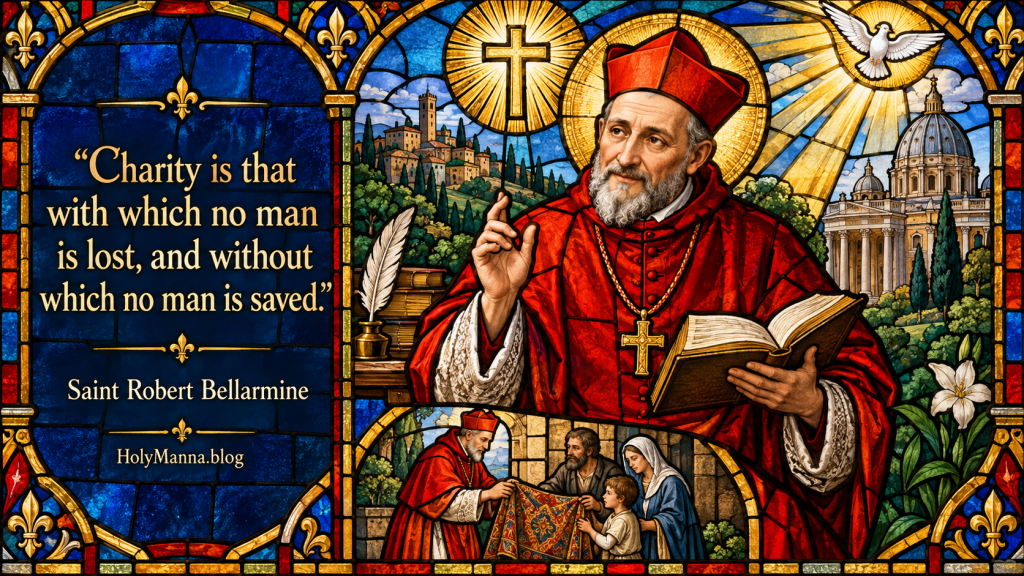
Imagine one of the most brilliant men in Europe, a cardinal living in a Roman palace, quietly stripping the tapestries off his own walls and handing them to the poor. That single image captures Saint Robert Bellarmine better than any list of his titles ever could, and his titles are considerable. He was a Jesuit priest, a professor, a spiritual director of saints, an Archbishop, a Cardinal of the Holy Roman Church, a personal theologian to popes, and, since 1931, a Doctor of the Church, one of only a few dozen saints in two thousand years of history to receive that honor. He stood at the center of the Catholic Counter Reformation, the Church’s great response to the upheaval of the sixteenth century, and he answered the fiercest theological attacks of his age not with insults but with clarity, patience, and love. The Church teaches that she raises certain believers to the altars precisely so that the rest of the faithful can see holiness lived out in full, recognizing in them “the presence of God’s kingdom” and finding in them models and intercessors (CCC 828). Saint Robert Bellarmine is exactly such a model, especially for anyone who wants to explain the faith to a confused and skeptical world.
He is also a patron with a very practical portfolio. Saint Robert Bellarmine is the patron saint of catechists, catechumens, canonists, and canon lawyers, and he is invoked as a patron by the Archdiocese of Cincinnati, the Archdiocese of Capua, and a whole family of schools and universities that bear his name. If you have ever taught a religious education class, prepared someone for Baptism, or simply tried to answer a friend’s hard question about the Catholic faith, this saint belongs to you. His feast is celebrated on September 17, the day he entered eternal life.
A Boy from Montepulciano with an Uncle on the Papal Throne
Roberto Francesco Romolo Bellarmino was born on October 4, 1542, in Montepulciano, a hill town in Tuscany famous for its wine and its views. His family was noble but poor, a combination that shaped his childhood in a very particular way. His father, Vincenzo Bellarmino, looked at his gifted son and saw the family’s ticket back to wealth and influence; he dreamed of a political career for Robert. His mother, Cinzia Cervini, was a woman of deep and disciplined devotion, known for her almsgiving, prayer, fasting, and works of mercy, and she dreamed of something entirely different. She belonged to the Cervini family, and the Catholic Encyclopedia records her as the sister of Cardinal Marcello Cervini, who briefly reigned as Pope Marcellus II in 1555. Some accounts describe her instead as the pope’s niece, so the exact relationship is reported differently across sources, but the family connection to the papacy is well established.
Robert was educated by the Jesuits at the newly founded college in his hometown, and the Society of Jesus, itself only a couple of decades old, captured his heart. His father resisted; a Jesuit vow of poverty was not the family restoration plan. His mother’s prayers prevailed. On September 20, 1560, at seventeen years old, Robert entered the Society of Jesus, and he made his first vows the very next day. This was not a conversion from unbelief, since Robert had been raised in a thoroughly Catholic home, but it was a decisive conversion of direction, the moment a young man chose God’s glory over his family’s ambitions. The Catechism reminds every believer that this kind of choice is the heart of vocation, for God calls each person “to know, to love, and to serve him” and to be ordered to eternal beatitude rather than earthly success (CCC 1, CCC 1721).
His formation took him through philosophy at the Roman College and teaching posts in Florence and Mondovì, and then to the great university city of Louvain in the Low Countries, where he was ordained a priest in 1570. There he became the first Jesuit ever to hold a professorship at Louvain, and his Latin sermons drew crowds that included Protestants who came simply to hear him preach. He was physically small and lifelong frail, plagued by health problems from his youth, and there is a charming tradition that he stood on a stool in the pulpit so the congregation could see him. That detail is told affectionately in later accounts rather than established by contemporary documentation, so it is best enjoyed as a tradition; it cannot be verified. What is certain is that a sickly young priest from Tuscany was becoming one of the most compelling voices of the Catholic Reformation.
The Scholar Who Answered a Revolution
To understand why Robert Bellarmine matters, you have to picture Europe in the decades after Martin Luther. Christendom was fractured. Entire nations had broken communion with Rome. Pamphlets, sermons, and books attacked Catholic teaching on the Eucharist, the papacy, the saints, justification, and Scripture itself, and for a long time the Catholic response was scattered and often as angry as the attacks. Bellarmine changed that. In 1576 he accepted the invitation of Pope Gregory XIII to take the chair of controversial theology at the Roman College, the school founded by Saint Ignatius of Loyola, and his lectures there grew into the work that made him famous across the continent: the three volume Disputationes de Controversiis Christianae Fidei, usually just called De Controversiis, published between 1586 and 1593.
What made the work revolutionary was not venom but order and fairness. Bellarmine took seventeen major controversies raised by the Reformers, stated the Protestant arguments accurately and in their strongest form, and then answered them systematically from Scripture, the Church Fathers, and the constant Tradition of the Church. He covered Scripture and Tradition, Christ, the pope and the Church, the Sacraments, sin, grace, free will, and good works. Contemporaries on both sides recognized its power; Protestant universities assigned professors specifically to refute Bellarmine, which is its own kind of compliment. His method embodied what the Church still teaches about how divine revelation is handed on, namely that “Sacred Tradition and Sacred Scripture make up a single sacred deposit of the Word of God” entrusted to the Church, with the Magisterium serving that Word rather than standing above it (CCC 97, CCC 86). And he did it all without ridicule. Witnesses to his style noted that he kept the focus on the theological issues and refused the mockery that was standard in the debates of his day, living out the counsel of Scripture: “Always be ready to give an explanation to anyone who asks you for a reason for your hope, but do it with gentleness and reverence” (1 Peter 3:15 to 16).
The Church kept handing him bigger jobs. In 1588 he became Spiritual Father to the Roman College, where he directed a frail, radiant young Jesuit named Aloysius Gonzaga, stood at his deathbed in 1591, and loved him so much that he asked to be buried at his feet. In 1590 he traveled to France as theologian to a papal embassy during the wars of religion. In 1592 he was named Rector of the Roman College, in 1595 Provincial of Naples, and in 1597 Pope Clement VIII called him back to Rome as his personal theologian, Examiner of Bishops, and Consultor of the Holy Office. He helped complete the revision of the Clementine Vulgate, the official Latin Bible, and wrote its preface. In 1599 Clement VIII created him a cardinal, and it is widely reported that the pope declared that the Church of God did not have his equal in learning; the remark comes to us through the standard biographical accounts rather than a surviving papal document, so it is repeated as the tradition attached to his elevation. In 1602 he was consecrated Archbishop of Capua, and here something surprising happened. The great scholar turned out to be a wholehearted pastor. For three years he preached constantly, catechized children himself, visited the poor, and implemented the reforms of the Council of Trent in his diocese, and when he was recalled to Rome in 1605 the people of Capua wept to lose him.
Two of his shortest works may have done the most good. His small catechism, Dottrina Cristiana Breve, and his longer catechism for teachers were translated into dozens of languages and taught the basics of the faith to generations of Catholics on every continent. This is why catechists claim him as their patron, and it connects him directly to the Church’s teaching that catechesis is the effort to make disciples and “to educate and instruct them in this life”, building up the Body of Christ (CCC 4 to 5). No miracles of healing or wonder working are recorded of Bellarmine during his lifetime in the major sources, and honesty requires saying so plainly. His contemporaries did not remember him for marvels. They remembered him for something the Church has always counted as a greater sign: heroic charity sustained for decades. He lived on bread and garlic, the food of the poor. He gave away virtually everything he received. During a time of plague and famine in Rome, the famous story goes, he took the tapestries off the walls of his apartments and gave them to the poor to sell, remarking that the walls would not catch cold. The exact wording of the quip varies between tellings, and the story rests on biographical tradition rather than a dated document, so it is told here as the cherished tradition it is; it cannot be verified in its details. It has endured because everyone who knew him agreed it was exactly the kind of thing he did. He once ransomed a soldier and reportedly used the hangings of his rooms for the poor more than once, while always making sure his own servants and aides lacked nothing. He took the Gospel at its word: “Blessed are the poor in spirit, for theirs is the kingdom of heaven” (The Gospel of Matthew 5:3), and the Catechism echoes what his life preached, that “love for the poor is even one of the motives for the duty of working” and that the Church’s love for the poor belongs to her constant tradition (CCC 2444 to 2447).
Battles Without Blood
Robert Bellarmine was never martyred, but do not imagine his road was smooth. His hardships were the slow, grinding kind that most believers actually face: opposition from family, chronic illness, misunderstanding from allies, and attacks on his good name that outlived him by three centuries.
The first battle was at home, when his father opposed his Jesuit vocation. The second was his body, which was frail from childhood and gave him trouble all his life. The third, remarkably, came from within the Church. Pope Sixtus V was displeased with the first volume of De Controversiis because Bellarmine argued that the pope’s power over temporal rulers was indirect rather than direct, a position Sixtus considered too modest, and the pope moved to place the volume on the Index of Forbidden Books. Sixtus died before the list was published, and his successor removed the censure. Ponder that for a moment: the greatest defender of the papacy of his era was nearly censured by a pope for defending the papacy too carefully. Bellarmine submitted, kept working, and never grew bitter, and the Church later vindicated his position. His teaching on indirect power also enraged monarchs abroad; he demonstrated that the divine right of kings theory was untenable, which earned him the fury of monarchists in England and France, including a running literary battle connected with King James I of England. Bellarmine insisted that political authority comes from God through the consent and nature of the community, not as a personal divine possession of kings, a principle that echoes in the Church’s teaching that political authority must be exercised within the limits of the moral order for the common good (CCC 1903).
Then there is the episode everyone asks about: Galileo. In 1615 and 1616, as a Consultor of the Holy Office, Bellarmine was drawn into the examination of heliocentrism. He admired Galileo, corresponded with him in friendship, and had earlier opposed harsher measures against him. His own position, stated in a famous letter of 1615, was that Copernicanism could be discussed as a mathematical hypothesis, and he even acknowledged that if a true demonstration of the earth’s motion were ever produced, the Church would have to proceed with great care in explaining the Scriptures that seemed contrary. In 1616 it fell to Bellarmine, obedient to the Holy Office’s decision, to deliver the admonition instructing Galileo not to hold or defend heliocentrism as established truth. History has debated the affair ever since, and the Church herself has acknowledged the errors made in Galileo’s later trial, which took place in 1633, twelve years after Bellarmine’s death. What is worth noticing is Bellarmine’s underlying conviction, which the Catechism states plainly today: “methodical research in all branches of knowledge, provided it is carried out in a truly scientific manner”, can never really conflict with the faith, “because the things of the world and the things of faith derive from the same God” (CCC 159). Bellarmine was a man of his time working with the science of his time, and within those limits he was a moderating, courteous presence in a dispute that grew far uglier after he was gone.
His final hardship arrived after death. Admirers opened his cause for canonization in 1627, only a few years after he died, and then it stalled for three hundred years. The delay was political rather than spiritual; his writings on papal power and the limits of royal authority had made enemies in high places, and successive generations found reasons to leave the cause untouched. He endured it all, in life and in memory, with the patience the Catechism calls the endurance of faith, for hope “keeps man from discouragement; it sustains him during times of abandonment” (CCC 1818). He spent his last years in prayer at the Jesuit novitiate of Saint Andrew in Rome, writing tender spiritual books, including De Ascensione Mentis in Deum, or The Mind’s Ascent to God, and De Arte Bene Moriendi, The Art of Dying Well. He practiced what he wrote. On the morning of September 17, 1621, at seventy eight years old, Robert Bellarmine died a peaceful and holy death, having prepared for it his whole life, a living illustration of the Church’s prayer to be delivered from a sudden and unprovided death and her teaching that the Christian who unites his own death to Christ’s views it as a step toward him (CCC 1014).
Three Centuries to the Altars
Rome responded to his death the way Rome responds to a saint. Tradition recounts that crowds pressed into the church where his body lay, touching rosaries and other objects to him and seeking small relics, so great was the reputation of his holiness; this outpouring is described in the biographical tradition surrounding his death and is told here as that tradition, since its details cannot be verified. He was buried in Rome, and in accordance with his own humble wish he was eventually laid to rest near his beloved spiritual son. Today his relics lie beside those of Saint Aloysius Gonzaga in the Church of Sant’Ignazio, the church of the old Roman College where he taught, prayed, and formed saints. His body, vested in the red robes of a cardinal, rests behind glass beneath a side altar, and pilgrims from around the world stop there to pray, often on the same visit that takes them to the tomb of Aloysius a few steps away. On June 21, 1923, his relics were solemnly translated to that church, and the momentum toward his canonization finally became unstoppable.
Pope Pius XI beatified him on May 13, 1923, canonized him on June 29, 1930, and on September 17, 1931, declared him a Doctor of the Church, a title reserved for saints whose teaching has enduring value for the whole Church. The formal causes of beatification and canonization in that era required approved miracles obtained through the saint’s intercession, and miracles were duly examined and approved in his cause; however, the specific details of those cures are not widely documented in accessible popular sources, and rather than embellish them they are simply acknowledged here as part of the official process. What can be said with certainty is that the Church, after three centuries of scrutiny by his fiercest critics, judged his life heroic and his teaching sound. As the Catechism explains, by canonizing certain of the faithful the Church “recognizes the power of the Spirit of holiness within her and sustains the hope of believers by proposing the saints to them as models and intercessors” (CCC 828).
His impact since then has been enormous and delightfully concrete. Universities, seminaries, high schools, and parishes across the world carry his name, from Bellarmine University in Louisville to Fairfield University in Connecticut to parish churches on several continents. The Archdiocese of Cincinnati and the Archdiocese of Capua claim his patronage. Every catechist who stands in front of a squirming confirmation class stands under his protection, as does every canon lawyer untangling a difficult case and every catechumen walking toward the font at the Easter Vigil. Jesuit institutions mark his feast each September 17 with Masses, lectures, and celebrations of Catholic learning. And his words still circulate wherever Catholics talk about what finally matters. His most famous saying, preserved and beloved in Catholic tradition, cuts to the heart: “Charity is that with which no man is lost, and without which no man is saved.” Another cherished line, popularized through his classic biography, imagines the final judgment as the only exam that counts: “On the last day, when the general examination takes place, there will be no question at all on the text of Aristotle, the aphorisms of Hippocrates, or the paragraphs of Justinian. Charity will be the whole syllabus.” From his spiritual writings comes counsel that could anchor anyone’s life: “Know that you have been created for the glory of God and your own eternal salvation. This is your goal; this is the center of your life; this is the treasure of your heart.” And he summarized his whole method in a single sentence: “The school of Christ is the school of charity.”
Living Like Bellarmine in a World of Arguments
Here is the beautiful paradox of Saint Robert Bellarmine: the greatest debater of his century is remembered, first and last, for love. That is not an accident, and it is not a footnote. It is the lesson. He teaches that truth and charity are not rivals competing for space in your heart; they are partners, and each one collapses without the other. Truth without charity hardens into a weapon. Charity without truth dissolves into sentimentality. Bellarmine held them together for sixty years, and the Catechism confirms his instinct, teaching that charity is “the theological virtue by which we love God above all things for his own sake, and our neighbor as ourselves for the love of God”, and that charity is the form of all the virtues, the thing that “articulates and orders them among themselves” (CCC 1822, CCC 1827).
So what does his life ask of you, practically, this week? First, it asks you to know your faith. Bellarmine’s power in debate came from decades of patient study, and while nobody is asking you to write three volumes in Latin, everybody is capable of ten minutes a day with Scripture or the Catechism. The Church teaches that all the faithful share in understanding and handing on revealed truth (CCC 91), and you cannot hand on what you have never picked up. When was the last time you read something that stretched your understanding of the faith you profess? Second, his life asks you to argue like a Christian. In an age of comment sections and family group chats, Bellarmine’s refusal to mock his opponents is almost shocking. He stated the other side’s best case fairly before answering it. Try that. State your critic’s position so accurately that they would recognize it, then respond with gentleness and reverence, as 1 Peter 3:15 to 16 commands. Do the people who disagree with you experience your convictions as an act of love or as an act of war? Third, his life asks you to check your walls for tapestries. Bellarmine looked at his own comfort and saw resources for the poor. Most people have something hanging on the wall, sitting in a closet, or padding a budget that could become mercy for someone else. The Catechism is blunt that giving alms to the poor is “a witness to fraternal charity” and “a work of justice pleasing to God” (CCC 2462). What is one comfort you could convert into charity before this month ends? Finally, his life asks you to prepare for a good death by living a good life. He wrote The Art of Dying Well and then demonstrated it, because he had practiced dying to himself daily for decades. Begin small: an honest examination of conscience tonight, a return to Confession this month, a habit of entrusting each day to God. If the general examination came for you this year, would charity have been your syllabus?
Engage With Us!
Saint Robert Bellarmine spent his life helping ordinary Catholics understand and love their faith, so it is only fitting that the conversation continue here. Share your thoughts and reflections in the comments below; your experience might be exactly the encouragement another reader needs today. To get the discussion started, consider these questions:
- Bellarmine defended the faith without ridicule or contempt. Where in your life, online or in person, is God inviting you to speak truth with more gentleness?
- He gave the tapestries off his walls to the poor. What is one concrete possession or comfort you feel called to give away, and what is holding you back?
- As patron of catechists and catechumens, Bellarmine championed lifelong learning of the faith. What is one question about Catholicism you have always wanted to explore, and what step could you take this week to explore it?
- Bellarmine wrote that charity will be the whole syllabus of the final examination. If you graded your past week on that syllabus alone, what would you change about the week ahead?
- He held demanding positions of power while living in radical simplicity. How can you practice detachment within your own responsibilities, at work, at school, or at home?
Whatever brought you to this page, whether devotion, curiosity, or a search that only God fully understands, know that the saints are not museum pieces; they are family, and they are praying for you. Take one lesson from Saint Robert Bellarmine’s life and put it into practice today. Study a little, argue kindly, give generously, and prepare your heart, and do everything, absolutely everything, with the love and mercy that Jesus taught us.
Saint Robert Bellarmine, pray for us!
Follow us on YouTube, TikTok, Instagram and Facebook for more insights and reflections on living a faith-filled life.

 Holy Manna!
Leave a comment