A Feather on the Breath of God
Every so often God raises up a soul so overflowing with gifts that the world hardly knows what to call her. Saint Hildegard of Bingen, celebrated on September 17th, is one of those souls. She was a Benedictine nun and abbess in 12th century Germany, a mystic and visionary, a theologian, a preacher, a composer, a poet, a playwright, a student of nature and medicine, and a counselor to popes, emperors, bishops, and ordinary strugglers who wrote to her from across Europe. Her contemporaries called her the Sibyl of the Rhine because so many people sought her wisdom. When Pope Benedict XVI declared her a Doctor of the Universal Church on October 7th, 2012, he recalled the words of Saint John Paul II, who had described her as “a light for her people and her time.” She is one of only 4 women ever to receive the title of Doctor of the Church, standing alongside Saint Catherine of Siena, Saint Teresa of Ávila, and Saint Thérèse of Lisieux.
Because she invented her own mystical language, the Lingua Ignota, Catholic reference works list Saint Hildegard as the patron saint of philologists, the scholars who study language, and of Esperanto speakers. In her native Germany she is also honored as a patroness of Bingen am Rhein, Böckelheim, and Disibodenberg. Many musicians, writers, and lovers of God’s creation have adopted her as a heavenly friend as well, though those devotions are popular rather than formal. When the Church raises up a saint like Hildegard, she is doing exactly what The Catechism describes: “By canonizing some of the faithful, i.e., by solemnly proclaiming that they practiced heroic virtue and lived in fidelity to God’s grace, the Church recognizes the power of the Spirit of holiness within her” (CCC 828). Hildegard’s life is a nine century old testimony to that power, and it began in the most hidden way imaginable.
A Tenth Child, Given to God
Hildegard was born around the year 1098 in the Rhineland of present day Germany, most likely at Bermersheim vor der Höhe, into a family of the lower nobility. She was the tenth child of her parents, Hildebert and Mechthild, and in keeping with a custom of the age, her parents offered their tenth child to God as a tithe. While still a girl she was entrusted to Jutta von Sponheim, a holy noblewoman living a hidden life of prayer attached to the Benedictine monastery of Disibodenberg. Sources differ on the exact timeline; some accounts say Hildegard went to Jutta at 8 years old, while others indicate she was formally enclosed at Disibodenberg around the year 1112, at about 14. Under Jutta she learned the Psalms, the rhythm of Benedictine prayer, and the quiet discipline of a life ordered entirely toward God. She received the veil of a Benedictine nun as a young woman, and when Jutta died in 1136, the community elected Hildegard as their magistra, their teacher and superior.
There was something in her life that almost no one knew. From earliest childhood, by her own account from about the age of 3, Hildegard experienced visions of a great light. She was often sickly, and she kept the visions almost entirely secret for decades, confiding only in Jutta and later in a monk named Volmar, who became her lifelong secretary and trusted friend. Then, in the year 1141, everything changed. In the opening declaration of her first great work, Scivias, which means Know the Ways, she describes the moment plainly: “And it came to pass, when I was forty two years and seven months old, that the heavens were opened and a blinding light of exceptional brilliance flowed through my entire brain.” In that light she suddenly understood the deep meaning of the Scriptures, and she heard a voice from heaven commanding her: “O fragile human, ashes of ashes, and filth of filth! Say and write what you see and hear.”
Hildegard hesitated. She was a woman with little formal schooling in an age that expected women to remain silent, and she doubted herself so severely that she fell gravely ill, an illness she later understood as the fruit of resisting God’s command. When she finally took up the task, with Volmar helping her polish the Latin, her health returned. Word of the visionary nun reached Saint Bernard of Clairvaux, the most influential churchman of the century, who encouraged her, and through him her writings came before Pope Eugenius III. At the Synod of Trier in 1147 and 1148, the pope had portions of Scivias read aloud, examined her case, and gave her his approval and his blessing to continue writing. This is the Catholic pattern in miniature. Private revelations must always be tested by the Church and can never add to the one deposit of faith; their role, as The Catechism teaches, “is not to improve or complete Christ’s definitive Revelation, but to help live more fully by it in a certain period of history” (CCC 67). Hildegard submitted everything to the judgment of the Church, and the Church, after testing her, told her to keep going. Saint Paul’s words could serve as the caption of her whole story: “God chose the foolish of the world to shame the wise, and God chose the weak of the world to shame the strong” (1 Corinthians 1:27).
The Greening Power of God
Once Hildegard obeyed, the gifts poured out in a torrent that has few parallels in the history of the Church. She completed Scivias around 1151 and followed it with two more visionary masterpieces, Liber Vitae Meritorum, the Book of the Rewards of Life, and Liber Divinorum Operum, the Book of Divine Works, which together present the whole sweep of salvation history, from creation through redemption to the last things, with Christ at the center. Pope Benedict XVI praised the rich theological content of these visions and the humility and obedience with which she received her gifts. That is worth pausing over. The Church teaches that “charisms are graces of the Holy Spirit which directly or indirectly benefit the Church” (CCC 799), and that no charism is exempt from being tested and governed by the Church’s pastors (CCC 801). Hildegard’s greatness lies not only in the gifts themselves but in her refusal to wield them apart from the Church.
She also composed. Around 77 of her liturgical chants survive, gathered under the title Symphonia armonie celestium revelationum, the Symphony of the Harmony of Heavenly Revelations, along with Ordo Virtutum, the earliest surviving morality play, in which the Virtues battle the devil for a wavering soul. Remarkably, the devil in the play never sings; he can only shout, because for Hildegard music belongs to heaven. Today she is the most recorded composer of medieval sacred chant in the world. Her instinct matches the mind of the Church, for The Catechism calls the musical tradition of the universal Church “a treasure of inestimable value” (CCC 1156). She wrote on the natural world too, producing Physica and Causae et Curae, works on plants, animals, stones, medicine, and the human body, and she cared for the sick with herbal remedies in the monastery infirmary. Running through everything is her signature word, viriditas, the greening power, her name for the fresh, life giving vitality of God that makes creation flourish and makes the soul fruitful in grace.
Her leadership matched her writing. Around 1150, against the fierce objection of Abbot Kuno of Disibodenberg, who did not want to lose his famous nun, Hildegard moved her growing community to a new foundation at Rupertsberg, near Bingen on the Rhine. During the standoff she was struck by a paralyzing illness that lifted only when permission was granted, which those around her read as a sign of God’s will. In 1165 she founded a second house across the river at Eibingen. She carried on an enormous correspondence, several hundred letters of which survive, with popes including Eugenius III, Anastasius IV, Adrian IV, and Alexander III, with Emperor Frederick Barbarossa, whom she boldly rebuked for backing antipopes against the legitimate successor of Peter, and with bishops, abbots, monks, nuns, and laypeople seeking counsel. Most astonishing of all for a 12th century woman, she undertook 4 preaching journeys through the Rhineland between about 1158 and 1171, speaking publicly in cathedral cities such as Cologne and Trier, calling clergy to reform and defending the faith against the Cathar heresy, which despised the goodness of the created world that Hildegard saw shining with God’s viriditas.
God also worked healings through her during her lifetime. Her medieval biography, the Vita Sanctae Hildegardis, and the testimony gathered by the Church’s canonization inquiry in 1233 record people healed through her prayer, her blessing, and water she had blessed. The most carefully documented episode is the case of Sigewiza, a woman tormented by demonic possession around 1169 after exorcists had failed to free her. Hildegard, moved with compassion, took the suffering woman into her own monastery at Rupertsberg, where through prayer, penance, and the Church’s ministry she was finally delivered, and Sigewiza remained there as a nun. A gentler story from the tradition tells of Hildegard restoring sight to a blind child using water drawn from the Rhine; it is a beloved story, and it cannot be verified. All of it, verified and unverified alike, points to the same truth the Church still teaches, that the Holy Spirit gives to some “a special charism of healing so as to make manifest the power of the grace of the risen Lord” (CCC 1508), and that every such gift exists for the good of others.
The Interdict and the Silenced Song
Hildegard was not a martyr, but her road was marked by suffering from beginning to end. Illness shadowed her whole life; she endured several prolonged episodes of debilitating sickness, and she came to understand her frailty as the very place where God’s strength did its work. She knew personal grief as well. In 1151 her beloved young assistant Richardis von Stade was taken from Rupertsberg to become abbess of another monastery. Hildegard fought the appointment with every letter she could write, and lost, and Richardis died suddenly the following year. Hildegard’s surviving letters show her wrestling her sorrow into surrender before God’s will. In 1173 death took Volmar, the faithful secretary who had stood beside her since her youth.
The hardest trial came at the very end. In 1178, when Hildegard was about 80 years old, she allowed a nobleman to be buried in the monastery cemetery at Rupertsberg. The man had once been excommunicated, and the prelates of Mainz demanded that she dig up the body and cast it out of consecrated ground. Hildegard refused. She insisted that the man had been reconciled to the Church and had received the sacraments before his death, and she would not dishonor a soul at peace with God. According to the accounts of the episode, she went to the grave with her abbess’s staff, blessed it, and removed the markers so the body could not be found and disturbed. The prelates answered by placing her monastery under interdict. For months the community was forbidden the Mass, Holy Communion, and the sung Divine Office. For Hildegard, who had spent her life teaching that music is an echo of heaven, the silence was a crucifixion.
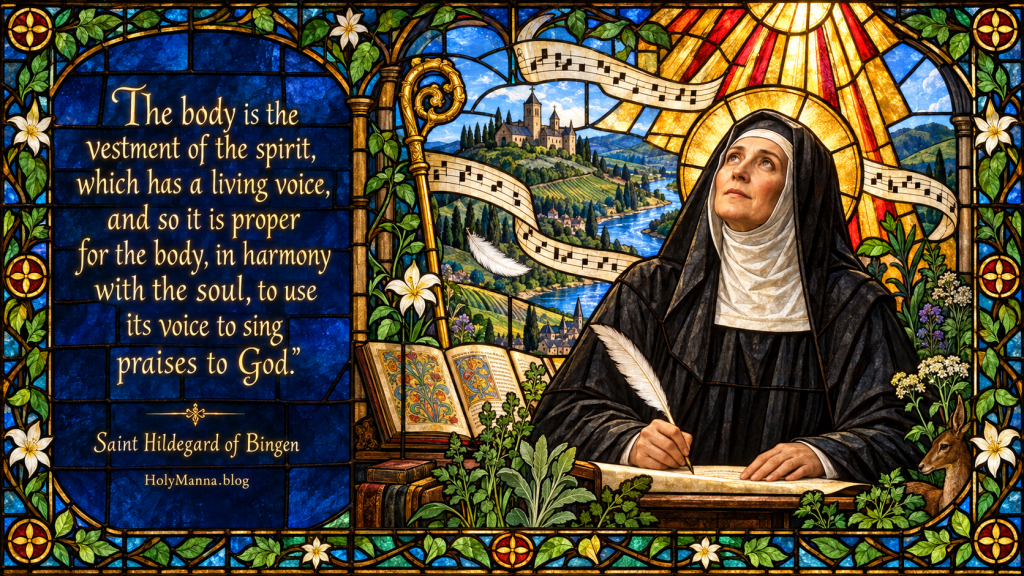
She obeyed the penalty while appealing it, and in her appeal she wrote one of the most stirring defenses of sacred music ever penned. To the prelates of Mainz she taught that “the body is the vestment of the spirit, which has a living voice, and so it is proper for the body, in harmony with the soul, to use its voice to sing praises to God.” And she warned them solemnly that “those who, without just cause, impose silence on a church and prohibit the singing of God’s praises… will lose their place among the chorus of angels, unless they have amended their lives through true penitence.” In March of 1179, Archbishop Christian of Mainz lifted the interdict, and the song returned to Rupertsberg. Hildegard died in peace among her daughters just 6 months later, on September 17th, 1179, at about 81 years of age. Her biography, the Vita Sanctae Hildegardis, relates that on the night of her death two arcs of brilliant, many colored light appeared in the sky and crossed over the room where she lay, forming the sign of the cross; this account comes from her medieval biographers and cannot be independently verified.
Light Over Eibingen
Devotion to Hildegard began at her tomb almost immediately. The third book of the Vita and the testimony collected by the Church record healings and favors granted to the sick and suffering who came to pray where she was buried. A tradition even holds that the crowds of pilgrims and the reported miracles became so overwhelming that the local prelate had to command moderation; it is a striking story, and it cannot be verified. What is certain is that the people of the Rhineland never stopped calling her a saint.
Her formal canonization, strangely, took more than 8 centuries. Pope Gregory IX opened her cause in the 13th century, and an official inquiry in 1233 gathered testimony about her life and miracles, but the paperwork was found deficient, lacking the names and details the process required. Pope Innocent IV renewed the effort in 1243, and still the process was never completed. Yet her cult endured; reference works report a confirmation of her veneration under Pope John XXII in 1326, her name was entered in the Roman Martyrology, and her feast was kept faithfully in German dioceses for centuries. Then, in a single remarkable year, the Church finished what the Middle Ages began. On May 10th, 2012, Pope Benedict XVI, who had long loved this daughter of his German homeland, extended her liturgical cult to the universal Church, an act known as equivalent canonization. On October 7th, 2012, he declared her a Doctor of the Universal Church together with Saint John of Ávila, praising “her holiness of life and the originality of her teaching.” In 2021, under Pope Francis, her optional memorial on September 17th was inscribed in the General Roman Calendar, so that the whole Church now celebrates her each year.
Her relics have their own dramatic history. Rupertsberg was destroyed by Swedish troops in 1632 during the Thirty Years’ War, and her remains were carried to safety, coming to rest at Eibingen. Today they are kept in a golden shrine in the parish and pilgrimage church of Saint Hildegard in Eibingen, a reliquary said to contain her skull, heart, tongue, and hair. Every September the town celebrates the Hildegardisfest, when the shrine is carried in solemn procession and pilgrims from around the world fill the streets. On the heights above Eibingen stands the Benedictine Abbey of Saint Hildegard, rebuilt between 1900 and 1904, where Benedictine nuns continue her life of prayer, work, and song to this day. Her cultural reach is astonishing; Germany has honored her on coins and stamps, her chants are performed and recorded across the globe, and her writings on natural healing have inspired a whole modern wellness movement, which is best read with discernment, always remembering that the center of Hildegard’s world was never a remedy but the living God. Praying for her intercession is simply the family life of the Church, for the saints in glory “do not cease to intercede with the Father for us” (CCC 956).
Staying Green
In Liber Divinorum Operum, Hildegard records the voice of Divine Love declaring: “I am the fiery life of divine substance, I blaze above the beauty of the fields, I shine in the waters, I burn in sun, moon and stars.” This is not pantheism; it is the vision of a Catholic mystic who saw every created thing ablaze with the presence of its Creator, the same truth The Catechism guards when it teaches that “God is infinitely greater than all his works” and yet intimately present to them (CCC 300). Hildegard’s viriditas, the greening power of God, is her gift to you. A soul in grace is green, supple, and fruitful; a soul cut off from God dries out. Where in your life have you grown dry, and what would it look like to let God’s grace make you green again?
Her life offers lessons that land squarely in the 21st century. She did not begin her great work until she was 42 years old. In a culture that idolizes youth and tells you that your window closes early, Hildegard proves that God’s timing is not yours, and that obedience in hiddenness is never wasted; four decades of silent prayer became the root system of everything she produced. Is there something God has been quietly asking of you that you have been postponing out of fear or self doubt? She held her extraordinary gifts with humility, submitting every vision to the judgment of the Church rather than trading on private spiritual experience, a needed medicine in an age of self appointed online prophets. She teaches the sacredness of beauty; her insistence that singing God’s praises belongs to the very dignity of the human person is an invitation to bring music, art, and reverence back into worship and into the home, since the Church herself calls sacred song a treasure beyond price (CCC 1156). She teaches wonder before creation, because “each creature possesses its own particular goodness and perfection” (CCC 339), and caring for the created world, rightly ordered, is a way of honoring the One who made it. And she teaches endurance; sick for much of her life, silenced, grieved, and opposed, she simply kept praying, kept writing, and kept singing. When hardship comes, do you let it dry you out, or do you let God turn it into deeper roots?
Practical ways to imitate her are close at hand. A person can begin the day by praying a Psalm slowly, as she did for decades in the cloister. A family can put on one of her chants during dinner preparation and let beauty quiet the house. A commuter can look at trees, water, and sky on the way to work and deliberately thank God for the viriditas humming through it all. Anyone can take one gift they have been hiding, a talent for writing, music, teaching, or healing, and offer it to their parish. And everyone can imitate her courage at the cemetery of Rupertsberg by standing firm, with charity and without compromise, when conscience formed by the Church demands it.
Engage With Us!
Saint Hildegard still has a voice, and now the conversation belongs to you. Share your thoughts and reflections in the comments below; your story of faith might be exactly the encouragement another reader needs today. To help you begin, here are some questions to pray with this week.
- Hildegard waited 42 years before God called her to write. What hidden season might God be using right now to prepare you for something you cannot yet see?
- She submitted her visions to the Church instead of trusting her own judgment alone. Where do you need more humility and docility in your own spiritual life?
- For Hildegard, singing God’s praises was essential to being human. What role does beauty, music, or art play in your prayer, and how could you give it more room?
- Her concept of viriditas describes the greening power of God’s grace. What habits, relationships, or sins are drying out your soul, and what one step could you take toward renewal?
- She defended the burial of a reconciled sinner at great personal cost. Is there a place in your life where fidelity to Christ and compassion for a person are calling you to courageous action?
Saint Hildegard of Bingen shows that a life given entirely to God, even a hidden, sickly, overlooked life, can become a light for its people and its time. Let her feast on September 17th stir you to use every gift God has planted in you, to stay green in his grace, and to do everything, at home, at work, and in the world, with the love and mercy that Jesus taught us.
Saint Hildegard of Bingen, pray for us!
Follow us on YouTube, TikTok, Instagram and Facebook for more insights and reflections on living a faith-filled life.

 Holy Manna!
Leave a comment