Thursday of the Twenty-fourth Week in Ordinary Time – Lectionary: 446
The Debt Nobody Could Pay
Every heart carries a ledger, and every honest heart knows the balance does not favor it. On this Thursday of the Twenty-fourth Week in Ordinary Time, September 17th, 2026, the Church places three portraits of mercy side by side, and together they tell one story: God forgives real debts, and the forgiven become the most convincing witnesses He has.
In the First Reading, Saint Paul hands the Corinthians the oldest creed of the Church, a summary of the Gospel so early that most of the five hundred witnesses to the Risen Christ were still alive to be questioned. Then Paul points to himself, a former persecutor of the Church, and confesses, “by the grace of God I am what I am” (1 Corinthians 15:10). The Responsorial Psalm answers with the song of someone pulled back from the edge of death: “I shall not die, but live, and declare the works of the LORD” (Psalm 118:17). And in the Gospel, a woman with a public reputation for sin crashes a dinner party, weeps over the feet of Jesus, and hears the words that only God can say: “Your sins are forgiven” (Luke 7:48).
Corinth was a rough port town. First-century Galilee had its Pharisees and its outcasts. The settings feel ancient, yet the drama is current, because the human heart still divides into Simons who keep score and sinners who know their debt. The readings insist that the measure of love is not respectability but gratitude. The one forgiven much, loves much. That is the thread to follow through every line that comes next.
First Reading — 1 Corinthians 15:1-11
The Creed Older Than the New Testament
When Paul wrote this letter from Ephesus around the year 55, the city of Corinth was a booming Roman colony, rebuilt by Julius Caesar, wealthy, cosmopolitan, and morally chaotic. Some believers there had begun to waver on the resurrection of the dead, so Paul does something remarkable: he quotes a creed he did not compose. The formula in verses 3 through 5 predates his letter and, most scholars agree, reaches back to within a few years of the Crucifixion itself. This passage is therefore among the earliest written testimony to the Resurrection anywhere, and it sets the day’s theme in motion: grace received must be handed on.
1 Corinthians 15:1-11
I am reminding you, brothers and sisters,
of the Gospel I preached to you,
which you indeed received and in which you also stand.
Through it you are also being saved,
if you hold fast to the word I preached to you,
unless you believed in vain.
For I handed on to you as of first importance what I also received:
that Christ died for our sins in accordance with the Scriptures;
that he was buried;
that he was raised on the third day in accordance with the Scriptures;
that he appeared to Cephas, then to the Twelve.
After that, he appeared to more than five hundred brothers at once,
most of whom are still living, though some have fallen asleep.
After that he appeared to James,
then to all the Apostles.
Last of all, as to one born abnormally,
he appeared to me.
For I am the least of the Apostles,
not fit to be called an Apostle,
because I persecuted the Church of God.
But by the grace of God I am what I am,
and his grace to me has not been ineffective.
Indeed, I have toiled harder than all of them;
not I, however, but the grace of God that is with me.
Therefore, whether it be I or they,
so we preach and so you believed.
Detailed Exegesis
Verse 1: “I am reminding you, brothers and sisters, of the Gospel I preached to you, which you indeed received and in which you also stand.”
Paul uses the technical vocabulary of tradition, preaching, receiving, standing firm. The Gospel is not an idea the Corinthians invented; it is a gift on which they now stand as on solid ground.
Verse 2: “Through it you are also being saved, if you hold fast to the word I preached to you, unless you believed in vain.”
Salvation is described in the present tense, an ongoing work, and it comes with a condition: perseverance. Faith that lets go of the apostolic word risks becoming empty.
Verses 3-4: “For I handed on to you as of first importance what I also received: that Christ died for our sins in accordance with the Scriptures; that he was buried; that he was raised on the third day in accordance with the Scriptures.”
Here is the kerygma, the beating heart of Christian preaching. Every clause matters. Christ truly died, and He died “for our sins,” an atoning death. He was truly buried, ruling out any illusion. He was truly raised, and all of it fulfills the Scriptures of Israel.
Verse 5: “that he appeared to Cephas, then to the Twelve.”
The Risen Lord appears first to Peter, called by his Aramaic name Cephas, the rock. The creed itself already honors the primacy of Peter and the apostolic college.
Verse 6: “After that, he appeared to more than five hundred brothers at once, most of whom are still living, though some have fallen asleep.”
Paul is effectively inviting cross-examination. The witnesses could still be found and questioned. Christianity stakes everything on a public, historical event.
Verse 7: “After that he appeared to James, then to all the Apostles.”
James, the “brother of the Lord” and leader of the Jerusalem Church, had not followed Jesus during the public ministry. An appearance of the Risen Christ explains his transformation.
Verse 8: “Last of all, as to one born abnormally, he appeared to me.”
Paul describes his encounter on the Damascus road with startling humility, comparing himself to a child born at the wrong time. Grace arrived when he least deserved it.
Verse 9: “For I am the least of the Apostles, not fit to be called an Apostle, because I persecuted the Church of God.”
Paul never sanitized his past. The man who guarded cloaks at the stoning of Stephen names his sin plainly, and precisely there mercy shines brightest.
Verse 10: “But by the grace of God I am what I am, and his grace to me has not been ineffective. Indeed, I have toiled harder than all of them; not I, however, but the grace of God that is with me.”
This is one of the great sentences on grace in all of Scripture. Grace does not cancel effort; it fuels it. Paul works harder than anyone, then credits the work entirely to God working within him.
Verse 11: “Therefore, whether it be I or they, so we preach and so you believed.”
There is one Gospel, whether Peter preaches it or Paul. Unity of preaching produces unity of faith.
Teachings
The Catechism cites this exact passage when defending the Resurrection as history. CCC 639 teaches, “The mystery of Christ’s Resurrection is a real event, with manifestations that were historically verified, as the New Testament bears witness.” The faith does not rest on a feeling but on testimony handed down through the Apostles. On the act of receiving that testimony, Saint Augustine, quoted in CCC 119, famously said, “But I would not believe in the Gospel, had not the authority of the Catholic Church already moved me.” And on Paul’s confession of grace, CCC 2001 draws again on Saint Augustine: “Indeed we also work, but we are only collaborating with God who works, for his mercy has gone before us.” Church history confirms the pattern. The same creed Paul recited was guarded through persecution, proclaimed at Nicaea, and prayed at every Sunday Mass today, an unbroken chain of hands passing on one deposit of faith.
Reflection
Paul’s honesty is the doorway into this reading. He did not hide his worst chapter; he let grace rewrite it into testimony. Consider learning the kerygma of verses 3 through 5 by heart this week, so that the core of the faith is always ready on your lips. Then practice Paul’s humility in one concrete way: when something goes well, thank God out loud before accepting any credit. What part of your past feels disqualifying, and what would change if you let God turn it into your testimony? Who first handed the faith to you, and have you ever thanked God for them by name?
Responsorial Psalm — Psalm 118:1b-2, 16ab-17, 28
The Song of Someone Who Should Be Dead
Psalm 118 closes the Hallel, the collection of praise psalms (Psalms 113 to 118) that Jewish families sang at Passover, which means Jesus Himself very likely sang these words with His Apostles on the night before He died. It is the thanksgiving of a man who was surrounded, struck down, and rescued by the right hand of the Lord. The Church naturally hears Easter in it, which is why it answers Paul’s resurrection creed so perfectly today. The refrain repeats the covenant word hesed, the steadfast, faithful mercy of God that simply does not run out.
Psalm 118:1b-2, 16ab-17, 28
R. (1) Give thanks to the Lord, for he is good.
Give thanks to the LORD, for he is good,
for his mercy endures forever.
Let the house of Israel say,
“His mercy endures forever.”
R. Give thanks to the Lord, for he is good.
“The right hand of the LORD is exalted;
the right hand of the Lord has struck with power.”
I shall not die, but live,
and declare the works of the LORD.
R. Give thanks to the Lord, for he is good.
You are my God, and I give thanks to you;
O my God, I extol you.
R. Give thanks to the Lord, for he is good.
Detailed Exegesis
Verses 1b-2: “Give thanks to the LORD, for he is good, for his mercy endures forever. Let the house of Israel say, ‘His mercy endures forever.’”
Thanksgiving here is not private; the whole house of Israel is summoned to say it together. Mercy is the community’s shared confession, the one truth everyone can proclaim regardless of their story.
Verses 16ab-17: “The right hand of the LORD is exalted; the right hand of the Lord has struck with power. I shall not die, but live, and declare the works of the LORD.”
The “right hand” is the biblical image of God’s saving strength. Notice the vocation that follows rescue: the one who lives, lives in order to declare. Survival becomes mission, exactly as it did for Paul and for the woman in the Gospel.
Verse 28: “You are my God, and I give thanks to you; O my God, I extol you.”
The psalm ends in pure relationship, “my God,” spoken twice. Gratitude ripens into praise, and praise into belonging.
Teachings
This psalm teaches the Church her native posture, which is thanksgiving. The Catechism makes the connection explicit in CCC 1360: “The Eucharist is a sacrifice of thanksgiving to the Father, a blessing by which the Church expresses her gratitude to God for all his benefits, for all that he has accomplished through creation, redemption, and sanctification. Eucharist means first of all ‘thanksgiving.’” Every Mass is Psalm 118 fulfilled, the rescued people gathered to give thanks because His mercy endures forever. It is a beautiful fact of the liturgy that this psalm resounds at Easter, the Church placing the words “I shall not die, but live” on the lips of the Risen Christ and of every soul raised with Him in Baptism.
Reflection
Gratitude is a discipline before it is a feeling. Try ending each day this week by naming three specific works of the Lord in your last 24 hours, then saying the refrain aloud: His mercy endures forever. Bring that list to Mass and offer it during the Eucharistic Prayer, where thanksgiving finds its true home. When was the last time God’s right hand pulled you out of something, and did you ever go back to declare it? What would change in your prayer if thanksgiving came before petition?
Holy Gospel — Luke 7:36-50
The Uninvited Guest Who Understood the Host
Banquets in first-century Galilee were semi-public affairs; doors stayed open, and onlookers could drift in along the walls while guests reclined on cushions, feet extended away from the low table. Hospitality had a fixed grammar: water for dusty feet, a kiss of greeting, a drop of oil for the head. Simon the Pharisee offered Jesus none of it. Into that chilly room walks a woman known in the city as a sinner, carrying an alabaster flask, and what follows is one of the most tender scenes in the Gospels. A long-standing Western tradition, voiced by Saint Gregory the Great, identified her with Mary Magdalene, though The Gospel of Luke leaves her unnamed, and the Church does not settle the question. What the text does settle is the day’s central theme: forgiveness received becomes love poured out.
Luke 7:36-50
A certain Pharisee invited Jesus to dine with him,
and he entered the Pharisee’s house and reclined at table.
Now there was a sinful woman in the city
who learned that he was at table in the house of the Pharisee.
Bringing an alabaster flask of ointment,
she stood behind him at his feet weeping
and began to bathe his feet with her tears.
Then she wiped them with her hair,
kissed them, and anointed them with the ointment.
When the Pharisee who had invited him saw this he said to himself,
“If this man were a prophet,
he would know who and what sort of woman this is who is touching him,
that she is a sinner.”
Jesus said to him in reply,
“Simon, I have something to say to you.”
“Tell me, teacher,” he said.
“Two people were in debt to a certain creditor;
one owed five hundred days’ wages and the other owed fifty.
Since they were unable to repay the debt, he forgave it for both.
Which of them will love him more?”
Simon said in reply,
“The one, I suppose, whose larger debt was forgiven.”
He said to him, “You have judged rightly.”
Then he turned to the woman and said to Simon,
“Do you see this woman?
When I entered your house, you did not give me water for my feet,
but she has bathed them with her tears
and wiped them with her hair.
You did not give me a kiss,
but she has not ceased kissing my feet since the time I entered.
You did not anoint my head with oil,
but she anointed my feet with ointment.
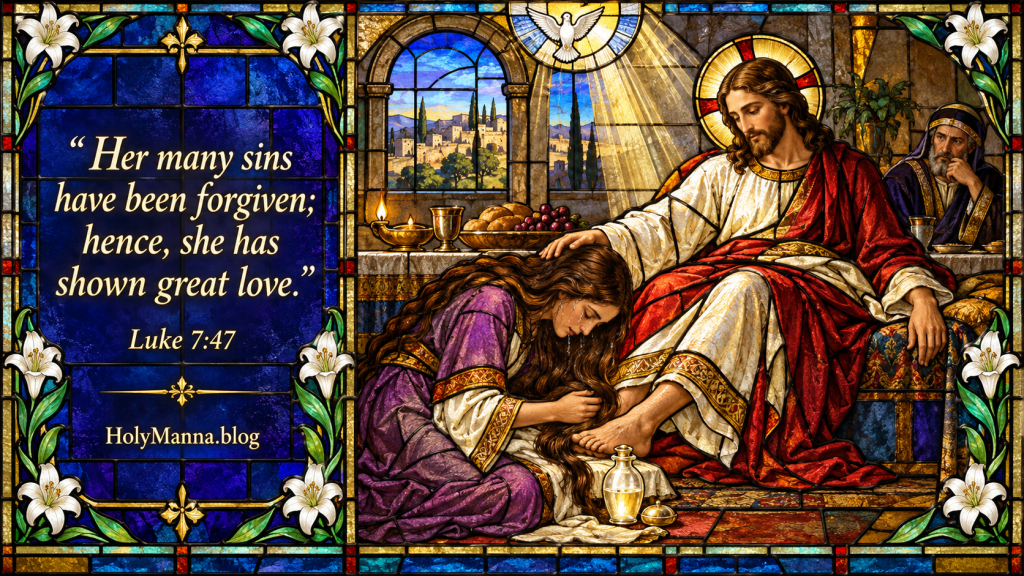
So I tell you, her many sins have been forgiven;
hence, she has shown great love.
But the one to whom little is forgiven, loves little.”
He said to her, “Your sins are forgiven.”
The others at table said to themselves,
“Who is this who even forgives sins?”
But he said to the woman,
“Your faith has saved you; go in peace.”
Detailed Exegesis
Verse 36: “A certain Pharisee invited Jesus to dine with him, and he entered the Pharisee’s house and reclined at table.”
Jesus accepts the invitation of a man who will judge Him. He refuses no table, neither the tax collector’s nor the Pharisee’s, because He comes for every kind of sinner.
Verses 37-38: “Now there was a sinful woman in the city who learned that he was at table in the house of the Pharisee. Bringing an alabaster flask of ointment, she stood behind him at his feet weeping and began to bathe his feet with her tears. Then she wiped them with her hair, kissed them, and anointed them with the ointment.”
Everything she does is costly. The ointment was expensive, and letting down her hair in public was a scandal in itself. Her tears supply the water Simon withheld; her love repairs the hospitality his pride refused.
Verse 39: “When the Pharisee who had invited him saw this he said to himself, ‘If this man were a prophet, he would know who and what sort of woman this is who is touching him, that she is a sinner.’”
Simon judges silently, and the irony is thick. Jesus proves He is more than a prophet by reading not the woman’s past but Simon’s hidden thoughts.
Verse 40: “Jesus said to him in reply, ‘Simon, I have something to say to you.’ ‘Tell me, teacher,’ he said.”
Jesus answers a thought no one spoke aloud. Even in correction He is courteous, addressing Simon by name and teaching through a story rather than a rebuke.
Verses 41-42: “‘Two people were in debt to a certain creditor; one owed five hundred days’ wages and the other owed fifty. Since they were unable to repay the debt, he forgave it for both. Which of them will love him more?’”
Five hundred denarii was nearly two years of labor. The parable’s quiet bombshell is that neither debtor could pay. Before God, the respectable man and the notorious sinner are equally insolvent; only the amounts differ.
Verse 43: “Simon said in reply, ‘The one, I suppose, whose larger debt was forgiven.’ He said to him, ‘You have judged rightly.’”
Simon answers grudgingly, “I suppose,” yet he convicts himself. Jesus lets the Pharisee pronounce the verdict that the rest of the scene will apply.
Verses 44-46: “Then he turned to the woman and said to Simon, ‘Do you see this woman? When I entered your house, you did not give me water for my feet, but she has bathed them with her tears and wiped them with her hair. You did not give me a kiss, but she has not ceased kissing my feet since the time I entered. You did not anoint my head with oil, but she anointed my feet with ointment.’”
The question “Do you see this woman?” is the hinge. Simon saw a category, a sinner; Jesus sees a person. Point by point, her love outstrips his etiquette.
Verse 47: “‘So I tell you, her many sins have been forgiven; hence, she has shown great love. But the one to whom little is forgiven, loves little.’”
Her love is not the price of forgiveness but its proof and overflow. The warning cuts the other way too: a heart that thinks it needs little mercy will produce little love.
Verses 48-49: “He said to her, ‘Your sins are forgiven.’ The others at table said to themselves, ‘Who is this who even forgives sins?’”
The guests ask exactly the right question. Only God forgives sins, so either Jesus blasphemes or He is Lord. The scene quietly proclaims His divinity.
Verse 50: “But he said to the woman, ‘Your faith has saved you; go in peace.’”
Her faith, expressed through repentant love, receives salvation. She entered condemned by the room and leaves commissioned by God, sent into peace, shalom, wholeness restored.
Teachings
The Catechism reads this scene as a revelation of who Jesus is. CCC 1441 teaches, “Only God forgives sins. Since he is the Son of God, Jesus says of himself, ‘The Son of man has authority on earth to forgive sins’ and exercises this divine power: ‘Your sins are forgiven.’ Further, by virtue of his divine authority he gives this power to men to exercise in his name.” Every confessional is this banquet continued. The Catechism also holds up the woman as a model of prayer in CCC 2712: “Contemplative prayer is the prayer of the child of God, of the forgiven sinner who agrees to welcome the love by which he is loved and who wants to respond to it by loving even more.” Saint Gregory the Great, preaching on this Gospel in his Homily 33 on the Gospels and following the tradition naming her Mary, confessed, “When I think of the repentance of Mary, I am more disposed to weep than to speak. Where is the heart so stony that the tears of this woman would not soften it by her example?”
Reflection
The room held two debtors that day, and only one knew it. The way into this Gospel is honesty about the debt. Make a plan this week to return to the Sacrament of Reconciliation, and prepare with a real examination of conscience rather than a quick scan. Then imitate the woman’s extravagance in one hidden act of love, generous, unmeasured, and unexplained. Guard against Simon’s silent commentary by praying for the next person you are tempted to categorize. Which chair do you occupy at this banquet, and what would it take to kneel where she knelt? When did you last let yourself feel how much you have been forgiven?
Go in Peace, and Say So
Held together, today’s readings form a single arc of mercy. Paul receives the Gospel of the Crucified and Risen Christ and cannot keep it to himself, because “by the grace of God I am what I am” (1 Corinthians 15:10). The psalmist, snatched from death, discovers that rescue comes with a job description: “I shall not die, but live, and declare the works of the LORD” (Psalm 118:17). And the woman with the alabaster flask shows what declaration looks like before a single word is spoken, tears, kisses, and costly oil poured out at the feet of Mercy Himself.
The pattern never changes. Grace finds a real sinner, forgives a real debt, and sends a real witness. The Church was built by people like this, a persecutor turned preacher, a weeping woman turned model of prayer, five hundred ordinary witnesses who saw the Risen Lord and could not stay quiet. Their line continues wherever a forgiven heart chooses gratitude over shame and love over scorekeeping.
So the invitation stands for this very day, September 17th. Return to the sacraments, especially Confession, where Jesus still says, “Your sins are forgiven” (Luke 7:48). Come to the Eucharist, the great thanksgiving, and sing with the whole house of Israel that His mercy endures forever. Then go find one person who needs to hear the works of the Lord declared, and tell the story. The one forgiven much, loves much. Let that be the epitaph of every disciple, and the anthem of this ordinary, grace-soaked Thursday.
Engage With Us!
The conversation does not end here, and every story of mercy shared strengthens someone else’s faith. Share your reflections in the comments below, whether it is a testimony of grace, a favorite line from today’s readings, or a question still turning in your heart. This community grows when forgiven people speak up.
Here are some questions to pray with today:
- In 1 Corinthians 15:1-11, Paul openly names his past as a persecutor before proclaiming what grace has made of him. What part of your own story is God inviting you to stop hiding and start offering as testimony?
- Psalm 118:1b-2, 16ab-17, 28 declares, “I shall not die, but live, and declare the works of the LORD.” What specific work of God in your life have you never actually declared to anyone, and who could hear it this week?
- In Luke 7:36-50, Jesus asks Simon, “Do you see this woman?” Who in your daily life have you reduced to a category, and what would it look like to truly see them as Jesus does?
- Taking all of today’s readings together, forgiveness received becomes love poured out. Where is the mercy you have received still sitting unspent, and what extravagant act of love could release it?
Live this day as someone forgiven much. Let gratitude set the tone, let confession keep the ledger clean, and let every encounter carry the love and mercy Jesus taught us. His mercy endures forever, and the forgiven heart was made to say so.
Sacred Heart of Jesus, we trust in You!
Immaculate Heart of Mary, pray for us!
Saint Michael the Archangel, defend us in battle!
Follow us on YouTube, TikTok, Instagram and Facebook for more insights and reflections on living a faith-filled life.

 Holy Manna!
Leave a comment