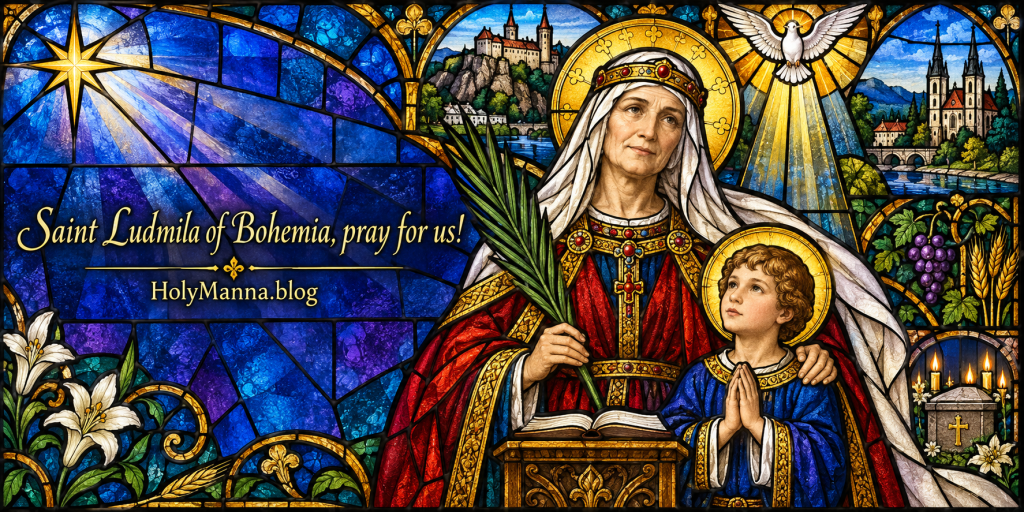
The Grandmother Who Baptized a Nation
There are saints whose names fill cathedrals and saints whose names fill Christmas carols, and then there are the quiet saints standing behind them, the ones who made the famous ones possible. Saint Ludmila of Bohemia is one of those quiet giants. Every December, millions of people sing about “Good King Wenceslas” looking out on the Feast of Stephen, and almost none of them know that the king in the carol learned his faith at the knee of his grandmother, a duchess who was murdered for the Gospel while he was still a boy. Ludmila, who lived from around the year 860 to September 15, 921, was the first Czech saint, the first Christian duchess of Bohemia, and one of the founding mothers of Christianity in Central Europe. Her feast is celebrated on September 16.
The Church honors her as a martyr, and the Catechism of the Catholic Church reminds everyone why that title matters so much: “Martyrdom is the supreme witness given to the truth of the faith” (CCC 2473). Ludmila gave that witness not on the sands of a Roman arena but in the private chapel of a castle, strangled in the dark by hired assassins because a pagan rival could not tolerate a grandmother teaching a future ruler to love Jesus Christ.
Saint Ludmila is venerated as the patroness of Bohemia and the Czech lands. She is also invoked as the patroness of converts to Christianity, of widows, of duchesses, and, in one of the most relatable patronages in the entire calendar of saints, of people who are struggling with difficult in-law relationships. That last patronage is not a joke or a later invention; it flows directly from the circumstances of her death, because the person who ordered her murder was her own daughter-in-law. Anyone who has ever gritted their teeth through a tense family holiday has a heavenly friend in Ludmila, and anyone who has ever tried to hand the faith on to a grandchild has a model in her.
From Pagan Princess to Daughter of the Church
Ludmila was born around the year 860 near Mělník, in Bohemia, in what is today the Czech Republic. She was the daughter of a Slavic prince named Slavibor, a ruler of the Sorbian people, and she was raised in the paganism of her ancestors. The Bohemia of her childhood sat on the frontier of the Christian world. To the south, the Frankish empire was Christian; to the east, the great mission of Saints Cyril and Methodius was bringing the Gospel to the Slavs in their own tongue; but the Czech lands themselves still worshipped the old gods.
As a young woman, Ludmila was married to Bořivoj I, a prince of the Přemyslid dynasty and the man history remembers as the first Christian Duke of Bohemia. Sources give the marriage date variously as 873 or as 882, when she would have been about fourteen years old, and honest storytelling has to admit that the exact chronology of her early life is uncertain. What is far better attested is the decisive event of their lives: through the influence of Saint Methodius, the Archbishop of the Slavs and Apostle of the Slavic peoples, Bořivoj was baptized, and Ludmila embraced the Christian faith as well. The earliest sources describe Bořivoj’s baptism at the hands of Methodius in Great Moravia; whether Ludmila was baptized at the same moment or shortly afterward is a detail historians still debate, since the oldest accounts do not explicitly say they were baptized together. Either way, the young duchess did not merely tolerate her husband’s new religion. She made it her own, completely.
Conversion for Ludmila was not a private hobby. Together with Bořivoj she set about planting the Church in Bohemian soil. The couple built the first Christian churches in the Czech lands, including a church dedicated to Saint Clement at Levý Hradec near Prague, and modern archaeology has actually confirmed the foundations of a small stone church there dating to the late ninth century. They invited priests to celebrate the liturgy for their people. This is what a real conversion looks like: it overflows. The Catechism teaches that “the home is the first school of Christian life” (CCC 1657), and Ludmila and Bořivoj took that logic one step further, treating their entire duchy as a household to be brought to Christ. The early efforts were not always gentle or successful; sources record that the couple’s push to Christianize their subjects met real resistance, and paganism remained strong among the Bohemian nobility for decades. Ludmila would live long enough to feel the full force of that resistance.
Bořivoj died young, likely in his mid thirties, sometime between about 888 and 894, leaving Ludmila a widow while she was still a young woman herself. Here is where her story could have become ordinary. A widowed duchess in the ninth century could have remarried for power, or faded into a comfortable retirement. Ludmila did neither. According to the tradition of the Church, she gave away her possessions to the poor and devoted herself to prayer, to works of mercy, and to the Christian formation of her family. Two of her sons, Spytihněv and Vratislav, would rule Bohemia after their father. And when Vratislav’s son Wenceslaus was born, Ludmila was given the task that would define her legacy and cost her life: she was entrusted with raising and educating the boy.
The Duchess Who Belonged to the Poor
What is Saint Ludmila most known for? Two things, and they are really one thing: she was a mother of the poor, and she was the catechist of a saint.
The accounts of her widowhood paint a consistent picture. Ludmila lived simply, prayed constantly, cared for the sick, fed the hungry, and used her position not to accumulate but to give. Later devotional tradition describes her keeping vigils, fasting, and practicing serious asceticism; those specific details belong to the idealized portrait painted by medieval writers and cannot be individually verified, but the core testimony, that she was known in her own lifetime for mercy toward the poor and the suffering, runs through every account of her life. This is precisely what the Church means when it teaches that the works of mercy are “charitable actions by which we come to the aid of our neighbor” (CCC 2447). Ludmila did not invent a new spirituality. She simply did the ordinary Christian things, generously, for decades, in a land where Christianity was still a fragile seedling.
It should be said honestly that the sources do not record dramatic wonder-working miracles performed by Ludmila during her lifetime, no multiplication of loaves, no raising of the dead. Her miracles came after her death, at her grave and through her relics, and they will be told in their place. During her life, her power was of a quieter kind: the slow miracle of a converted heart converting others. By her zeal, tradition records, she drew many of her people out of paganism and into the Church. There is something deeply encouraging in that. Not every saint gets visible signs. Some saints simply love God and neighbor so steadily, for so long, that a whole nation tilts toward Christ because of them.
Her greatest work, though, had a name: Wenceslaus. When her son Vratislav became duke in 915, and especially after his early death in February of 921, the education of the young heir Wenceslaus was placed in Ludmila’s hands. She took the assignment seriously in the way only a grandmother can. She taught the boy the faith, taught him prayer, taught him love for the poor, and formed in him the conscience that would later make him one of the most beloved Christian rulers of the Middle Ages and, eventually, a martyr himself. The Catechism insists that “education in the faith by the parents should begin in the child’s earliest years” (CCC 2226), and where parents cannot or will not do it, God has a long history of raising up grandmothers. Scripture itself honors this pattern. Saint Paul, writing to his young disciple, remembers “your sincere faith, a faith that dwelt first in your grandmother Lois” (2 Timothy 1:5). Ludmila is the Lois of the Czech nation. The famous carol king, the “Good King Wenceslas” trudging through the snow to bring food and firewood to a poor man, is in a very real sense Ludmila’s catechism lesson set to music.
Why should the reader remember her and emulate her? Because most people will never rule a duchy, but almost everyone will, at some point, hold influence over a child, a godchild, a niece, a nephew, a grandchild. Ludmila proves that this hidden, domestic, unglamorous work of handing on the faith can echo for eleven hundred years.
A Veil, a Prayer, and a Crown
Ludmila’s holiness made her enemies. Bohemia in 921 was a land divided between the new faith and the old paganism, and when Vratislav died that February, the fault line ran straight through his own family. The regency of the duchy passed to Vratislav’s widow, Drahomíra, a princess who, according to the Christian sources, remained attached to paganism, or at least allied herself firmly with the pagan party among the nobles. Wenceslaus, the heir, was still a boy, and everyone could see that his heart belonged to his grandmother and to his grandmother’s God.
Drahomíra grew jealous and afraid of Ludmila’s influence over her son. The sources describe rising hostility between the two women, a conflict that was at once a family feud, a political struggle, and a war of religions. Ludmila, for her part, did not fight for power. Seeking peace, she withdrew from the court to Tetín Castle, a fortress on a rocky height southwest of Prague. It did not save her. For Drahomíra and her faction, Ludmila’s mere existence, praying and beloved and shaping the future duke’s soul, was threat enough.
On the night of September 15, 921, two assassins named Tunna and Gommon, men whose names suggest they may have been of Frankish or Varangian origin, entered Tetín with their accomplices at Drahomíra’s instigation and murdered the sixty-one year old duchess. The earliest sources record plainly that she was strangled. The detail that has become inseparable from her image, that she was strangled with her own widow’s veil, appears prominently in later retellings, where it carries a piercing symbolism: the very sign of her consecrated widowhood became the instrument of her martyrdom. That is why her attribute in Christian art is the veil, and why she is so often painted or sculpted with it wound about her neck.
The tradition of the Church surrounds her final hours with details that read like a quiet liturgy. It is told that Ludmila, sensing what was coming, went to Confession, received the Holy Eucharist, and was found by her killers at prayer. It is also told that when the assassins seized her, she begged them to kill her with a sword instead, pleading in words remembered along these lines: “Better pierce me with a sword, so I would spill my blood for Christ like the martyrs.” They refused, and strangled her. These details, the Confession, the Communion, and the plea for the sword, come from the hagiographic tradition and cannot be verified as historical fact. What can be said with confidence is this: a Christian duchess was murdered, in hatred of her influence for the faith, by agents of a pagan-aligned regent, and the Church from the very beginning honored her death as martyrdom. The words of Jesus in The Gospel of Matthew apply to her without any embellishment at all: “Blessed are those who are persecuted for righteousness’ sake” (Matthew 5:10). Whether or not the veil detail is exact, whether or not her last sentence is preserved word for word, Ludmila died because she was a Christian who would not stop being one, and that is the whole definition of a martyr.
Her body was buried at Tetín, and by one tradition it was first cast down or hastily buried near the castle wall, denied the honor due to her rank. The pagans thought the story was over. Heaven disagreed.
Lights Over Tetín
Almost immediately, the faithful began to report wonders at Ludmila’s grave. Tradition tells that lights like candles appeared over her burial place at night, that a heavenly fragrance spread around her tomb, and that a blind man recovered his sight after touching the earth where she lay. These miracle stories come down through the early accounts of her life and cult; they are treasured traditions rather than verifiable historical records, and it must be stated plainly that they cannot be verified. Yet even the skeptical historian has to reckon with one remarkable, well-attested response to them: the sources record that Drahomíra herself, alarmed that the growing miracles were exposing her crime and turning her victim into a saint, had a church built over the grave, apparently hoping that any wonders would then be credited to the church’s own patron rather than to Ludmila. Some read that gesture as pure damage control; others have wondered whether it hides a flicker of remorse. Either way, the murderer ended up building a shrine.
The decisive vindication came from the boy Ludmila had raised. When Wenceslaus came of age and took the government of Bohemia into his own hands, one of his early acts as duke was to honor his grandmother. In the year 925 he had her remains solemnly transferred from Tetín to the Basilica of Saint George at Prague Castle, the church at the very heart of the dynasty’s seat. In that era, before the formal canonization processes of later centuries, such a solemn translation of relics by the Church was itself the recognition of sainthood, and Ludmila was venerated as a saint from that time forward. Tradition adds that when her body was exhumed for the translation, it was found incorrupt, a sign her contemporaries read as heaven’s confirmation of her holiness; this detail belongs to the early tradition surrounding the translation and cannot be verified. The Church’s later theology explains what that ancient act of veneration meant, for in canonizing saints “the Church recognizes the power of the Spirit of holiness within her” (CCC 828).
Numerous healings and favors were reported at her relics in Prague across the centuries, so many that her tomb became one of the spiritual anchors of the Czech nation. Around the year 976, her own great-granddaughter, Mlada, founded the first convent in Bohemia, a community of Benedictine nuns attached to Saint George’s Basilica, so that consecrated women have kept prayerful watch near Ludmila’s resting place for a thousand years. A Gothic chapel dedicated to her was added to the basilica in the thirteenth century and holds her tomb to this day. Her skull is preserved separately in the treasury of Saint Vitus Cathedral and is brought out for public veneration on her feast day.
Her cultural and national impact is hard to overstate. Ludmila is the first Czech saint, the spiritual grandmother of the entire nation, and through the marriages of her descendants her blood runs through a remarkable share of Europe’s royal houses. Pilgrims today can walk the Saint Ludmila Trail, a route of about 132 kilometers stretching from Mělník, where she was born, to Tetín, where she was martyred, and Tetín itself remains a place of pilgrimage crowned with churches. In 2021 the Czech Republic marked the eleven hundredth anniversary of her martyrdom with national celebrations. The great Czech composer Antonín Dvořák honored her with his oratorio Svatá Ludmila, and one of Prague’s most beloved landmarks, the soaring neo-Gothic Church of Saint Ludmila in the Vinohrady district, bears her name. Not bad for a grandmother whose enemies assumed she would be forgotten by the following spring. As for famous sayings, honesty requires a clear statement: no verified quotations of Saint Ludmila survive, and the words attributed to her at her death belong to tradition rather than documented history.
What a Grandmother’s Faith Can Build
Saint Ludmila’s life presses three lessons into the hands of anyone willing to receive them.
First, conversion is meant to overflow. Ludmila did not treat her baptism as a private upgrade to her interior life. She built churches, invited priests, served the poor, and reordered her whole household around Christ. The reader might sit with this honestly. Does faith stay locked in one hour on Sunday, or does it spill into the home, the budget, the calendar, and the way guests and strangers are treated? The Catechism teaches that the family is the domestic church (CCC 1666), and Ludmila shows what happens when someone actually believes that.
Second, the hidden work of passing on the faith is world-changing work. Ludmila’s most enduring act was not a decree or a battle; it was teaching a little boy his prayers. The Book of Proverbs puts the principle simply: “Train up a child in the way he should go” (Proverbs 22:6). Whoever is reading this almost certainly has a Wenceslaus somewhere in their life, a child or teenager watching how the adults around them live. Who is being formed, right now, by what they see in this reader’s daily choices? Practical ways to imitate Ludmila are wonderfully concrete: pray aloud with the children in the family instead of only around them, tell them the stories of the saints at bedtime, bring them along when serving the poor, let them see an adult go to Confession. Nobody catechizes alone, and grandparents, godparents, aunts, and uncles are not spiritual spectators; in Ludmila’s case, the grandmother was the difference between a pagan prince and a holy king.
Third, fidelity may be costly, and it is worth the cost. Ludmila lost her position, her peace, and finally her life, and from the world’s point of view she lost them to a smaller, meaner rival. Yet eleven centuries later, pilgrims still walk from Mělník to Tetín, and Drahomíra is remembered chiefly as the woman who murdered a saint. The famous observation attributed to the early Church writer Tertullian proved true once again in Bohemia: “The blood of the martyrs is the seed of the Church.” When faithfulness to Christ starts to cost something real, comfort, approval, or a relationship, what usually wins? Ludmila’s answer was quiet, steady endurance, rooted in prayer and the sacraments, and her endurance seeded the conversion of a nation. The reader’s endurance, in far smaller trials, is seed too.
Finally, for anyone carrying a wounded family relationship, and especially tension with in-laws, Ludmila is a patroness who understands from the inside. She did not win Drahomíra over in this life. Sanctity does not guarantee a happy ending to every family conflict this side of heaven. But she never returned hatred for hatred, she withdrew rather than escalate, and she kept loving the child they both claimed. That is a hard, holy road, and she has walked it ahead of everyone on it now. Since the saints in glory “do not cease to intercede with the Father for us” (CCC 956), no one has to walk it without her help.
Engage With Us!
The conversation should not end here. Readers are warmly invited to share their thoughts, their stories, and their reflections on Saint Ludmila in the comments below. Was her story familiar, or is this the first meeting with the grandmother behind Good King Wenceslas? Here are some questions to spark reflection and discussion:
- Who first handed on the faith to you, and have you ever thanked God, or them, for it?
- Is there a child in your life right now, a son, daughter, grandchild, godchild, or student, whose faith you could intentionally help form the way Ludmila formed Wenceslaus?
- Ludmila gave away her wealth and belonged to the poor. What is one concrete possession, comfort, or hour of your week you could give away this month?
- When you face conflict inside your own family, do you respond more like Ludmila, with patience and prayer, or do you fight to win? What would change if you asked for her intercession?
- If being a Christian quietly cost you your reputation, your comfort, or a relationship, as it cost Ludmila everything, what would help you stay faithful?
Saint Ludmila spent her life doing small, faithful things with great love, teaching prayers, feeding the poor, keeping vigil, and God turned those small things into the conversion of a nation. The same God is at work in every ordinary kitchen, classroom, and living room today. So go and do likewise: love the people in front of you, hand on the faith without embarrassment, forgive the ones who are hardest to forgive, and do everything with the love and mercy that Jesus taught us.
Saint Ludmila of Bohemia, grandmother of saints and martyr of Christ, pray for us!
Follow us on YouTube, TikTok, Instagram and Facebook for more insights and reflections on living a faith-filled life.

 Holy Manna!
Leave a comment