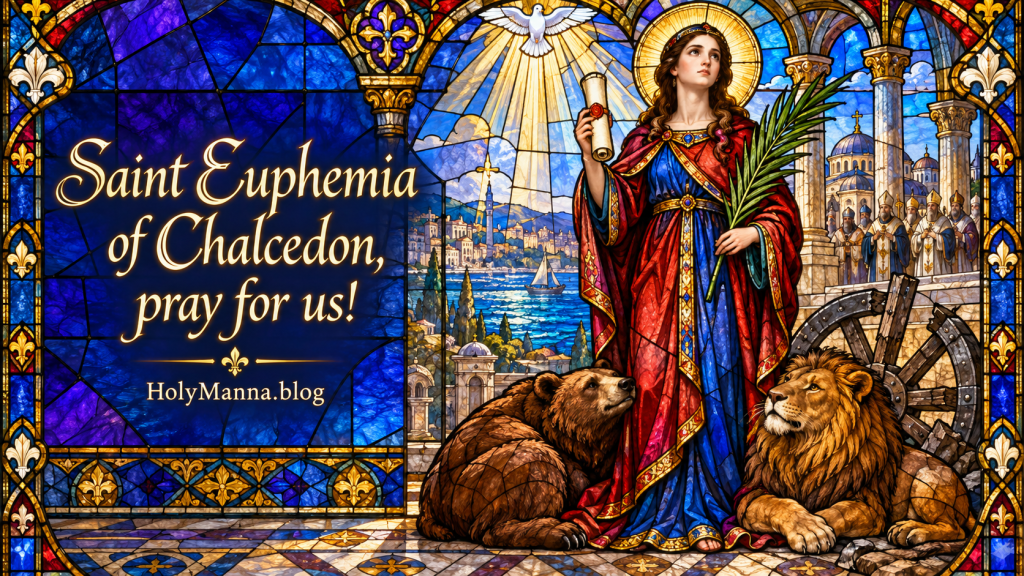
The Martyr Who Held the Faith in Her Hand
Every September 16th, the Church pauses to remember a young woman whose very name means good report, and whose report has now carried across 17 centuries of Christian history. Saint Euphemia of Chalcedon, virgin and martyr, gave her life for Christ around the year 303, at the very outbreak of the Great Persecution under the Emperor Diocletian. The Roman Martyrology commemorates her on September 16th, the same day the universal calendar keeps the Memorial of Saints Cornelius and Cyprian, and the Christian East honors her with the exalted titles of Great Martyr and All Praised. Few saints of the early Church were loved so widely, so quickly. Churches rose in her honor from Egypt to Rome within a few generations of her death, pilgrims crossed the empire to pray at her tomb, and her name was even woven into the Canon of the Mass in the ancient Ambrosian liturgy of Milan.
Yet Euphemia is remembered above all for something that happened 148 years after she died. In 451, the Fourth Ecumenical Council, the Council of Chalcedon, gathered in the basilica built over her tomb and there defined one of the most important truths of the Catholic faith: that Jesus Christ is one divine Person in two natures, true God and true man. The council fathers themselves credited the young martyr with crowning their work, and a beloved tradition holds that the true confession of faith was found resting in her hand. When the Church raises her saints to the altars, The Catechism teaches that “the Church recognizes the power of the Spirit of holiness within her” (CCC 828), and in Euphemia that power proved stronger than torture, stronger than empire, and stronger than death itself. She is honored today as the patroness and protector of Rovinj, a coastal town in Croatia that treasures her relics and keeps her feast as its city day. Her story is the story of a teenage girl who refused to bow, and of a God who never stopped speaking through her.
A Senator’s Daughter in the Shadow of Byzantium
Euphemia was born in Chalcedon, a prosperous city of the Roman province of Bithynia, set on the eastern shore of the Bosphorus directly across the water from ancient Byzantium. Today that ground lies within the Kadıköy district of Istanbul. The documented historical core of her life is brief but firm. Her name, her city, and the year of her death are recorded in the Martyrologium Hieronymianum, the earliest surviving list of Christian martyrs, compiled in the 5th century. The year given, 303, was the first year of the Diocletianic persecution, the last and fiercest of the Roman persecutions of the Church. The earliest detailed witness to her passion is Saint Asterius of Amasea, a bishop who died around the year 410, who preached a homily describing a vivid painting of her martyrdom displayed near her tomb in Chalcedon. That homily proves that within a century of her death, her story was already famous, already painted, already drawing crowds.
The fuller portrait of her early life comes from her traditional Acts, a later account that scholars, including the New Catholic Encyclopedia, judge not historically trustworthy in its details. The Church therefore tells these details as tradition rather than as established fact, and this post will do the same. According to that tradition, Euphemia was the daughter of Philophronos, a senator of Chalcedon, and his wife Theodosia, both devout Christians. Raised in the faith from childhood, she is said to have been formed in prayer, fasting, and chastity, and to have consecrated her virginity to Christ. Her conversion, then, was not a dramatic turn from paganism but the quiet deepening of a baptized soul, the daily decision to belong wholly to the Lord. The Catechism describes such women from the Church’s earliest days as virgins “called by the Lord to cling only to him with greater freedom” (CCC 922). In a wealthy home, in a comfortable city, a young woman with every earthly prospect chose the better part. That choice, made in peacetime, prepared her for the storm.
Courage in a Hidden Church
The storm broke when the imperial machinery of persecution reached Chalcedon. According to her traditional Acts, the governor of the region, named Priscus in the account, decreed a great public festival in honor of the pagan god Ares and commanded every inhabitant of the city and its surroundings to attend and offer sacrifice, under threat of terrible punishment. It is here that the tradition offers one of its most beautiful images. While the city streamed to the idol, 49 Christians hid themselves in a house and continued, in secret, to offer worship to the true God. The young Euphemia was among them, praying in that hidden church while the empire celebrated outside. The hiding place was discovered, and the whole company was arrested and brought before the governor.
The tradition relates that for 19 days the Christians were pressured and tormented, and that they would not yield. The others were then sent on to the emperor for judgment, while Euphemia, the youngest of the company, was held back, perhaps because her persecutors believed a young girl would break most easily. Her traditional Acts place a fearless answer on her lips before the governor: “We are not afraid of torments you threaten us with” (Acts of Saint Euphemia). These words come from the later passio and cannot be verified as her exact historical words, but they faithfully express the spirit the earliest sources attest.
Why should the reader remember and emulate her? Because Euphemia’s first miracle was not a wonder of nature but a wonder of fidelity. Long before any angel intervened, she and her companions simply kept worshiping God when it was illegal to do so. The Lord himself promised, “Everyone who acknowledges me before men, I also will acknowledge before my Father” (Matthew 10:32), and The Catechism teaches that the disciple of Christ must “not only keep the faith and live on it, but also profess it” (CCC 1816). Euphemia professed it with her presence in that hidden room, with her answer before the governor, and finally with her blood. Compassion marked her as well; the tradition remembers her not as a solitary hero but as one soul within a praying community, the youngest member of a little church that refused to disappear. God’s intervention through her began precisely there, in the grace that made a teenager braver than a proconsul.
The Arena, the Wheel, and the Crown
What Euphemia suffered next comes down through two streams. The earlier and more sober stream is Saint Asterius of Amasea, who described the painting near her tomb: the maiden standing trial before the magistrate, soldiers striking out her teeth with a hammer so that blood ran down, and her death in the flames. This is the oldest surviving account of her passion, preached within living memory of pilgrims who knew her shrine. The later and more elaborate stream is her traditional Acts, which the Church tells as tradition rather than verified history. In that account, Euphemia was subjected to torture upon the wheel, and an angel of the Lord came to her aid and she was healed. She was cast into a blazing furnace, and the flames spared her while turning upon her tormentors. Torment after torment failed, and the tradition presents each failure as a display of divine protection, God visibly refusing to let his handmaid be conquered before her hour.
Finally, the tradition says, she was condemned to the beasts in the arena. The animals released against her would not attack; the story tells that they gathered about her and licked her feet. Euphemia, longing to be united with her Bridegroom, prayed that the Lord would count her worthy of martyrdom. Then a single she-bear inflicted one small wound, and with that the holy virgin gave up her soul to God. The tradition adds that at that moment an earthquake shook the city, scattering the terrified crowd, so that her parents were able to recover her body and bury it with reverence near Chalcedon. These dramatic episodes cannot be verified, and some sources differ even on the manner of her death; a few later summaries speak of a lion, the passio speaks of a bear, and Asterius, the earliest witness, speaks of fire. Sources likewise vary on the year, giving 303, 304, or occasionally 307, and one ancient calendar places her death on October 16th rather than September 16th. What no source disputes is the essential fact: at Chalcedon, at the height of the Great Persecution, a young consecrated virgin was tortured and killed because she would not deny Jesus Christ.
The significance of that fact is immense. The Catechism teaches that “Martyrdom is the supreme witness given to the truth of the faith” (CCC 2473), and it adds that “The Church has painstakingly collected the records of those who persevered to the end” (CCC 2474). Euphemia’s record was collected almost immediately, painted on canvas, preached from pulpits, and inscribed in the oldest martyrology the Church possesses. In her the words of Scripture were fulfilled to the letter: “Be faithful unto death, and I will give you the crown of life” (Revelation 2:10). She was perhaps no more than a teenager. The empire that killed her thought it was erasing her. Instead it was writing her name where it could never be removed.
The Saint Who Guarded a Council
If Euphemia’s life was brief, her afterlife in the Church has been astonishing. A great basilica rose over her tomb at Chalcedon in the 4th century and became one of the most famous pilgrimage destinations of the Christian East. The pilgrim Egeria and Saint Melania the Younger both visited it. The church historian Evagrius Scholasticus reported a wonder cherished for generations: that at certain times fragrant blood issued from the martyr’s relics, which the clergy reverently gathered and distributed among the faithful. This report comes from an ancient historian and was widely believed, though it belongs to pious testimony rather than to anything that can now be verified.
Then came the moment that bound her name to the faith of the whole Church. By the middle of the 5th century, a grave error was spreading. The monk Eutyches taught, in effect, that Christ’s humanity was absorbed into his divinity, so that he possessed only one nature. Against this, the emperor Marcian and the empress Pulcheria convoked an ecumenical council in 451, and the fathers, numbering 630 according to the traditional count, gathered in the basilica of Saint Euphemia at Chalcedon, in the very presence of her relics. There, guided by the Tome of Pope Saint Leo the Great, the council solemnly defined that Jesus Christ is one Person “to be acknowledged in two natures, without confusion, change, division, or separation” (CCC 467, quoting the Council of Chalcedon). This definition remains the Church’s faith to this day, and every Catholic who confesses that Jesus is true God and true man stands on the ground of Chalcedon, which is to say, on the ground of Euphemia’s tomb.
The council fathers themselves saw her hand in their work. In their official letter to Pope Saint Leo, a genuine surviving document, they wrote that “it was God who worked, and the triumphant Euphemia who crowned the meeting” (Letter of the Council of Chalcedon to Pope Leo). From this conviction grew the most famous story attached to her name. Tradition relates that when agreement seemed impossible, the fathers wrote out two confessions of faith, the orthodox definition and the heretical one, sealed both in the tomb of the martyr, and gave themselves to 3 days of fasting and prayer. When the tomb was opened, the story says, the orthodox confession lay in Euphemia’s right hand, and the false one at her feet. It is a magnificent story, and it explains why her icons so often show her holding a scroll, and why the Byzantine churches keep a second feast for her on July 11th in memory of this miracle. But honesty requires saying plainly that this story does not appear in the surviving acts of the council and cannot be verified.
Her relics themselves became pilgrims. Around 617 to 620, as Persian armies bore down on Chalcedon, the relics were carried across the water to Constantinople for safekeeping. During the iconoclast persecutions of the 8th century, tradition relates that her reliquary was cast into the sea by the enemies of holy images, recovered by pious seafaring brothers, sheltered on the island of Lemnos, and returned to Constantinople in 796. This story of the sea rescue likewise cannot be verified. What is certain is that the greater part of her relics rests today in the Patriarchal Church of Saint George at the Phanar in Istanbul, where Christians still venerate her more than 1,700 years after her death.
One more journey belongs to her story. The town of Rovinj on the Croatian coast of Istria treasures the tradition that in the year 800 a marble sarcophagus washed ashore after a violent storm. The townspeople could not move it by any strength of men or oxen, until a young boy, prompted by a vision of the saint, drew it up the hill with 2 young calves, and the astonished town received Euphemia as its patroness and protector. This story cannot be verified. Yet the sarcophagus itself is real; a Roman marble tomb dating to the 6th century stands to this day behind a side altar of the great baroque Church of Saint Euphemia, completed in 1736, which crowns Rovinj’s hill and dominates its skyline, topped by a statue of the saint that turns with the wind. Every September 16th, Rovinj celebrates her feast as its city day, drawing pilgrims from across Croatia and beyond. Her cult spread just as widely in the ancient world; churches were dedicated to her in Rome, where Pope Saint Sergius I restored her church on the Viminal Hill, and in Tivoli, Ravenna, Grado, Aquileia, Zadar, Malta, Carthage, Daphne near Antioch, and Oxyrhynchus in Egypt. Such devotion is not nostalgia. The Catechism teaches of the saints that “they do not cease to intercede with the Father for us” (CCC 956), and generation after generation has found Euphemia a powerful intercessor, especially when the faith itself is under pressure.
Holding Fast When the World Demands Otherwise
Euphemia’s world demanded public conformity to false worship, and it offered her an easy exit; one pinch of incense, one nod to Ares, and she could have gone home to her comfortable life. Her greatness lies in seeing clearly what that gesture would have meant. The Catechism warns that “Idolatry consists in divinizing what is not God” (CCC 2113), and it notes that idolatry remains a constant temptation, not a relic of antiquity. Few readers will ever face a proconsul, but every reader faces the quiet daily pressure to bow to lesser gods: career, approval, comfort, the fear of standing out. What idol quietly asks for your incense, and what would it cost you to refuse it?
Her story also honors the hidden church. Before the arena, there was a house where 49 believers worshiped in secret rather than skip the worship of God. For the modern Catholic, the application is almost embarrassingly direct: fidelity to Sunday Mass, kept as truly non-negotiable, is the ordinary battlefield where Euphemia’s courage becomes imitable. Is there anything on your calendar that outranks the worship of God, and should there be? From there, her witness invites small, visible acts of confession: grace prayed before meals in public, a crucifix worn without apology, a conversation about faith not dodged. These are little things, but martyrdom is simply fidelity in little things carried to its final consequence.
Euphemia also teaches resilience rooted in identity. The tradition presents her as a consecrated soul who already belonged entirely to Christ, which is why no torment could pry her loose; a person cannot be robbed of what she has already given away. The reader can imitate this by consecrating the day each morning, deliberately handing over work, family, worries, and plans to the Lord before the world makes its claims. And because Euphemia’s tomb became the cradle of the Church’s confession that Christ is true God and true man, there is no better tribute to her than to know that faith well. Reading CCC 464 through CCC 469, slowly and prayerfully, would make a fitting devotion for her feast. Finally, she models compassion under pressure; she suffered within a community, not above it, and the reader who feels alone in living the faith might ask her intercession to find, or to build, a company of believers who hold one another fast. Who in your life strengthens your faith, and whose faith are you strengthening?
Engage With Us!
HolyManna warmly invites you to share your thoughts and reflections on Saint Euphemia in the comments below. Her story stretches from a hidden house church in Chalcedon to an ecumenical council to a hilltop basilica on the Adriatic, and there is room in it for every reader’s questions and experiences. To help the conversation begin, here are some reflection questions to pray with and to discuss:
- Euphemia worshiped in secret rather than abandon the worship of God. What would it take for Sunday Mass to become truly non-negotiable in your life?
- The tradition says the beasts would not harm her until she prayed to receive martyrdom. Where in your life is God asking you to stop clinging to safety and trust him completely?
- The Council of Chalcedon defined that Jesus is true God and true man in her basilica. How would your daily life change if you took that truth completely seriously?
- Euphemia’s name means good report. If the people around you gave a report of your faith, what would it say, and what do you want it to say?
- She stood firm as the youngest of her company. Who is watching your example right now, and what is it teaching them?
Saint Euphemia was young, outnumbered, and utterly unarmed, and she still outlasted an empire, because the One she confessed is stronger than everything that opposed her. That same Lord, true God and true man, is with you today. Take courage from this brave daughter of Chalcedon, hold fast to the faith she died for and defended, and go into this week resolved to do everything, the great things and the hidden ones, with the love and mercy that Jesus taught us.
Saint Euphemia of Chalecedon, virgin and great martyr, pray for us!
Follow us on YouTube, TikTok, Instagram and Facebook for more insights and reflections on living a faith-filled life.

 Holy Manna!
Leave a comment