Memorial of Saints Cornelius, Pope, and Cyprian, Bishop, Martyrs – Lectionary: 445
The Love That Outlasts the Fire
Some words get read at so many weddings that people forget they were written for a church in crisis. On Wednesday, September 16th, 2026, the Memorial of Saints Cornelius, Pope, and Cyprian, Bishop, Martyrs, the Church proclaims the most famous chapter Saint Paul ever wrote, and it lands with far more weight than candlelight and flowers. The central theme uniting today’s readings is that love is the measure of everything. In 1 Corinthians 12:31-13:13, Paul tells a talented, quarreling community that tongues, prophecy, heroic faith, and even bodily sacrifice amount to nothing without charity. Psalm 33 answers with the song of a people who know they are loved, chosen not for their merits but by the kindness of the LORD that fills the earth. Then, in Luke 7:31-35, Jesus holds up a mirror to a generation that found excuses to reject both John’s fasting and His own feasting, because a heart without love can always find a reason to say no.
The two saints honored today lived this theme in blood. Cornelius governed the Church of Rome from 251 to 253, in the shadow of the Decian persecution, while Cyprian led the great church of Carthage in North Africa. Though they never met face to face, their letters bound them in one battle: defending Christ’s mercy toward Christians who had denied the faith under torture and later repented. A rigorist faction led by Novatian called that mercy weakness and tore the Church’s unity. Both bishops paid for their fidelity, Cornelius in exile and Cyprian under the executioner’s sword in 258. Their witness frames every line that follows: gifts pass away, applause passes away, but love never fails.
First Reading — 1 Corinthians 12:31-13:13
The Hymn That Was Written for a Fight
Corinth was a boomtown, a wealthy Greek port rebuilt by Rome, full of ambition, patronage, and status-chasing. Its young church caught the same fever. Believers ranked one another by spiritual gifts, treating tongues and prophecy like trophies. Paul does not deny the gifts are real; he relocates them. Chapter 13 is not sentimental poetry but surgery, cutting pride out of a divided community. The Greek word Paul chooses, agape, names the self-giving love revealed on the Cross, and on this memorial it rings with special force, because Saint Cyprian quoted this very chapter to explain why even martyrdom means nothing apart from charity and unity.
1 Corinthians 12:31-13:13
Brothers and sisters:
Strive eagerly for the greatest spiritual gifts.But I shall show you a still more excellent way.
If I speak in human and angelic tongues
but do not have love,
I am a resounding gong or a clashing cymbal.
And if I have the gift of prophecy
and comprehend all mysteries and all knowledge;
if I have all faith so as to move mountains,
but do not have love, I am nothing.
If I give away everything I own,
and if I hand my body over so that I may boast
but do not have love, I gain nothing.Love is patient, love is kind.
It is not jealous, love is not pompous,
it is not inflated, it is not rude,
it does not seek its own interests,
it is not quick-tempered, it does not brood over injury,
it does not rejoice over wrongdoing
but rejoices with the truth.
It bears all things, believes all things,
hopes all things, endures all things.Love never fails.
If there are prophecies, they will be brought to nothing;
if tongues, they will cease;
if knowledge, it will be brought to nothing.
For we know partially and we prophesy partially,
but when the perfect comes, the partial will pass away.
When I was a child, I used to talk as a child,
think as a child, reason as a child;
when I became a man, I put aside childish things.
At present we see indistinctly, as in a mirror,
but then face to face.
At present I know partially;
then I shall know fully, as I am fully known.
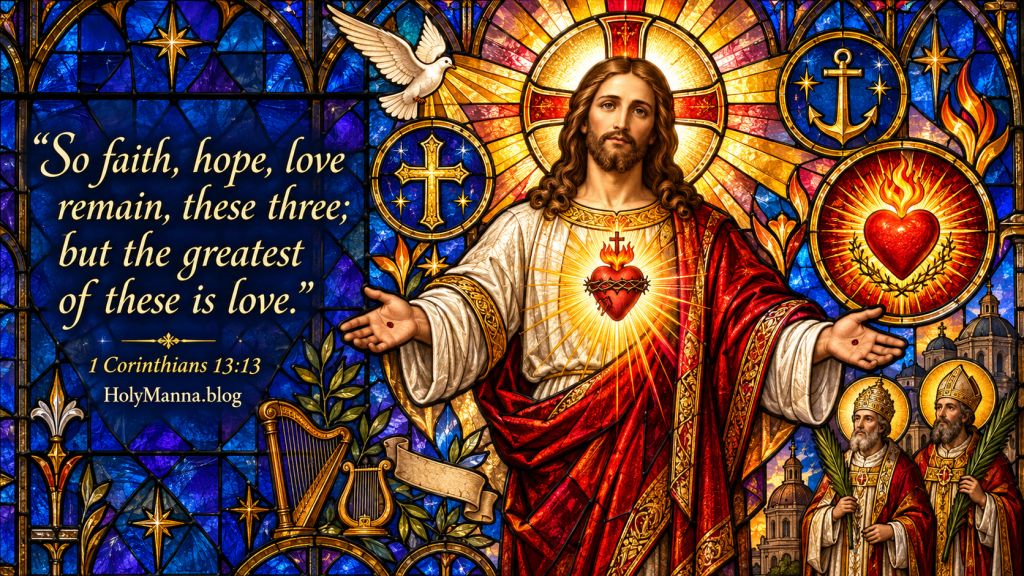
So faith, hope, love remain, these three;
but the greatest of these is love.
Detailed Exegesis
1 Corinthians 12:31: “Strive eagerly for the greatest spiritual gifts. But I shall show you a still more excellent way.” Paul closes his teaching on charisms with a hinge. Desiring gifts is good, yet there exists a “way,” a road to walk rather than a possession to display. CCC 800 teaches that charisms exist for the good of the Church, and charity is the road on which every gift must travel.
1 Corinthians 13:1: “If I speak in human and angelic tongues but do not have love, I am a resounding gong or a clashing cymbal.” Corinth’s pagan temples used gongs and cymbals in their rites. Paul’s point stings: religious noise without love is just noise, indistinguishable from the racket of idols.
1 Corinthians 13:2: “And if I have the gift of prophecy and comprehend all mysteries and all knowledge; if I have all faith so as to move mountains, but do not have love, I am nothing.” Paul stacks up the most prestigious gifts imaginable, then delivers the verdict. Not “I accomplish nothing” but “I am nothing.” Love is not one accessory of the Christian life; it is the substance of the person.
1 Corinthians 13:3: “If I give away everything I own, and if I hand my body over so that I may boast but do not have love, I gain nothing.” Even philanthropy and death itself can be corrupted by self-regard. This is the verse Cyprian seized upon against schismatics who courted martyrdom while despising their brothers.
1 Corinthians 13:4: “Love is patient, love is kind. It is not jealous, love is not pompous, it is not inflated, it is not rude,” Paul now describes love with fifteen verbs, not adjectives. In Greek, love does things and refuses to do things. Patience and kindness lead the list because they are love’s most daily, least glamorous forms.
1 Corinthians 13:5: “it does not seek its own interests, it is not quick-tempered, it does not brood over injury,” The phrase about brooding uses an accounting term: love keeps no ledger of wrongs. Every marriage, friendship, and parish knows how revolutionary that bookkeeping decision is.
1 Corinthians 13:6: “it does not rejoice over wrongdoing but rejoices with the truth.” Love refuses the secret pleasure of gossip and schadenfreude. It cheers only for the truth, even when the truth is costly.
1 Corinthians 13:7: “It bears all things, believes all things, hopes all things, endures all things.” The fourfold “all things” describes love’s endurance under weight, its refusal of cynicism, and its stamina. This is the love that carried Cyprian through plague and persecution.
1 Corinthians 13:8: “Love never fails. If there are prophecies, they will be brought to nothing; if tongues, they will cease; if knowledge, it will be brought to nothing.” The gifts Corinth prized are scaffolding; the building is love. Scaffolding comes down when the work is finished.
1 Corinthians 13:9: “For we know partially and we prophesy partially,” Even the holiest knowledge in this life is a fragment. Humility about what remains unknown is built into the Christian condition.
1 Corinthians 13:10: “but when the perfect comes, the partial will pass away.” “The perfect” is the face-to-face vision of God in heaven. Everything provisional yields to that fullness.
1 Corinthians 13:11: “When I was a child, I used to talk as a child, think as a child, reason as a child; when I became a man, I put aside childish things.” Paul compares this present life to childhood. Fighting over gifts, he implies, is spiritual immaturity; charity is adulthood in Christ.
1 Corinthians 13:12: “At present we see indistinctly, as in a mirror, but then face to face. At present I know partially; then I shall know fully, as I am fully known.” Corinth was famous for its bronze mirrors, which gave only a dim reflection. Heaven replaces the reflection with the Face, and the astonishing promise is mutual knowledge: to know God as one is already known by Him.
1 Corinthians 13:13: “So faith, hope, love remain, these three; but the greatest of these is love.” Faith will become sight and hope will become possession, but love continues unchanged into eternity, because “God is love” (1 John 4:16). Love is the greatest because it is the one virtue heaven does not retire.
Teachings
The Catechism places this chapter at the heart of the moral life. CCC 1822 defines the virtue: “Charity is the theological virtue by which we love God above all things for his own sake, and our neighbor as ourselves for the love of God.” CCC 1827 adds that charity is “the form of the virtues,” the soul that animates every other good habit. Astonishingly, the entire Catechism announces its purpose with this very reading, quoting the Roman Catechism in CCC 25: “The whole concern of doctrine and its teaching must be directed to the love that never ends.” Saint Cyprian, whose feast this is, applied the passage to his own crisis in On the Unity of the Church, chapter 14, writing of schismatics who sought glory in death: “He cannot be a martyr who is not in the Church… he cannot show himself a martyr who has not maintained brotherly love.” Saint Augustine distilled the chapter into one bracing rule in his Homilies on the First Epistle of John, Homily 7: “Love, and do what you will.” And Saint Thérèse of Lisieux, reading this passage in Story of a Soul, discovered her whole mission: “In the heart of the Church, my Mother, I shall be love.”
Reflection
Try a simple, humbling exercise today. Read verses 4 through 7 and replace the word “love” with your own name, then notice which line makes you wince. That wince is the Holy Spirit pointing to this week’s assignment. Choose one concrete act: refuse to replay an old injury, let someone else receive credit, or answer irritation with patience at home, where love is hardest to fake. Which of your gifts, talents, or accomplishments are you most tempted to value above charity? Whose ledger of wrongs do you need to close for good?
Responsorial Psalm — Psalm 33:2-5, 12, 22
The Song of a Chosen People
Psalm 33 comes from Israel’s public worship, a hymn sung with harp and ten-stringed lyre in the temple courts. It praises the LORD not first for what He gives but for who He is: upright in word, trustworthy in works, a lover of justice whose kindness fills the earth. The refrain the Church sings today, “Blessed the people the Lord has chosen to be his own,” turns that praise personal. After hearing Paul insist that love is everything, the psalm reveals the source: God loved His people first, and the only sane response is music.
Psalm 33:2-5, 12, 22
R. (12) Blessed the people the Lord has chosen to be his own.
Give thanks to the LORD on the harp;
with the ten stringed lyre chant his praises.
Sing to him a new song;
pluck the strings skillfully, with shouts of gladness.
R. Blessed the people the Lord has chosen to be his own.
For upright is the word of the LORD,
and all his works are trustworthy.
He loves justice and right;
of the kindness of the LORD the earth is full.
R. Blessed the people the Lord has chosen to be his own.
Blessed the nation whose God is the LORD,
the people he has chosen for his own inheritance.
May your kindness, O LORD, be upon us
who have put our hope in you.
R. Blessed the people the Lord has chosen to be his own.
Detailed Exegesis
Psalm 33:2: “Give thanks to the LORD on the harp; with the ten stringed lyre chant his praises.” Gratitude in Israel was never merely mental; it was embodied, instrumental, and communal. The psalm assumes that real thanksgiving eventually needs an orchestra.
Psalm 33:3: “Sing to him a new song; pluck the strings skillfully, with shouts of gladness.” The “new song” celebrates God’s ever-fresh saving deeds, and the call for skill matters. Offering God excellence, not leftovers, is itself an act of love.
Psalm 33:4: “For upright is the word of the LORD, and all his works are trustworthy.” Here is the reason for the music. Unlike the fickle gods of the nations, the LORD’s word and works line up perfectly. He is worth trusting because He has never once been false.
Psalm 33:5: “He loves justice and right; of the kindness of the LORD the earth is full.” The Hebrew word behind “kindness” is hesed, God’s covenant love, the Old Testament seed of Paul’s agape. The psalmist looks at the whole earth and sees it brimming with that love.
Psalm 33:12: “Blessed the nation whose God is the LORD, the people he has chosen for his own inheritance.” Election is pure gift. Israel was chosen not for size or virtue but by love, and through Baptism that blessing now embraces the Church drawn from every nation.
Psalm 33:22: “May your kindness, O LORD, be upon us who have put our hope in you.” The hymn ends as a petition, asking that the hesed filling the earth would rest personally on those who hope. Praise and dependence turn out to be the same posture.
Teachings
Saint Augustine loved this psalm’s summons to sing. In Sermon 336 he taught, “Cantare amantis est,” singing belongs to the one who loves, which means the new song is not a performance but a symptom: hearts touched by God’s love cannot stay silent. The Catechism explains what it means to be the chosen people of the refrain. CCC 782 teaches that one becomes a member of the People of God “not by a physical birth, but by being ‘born anew,’ a birth ‘of water and the Spirit,’ that is, by faith in Christ, and Baptism.” Saints Cornelius and Cyprian gave their lives defending precisely this truth, insisting that the Church remains God’s one chosen family even when her children fail, and that the fallen who repent belong at the table again.
Reflection
Consider what your life sounds like to the people around you. Complaint is also a kind of song, and it teaches everyone nearby what you believe about God. Choose one habit of praise this week: sing at Mass like you mean it, keep a nightly list of three mercies, or thank God out loud in the car. Where in your ordinary Wednesday can you honestly say that the earth is full of the kindness of the LORD? What new song is God waiting to hear from you?
Holy Gospel — Luke 7:31-35
The Children Who Refused to Play
This scene follows immediately after messengers from the imprisoned John the Baptist question Jesus, and after Jesus praises John as more than a prophet. Then He turns to the crowd with an image straight out of any ancient town square: children playing pretend weddings and pretend funerals, and sulking playmates who refuse both games. The generation that rejected John’s austere call to repentance also rejected Jesus’ joyful table fellowship, proving that the problem was never the invitation. A heart without love can always manufacture an objection. On the memorial of two bishops slandered for showing mercy, this Gospel reads like their biography.
Luke 7:31-35
Jesus said to the crowds:
“To what shall I compare the people of this generation?
What are they like?
They are like children who sit in the marketplace and call to one another,‘We played the flute for you, but you did not dance.
We sang a dirge, but you did not weep.’For John the Baptist came neither eating food nor drinking wine,
and you said, ‘He is possessed by a demon.’
The Son of Man came eating and drinking and you said,
‘Look, he is a glutton and a drunkard,
a friend of tax collectors and sinners.’
But wisdom is vindicated by all her children.”
Detailed Exegesis
Luke 7:31: “To what shall I compare the people of this generation? What are they like?” Jesus opens with the classic rabbinic formula for a parable, inviting His hearers to see themselves. The question is gentle in form and devastating in intent.
Luke 7:32: “They are like children who sit in the marketplace and call to one another, ‘We played the flute for you, but you did not dance. We sang a dirge, but you did not weep.’” The flute belonged to wedding games, the dirge to funeral games. The complaining children stand for a generation that wanted God on its own terms, refusing both the celebration and the mourning.
Luke 7:33: “For John the Baptist came neither eating food nor drinking wine, and you said, ‘He is possessed by a demon.’” John’s fasting in the desert was dismissed as madness. When holiness looks demanding, the loveless heart calls it fanaticism.
Luke 7:34: “The Son of Man came eating and drinking and you said, ‘Look, he is a glutton and a drunkard, a friend of tax collectors and sinners.’” The insult echoes Deuteronomy 21:20, the legal charge against a rebellious son, a capital accusation. Yet the intended slur, “friend of sinners,” is accidentally the best news in the Gospel, and the Church has treasured the title ever since.
Luke 7:35: “But wisdom is vindicated by all her children.” God’s wisdom, at work in both John’s penance and Jesus’ mercy, is proven right by its fruit: the tax collectors, sinners, and saints whose transformed lives silence every critic.
Teachings
The Catechism names exactly what scandalized that generation. CCC 588 teaches: “Jesus scandalized the Pharisees by eating with tax collectors and sinners as familiarly as with themselves.” Divine mercy has always offended those who prefer a smaller, tidier God. Saints Cornelius and Cyprian inherited that same scandal. When they welcomed back Christians who had lapsed under persecution and then repented, the Novatianist rigorists accused them of cheapening the faith, much as Jesus was called a friend of sinners for eating with them. Cyprian answered in On the Unity of the Church, chapter 6, with words that still thunder: “He can no longer have God for his Father, who has not the Church for his mother.” Mercy and unity, he insisted, are not opposites of holiness; they are its proof. History delivered the verdict of Luke 7:35. The schism withered, while the two bishops who held mercy and truth together are named at the altar in the Roman Canon to this day, wisdom vindicated by her children.
Reflection
Notice how easy it is to become the sulking child in the marketplace. When the Church calls for penance, she seems too harsh; when she lavishes mercy, she seems too soft. The critique always conveniently excuses you from responding. This week, say yes to one invitation you have been dodging, whether that means finally going to Confession or finally accepting joy without guilt. Which of God’s invitations have you been explaining away, the dirge of repentance or the flute of celebration? Who in your life needs you to be a friend of sinners the way Jesus was for you?
Where Love Gets the Last Word
Picture Cyprian on September 14th, 258, standing before the Roman proconsul who has just read his death sentence, answering with two words: “Deo gratias.” Thanks be to God. That is what 1 Corinthians 13 looks like when it stops being a reading and becomes a life. Paul taught that prophecy, tongues, knowledge, and even a martyr’s death gain nothing without love, and Cyprian, who quoted that very chapter, went to his death not chasing glory but keeping faith with the Church he loved and the Lord who loved him first. Cornelius did the same in the slow martyrdom of exile, mocked as too merciful, vindicated as wise.
Today’s readings hand every believer the same measuring stick. Not productivity, not reputation, not even religious achievement, but love: patient, kind, unresentful, truth-loving, enduring love. The psalm reveals where such love comes from, a God whose kindness fills the earth and who chose His people before they could earn it. The Gospel warns what happens without it, a generation so busy critiquing the music that it never joined the dance. Faith will one day give way to sight, and hope will give way to possession, but love will simply keep going, straight through death and into the face-to-face vision of God.
So take the more excellent way home today. Love the difficult person patiently. Sing the new song honestly. Answer God’s invitation instead of grading it. Ask Saints Cornelius and Cyprian, friends who never met yet stood together unto death, to intercede for a Church and a world that need their kind of love, the kind that never fails.
Engage With Us!
Today’s readings are rich soil, and the harvest grows in conversation. Share your reflections in the comments below, because someone else walking this same road needs to hear how God is working in your life. To help prayer go deeper, here are some questions drawn from each reading.
- In 1 Corinthians 12:31-13:13, Paul writes that without love he is nothing. When you honestly substitute your own name into verses 4 through 7, which description of love challenges you most, and what one step could you take this week to grow in it?
- In Psalm 33:2-5, 12, and 22, the chosen people respond to God’s kindness with a new song. What would change in your home, work, or parish if gratitude, rather than complaint, became the soundtrack of your day?
- In Luke 7:31-35, the crowd rejects both John’s fasting and Jesus’ feasting. Which of God’s invitations are you currently explaining away, and what would saying yes actually cost you?
- Considering all the readings together on this Memorial of Saints Cornelius and Cyprian, where is God asking you to hold truth and mercy together the way these two martyr bishops did, even if it costs you criticism?
Living a life of faith is not about spiritual trophies; it is about letting the love that never ends take over one ordinary decision at a time. Go do everything today with the love and mercy Jesus taught, and let wisdom be vindicated in you, one of her children.
Sacred Heart of Jesus, we trust in You!
Immaculate Heart of Mary, pray for us!
Saint Michael the Archangel, defend us in battle!
Follow us on YouTube, TikTok, Instagram and Facebook for more insights and reflections on living a faith-filled life.

 Holy Manna!
Leave a comment