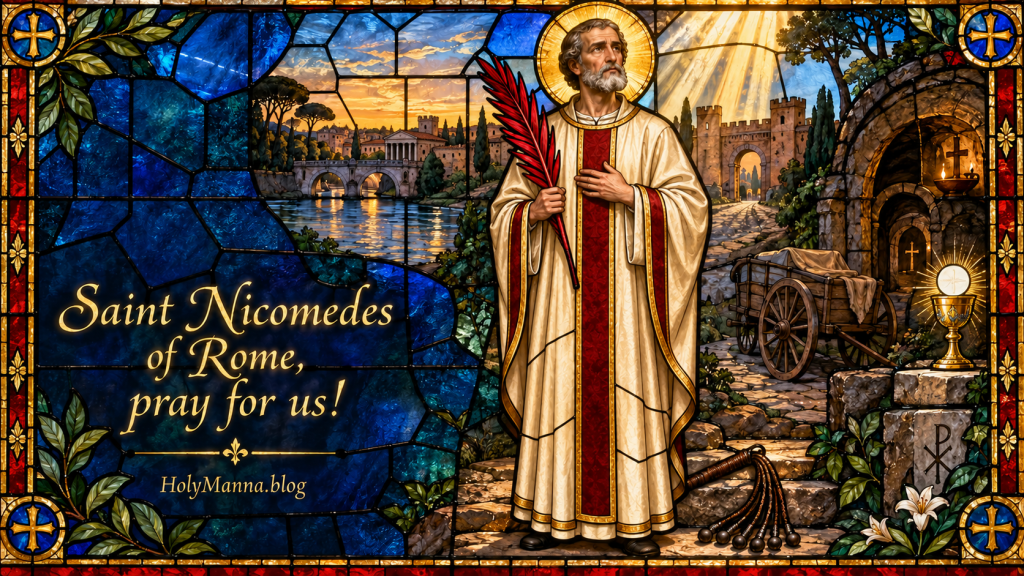
The Priest Who Buried the Martyrs
Some saints left behind volumes of writing, dramatic conversion stories, and lives documented down to the day. Saint Nicomedes of Rome left behind almost nothing except the one thing that matters most: the unbroken memory of the Church that he died for Jesus Christ. Nicomedes was a priest of ancient Rome and a martyr, and his feast has been celebrated on September 15 for well over a thousand years. He appears in the Roman Martyrology, in the martyrology of Saint Bede, and in the ancient Gregorian Sacramentary, which contains the prayers for his Mass. Pilgrims were already visiting his tomb on the Via Nomentana in the seventh century, and a titular church in Rome bore his name as early as the fifth century.
That is a remarkable thing to sit with. Centuries before most of the famous saints were even born, Christians in Rome were kneeling at the grave of Nicomedes and asking for his prayers. The Church has never forgotten him, even though history has forgotten nearly everything about him. Tradition remembers him for one great work of love: he buried the bodies of the martyrs when doing so could cost a man his life, and eventually it cost him his. In an age that celebrates visibility, Nicomedes is the saint of hidden faithfulness, the man whose greatness was known fully to God alone. The Catechism teaches that the Church is holy because Christ makes her holy, and that in her saints the Church finds her models and her intercessors (CCC 828). Nicomedes is one of those models, and he has been interceding for the Church for a very long time.
A Life Known Best to God
Honesty is the first duty of anyone telling the story of Saint Nicomedes, so it should be said plainly: nothing is documented about his birthplace, his family, his upbringing, or his formation. No contemporary biography of him survives, and the historical record does not even settle the century in which he died. The earliest account that names him is the traditional passio of Saints Nereus and Achilleus, a text composed in the fifth or sixth century, which presents Nicomedes as a presbyter, a priest of the Roman Church. That account places his martyrdom at the end of the first century, during the persecution of the Emperor Domitian, and later devotional tradition assigned dates around the year 71 or the year 90. Other versions of his martyrdom account, however, place his death under the Emperor Maximian at the beginning of the fourth century. The sources conflict, and no one today can resolve the conflict with confidence. What is certain, and what the Church has always held as certain, is that he was a true martyr of the Roman Church, killed for the faith and buried in a catacomb on the Via Nomentana near the city gate of that name.
There is something quietly beautiful in this uncertainty. Nicomedes was a priest in an era when being a priest was itself a capital risk. Whether he served under Domitian or under the later persecutors, he belonged to a Church that worshiped in homes and cemeteries, that passed the Eucharist from hand to trembling hand, and that measured fidelity not in applause but in blood. His conversion story is unknown, but his perseverance is not. He remained a priest of Jesus Christ to the end, and the end proved everything. The Catechism reminds the faithful that martyrdom is the supreme witness given to the truth of the faith, borne even unto death (CCC 2473). Whatever else is lost to history, that witness is secure.
The Ministry of the Catacombs
Tradition remembers Nicomedes above all as a priest who cared for the persecuted and who buried the bodies of the martyrs. The traditional account, which comes from the passio and cannot be confirmed as documented history, connects him to two beloved early Roman saints, Petronilla and her foster sister Felicula. In that story, a Roman count named Flaccus desired to marry Petronilla and came with soldiers to compel her. While Petronilla fasted and prayed with Felicula, the priest Nicomedes came to them and celebrated the mysteries of Christ, bringing the Eucharist to two frightened young women in their hour of trial. After Petronilla’s death, Flaccus turned his attention to Felicula, who refused both his marriage proposal and the demand to sacrifice to idols. She was imprisoned without food or water, tormented, and finally killed, her body cast into a sewer so that no one could honor it.
Then comes the moment that defines Nicomedes in the memory of the Church. According to the story, Nicomedes, who was himself in hiding, went out at night, recovered the body of Felicula, laid it in a small two wheeled cart, carried it to his little dwelling at the seventh mile of the Via Ardeatina, and gave it Christian burial. The ancient account adds a tender devotional note, saying that in that place prayers are answered even to this day. This entire narrative comes from the traditional passio and cannot be verified as historical fact.
Even told as a tradition, the story teaches something the Church holds as solid doctrine. Burying the dead is one of the corporal works of mercy, among the works of charity by which we come to the aid of our neighbor in his bodily necessities (CCC 2447). The Church has always taught that the bodies of the dead must be treated with respect and charity, in faith and hope of the resurrection, and that the burial of the dead honors the children of God who are temples of the Holy Spirit (CCC 2300). Nicomedes did not perform this work when it was safe or respectable. He performed it when it was a crime. No miracles are recorded during his lifetime; the sources are silent on that point, and it would be wrong to invent any. His recorded greatness during life is simpler and, in a way, more imitable: he showed up, he brought Christ to the suffering, and he honored the dead whom the world had thrown away. That is a holiness available to anyone. When was the last time you did a hidden work of mercy that no one would ever see or praise?
Faithful Unto Death
The traditional account of his martyrdom continues from the story of Felicula. Flaccus, the same official who had destroyed the two young women, discovered what Nicomedes had done and had him arrested. The priest was brought before his persecutors and ordered to prove his loyalty to Rome by offering sacrifice to the pagan gods. The old liturgical tradition, preserved in the Roman Breviary and the Roman Martyrology, records his answer: “I sacrifice only to the almighty God who reigns in heaven.” With those words, Nicomedes signed his own death sentence. He was scourged with whips weighted with lead, a torture designed to tear the body apart slowly, and under that prolonged agony he surrendered his soul to God. His executioners threw his body into the Tiber, intending to deny him the very burial he had given to others. But God is not mocked, and neither is charity forgotten. A cleric named Justus recovered the body of Nicomedes from the river, laid it in a cart just as Nicomedes had once done for Felicula, and buried him in his own small garden beside the city walls on the Via Nomentana. This narrative of the arrest, the martyrdom, and the recovery of his body comes from the traditional passio and cannot be verified as documented history.
What can be verified is the burial place itself, because the entire ancient Church testified to it. Nicomedes really was buried on the Via Nomentana near the gate, and Christians really did venerate that grave from the earliest centuries. The manner of his death told in the tradition matches the sober historical certainty that he died a martyr. Here the story and the history embrace each other. The Catechism teaches that the martyr bears witness to Christ who died and rose, to whom he is united by charity, and endures death through an act of fortitude (CCC 2473). It also teaches that the Church has painstakingly collected the records of those who persevered to the end, in the acts of the martyrs, which form the archives of truth written in letters of blood (CCC 2474). Nicomedes belongs to those archives. His name was written there before the Church even wrote down his story.
A Cult Older Than Memory
No specific named miracles after his death are recorded in the sources, and none will be invented here. What history does record is something arguably more astonishing: an unbroken river of veneration flowing from ancient Rome across all of Europe. By the fifth century, a titular church in Rome was dedicated to him, the titulus S. Nicomedis. Three separate pilgrim itineraries from the seventh century, essentially the travel guides of the early medieval Church, point pilgrims explicitly to his grave. Pope Boniface V, who reigned from 619 to 625, built a basilica over his tomb, and Pope Adrian I restored that church at the end of the eighth century. The old Roman Martyrology announced his feast with the words, “At Rome, on the Nomentan Way, the birthday of blessed Nicomedes, priest and martyr,” using the Church’s ancient and defiant habit of calling the day of a martyr’s death his birthday, his birth into heaven.
Later tradition holds that his relics were removed from the catacomb in the ninth century, around the year 817, which fits the era when Pope Paschal I translated the bones of thousands of martyrs from the vulnerable catacombs into churches within the city walls. Some of his relics are said to have been transferred to churches in Milan and Parma in Italy. These relic traditions are reported in devotional sources and cannot be fully verified. What can be verified is how far his devotion traveled. In Borghorst in Westphalia, Germany, a collegiate church was dedicated to Saint Nicomedes, and around the year 1050 it received one of the great treasures of medieval art, the Borghorst Cross, a reliquary crucifix of gold and precious stones. To this day the Catholic parish church of Borghorst is Saint Nicomedes’ Church, a soaring neo Gothic building whose tower rises ninety nine meters, one of the tallest in the region. His feast was kept in the medieval calendars of England, and his image appears in a stained glass window in Norfolk and in sculpture in a chapel in Brittany, France. Meanwhile, in a final touch of holy irony, the catacomb of San Nicomede itself has never been definitively located by archaeologists, despite searches near the Porta Pia going back to the seventeenth century. The saint who buried others so carefully has kept his own resting place hidden.
All of this veneration rests on the Church’s confidence in the communion of saints. The Catechism teaches that the witnesses who have preceded us into the kingdom, especially those whom the Church recognizes as saints, share in the living tradition of prayer and contemplate God, praise him, and constantly care for those whom they have left on earth, and that their intercession is their most exalted service to God’s plan (CCC 2683, CCC 2635). It also teaches that the religious sense of the Christian people has always found expression in forms of piety surrounding the Church’s sacramental life, such as the veneration of relics and visits to sanctuaries (CCC 1674). Fifteen centuries of Christians have trusted that Nicomedes hears them. That trust is not sentimentality; it is doctrine lived out.
Lessons From a Man History Forgot and Heaven Did Not
Saint Nicomedes poses a quiet challenge to the modern heart, especially to a generation trained to document everything and to measure worth in visibility. Here is a saint with no recorded childhood, no writings, no famous miracles, and not even a settled date of death, and yet the Church has honored him at the altar since antiquity. His witness cuts directly against the anxiety that a life unnoticed is a life wasted. God saw Nicomedes. God remembered him when the archives burned and the records crumbled. Jesus promised exactly this in The Gospel of Matthew when He taught, “your Father who sees in secret will reward you” (Mt 6:4). Nicomedes staked his whole life on that promise, and the wager paid eternally.
His story invites a few concrete practices. First, take up the corporal works of mercy deliberately, including the forgotten ones. Attend the funeral no one else will attend. Pray for the dead who have no one to pray for them. Visit the cemetery. The Church numbers burying the dead among the works of mercy precisely because charity does not end at the grave (CCC 2447). Second, practice hidden fidelity. Do one act of service each day that no one will ever discover, and resist the itch to mention it. Third, be the person who shows up in someone’s persecution. Nicomedes came to Petronilla and Felicula when they were afraid and brought them the Eucharist. Most people will never face soldiers at the door, but nearly everyone knows someone facing ridicule, isolation, or quiet suffering for doing what is right. Bringing Christ into that room is the family business of the Church. Fourth, hold fast when asked to compromise. Few will ever be commanded to burn incense to an idol, but everyone is eventually pressured to bend the knee to something that is not God, whether comfort, career, approval, or fear. Nicomedes’ answer, that he would sacrifice only to the almighty God who reigns in heaven, is a sentence worth memorizing before the pressure comes.
What would remain of your faith if every audience disappeared and only God were watching? Is there a work of mercy you have been avoiding because it is inconvenient, unglamorous, or costly? When you are pressured to offer a small sacrifice to a false god, what is your prepared answer? Sit with those questions honestly. Nicomedes did not become a martyr in the moment of his arrest. He became one through years of hidden, faithful, dangerous love, so that when the moment came, the answer was already living inside him.
Engage With Us!
Readers are warmly invited to share their thoughts and reflections in the comments below. Saint Nicomedes may be one of the least documented saints on the calendar, but that is exactly why his witness belongs to everyone whose faithfulness goes unseen, and hearing how his story lands in real lives is a gift to this whole community. Here are some questions to spark reflection and discussion.
- Which hidden or thankless act of love in your life might matter far more in eternity than you realize?
- Nicomedes brought the Eucharist to two women in their darkest hour. Who in your life needs you to bring Christ to them this week, and what is stopping you?
- The corporal works of mercy include burying the dead and praying for them. How could you honor the dead in a concrete way this month?
- If you were asked to name the one thing you would never sacrifice to the idols of comfort, approval, or fear, what would your answer be?
- How does it change your view of success to know that the Church has venerated for fifteen centuries a man whose biography is almost entirely lost?
Take heart from this quiet Roman priest. A life poured out in hidden love is never lost, because the Father who sees in secret forgets nothing and no one. Live this week with the courage of Nicomedes: serve without applause, honor the forgotten, stand firm when it costs something, and do everything, small and great, with the love and mercy that Jesus taught us.
Saint Nicomedes of Rome, pray for us!
Follow us on YouTube, TikTok, Instagram and Facebook for more insights and reflections on living a faith-filled life.

 Holy Manna!
Leave a comment