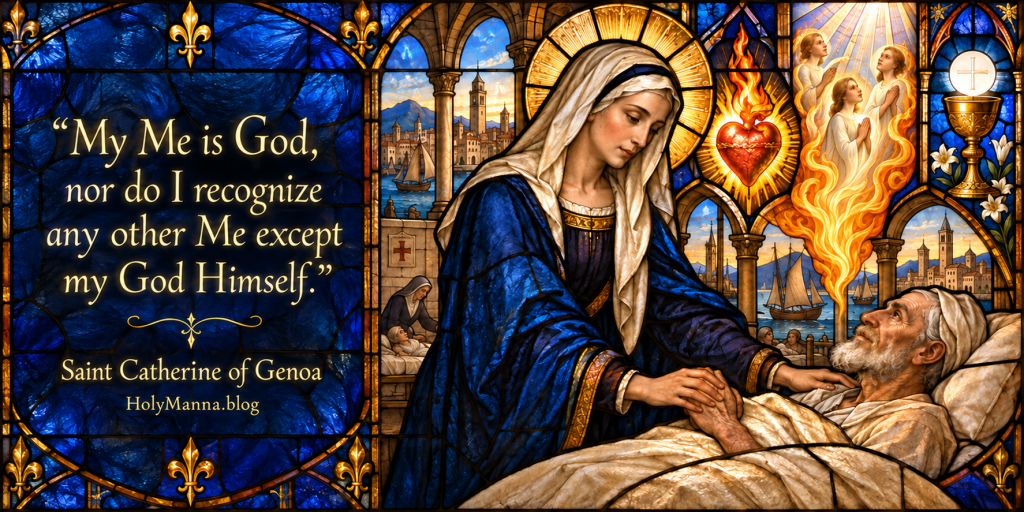
The Fire Within
Some saints seem to float above ordinary life. Saint Catherine of Genoa waded straight through the middle of it. She was a wife in a painful marriage, a woman who knew loneliness and depression, a hospital administrator who balanced the books, and at the very same time one of the most profound mystics the Church has ever produced. Born Caterinetta Fieschi in Genoa in 1447 and dying there on September 15th, 1510, she is remembered above all as the Apostle of Purgatory, the saint whose vision of God’s purifying love reshaped how generations of Catholics understand what happens to the soul after death. Pope Benedict XVI devoted an entire General Audience catechesis to her on January 12th, 2011, holding her up as proof that deep prayer and tireless service of the poor are not rivals but partners.
Her teaching on purgatory did not come from spectacular visions of the afterlife. It came from what God did inside her own soul. She discovered that the fire which purifies is the very fire of God’s love, and that the soul, once it glimpses that love, wants nothing more than to be made ready for it. The Church teaches this same truth in the Catechism: “All who die in God’s grace and friendship, but still imperfectly purified, are indeed assured of their eternal salvation; but after death they undergo purification, so as to achieve the holiness necessary to enter the joy of heaven” (CCC 1030).
Catherine holds a formally documented patronage: in 1944 Pope Pius XII proclaimed her Patroness of the Hospitals in Italy, a fitting crown for a woman who spent decades nursing the dying poor. In Catholic devotional tradition she is also widely invoked as a patroness of brides, childless couples, people in difficult marriages, victims of unfaithfulness, and widows, because she lived every one of those crosses herself.
A Noble Daughter and an Unwanted Marriage
Catherine was born into serious power. The Fieschi were among the most influential Guelph families of Genoa, a line that had already given the Church two popes, Innocent IV and Adrian V. Her father, Giacomo Fieschi, served as Viceroy of Naples; her mother, Francesca di Negro, came from ancient Genoese nobility. Catherine was the youngest of five children, and from childhood she showed unusual piety and a deep devotion to the Passion of Christ. Her older sister Limbania entered religious life as an Augustinian canoness, and at 13 Catherine tried to follow her into the convent. She was refused because of her age.
Then her world shifted. Her father died, and at 16 her family arranged her marriage to Giuliano Adorno, a young nobleman from a rival clan. The match was pure politics, an attempt to patch up the long feud between the Fieschi and the Adorno families. Nobody asked what Catherine wanted, and nobody asked whether Giuliano was ready to be a husband. He was not. The sources are blunt about him: he was pleasure loving, quick tempered, unfaithful, and reckless with money. He even fathered a daughter, Thobia, outside the marriage.
For the first five years Catherine withdrew into lonely seclusion. For the next five she tried the opposite strategy, throwing herself into the parties and diversions of Genoese high society, hoping the noise would drown the emptiness. It did not. The early biographical tradition records that she never fell into grave sin during those years, but she was profoundly unhappy, and near the end of that decade she was so desperate that she spent three months praying that God would simply keep her sick in bed rather than make her face her life. Anyone who has ever prayed a prayer like that, half surrender and half despair, already knows something of Catherine’s heart.
God answered a different prayer than the one she prayed. On March 22nd, 1473, at her sister’s suggestion, Catherine knelt for confession at the convent chapel. Before she could even make her confession, she was suddenly pierced by an overwhelming awareness of God’s love for her and, in the same instant, a piercing awareness of her own sins. The early Vita records her interior cry in that moment: “No more world! No more sins!” She was so overcome that she left without finishing her confession and returned a few days later to complete it. The biographical tradition adds that shortly afterward she received a vision of Christ carrying His Cross, blood seeming to fill the house, which sealed her conversion; this account comes from the tradition compiled by her disciples.
From that day forward Catherine belonged wholly to God. She began receiving Holy Communion daily and continued for the rest of her life, something almost unheard of for a layperson in the 15th century. The Church would later formally encourage exactly what Catherine instinctively lived, teaching that “the Church strongly encourages the faithful to receive the holy Eucharist on Sundays and feast days, or more often still, even daily” (CCC 1389). Her conversion is a living illustration of what the Catechism calls the second conversion, the uninterrupted task of the whole Church, “clasping sinners to her bosom, at once holy and always in need of purification” (CCC 1428).
Love With Its Sleeves Rolled Up
Here is what makes Catherine so startling: her mysticism never floated free of the real world. Almost immediately after her conversion, this sheltered aristocrat walked into the slums of Genoa. She sought out the sick and the destitute, cleaned their filthy homes, and washed clothing crawling with vermin. The early sources admit that at first she had to fight down her physical revulsion; holiness did not erase her humanity, it worked through it. She deliberately did the things that disgusted her most, until love burned the disgust away.
Her life’s great stage became the Pammatone, the largest hospital in Genoa, a place of last resort for incurables, the aged, and the abandoned. From 1473 onward she and, eventually, her husband served there. Giuliano’s story is one of the quiet miracles of her life. His reckless spending drove the couple into bankruptcy, and that humiliation, combined with the witness of his transformed wife, broke something open in him. He repented, became a Third Order Franciscan, and agreed with Catherine to live in continence. In 1479 the couple moved into two small rooms inside the hospital and worked without pay. Catherine also made sure that Thobia, her husband’s daughter by another woman, was cared for and provided for. Let that sink in: she took responsibility for the child of her husband’s infidelity. That is not natural virtue; that is grace.
From 1490 to 1496 Catherine served as director and treasurer of the Pammatone, managing its finances with such exactness that her accounts reportedly balanced perfectly. The mystic who spent hours lost in God also ran a major institution competently. Benedict XVI drew attention to precisely this balance, teaching that her life was marked by two inseparable elements, profound union with God and service to the most needy, and he observed of the saints, “the more we love God and enter into intimacy with him in prayer the more he makes himself known to us, setting our hearts on fire with his love” (Benedict XVI, General Audience, January 12th, 2011). This is the Catechism‘s teaching on love of neighbor made flesh: “The works of mercy are charitable actions by which we come to the aid of our neighbor in his spiritual and bodily necessities” (CCC 2447).
Her heroism reached its peak in 1493, when plague devastated Genoa and killed a terrible share of those who remained in the city. Catherine did not flee, as many of the wealthy did. She organized an outdoor infirmary in the open space behind the Pammatone and threw herself into caring for the dying. The most famous story from that plague comes from her early biography: a dying woman, no longer able to speak, was urged by Catherine to call on the name of Jesus. When the woman could only move her lips, Catherine bent down and kissed her mouth. She contracted the plague herself and nearly died, and her health never fully recovered. She saw in every dying pauper exactly what the Lord promised His disciples they would see: “I was ill and you cared for me” (The Gospel of Matthew, Mt 25:36).
Catherine’s interior life during these decades was as extraordinary as her exterior service. The early Vita records that for roughly 23 years, during Advent and Lent, she was physically unable to take ordinary food, subsisting on the Holy Eucharist and small amounts of water mixed with vinegar and salt, while continuing to work vigorously. Physicians who observed her could find no natural explanation. This account rests on her early biography and the testimony of those who lived alongside her; it is a well attested tradition rather than an independently verifiable medical record. Just as remarkably, for about 25 years after her conversion she lived this intense spiritual life without any regular confessor or spiritual director, guided interiorly by God, until around 1499, when Father Cattaneo Marabotto became her director and began recording her teachings.
Those teachings became her enduring gift to the Church. Catherine left three works that circulated under her name, the Vita, the Treatise on Purgatory, and the Dialogue between the Soul and the Body, published together in Genoa in 1551. She did not write them with her own hand; they were compiled from her words by Marabotto and her devoted disciple Ettore Vernazza. Their authenticity as a record of her doctrine was so strong that when the Holy Office later examined her writings, it declared that the doctrine they contained would alone be enough to prove her sanctity. Her most famous recorded saying captures the goal of her whole spiritual life: “My Me is God, nor do I recognize any other Me except my God Himself” (Vita). A word of caution for anyone quoting her online: the popular version, rendered as “My deepest me is God,” is a modern paraphrase of this line rather than her recorded wording.
Her vision of purgatory grew out of her own purification. She insisted that the soul stained by sin is like metal covered with rust, and that the fire of God’s love burns the rust away; in the Treatise on Purgatory she taught that just as gold refined to 24 carats can be purified no further, so the soul in the fire of God’s love is purified until nothing remains but God. Benedict XVI stressed that in her mystical experience Catherine never received specific revelations about purgatory or about the souls being purified there; her doctrine came from her lived experience of God’s love, and its heart is this: “Catherine, however, did not see purgatory as a scene in the bowels of the earth: for her it is not an exterior but rather an interior fire. This is purgatory: an inner fire” (Benedict XVI, General Audience, January 12th, 2011). Her insight harmonizes perfectly with Scripture’s teaching that a man’s work will be tested, “the person will be saved, but only as through fire” (The First Letter to the Corinthians, 1 Cor 3:15), and with the Church’s constant practice of praying for the dead, for “from the beginning the Church has honored the memory of the dead and offered prayers in suffrage for them, above all the Eucharistic sacrifice, so that, thus purified, they may attain the beatific vision of God” (CCC 1032).
The Long Purification
Catherine was never martyred, but her life reads like one long, slow martyrdom of love. Consider the sheer weight of what she carried. She endured 10 years in a marriage marked by neglect, infidelity, and financial ruin, in an age when a noblewoman had no exit and little sympathy. She endured the interior desolation of those years, a darkness so heavy that she begged God for illness as an escape. After her conversion she endured the opposite trial, an interior fire of love so intense that her early biographers struggled to describe it, along with severe penances in her early converted years, the mysterious seasonal fasts, and the physical devastation left by the plague she contracted while kissing a dying woman.
She also endured the quieter hardships that rarely make stained glass windows. She lived with her husband’s bankruptcy and public humiliation. She raised her voice for no cause and led no movement, choosing instead decades of hidden, repetitive, unglamorous work among people whose bodies were failing and whose smells and sores tested her every day. She buried Giuliano in 1497, after having the joy of seeing him die a penitent Franciscan tertiary, and then lived on as a widow, still serving, still pouring herself out.
Her final trial came in her last years, roughly from 1506 until her death, when she was consumed by a long and mysterious illness that baffled her physicians. Among the doctors who examined her was Giovanni Battista Boerio, who had served as physician to King Henry VII of England, and he could find no natural cause for her suffering. Those around her became convinced that her illness was itself spiritual, the final burning of the fire of divine love in her body. She suffered intensely, united to Christ crucified, and died in the hospital she had served for nearly 40 years on September 15th, 1510. Her death fulfilled the Catechism‘s description of illness lived in faith, by which suffering “can also make a person more mature, helping him discern in his life what is not essential so that he can turn toward that which is” (CCC 1501). She had spent her whole converted life turning toward the one essential thing.
An Incorrupt Witness and the Apostle of Purgatory
The story of Catherine after death begins about 18 months after her burial. She had been laid to rest beside a wall of the hospital chapel, and when flooding threatened the site, her coffin was exhumed and opened. Her body was found perfectly intact, untouched by the damp that should have destroyed it. Word spread instantly, and great crowds of Genoese flocked to see her. The body was transferred to a marble tomb inside the church, and the faithful immediately began calling her blessed. Her incorrupt body can still be venerated today in a crystal casket at the Church of Santissima Annunziata di Portoria in Genoa, a Capuchin church now commonly known simply as the Church of Saint Catherine. In 1960 her remains were placed in a mausoleum designed by the architect Eugenio Fuselli, where pilgrims continue to visit her. Devotional tradition holds that healings and graces have been received at her tomb across the centuries; these individual accounts of favors, as is common with such traditions, cannot be verified.
The Church moved carefully and confidently in raising her to the altars. Pope Clement X beatified her on April 6th, 1675, and Pope Clement XII canonized her in 1737. An honest note on the record: reputable Catholic sources conflict on the exact day of her canonization, with the New Catholic Encyclopedia giving May 18th, 1737 and other standard references giving June 16th, 1737; the year and the pope are certain even though the day is disputed.
Her deepest impact, though, may be the one most people have never heard about. Her circle of disciples at the Pammatone included the notary Ettore Vernazza, who, formed by her spirituality of divine love and practical charity, founded the Oratory of Divine Love in Genoa around 1497. That confraternity of laymen and priests, committed to personal holiness and service of the sick, spread to Rome and other cities and became one of the true seedbeds of authentic Catholic reform in the 16th century. A laywoman in a hospital, without office or title, helped light the fire that renewed the Church. Her writings went on to shape Saint Robert Bellarmine, Saint Francis de Sales, and Cardinal Henry Edward Manning, and in the modern era Baron Friedrich von Hügel built his landmark study The Mystical Element of Religion around her life. Benedict XVI’s 2011 catechesis introduced her to a new generation, and her title as the Apostle of Purgatory endures wherever Catholics pray for their dead. Every November, when the Church turns her heart toward the holy souls, Catherine’s teaching quietly stands behind that prayer, reminding the faithful that the souls in purgatory are not far from God but being drawn into Him, and that the communion of saints binds heaven, purgatory, and earth in one exchange of love, for “in this wonderful exchange, the holiness of one profits others” (CCC 1475).
What Catherine Teaches a Restless Heart
Catherine of Genoa is a saint for anyone whose life did not go according to plan. She wanted the convent and got a broken marriage. She wanted peace and got a decade of depression. And it was precisely there, at the bottom, in the middle of a confession she did not even finish, that God found her. Her story is a standing promise that no situation is too compromised, too stuck, or too far gone for grace. The Catechism teaches that “all Christians in any state or walk of life are called to the fullness of Christian life and to the perfection of charity” (CCC 2013), and Catherine proves that this call reaches into unhappy marriages, hospital wards, and account ledgers.
Where in your own life have you concluded that God cannot work, and what would change if you handed that exact place over to Him?
Her second lesson is that love of God and love of neighbor are one movement. Catherine did not choose between the chapel and the plague ward; the fire she received in prayer is the fire she spent on the dying. In an age that often splits faith into either private spirituality or busy activism, she refuses the split. The reader who wants to pray like Catherine must be willing to serve like Catherine, and the reader who wants to serve like Catherine will not last without her prayer.
What is one concrete act of mercy, visiting someone who is sick, forgiving someone who wounded you, serving someone who repulses you, that you have been avoiding?
Her third lesson is her teaching on purgatory itself, which is really a teaching about how much God wants each soul. Purgatory, in her vision, is not God’s reluctance but God’s thoroughness; He loves the soul too much to leave any rust on it. That truth changes how a person examines his conscience, how he confesses, and how he prays for his beloved dead. Praying for the holy souls, having Masses offered for deceased parents and grandparents and friends, is not sentimental; it is effective love reaching across death.
When was the last time you had a Mass offered for someone you loved who has died?
Practically, Catherine suggests a rule of life that any working adult can attempt: frequent reception of the Eucharist, since daily Communion was the engine of everything she did; regular confession, since her whole story began in a confessional; some daily service or hidden act of charity done especially when it is repugnant; and a nightly prayer for the souls in purgatory. None of that requires a convent. All of it requires a decision.
Engage With Us!
HolyManna would love to hear from you. Share your thoughts and reflections on Saint Catherine of Genoa in the comments below, especially if her story of a painful marriage transformed by grace, or her vision of purgatory as the fire of God’s love, touched something in your own journey. To spark the conversation, here are a few questions to pray with this week.
- Catherine’s conversion happened in a single moment in the confessional after ten years of misery. What has been holding you back from returning to the Sacrament of Reconciliation, and could this week be your March 22nd?
- Catherine cared for Thobia, the daughter of her husband’s infidelity. Is there someone attached to a wound in your life whom God may be asking you to love anyway?
- She overcame her revulsion for the sick by doing the very tasks that disgusted her. What act of service do you avoid because it costs you comfort, and how could you offer it to God this month?
- Catherine teaches that purgatory is the fire of God’s love completing what remains unfinished in the soul. Which of your beloved dead will you pray for by name tonight, and could you arrange a Mass to be offered for them?
- She ran a hospital and balanced its books while living in profound union with God. How can your ordinary work, your job, your budget, your daily grind, become a place of prayer this week?
Saint Catherine spent her life proving that the fire of God’s love is stronger than a broken marriage, stronger than plague, stronger than death, and stronger than every rust of sin that clings to the soul. Let her story stir you to live your faith boldly right where you are, in your home, your work, and your struggles, and to do everything, from the greatest sacrifice to the smallest chore, with the love and mercy that Jesus taught us.
Saint Catherine of Genoa, pray for us!
Follow us on YouTube, TikTok, Instagram and Facebook for more insights and reflections on living a faith-filled life.

 Holy Manna!
Leave a comment