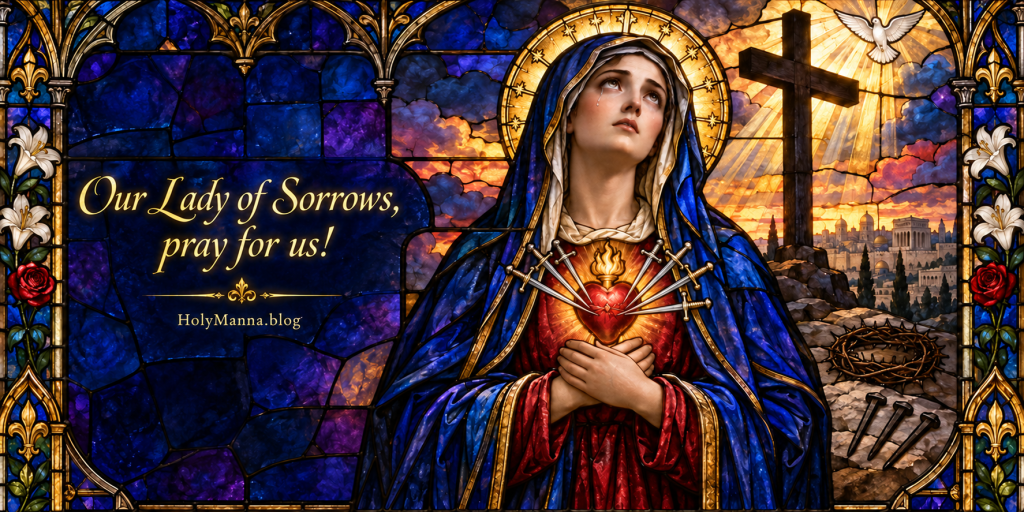
A Sword, a Promise, and a Mother’s Heart
Every year on September 15th, one day after the Church celebrates the Exaltation of the Holy Cross, the liturgy turns its gaze from the wood of the Cross to the woman standing beneath it. The Memorial of Our Lady of Sorrows honors the Blessed Virgin Mary in her suffering, contemplating what it cost her Immaculate Heart to remain united to her Son from Bethlehem all the way to Calvary. The placement of these 2 September celebrations, back to back, is no accident. The Church first lifts up the Cross of Christ, the instrument of salvation, and then honors the Mother who shared its weight more intimately than any other creature ever has or ever will.
The roots of this devotion reach back to a single sentence spoken in the Temple in Jerusalem. When Mary and Joseph presented the infant Jesus, the aged Simeon took the Child into his arms, blessed God, and then turned to Mary with words that would shape her entire life: “Behold, this child is destined for the fall and rise of many in Israel, and to be a sign that will be contradicted, and you yourself a sword will pierce, so that the thoughts of many hearts may be revealed” (Luke 2:34-35). From that moment forward, the Church has understood that Mary’s motherhood was inseparable from sorrow, and that her sorrow was inseparable from the salvation her Son came to accomplish. Older spiritual writers loved to point out that this memorial falls exactly 1 week after the Nativity of the Blessed Virgin Mary on September 8th, almost like an octave to her birthday. The Church celebrates the birth of the Mother, and then, 7 days later, contemplates the mission that birth made possible.
Why does the Church give an entire day to Mary’s grief? Because her sorrows are not a detour from the Gospel; they are a window into it. The Catechism of the Catholic Church teaches that Mary’s union with her Son “in the work of salvation is made manifest from the time of Christ’s virginal conception up to his death” (CCC 964). Her tears at Calvary were not the collapse of her faith but its fullest expression. In a culture that runs from suffering, numbs it, and hides it away, the Sorrowful Mother stands as a quiet rebuke and a tender invitation. Love does not leave. Love stays. This is the heart of the celebration, and it is central to Marian devotion because it reveals who Mary is for the Church: the Mother who stood by her Son, and who now stands by every one of his disciples.
From Florence to the Whole Church
Devotion to the sorrows of Mary began to flower in the 12th century, nurtured especially by the Cistercian monks, whose meditations on the Passion of Christ drew them naturally to the Mother who lived that Passion at her Son’s side. The devotion found its great champions in 1233, when 7 cloth merchants of Florence left behind their prosperous lives to found the Order of the Servants of Mary, known ever since as the Servites. A cherished tradition of the Order, and it must be labeled a tradition rather than an established historical fact, holds that the Blessed Virgin herself appeared to the 7 founders, entrusting them with their habit, their rule of life, and a mission to spread devotion to her sorrows. Whatever the precise origins, the historical record is clear on this much: the Servites made the sorrows of Mary the beating heart of their spirituality and carried that devotion across Europe with remarkable zeal.
The liturgical history unfolded slowly, and the sources preserve a few honest wrinkles worth naming. The first liturgical celebrations of the sorrowful Mother, under the title of Our Lady of Compassion, appear in the 15th century, and in 1482 the celebration entered the Missal under that title. In 1668 the Servites were granted permission to celebrate a votive Mass of the Seven Sorrows of Mary. In 1692 Pope Innocent XII authorized a feast in honor of Our Lady of Sorrows on the third Sunday of September. In the early 18th century the feast was transferred to the Friday before Palm Sunday, and in 1727 Pope Benedict XIII placed it on the Roman Calendar on that Friday, extending it broadly through the Latin Church.
Then came Napoleon. In 1809 the emperor annexed the Papal States, and when Pope Pius VII excommunicated him, Napoleon had the pope arrested and held captive until 1814. Upon his release, which the pope attributed to the intercession of the Blessed Mother, Pius VII extended the feast of the Seven Sorrows to the entire Latin Church on September 18th, 1814, assigning it to the third Sunday of September in thanksgiving. A few popular sources give 1817 for this extension, but Vatican News and the majority of Catholic references record 1814, which is the date followed here. In 1913 Pope Saint Pius X fixed the celebration on September 15th, deliberately placing it beside the Exaltation of the Holy Cross. For decades the Church actually kept 2 annual celebrations of Mary’s sorrows, one in Passiontide and one in September; the 1969 reform of the General Roman Calendar retained the September date alone as the Memorial celebrated today, while the springtime observance lives on in popular devotion as the Friday of Sorrows in many Catholic cultures.
One more treasure belongs to this story. The Stabat Mater, the great 13th-century sequence on Mary at the Cross, is traditionally attributed to the Franciscan poet Jacopone da Todi, though scholars debate its authorship. Its opening lines, in the beloved English translation, still pierce the heart: “At the cross her station keeping, stood the mournful Mother weeping, close to Jesus to the last.” To this day, the Stabat Mater remains an optional sequence sung or recited before the Gospel on September 15th.
Seven Swords
Because this memorial commemorates a title of Mary rather than a single event, its deepest foundations are scriptural. Tradition gradually settled on 7 sorrows, drawn from the Gospels and from the ancient devotion of the Way of the Cross: the prophecy of Simeon (Luke 2:34-35); the flight into Egypt to escape Herod (Matthew 2:13-15); the loss of the Child Jesus for 3 days in Jerusalem (Luke 2:41-50); the meeting of Mary and Jesus on the road to Calvary, handed down in the tradition of the Way of the Cross; the crucifixion and death of Jesus (John 19:25-30); the taking down of the body of Jesus from the Cross; and the burial of Jesus (John 19:40-42). The 17th-century title “The Seven Dolors” gave rise to the familiar image of Mary’s heart pierced by 7 swords, a visual echo of Simeon’s prophecy. At the center of it all stands the scene Saint John witnessed with his own eyes: “Standing by the cross of Jesus were his mother and his mother’s sister, Mary the wife of Clopas, and Mary of Magdala” (John 19:25). She did not faint, flee, or look away. She stood.
In modern times, the Church has formally recognized an apparition in which the Blessed Virgin presented herself precisely as the Mother of Sorrows. Beginning on November 28th, 1981, at a school in Kibeho, Rwanda, the Blessed Virgin Mary appeared to a young student named Alphonsine Mumureke, and later to Nathalie Mukamazimpaka and Marie Claire Mukangango. She identified herself as Nyina wa Jambo, “Mother of the Word,” and her messages called insistently for repentance, conversion, and prayer. On August 19th, 1982, the visionaries saw terrifying images of violence and rivers of blood, visions that many, including Church commentators, came to understand as a prophetic warning of the horrors that engulfed Rwanda in the 1994 genocide. To Marie Claire, Our Lady entrusted a specific mission: to revive the Rosary of the Seven Sorrows, a devotion belonging to the old Servite tradition that had fallen into obscurity. The diocesan commissions found no evidence that Marie Claire knew this rosary before the apparitions began. In a detail that still gives chills, Marie Claire’s final public apparition took place on September 15th, 1982, the very day of Our Lady of Sorrows. She was later killed in the genocide, alongside so many of her people.
The approval status is clear and should be stated plainly. Public devotion connected to Kibeho was authorized by the local bishop in 1988, and on June 29th, 2001, Bishop Augustin Misago of Gikongoro issued the definitive judgment declaring the apparitions to these 3 visionaries worthy of belief. Apparitions reported by other individuals at Kibeho were not approved. Kibeho thus stands as the first approved Marian apparition on the African continent. As with every approved apparition, this remains private revelation, non-binding on the faithful; the Catechism teaches that private revelations do not belong to the deposit of faith and do not improve or complete the definitive Revelation of Christ, but can help the faithful live it more fully in a certain period of history (CCC 67). What Kibeho reveals about the Sorrowful Mother is profoundly consistent with the Gospel: she is a mother who weeps with her children, warns them in love, and never stops calling them home to her Son.
Standing in the Divine Plan
The Church’s richest single paragraph on this mystery comes from the Catechism, quoting the Second Vatican Council: “Thus the Blessed Virgin advanced in her pilgrimage of faith, and faithfully persevered in her union with her Son unto the cross. There she stood, in keeping with the divine plan, enduring with her only begotten Son the intensity of his suffering, joining herself with his sacrifice in her mother’s heart, and lovingly consenting to the immolation of this victim, born of her” (CCC 964, citing Lumen Gentium 58). Every phrase deserves a slow reading. Mary’s presence at Calvary was not an accident of geography; it was “in keeping with the divine plan.” Her grief was not passive; she was “joining herself” and “lovingly consenting.” The yes she spoke at the Annunciation, she spoke again at the Cross, this time through tears.
This is why the Church calls Mary the preeminent model of faith. The Catechism teaches that throughout her life, and even in her final trial at the Cross, her faith never wavered, and for this reason the Church venerates in her the purest realization of faith (CCC 149). It teaches likewise that believers walking through darkness must turn to the witnesses of faith, and it names Mary at the Cross among them, for she entered the night of faith and persevered (CCC 165). Pope Saint John Paul II, in Redemptoris Mater 18, described her standing beneath the Cross as perhaps the deepest self-emptying of faith in all of human history, and in Salvifici Doloris 25 he taught that her suffering at Calvary was a sharing in the redemptive suffering of her Son unlike that of any other person. The Catechism confirms this: Jesus desired to associate his mother, before anyone else and more intimately than anyone else, in the mystery of his redemptive suffering (CCC 618).
Her sorrows also illuminate the great Marian dogmas. Because she is truly the Mother of God, the Theotokos (CCC 495), her grief has a depth no other mother’s grief could have; the Son dying before her eyes was her own child and her own Lord. Because her whole being was given to God, virgin and mother wholly consecrated to her Son’s mission (CCC 499-501), nothing in her held back from the sacrifice unfolding on Golgotha. And precisely at the Cross, her motherhood expanded to embrace the whole Church. Jesus, seeing his mother and the disciple whom he loved, said to her, “Woman, behold, your son,” and then to the disciple, “Behold, your mother” (John 19:26-27). The Church has always read this as more than a practical arrangement. Mary’s spiritual motherhood extends to all whom her Son came to save (CCC 501), and at the foot of the Cross she became Mother of the Church, the title Blessed Pope Paul VI solemnly proclaimed in 1964 (CCC 963). Paul VI’s apostolic exhortation Marialis Cultus likewise presents the restored September 15th memorial as a privileged occasion for the faithful to relive with Mary a decisive moment in the history of salvation and to venerate the Mother associated with the sacrifice of her Son. None of this ever competes with Christ. The Catechism insists that Mary’s maternal role in no way obscures or diminishes the unique mediation of Christ, but rather shows its power, for all of her influence flows from his merits and depends entirely on his mediation (CCC 970). The Sorrowful Mother does not stand beside the Cross to draw attention to herself. She stands there to hold every gaze fixed on Jesus.
Chaplets, Scapulars, and the Way of the Mother
Centuries of love for the Sorrowful Mother have produced a rich family of devotions, and each one gives grief a grammar, a way for the heart to pray what words alone cannot carry. The best known is the Rosary of the Seven Sorrows, sometimes called the Chaplet of the Seven Sorrows, which comes from the Servite tradition. In it, the one praying meditates on each of the 7 sorrows in turn, praying 7 Hail Marys for each sorrow, walking slowly with Mary from the Temple in Jerusalem to the tomb outside its walls. This is the very devotion Our Lady asked Marie Claire to revive at Kibeho, and since the 2001 approval of those apparitions it has spread across the world with new vigor. Closely related is the Black Scapular of the Seven Dolors, a sacramental of the Servite Order worn as a sign of consecration to the Sorrowful Mother, and the Via Matris, or Way of the Mother, a devotion of 7 stations paralleling the Way of the Cross, prayed especially in Servite churches. The Stabat Mater itself remains a devotion as much as a hymn, prayed for centuries during the Stations of the Cross.
Pilgrimage has always followed devotion. In Florence, the Basilica della Santissima Annunziata, mother church of the Servite Order, has drawn pilgrims to Marian devotion for centuries. In the United States, the Basilica of Our Lady of Sorrows in Chicago, entrusted to the Servites, became famous for the Sorrowful Mother Novena, which in the mid-20th century drew enormous crowds week after week to pray with the Mother of Sorrows. In Slovakia, the National Basilica of the Seven Sorrows at Šaštín stands as the spiritual heart of an entire nation consecrated to her. And in Rwanda, the Sanctuary of Our Lady of Kibeho, named the Shrine of Our Lady of Sorrows in 1992, welcomes pilgrims from across Africa and the world, many of them survivors of unspeakable loss, who come to pray beside the Mother who wept before they did.
What do these practices actually do for the soul? They train the heart to stay. A person who prays the Seven Sorrows regularly learns, sorrow by sorrow, that grief brought to God is never wasted, that suffering shared with Christ becomes redemptive, and that no darkness is beyond the reach of a mother’s intercession. Pilgrims return from Šaštín and Kibeho saying much the same thing: they came carrying a private sorrow, and they left knowing they had never carried it alone.
A Sorrow the Whole World Keeps
Few Marian titles have sunk deeper roots into the cultures of the Catholic world. Slovakia offers the most striking example: Our Lady of the Seven Sorrows is the formally recognized patroness of the Slovak nation, September 15th is kept there as a solemnity, and it is a national public holiday, with tens of thousands making the pilgrimage to Šaštín. In the Philippines, the town of Pakil in Laguna honors Nuestra Señora de los Dolores with the Turumba devotion, a joyful cycle of processions and festivities often described as the longest running religious festival in the country, in which an entire community turns its love for the Sorrowful Mother into song and dance.
Across the Hispanic world, devotion to La Dolorosa shapes the very rhythm of Lent and Holy Week. The Friday before Palm Sunday is kept in popular piety as the Viernes de Dolores, the Friday of Sorrows, a living remnant of the old Passiontide feast. In Mexico, families and parishes build Altares de Dolores, home altars adorned with images of the grieving Virgin, bitter oranges, and sprouted wheat, each element a symbol of her tears and her hope. In Seville and throughout Spain and Latin America, the great Semana Santa processions carry magnificent images of the Sorrowful Mother through the streets, her face streaked with crystal tears, while crowds fall silent as she passes.
Art and music tell the same story. Michelangelo’s Pietà, perhaps the most beloved sculpture in the world, is nothing other than the sixth sorrow carved in marble: the Mother receiving the body of her Son. Traditional Mater Dolorosa iconography shows her heart pierced by 7 swords, Simeon’s prophecy made visible. Composers across 5 centuries, from Palestrina to Pergolesi, Rossini, and Dvořák, have set the Stabat Mater to music, and Pergolesi’s setting remains among the most performed sacred works ever written. There is a reason for this universal resonance. Every culture knows sorrow, and cultures that have suffered deeply, whether under persecution, poverty, war, or occupation, have consistently found in the Sorrowful Mother a mother who understands them from the inside. She has buried a child. She has fled as a refugee. She has stood at an execution. Wherever her people weep, they discover that she wept first.
Learning to Stand: Living With the Sorrowful Mother
Here is the honest question this memorial asks of you: when suffering comes, and it will come, do you run or do you stand? Mary’s example is not a demand that you feel no pain. She felt everything; the sword pierced all the way through. Her example is that she brought her pain into the presence of God and refused to let go of him in the dark. That is a skill, a habit of the heart, and like every habit it can be learned and practiced.
Start small and start concrete. Consider praying the Rosary of the Seven Sorrows once a week, perhaps on Friday, the day the Church remembers the Passion. Let each sorrow become a place to lay down one of your own: a diagnosis, a broken relationship, a child who has left the faith, a grief that has never fully healed. When you meditate on the flight into Egypt, pray for refugees and for everyone whose life has been uprooted. When you meditate on the loss of Jesus in the Temple, pray for those searching for God and for parents aching over their children. Sorrow prayed this way stops being a dead weight and becomes intercession.
Then let the devotion move outward, because compassion literally means suffering with. Mary did not fix Calvary; she stayed at it, and her staying was itself a gift. You can do the same. Sit with the friend in the hospital waiting room without filling the silence. Go to the funeral. Send the message on the anniversary of the loss everyone else has forgotten. Saint Paul teaches in Colossians 1:24 that sufferings offered in Christ are joined to his work for the sake of the Church, and the Sorrowful Mother shows what that looks like in a human life. Finally, take the beloved disciple as your model. Scripture says that “from that hour the disciple took her into his home” (John 19:27). Take her into yours. Keep an image of the Sorrowful Mother where you will see it, speak to her plainly about what hurts, and let her do what mothers do: hold what you cannot hold alone, and lead you, gently and relentlessly, to her Son.
Engage With Us!
The Sorrowful Mother has walked with countless souls through their darkest hours, and hearing how she has walked with you strengthens everyone in this community. Share your thoughts and reflections in the comments below; someone reading today may need exactly the witness you have to give.
- Which of the 7 sorrows of Mary speaks most directly to a sorrow you are carrying right now, and why?
- When suffering has entered your life, have you tended to run from God or to stand with him? What would it look like to stand at the Cross with Mary this week?
- How might praying the Rosary of the Seven Sorrows change the way you accompany someone who is grieving?
- What would it mean, concretely, for you to take Mary into your home as the beloved disciple did?
- Where have you seen sorrow, offered to God, become a source of compassion or strength in your life or in someone else’s?
Take heart, dear friends. The sword that pierced Mary’s heart did not have the last word; the Resurrection did, and it will have the last word in your story too. Live this week with the courage of the Mother who stayed, bring every sorrow to the foot of the Cross, and keep walking the pilgrimage of faith one step at a time. May we grow together in faith, hope, and love under the guidance of our Blessed Mother, Our Lady of Sorrows, who never stops leading her children to Jesus.
Our Lady of Sorrows, pray for us!
Follow us on YouTube, TikTok, Instagram and Facebook for more insights and reflections on living a faith-filled life.

 Holy Manna!
Leave a comment