Memorial of Our Lady of Sorrows – Lectionary: 444/639
When Sorrow Builds a Family
There is a moment in every family’s story when everything is decided, and for the family of God that moment happened on a hill outside Jerusalem. Yesterday the Church lifted high the Cross in the feast of its Exaltation. Today, September 15th, on the Memorial of Our Lady of Sorrows, she turns her gaze just a few feet lower, to the Mother standing beneath it. The two days belong together like a diptych, the Cross and the heart that stayed closest to it.
The readings for this memorial tell one story from three angles. Saint Paul tells the Corinthians, and every baptized soul since, that the Church is not a club or a crowd but a living Body, Christ’s own Body, with many parts and one Spirit. The psalmist sings the same truth in pastoral colors: “We are his people: the sheep of his flock.” Then the Gospel reveals where that Body and that flock were born. In John 19, the dying Jesus gives his Mother to the beloved disciple and the disciple to his Mother, founding a family with his final breaths. In Luke 2, old Simeon had seen it coming decades earlier, promising Mary that a sword would pierce her own soul.
The central theme of this memorial, then, is belonging. Belonging to Christ means belonging to his Body, his flock, and his Mother, and none of it came cheap. It was purchased at Calvary, and Mary paid alongside her Son, not as co-redeemer by nature but as the mother whose heart, in the design of God, was joined to his sacrifice. Her sorrow is not a dead end. It is the doorway through which a family walked into existence, and every reader of these words is part of it.
First Reading — 1 Corinthians 12:12-14, 27-31a
A Body With Many Parts and One Heartbeat
Corinth in the fifties of the first century was the kind of city that would feel familiar today: a booming Roman commercial hub between two seaports, crowded with immigrants, entrepreneurs, slaves, freedmen, Jews, and Greeks, all hustling for status. The young church there had absorbed that competitive spirit, and its members had begun ranking one another by spiritual gifts, treating tongues and prophecy like trophies. Writing from Ephesus around the mid-fifties, Saint Paul answered with an image his readers knew from civic speeches, the community as a body, but he transformed it into something no Roman orator ever dared say. The Church does not merely function like a body. It is a Body, and the Body belongs to Christ. On the Memorial of Our Lady of Sorrows, this reading quietly sets the stage for the Gospel, because the Body Paul describes is the same family Jesus will found from the Cross.
1 Corinthians 12:12-14, 27-31a
Brothers and sisters:
As a body is one though it has many parts,
and all the parts of the body, though many, are one body,
so also Christ.
For in one Spirit we were all baptized into one Body,
whether Jews or Greeks, slaves or free persons,
and we were all given to drink of one Spirit.Now the body is not a single part, but many.
Now you are Christ’s Body, and individually parts of it.
Some people God has designated in the Church
to be, first, Apostles; second, prophets; third, teachers;
then, mighty deeds;
then gifts of healing, assistance, administration,
and varieties of tongues.
Are all Apostles? Are all prophets? Are all teachers?
Do all work mighty deeds? Do all have gifts of healing?
Do all speak in tongues? Do all interpret?
Strive eagerly for the greatest spiritual gifts.
Detailed Exegesis
Verse 12: “As a body is one though it has many parts, and all the parts of the body, though many, are one body, so also Christ.”
The shock of this verse sits in its last three words. A careful writer would be expected to say “so also the Church,” but Paul says “so also Christ.” The Church is so united to her Lord that naming one names the other. Saint Augustine would later call this reality the whole Christ, head and members together, and the Catechism enshrines his insight. Unity here is not sameness; it is the coherence of many distinct parts animated by one life.
Verse 13: “For in one Spirit we were all baptized into one Body, whether Jews or Greeks, slaves or free persons, and we were all given to drink of one Spirit.”
Baptism is the door. The deepest divisions of the ancient world, ethnicity and legal status, dissolve in the baptismal font, not because differences vanish but because a deeper identity now holds them. The Catechism teaches plainly that “Baptism makes us members of the Body of Christ” (CCC 1267). The phrase about drinking of one Spirit carries a Eucharistic echo as well, the one cup that sustains the one Body.
Verse 14: “Now the body is not a single part, but many.”
This short sentence rebukes two opposite temptations: the pride that wants the whole Church to look like oneself, and the discouragement that whispers that one’s own part does not matter. Both errors amputate. God designed multiplicity into the Body on purpose.
Verse 27: “Now you are Christ’s Body, and individually parts of it.”
Paul moves from principle to address. The Corinthians, quarrels and all, are already what he has described. Membership in Christ is not an achievement awaiting completion but a present fact awaiting cooperation. Every baptized person can hear this verse spoken directly to them at Mass today.
Verse 28: “Some people God has designated in the Church to be, first, Apostles; second, prophets; third, teachers; then, mighty deeds; then gifts of healing, assistance, administration, and varieties of tongues.”
The ordering matters. The apostolic office comes first because the Church is built on the foundation of the Apostles, which is why Catholics speak of apostolic succession. Yet notice what makes the list alongside miracles: assistance and administration. The parish secretary and the miracle worker appear in the same sentence, because God designates both.
Verse 29: “Are all Apostles? Are all prophets? Are all teachers? Do all work mighty deeds?”
Verse 30: “Do all have gifts of healing? Do all speak in tongues? Do all interpret?”
Seven rapid questions, each expecting the answer no. Paul dismantles the Corinthian scoreboard by showing that no single gift was ever meant to be universal. A body that was all eye would be a monster, not a marvel.
Verse 31a: “Strive eagerly for the greatest spiritual gifts.”
Far from telling believers to settle, Paul commands holy ambition, and the very next line of his letter, just beyond today’s selection, reveals the still more excellent way he means: love. The greatest gift is the one every member can hold.
Teachings
The Catechism states that “the body’s unity does not do away with the diversity of its members” (CCC 791), and it defines the gifts Paul lists with precision: “Whether extraordinary or simple and humble, charisms are graces of the Holy Spirit which directly or indirectly benefit the Church, ordered as they are to her building up, to the good of men, and to the needs of the world” (CCC 799). Discernment of these gifts belongs to the Church’s pastors (CCC 801), which keeps charisms from becoming private property.
The most breathtaking commentary remains Saint Augustine’s, preserved in CCC 795 from his Tractates on the Gospel of John: “Let us rejoice then and give thanks that we have become not only Christians, but Christ himself. Do you understand and grasp, brethren, God’s grace toward us? Marvel and rejoice: we have become Christ.”
Centuries later, a young Carmelite nun read chapters 12 and 13 of this very letter while agonizing over her place in the Church, wishing she could be apostle, martyr, and priest all at once. Saint Thérèse of Lisieux recounts in Story of a Soul the moment the answer struck her, and she resolved: “In the heart of the Church, my Mother, I shall be Love!” Her doctorate of the Church rests on that discovery, which is simply this reading lived to the full.
Reflection
Every believer has, at some point, envied someone else’s gift, the friend who evangelizes effortlessly, the cantor with the voice, the volunteer with endless energy. Today’s reading invites you to trade envy for inventory. Name one gift God has actually given you, however humble it looks beside verse 28’s miracles, and offer it to your parish this week in a concrete way: an hour of assistance, a skill of administration, a word of teaching to a child or a coworker. Then thank God for one gift you see in another person, out loud, to that person. Which part of Christ’s Body have you been designated to be, and are you playing it or auditioning for someone else’s? Where has comparison quietly convinced you that your contribution does not matter?
Responsorial Psalm — Psalm 100:1b-5
The Song of a People Who Know Whose They Are
Among all one hundred fifty psalms, Psalm 100 alone bears the Hebrew superscription marking it for the todah, the thanksgiving sacrifice. Picture the scene it was written for: a worshiper whose prayer has been answered climbs to Jerusalem with an offering, and as the procession reaches the temple gates, this song erupts. It is an entrance hymn, five verses of pure gratitude sung on the threshold of God’s house. The Church places it on the lips of the faithful today because it names the identity that Paul just described and that the Gospel will seal at Calvary. The refrain says it all: “We are his people: the sheep of his flock.” Belonging comes before doing. The flock does not earn the Shepherd; the Shepherd claims the flock.
Psalm 100:1b-5
R. (3) We are his people: the sheep of his flock.
Sing joyfully to the LORD, all you lands;
serve the LORD with gladness;
come before him with joyful song.
R. We are his people: the sheep of his flock.
Know that the LORD is God;
he made us, his we are;
his people, the flock he tends.
R. We are his people: the sheep of his flock.
Enter his gates with thanksgiving,
his courts with praise;
Give thanks to him; bless his name.
R. We are his people: the sheep of his flock.
For he is good, the LORD,
whose kindness endures forever,
and his faithfulness, to all generations.
R. We are his people: the sheep of his flock.
Detailed Exegesis
Verse 1b: “Sing joyfully to the LORD, all you lands;”
The invitation explodes past Israel’s borders to every land on earth. Gratitude, the psalmist insists, is not a private mood but a universal vocation, and the Church reads here an early hint of the Gentiles streaming into the one flock.
Verse 2: “serve the LORD with gladness; come before him with joyful song.”
Service and gladness sit in the same breath, which is its own quiet miracle. Scripture knows nothing of a God served through gritted teeth as the ideal. Saint Augustine, expounding this psalm, taught that serving the Lord is the truest freedom, because this Master’s service ennobles rather than enslaves.
Verse 3: “Know that the LORD is God; he made us, his we are; his people, the flock he tends.”
This is the theological heart of the psalm, and it turns on a single tiny Hebrew word with two ancient readings: “he made us, and not we ourselves,” or “he made us, and we are his.” The NABRE follows the second, and both readings preach. Creatures did not make themselves, and creatures belong to their Maker. Every anxiety about self-invention that exhausts the modern soul dies right here.
Verse 4: “Enter his gates with thanksgiving, his courts with praise; Give thanks to him; bless his name.”
The gates are the temple gates, and thanksgiving is the ticket of entry. For Catholics the line points forward: the word Eucharist comes from the Greek for thanksgiving, and every Mass is this verse fulfilled, the flock entering the courts of God with the perfect todah of Christ himself.
Verse 5: “For he is good, the LORD, whose kindness endures forever, and his faithfulness, to all generations.”
The psalm ends with reasons. God’s goodness, covenant kindness, and faithfulness stretch across generations, which means the promises sung by that ancient procession still hold for the reader scrolling this post. Mary standing at the Cross is the supreme proof that God’s faithfulness does not skip the hard chapters.
Teachings
The Catechism gathers up the psalm’s central image when it teaches that “the Church is, accordingly, a sheepfold, the sole and necessary gateway to which is Christ” (CCC 754), the flock of which God himself foretold that he would be the shepherd. Jesus claims the title personally in The Gospel of John, chapter 10, and the Church has never stopped painting him carrying the lost lamb on his shoulders; the image appears in the Roman catacombs before almost any other.
On thanksgiving, the Catechism draws the Eucharistic line explicitly: “Thanksgiving characterizes the prayer of the Church which, in celebrating the Eucharist, reveals and becomes more fully what she is” (CCC 2637). Gratitude is not one devotional option among many. It is the Church’s native language, and CCC 2639 adds that praise is the form of prayer that recognizes most immediately that God is God, loving him for his own sake and not only for his gifts. On a memorial of sorrow, the Church still sings a psalm of joy, because sorrow inside the flock is never sorrow without a Shepherd.
Reflection
Gratitude tends to collapse when life gets heavy, which is exactly when it matters most. Mary teaches this better than anyone; her Magnificat praise and her Calvary sorrow lived in the same heart without contradiction. Try the todah practice this week: before bringing God a single request, name three specific mercies from the last twenty-four hours, out loud or in a journal, and only then move to petitions. Bring that list to Mass and let it walk you through the gates of verse 4. When did you last enter God’s presence with thanksgiving first rather than requests first? What would change in your prayer if you truly believed the words “his we are” applied to your worst day as much as your best?
Holy Gospel (Option 1) — John 19:25-27
The Mother Who Stayed, and the Family Born at Calvary
Every other Gospel records the crowds who mocked and the disciples who fled, but The Gospel of John alone records who stayed within earshot of the Cross: three or four women and one young disciple. Rome designed crucifixion to scatter a condemned man’s followers through sheer terror, and it worked on nearly everyone. It did not work on the Mother. John, an eyewitness, places her not at a safe distance but “by the cross,” close enough to be spoken to by a man who could barely breathe. What Jesus says from that Cross is not sentimental housekeeping for a widow’s care, though it is that too. It is the founding charter of a family. The Body of Christ that Paul described in the first reading receives, in this scene, its Mother, which is why the Church reads these verses on the Memorial of Our Lady of Sorrows.
John 19:25-27
Standing by the cross of Jesus were his mother
and his mother’s sister, Mary the wife of Clopas,
and Mary Magdalene.
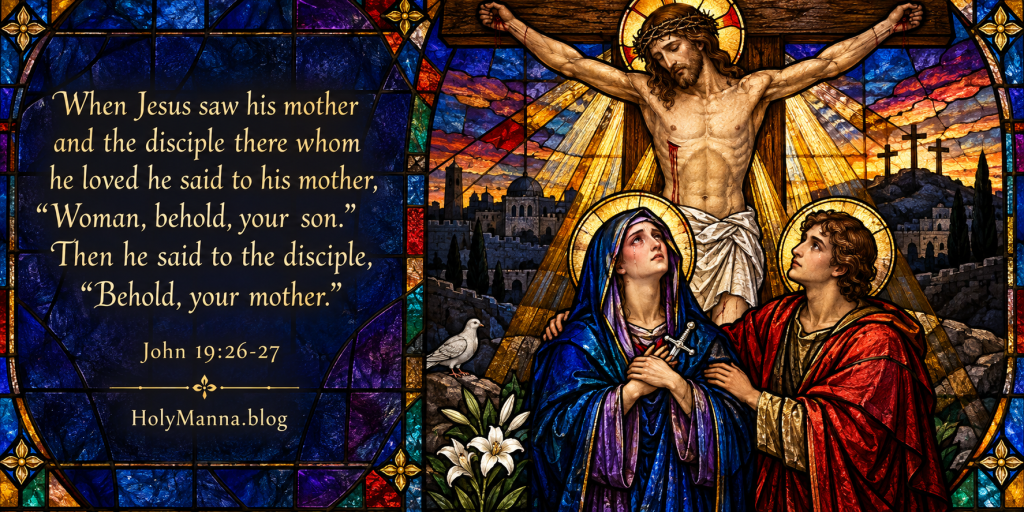
When Jesus saw his mother and the disciple there whom he loved
he said to his mother, “Woman, behold, your son.”
Then he said to the disciple,
“Behold, your mother.”
And from that hour the disciple took her into his home.
Detailed Exegesis
Verse 25: “Standing by the cross of Jesus were his mother and his mother’s sister, Mary the wife of Clopas, and Mary Magdalene.”
The verb is the quiet hero of this verse: standing. Not collapsing, not fleeing, standing. The Greek grammar leaves open whether John names three women or four, and tradition has discussed the identities of the others, but the first name anchors everything. Where the twelve pillars of the Church largely scattered, the women held the ground, and the Mother held it first.
Verse 26: “When Jesus saw his mother and the disciple there whom he loved he said to his mother, ‘Woman, behold, your son.’”
Jesus does not say “Mother” but “Woman,” the same address he used at Cana in John 2. No Jewish son would use that word coldly, and Jesus uses it theologically. She is the Woman promised in Genesis 3:15, whose offspring crushes the serpent, the New Eve standing beside the New Adam at the tree of the Cross. The Fathers, beginning with Saint Irenaeus, read her this way from the Church’s earliest centuries. In naming the beloved disciple her son, Jesus enlarges her motherhood beyond biology.
Verse 27: “Then he said to the disciple, ‘Behold, your mother.’ And from that hour the disciple took her into his home.”
John never names himself in his Gospel, which lets every disciple whom Jesus loves stand in his place. The final phrase in Greek, eis ta idia, means literally “into his own,” his own things, his own inner life. The disciple did not merely give Mary a spare room; he gave her a place among all that was his. Saint John Paul II reflects in Redemptoris Mater 45 that every Christian, entrusting himself to Mary in a filial way, welcomes the Mother of Christ into his own home just as the Apostle did. The words “from that hour” carry John’s full theology of the hour of glory: the family begins precisely when the sacrifice is accomplished.
Teachings
The Catechism, quoting Lumen Gentium 58, describes this scene with words worth reading slowly: the Blessed Virgin “faithfully persevered in her union with her Son unto the cross. There she stood, in keeping with the divine plan, enduring with her only begotten Son the intensity of his suffering, joining herself with his sacrifice in her mother’s heart” (CCC 964). And again: “This is achieved supremely in the case of his mother, who was associated more intimately than any other person in the mystery of his redemptive suffering” (CCC 618). Her motherhood, the Catechism adds, reaches every soul her Son came to save, for “her spiritual motherhood extends to all men whom indeed he came to save” (CCC 501), so that she is rightly called mother of the whole Christ (CCC 726), head and Body together.
Saint Bernard of Clairvaux, whose sermon the Church reads in today’s Office of Readings, gazes at her pierced heart and preaches: “Truly, O blessed Mother, a sword has pierced your heart. For only by passing through your heart could the sword enter the flesh of your Son.” History wrapped devotion around this truth. The Servite Order, founded in 1233, spread love for the Sorrowful Mother across Europe; Pope Pius VII extended her feast to the whole Church in 1814 after his own captivity under Napoleon; and Pope Pius X fixed it on September 15th in 1913, so that the Mother would forever follow the Cross on the calendar. The Stabat Mater, the sequence traditionally attributed to Jacopone da Todi, still sings her station at the Cross.
Reflection
The invitation of this Gospel is startlingly practical: do what the beloved disciple did. Take Mary into your home, which means into your schedule, your worries, your actual life. Begin small and concrete this week. Place an image of Our Lady of Sorrows where you will see it daily, pray one decade of the Rosary or the Sorrowful Mysteries with your commute or your coffee, and hand her by name the person or situation currently crucifying your peace. She has stood at a cross before; she knows how to stand at yours. Whom has fear caused you to abandon at their cross, and what would standing with them look like this week? What corner of your home, and of your heart, have you never actually opened to the Mother Jesus gave you?
Holy Gospel (Option 2) — Luke 2:33-35
A Sword Foretold: The First of the Seven Sorrows
Roughly three decades before Calvary, the scene of the Cross was already announced in the Jerusalem temple. The Gospel of Luke describes a young couple arriving forty days after their Son’s birth to fulfill the Law of Moses, carrying the offering of the poor. Out of the crowd comes Simeon, a righteous and devout old man to whom the Holy Spirit had promised a glimpse of the Messiah before death. He takes the Child in his arms, blesses God, and then turns to the Mother with words no new parent has ever wanted to hear. The Church counts this prophecy as the first of the Seven Sorrows of Mary honored by long devotion, and it reveals the day’s central theme from its earliest root: the family of God would be born through contradiction, and the Mother’s heart would be the first to feel the blade.
Luke 2:33-35
Jesus’ father and mother were amazed at what was said about him;
and Simeon blessed them and said to Mary his mother,
“Behold, this child is destined
for the fall and rise of many in Israel,
and to be a sign that will be contradicted
and you yourself a sword will pierce
so that the thoughts of many hearts may be revealed.”
Detailed Exegesis
Verse 33: “Jesus’ father and mother were amazed at what was said about him;”
Luke has just recorded Simeon’s canticle naming the Child a light for the Gentiles and glory for Israel. Mary and Joseph marvel, not because they lack faith, but because faith keeps unfolding. Even the Immaculate one walked by faith, discovering her Son’s mission piece by piece, which the Church calls her pilgrimage of faith.
Verse 34: “and Simeon blessed them and said to Mary his mother, ‘Behold, this child is destined for the fall and rise of many in Israel, and to be a sign that will be contradicted.’”
Simeon blesses, then prophesies shadow. Jesus will be a sign that forces a decision; before him, neutrality dies, and hearts either fall or rise. Notice that Simeon addresses Mary specifically. Her destiny is welded to her Son’s, and the contradiction he meets will strike her too. Saint John Paul II, in Redemptoris Mater 16, calls these words “a second Annunciation” to Mary, since they reveal the concrete conditions of her Son’s mission: misunderstanding, opposition, and sorrow.
Verse 35: “and you yourself a sword will pierce so that the thoughts of many hearts may be revealed.”
The sword is not a passing sadness but a piercing, and Luke’s word suggests a great blade. Devotion has traditionally counted its seven deepest thrusts: this prophecy, the flight into Egypt, the loss of the twelve-year-old Jesus in the temple, the meeting with Jesus on the road to Calvary held by tradition in the Stations of the Cross, the Crucifixion, the taking down of his body, and his burial. The strange purpose clause matters most: her pierced heart somehow serves the revealing of other hearts. At the foot of the Cross, where her sorrow reached its depth, the truth of every onlooking heart came to light, and it still does.
Teachings
The Catechism reads this scene with unmistakable clarity: at the Presentation Jesus is recognized as the Messiah and light of the nations, but also a sign of contradiction, and “the sword of sorrow predicted for Mary announces Christ’s perfect and unique oblation on the cross that will impart the salvation God had ‘prepared in the presence of all peoples’” (CCC 529). Simeon’s oracle and Calvary are one prophecy and its fulfillment, which is precisely why the Lectionary offers this passage alongside John 19 today.
Saint Bernard of Clairvaux, in the sermon read on this memorial, answers those who wonder whether Mary’s sufferings deserve the name martyrdom, teaching that she was a martyr not in body but in spirit, wounded by love where the martyrs were wounded by iron. He preaches that her Son “died in body through a love greater than anyone had known,” while she “died in spirit through a love unlike any other since his.” Saint John Paul II adds in Salvifici Doloris 25 that on Calvary her suffering, beside the suffering of Jesus, reached an intensity hard to imagine from a human point of view, yet fruitful for the Redemption of the world. Sorrow accepted in union with Christ is never wasted; in Mary it became maternity for the whole Church.
Reflection
Simeon hands every disciple a hard gift: the truth, spoken in blessing, that love will cost. Mary heard the prophecy and did not run from motherhood; she carried the sword’s promise for thirty years and still said yes daily. Consider the swords you can see coming, the aging parent, the difficult vocation, the conversion that will cost a friendship, and instead of numbing yourself, consecrate them in advance as Mary did. Pray one Memorare this week for the grace to receive foreseen suffering with her steadiness. What sword has God allowed you to see on the horizon, and have you handed it to him or just braced for it? When contradiction reveals the thoughts of your heart, what do they say about whom you trust?
The Family Standing in the Shadow of the Cross
Step back and the whole day comes into focus like a single painting. Saint Paul insists that the baptized are one Body in Christ, each part designated and needed. The psalmist gives that Body its song: “We are his people: the sheep of his flock.” Simeon reveals the price of the family portrait decades in advance, and at Calvary the price is paid, the sword falls, and the dying Lord speaks the words that turn a grieving mother and a heartbroken disciple into the first household of the Church: “Behold, your son… Behold, your mother.”
Our Lady of Sorrows is not a memorial about sadness for its own sake. The Church never canonized despair. It is a memorial about love that stays, about a Mother who stood when standing cost everything, and about a God who wastes nothing, not even a pierced heart, in building his family. Every believer who has ever felt like a spare part in the Church, every soul grieving at a cross that will not move, every heart bracing for a foreseen sword can look at Mary and learn that sorrow joined to Christ becomes fruitful, that belonging outlasts breaking, and that the flock is never abandoned by its Shepherd.
Let the response to today’s readings be beautifully simple. Go to Mass and enter his gates with thanksgiving. Find the part of the Body only you can be, and play it with gladness. And before the day ends, do what the beloved disciple did in a single hour and the saints have done ever since: take the Mother of Sorrows home, entrust to her the heaviest thing in life right now, and let the family born at Calvary become fully, personally yours.
Engage With Us!
Share your reflections in the comments below! This community grows every time a reader opens their heart, and someone out there needs to hear exactly what today’s readings stirred in you. Here are some questions to pray with:
- Reflecting on 1 Corinthians 12:12-14, 27-31a, which gift has God designated for you within the Body of Christ, and what is one concrete way you will offer it to your parish or family this week?
- Praying with Psalm 100:1b-5, what would change in your daily prayer if you entered God’s presence with thanksgiving before any request, trusting that “his we are” on your hardest days?
- Sitting with John 19:25-27, what would it look like, practically and daily, for you to take Mary into your home as the beloved disciple did?
- Pondering Luke 2:33-35, what foreseen sword in your life needs to be consecrated to God in advance rather than merely endured, and what do moments of contradiction reveal about the thoughts of your heart?
- Bringing it all together, if you truly believed you belong to Christ’s Body, his flock, and his Mother, purchased at the price of Calvary, how would you live differently this week?
Faith is not a solo climb. It is a family walk, with a Mother who never leaves the foot of anyone’s cross. Live this day with courage, stand where love asks you to stand, and do everything with the love and mercy Jesus taught us.
Sacred Heart of Jesus, we trust in You!
Immaculate Heart of Mary, pray for us!
Saint Michael the Archangel, defend us in battle!
Follow us on YouTube, TikTok, Instagram and Facebook for more insights and reflections on living a faith-filled life.

 Holy Manna!
Leave a comment