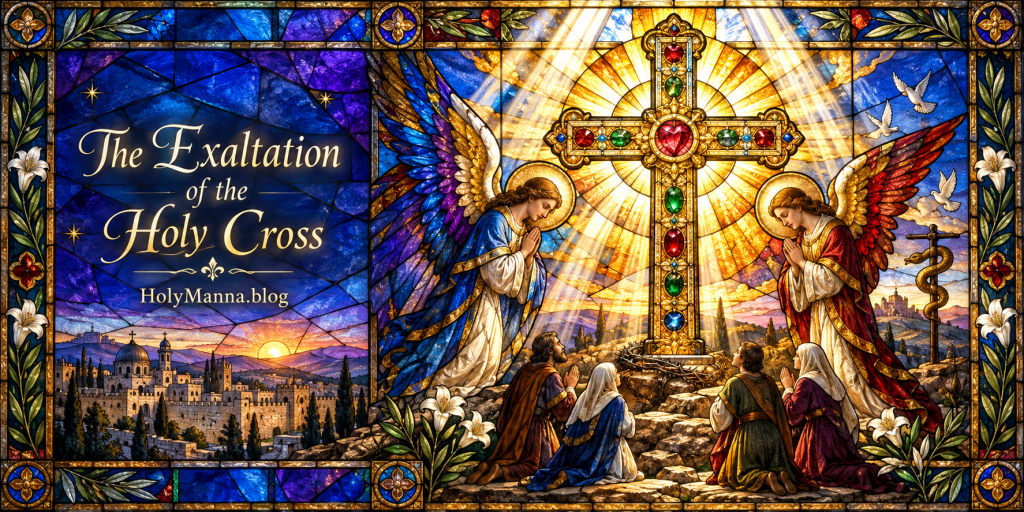
The Love That Conquered Death
Every year on September 14th, the Catholic Church does something the ancient world would have found unthinkable. She takes the cross, the most feared and shameful instrument of execution the Roman Empire ever devised, and lifts it high in gold and glory above her altars. She sings to it. She venerates it. She calls it holy. This is the Feast of the Exaltation of the Holy Cross, a Feast of the Lord on the General Roman Calendar, and in 2026 it falls on a Monday, replacing the ordinary weekday liturgy with its own proper readings, the singing of the Gloria, and vestments of deep red.
The feast is one of the oldest celebrations in the entire Christian calendar, reaching back to 4th-century Jerusalem, to the age of Constantine and the first great pilgrimages to the Holy Land. It has been kept without interruption in both East and West for roughly 1,700 years. Yet the heart of the feast is not an artifact or a relic. The heart of the feast is a paradox, the same paradox St. Paul preached to the Corinthians: the message of the cross is foolishness to the perishing, but to those being saved it is the very power of God, as 1 Corinthians 1:18 proclaims. The Catechism teaches that Christ’s death on the Cross is the unique and definitive sacrifice that completes and surpasses all others (CCC 613-614).
For believers between the ages of 20 and 45, living in a culture that hides suffering, curates every image, and avoids the subject of death entirely, this feast is strangely and wonderfully countercultural. It insists that the worst thing human beings ever did, killing the Author of Life, became the best thing that ever happened to the human race, because God’s love is stronger than human cruelty. The Exaltation of the Holy Cross does not celebrate suffering for its own sake. It celebrates a victory. It celebrates the moment when death itself was put to death, and it invites every generation to look up at the Crucified One and live.
A Basilica, an Empress, and a Feast Born in Jerusalem
The story begins in the early 4th century, in the years after the Emperor Constantine legalized Christianity with the Edict of Milan in 313. Christians could finally honor publicly the places where the Lord had suffered, died, and risen. Constantine ordered the construction of a magnificent basilica complex in Jerusalem on the site of Calvary and the empty tomb. The complex included the great Martyrium basilica and the Anastasis, the rotunda built over the Holy Sepulchre itself.
Into this story steps one of the most beloved women of Christian history, St. Helena, the mother of Constantine. Already advanced in years, she traveled to the Holy Land around the year 326 on a journey of devotion, prayer, and charitable works. According to a venerable tradition attested by 4th-century Fathers including St. Ambrose in De obitu Theodosii in 395, and by the historians Rufinus, Socrates, and Sozomen, Helena searched for and discovered the True Cross of Christ near Calvary. Honesty requires a careful note here: Eusebius of Caesarea, the earliest historian of these events, describes the excavation of the tomb but does not mention Helena finding the Cross, so the Church presents her discovery as a cherished and ancient tradition rather than as a verified historical certainty. What is beyond dispute is that within about 20 years of Helena’s journey, St. Cyril of Jerusalem was teaching openly in his Catechetical Lectures, delivered around the year 348, that the wood of the Cross was venerated in Jerusalem and that fragments of it had already spread throughout the whole world. Something real and revered was there, and the whole Church knew it.
The basilica complex was solemnly dedicated on September 13, 335. On the following day, September 14th, the bishop lifted up the relic of the Cross before the assembled faithful for veneration. From that annual showing, the feast of the Exaltation was born. The Spanish pilgrim Egeria, who visited Jerusalem in the 380s, describes the anniversary celebrations, called the Encaenia, as ranking among the greatest of the year, drawing bishops, monks, and pilgrims from across the East.
History then added a second layer to the feast. In 614 the armies of the Persian king Khosrau II captured Jerusalem and carried off the relic of the Cross as a trophy of war. The Byzantine Emperor Heraclius fought a long campaign against Persia, and around the year 630 the precious relic was restored to Jerusalem; sources vary on the precise year, giving 628, 629, or 630, a discrepancy worth naming honestly. A moving story, and it must be labeled a story, tells that Heraclius attempted to carry the Cross into the city in full imperial splendor and found himself unable to move forward until he removed his finery and walked barefoot in the garments of a poor man. Whatever the historical details, the recovery of the Cross made the feast a celebration of triumph as well as veneration, and by the 7th century the Exaltation had been adopted in Rome itself, where the popes venerated the relic of the Cross on this day. For many centuries the Western calendar also kept a second feast, the Finding of the Holy Cross on May 3rd, until the calendar reform of Pope St. John XXIII in 1960 consolidated the celebration on September 14th, the arrangement retained in the calendar of 1969.
The Scriptures That Frame the Feast: A Serpent, a Hymn, and a Nighttime Conversation
The liturgy of September 14th builds its case from Scripture with breathtaking precision, and the readings for 2026 place the whole mystery before the congregation in 3 movements.
The first reading, Numbers 21:4b-9, recounts one of the strangest episodes in the Old Testament. The Israelites, worn out in the desert, grumble against God and Moses, and seraph serpents come among the people, whose bite brings death. When the people repent, God gives Moses a startling remedy: “Make a saraph and mount it on a pole”, so that anyone bitten who looks upon it will live. The cure is shaped like the wound. The people must look directly at an image of the very thing killing them, lifted up on a pole, and in that obedient gaze God grants healing. The Catechism teaches that this divinely commanded image, along with the ark and the cherubim, pointed forward symbolically to salvation through the incarnate Word (CCC 2130).
The Gospel, John 3:13-17, reveals what the serpent foreshadowed. In His nighttime conversation with Nicodemus, Jesus reaches back to that desert scene and applies it to Himself: just as Moses lifted up the serpent, “so must the Son of Man be lifted up”, that everyone who believes in Him may have eternal life. In the Gospel of John, this “lifting up” carries a deliberate double meaning: Jesus is lifted up physically on the wood of the Cross, and in that very moment He is lifted up in glory, drawing all people to Himself. The Catechism makes the connection explicit, teaching that Christ’s being lifted up on the Cross announces and already begins His being lifted up in the Ascension (CCC 662). Then comes the verse many believers memorized as children, John 3:16, the summary of the entire Gospel: God so loved the world that He gave His only Son. The Cross is not primarily about wrath. It is about a love that spared nothing.
The second reading, Philippians 2:6-11, is the ancient hymn of Christ’s self-emptying. Though He was in the form of God, Christ did not cling to equality with God but emptied Himself, taking the form of a slave; “he humbled himself, becoming obedient to death, even death on a cross”. And precisely because of this obedient descent, God greatly exalted Him and bestowed on Him the name above every name. The hymn traces a great V-shape: down into humiliation, then up into glory. The exaltation of the feast’s title is first of all the Father’s exaltation of the obedient Son (CCC 434). The entrance antiphon of the Mass, drawn from Galatians 6:14, gathers everything into a single boast: “We should glory in the Cross of our Lord Jesus Christ”, in whom is salvation, life, and resurrection. It should be noted that when this Feast of the Lord occurs on a weekday, the rubrics permit a single reading before the Gospel, chosen from either the first or second reading, though many parishes proclaim both.
Why the Cross Changes Everything: The Theology of the Feast
The Exaltation of the Holy Cross is not sentimentality about an old relic. It is a feast of doctrine, and the doctrine is stunning. The Catechism teaches that by His obedience unto death, Jesus accomplished the substitution of the suffering Servant, who gives His life as a ransom for many and justifies the multitude by bearing their sins (CCC 615). It is love to the end that gives Christ’s sacrifice its value as redemption, reparation, atonement, and satisfaction, for He knew and loved each person when He offered His life (CCC 616). The Council of Trent’s teaching, echoed in the Catechism, states that Christ’s most holy Passion on the wood of the Cross merited justification for the human race (CCC 617).
This is why the Church exalts the Cross rather than hiding it. The Cross is where divine justice and divine mercy meet, where the deepest human questions about suffering, guilt, and death receive not a theory but a Person. The Catechism teaches further that Christ, by His Passion, gave suffering itself a new meaning, so that human suffering can now be configured to His and joined to His redemptive work (CCC 1505). Nothing in a believer’s life, no diagnosis, no grief, no failure, is wasted when it is united to the Cross.
The Fathers of the Church saw all of this with piercing clarity. St. Andrew of Crete, the 8th-century bishop whose homily on this feast the Church still reads in the Liturgy of the Hours on September 14th, declares that “had there been no cross, Christ could not have been crucified”, and goes on to reason that without the Cross there would be no piercing of the Lord’s side, no blood and water, no fountain of life for the world. For Andrew, the Cross is rightly called the glory and the exaltation of Christ, because on it the Lord triumphed and through it every blessing flows. Centuries earlier, the poet Venantius Fortunatus had composed the hymns Vexilla Regis and Pange Lingua in 569 for the arrival of a relic of the Cross at Poitiers, given to Queen St. Radegund’s monastery; those hymns still frame the Church’s worship of the Crucified today, singing of the royal banners going forward and of the faithful Cross as the one noble tree.
The popes of the modern era have returned to John 3 on this feast again and again, preaching that the crucified Christ is the true measure of God’s love and that looking upon Him with faith, as the Israelites looked upon the bronze serpent, is the beginning of healing. The Catechism gathers the whole spiritual tradition into one sentence when it teaches that “the way of perfection passes by way of the Cross” (CCC 2015). There is no holiness without renunciation and spiritual battle. That is not grim news. It is the most realistic and hopeful map ever drawn of the human journey.
Wood That the World Still Touches: Devotions, Relics, and Pilgrim Roads
Because the feast began with the veneration of a physical relic, devotion to the Holy Cross has always been tangible, something believers touch, trace, kiss, and walk toward. The most universal of all these devotions is also the smallest: the sign of the cross. The Catechism teaches that the Christian begins the day, prayers, and activities with the sign of the cross, dedicating the whole of daily life to the glory of God and strengthening the believer in temptation (CCC 2157). Among the sacramentals of the Church, blessings and holy signs prepare the faithful to receive grace and sanctify the ordinary moments of life (CCC 1670). A believer who traces the cross over body and heart each morning is keeping the Exaltation in miniature, every single day.
The Church’s liturgy itself contains an annual echo of the ancient Jerusalem rite. On Good Friday, the priest unveils the cross and sings the invitation to behold the wood of the Cross on which hung the salvation of the world, and the faithful come forward one by one to venerate it. The Stations of the Cross, prayed in nearly every parish on earth, extend that veneration into a walking meditation on the Lord’s Passion.
Then there are the great pilgrim destinations. The Basilica of the Holy Sepulchre in Jerusalem, heir of Constantine’s original complex, still draws believers to Calvary and the empty tomb, the very ground where this feast was born. In Rome, the Basilica of Santa Croce in Gerusalemme, built in connection with St. Helena’s imperial residence, has for centuries housed relics associated with the Passion, and soil from Jerusalem is said by tradition to lie beneath it, so that pilgrims to Rome could stand, in a sense, on holy ground. In northern Spain, the monastery of Santo Toribio de Liébana guards the largest surviving fragment of the relic of the Cross, known as the Lignum Crucis, and celebrates its own jubilee year when the feast of its patron falls on a Sunday, drawing pilgrims along routes connected to the Camino. Religious communities keep the day as well; the Congregation of Holy Cross celebrates September 14th with particular solemnity as the feast from which its very name and mission take their meaning, and the Carmelite tradition, following the Rule of St. Albert, historically began its great fast on this feast, stretching from September 14th until Easter.
One Feast, Many Voices: How the World Keeps the Day
Few celebrations reveal the catholicity of the Church, her presence in every culture, as vividly as this one. In the Byzantine East, among both Orthodox Christians and Eastern Catholics, the day is called the Universal Exaltation of the Precious and Life-Giving Cross and ranks among the 12 Great Feasts of the liturgical year. It is kept as a strict fast day, a rare thing for a feast, precisely because the Cross is honored through sharing in its self-denial. At the heart of the Byzantine celebration stands the rite of elevation, in which the priest or bishop, holding the flower-adorned cross aloft, blesses the 4 directions of the world while the faithful sing repeated litanies of mercy, a living descendant of that first lifting up of the relic in 4th-century Jerusalem. In Greek parishes the cross is traditionally adorned with basil, and a beloved tradition, to be received as tradition, holds that basil grew on the spot where the Cross was found; its very name in Greek speaks of royalty.
The Christian East of Africa keeps the mystery with fire. In Ethiopia and Eritrea, the late-September celebration of Meskel commemorates the finding of the True Cross with the lighting of the great Demera bonfire, crowds in white gathered at dusk, and processions of clergy in radiant vestments; Ethiopian Catholics share in this patrimony alongside their Orthodox neighbors. In the Latin world, centuries of devotion to the Holy Cross flowered around the older feast of May 3rd, the Finding of the Cross, which survives in popular culture even after the 1960 calendar consolidation; in Mexico and elsewhere, the Día de la Santa Cruz remains the cherished day of masons and construction workers, who decorate and raise crosses on their worksites. Across the Philippines, Latin America, and southern Europe, towns named for the Santa Cruz or the Holy Cross keep patronal fiestas, processions, and novenas that carry this feast into streets, plazas, and family kitchens. And in the sanctoral rhythm of the universal calendar, September 14th does not stand alone: the very next day, September 15th, the Church keeps the Memorial of Our Lady of Sorrows, so that the faithful contemplate the Cross on one day and, on the next, the Mother who stood beneath it, a pairing the liturgy has woven together with quiet genius.
Standing at the Foot of the Cross in 2026
So what does a 1,700-year-old feast about an ancient execution device have to say to you, right now, in the middle of a life of group chats, deadlines, student loans, diapers, or hospital waiting rooms? Everything, actually.
Start with the serpent in the desert. The Israelites were healed not by looking away from what was killing them but by looking straight at it, lifted up by God’s command. There is a whole spirituality in that single detail. You are invited to stop numbing, scrolling past, and minimizing the wounds in your life, and instead to bring them into the light of the Crucified One, because the Cross is proof that God does not waste pain. The Catechism’s teaching that suffering united to Christ acquires new meaning (CCC 1505) is not an abstraction; it is a lifeline for the parent of a sick child, the young adult battling anxiety, the worker enduring a job that feels like a desert.
Consider next the hymn from Philippians 2. Christ’s path ran downward before it ran upward: self-emptying, service, obedience, and only then exaltation. In a culture that trains you to self-promote, curate, and climb, the feast proposes the opposite ladder. Choose one hidden act of service this week that no one will see or repost. That is exaltation training.
Finally, take back the sign of the cross. Make it slowly, deliberately, in public if the moment calls for it: before meals, before a hard conversation, before opening the laptop. Consider placing a crucifix, not a bare decoration but a true crucifix, somewhere you will see it daily, and letting it interrogate your priorities. Fast in some small way on September 14th in solidarity with the Christian East. Pray the Stations of the Cross even though it is not Lent. Look up the words of Vexilla Regis and let a 6th-century hymn become part of a 21st-century playlist. The Cross was lifted high so that you would look at it, and live.
Engage With Us!
The conversation does not end here, and the comments below are open precisely for this: share the thoughts, questions, and reflections this feast stirs in your own heart, and read what others are carrying too, because faith grows in community.
- When you look at a crucifix, what do you honestly see first: suffering, love, victory, or something else, and why?
- The Israelites had to look directly at the image of what wounded them in order to be healed. What is one wound or struggle you have been avoiding that you could bring to the Cross this week?
- Philippians 2 shows Christ descending into humility before being exalted. Where in your life is God inviting you to take the lower place?
- The Christian East keeps this feast with fasting. What is one small sacrifice you could offer on September 14th as an act of love?
- How could the simple sign of the cross, made slowly and intentionally, change the rhythm of your daily life?
Take heart and take up the Cross with joy rather than fear, because the One who carried it first has already won the victory and walks beside you in every trial. Live this week with courage, gentleness, and generosity, and do everything, the great things and the hidden things alike, with the love and mercy Jesus taught us.
Jesus Christ, our Lord and our God, have mercy us!
Follow us on YouTube, TikTok, Instagram and Facebook for more insights and reflections on living a faith-filled life.

 Holy Manna!
Leave a comment