Thanks Be to God
Some saints come to the faith as children and grow into holiness slowly, like a tree putting down rings. Saint Cyprian of Carthage came to it like a man rescued from a shipwreck, and he spent the rest of his short Christian life pulling other people out of the water. A celebrated pagan orator converted in middle age, he became a bishop within about three years of his baptism and shepherded the Church of Carthage through two imperial persecutions, a catastrophic plague, and divisions bitter enough to threaten Christian communion itself. He answered every one of those storms with the same conviction: the Church is one, because Christ is one, and nothing, not fear, not sin, not even the sword, is allowed to divide her.
Cyprian died a martyr on September 14th, 258, the first bishop of Africa to shed his blood for Christ, and the Church has honored him ever since. The Roman Martyrology commemorates him on September 14th, the day of his death, while the General Roman Calendar celebrates his Memorial on September 16th together with Pope Saint Cornelius, since September 14th belongs to the Feast of the Exaltation of the Holy Cross. He is counted among the Fathers of the Church, and he is honored as a patron of North Africa and of Algeria, the lands he served and sanctified. The Catechism teaches that “martyrdom is the supreme witness given to the truth of the faith: it means bearing witness even unto death” (CCC 2473), and few lives illustrate that witness with the clarity of Cyprian’s.
From Courtroom Applause to the Waters of Rebirth
Thascius Cyprianus was born in or near Carthage, in Roman North Africa, in what is now Tunisia. His birth year was never recorded; historians place it somewhere between the years 200 and 210, and honesty requires leaving that question open. What is certain is that he was born into wealth and privilege. His family was pagan, cultured, and prominent, and Cyprian received the finest classical education in Carthage, one of the intellectual capitals of the Roman world. He became a celebrated rhetorician and advocate, successful, admired, and comfortable.
He was also, by his own account, restless, describing his pre-Christian life as captivity to habits he could see through but felt powerless to escape. The turning point came through friendship. An elderly priest of Carthage took Cyprian under his wing, taught him the Scriptures, and led him toward baptism around the year 245 or 246. The earliest sources disagree on the priest’s exact name; Pontius, Cyprian’s own deacon and biographer, calls him Caecilianus, while Saint Jerome calls him Caecilius. Whatever the precise form, Cyprian loved the man so much that he added the priest’s name to his own, becoming Thascius Caecilius Cyprianus. It is one of the most touching details of his story: a famous public man, renamed by gratitude.
Even before his baptism, Cyprian began selling his estates for the relief of the poor, a generosity recorded by Pontius in the Vita Cypriani, often called the first Christian biography ever written. Cyprian’s own description of his baptism in Ad Donatum remains one of the most beautiful conversion accounts in Christian literature: “By the help of the water of new birth, the stain of former years had been washed away, and a light from above, serene and pure, had been infused into my reconciled heart; a second birth had restored me to a new man.” The Catechism teaches exactly what Cyprian experienced, that in baptism the person becomes “a new creature, an adopted son of God, who has become a partaker of the divine nature” (CCC 1265).
The Church of Carthage recognized what God had done, and quickly. Cyprian was ordained a priest, and around the year 248 or 249, only about three years after his baptism, he was elected Bishop of Carthage by the overwhelming acclaim of the people. He hesitated; the people insisted. Five presbyters of the city opposed his election and never fully reconciled to it, a wound that would reopen painfully in the years ahead. But the choice was made, and it placed Cyprian at the head of the most important Church in Latin-speaking Africa on the very eve of the most sweeping persecution the Church had yet faced.
A Pastor in Plague and Persecution
Here the story requires the honesty Cyprian himself would demand. The earliest sources do not present him as a wonder-worker; no catalogue of healing miracles during his lifetime was ever documented. What they record, and what Cyprian himself claimed in his letters, is that God guided him through visions during the crises of his episcopate. His miracle, so to speak, was his shepherding: a Church held together when every human force was pulling it apart. Sanctity does not require spectacle, and faithfulness under pressure is itself a work of grace.
The first crisis came almost immediately. In the year 250, the Emperor Decius ordered every inhabitant of the empire to sacrifice to the Roman gods and obtain a certificate proving it. Refusal meant imprisonment, torture, or death. It was the first empire-wide persecution of Christians, and it broke over a Church grown comfortable in decades of peace. Cyprian, as the most visible Christian in Carthage, was hunted by name; pagan crowds in the amphitheater chanted for him to be thrown to the lions. After prayer and discernment, he made a decision that would be criticized for the rest of his life: he went into hiding, governing his Church by a stream of letters, so that his flock would not be left shepherdless. Some murmured cowardice. Cyprian answered that he had withdrawn under God’s direction for the good of the Church, and his martyrdom would silence the accusation forever. Courage is not always the loudest option, and prudence in one season can prepare the ultimate witness of another.
When the persecution ebbed, a second crisis rose out of the first. Thousands of Christians had lapsed, either by actually offering sacrifice or by purchasing false certificates. What was the Church to do with them? Laxists wanted the lapsed readmitted at once without real penance. Rigorists, led by the Roman priest Novatian, who set himself up as antipope against Saint Cornelius, insisted the Church could not absolve so grave a sin at all, and tore themselves into schism. Cyprian, in his treatise De lapsis and in council with his fellow bishops, held the Catholic center: the lapsed could and should be reconciled, but through genuine penance, because mercy without conversion is not mercy and rigor without hope is not holiness. The Church’s enduring teaching echoes his pastoral wisdom, that Christ “willed that in her prayer and life and action his whole Church should be the sign and instrument of the forgiveness and reconciliation that he acquired for us at the price of his blood” (CCC 1442).
Out of the Novatianist schism came Cyprian’s most famous work, De catholicae ecclesiae unitate, on the unity of the Catholic Church, and its most famous sentence, quoted by the Catechism itself: “No one can have God as Father who does not have the Church as Mother” (De unitate 6; CCC 181). For Cyprian the Church was no optional container for private faith; she is the Bride of Christ, the seamless garment the soldiers refused to tear, and to rip oneself from her communion is to walk out of the family in which God gives Himself as Father. The Catechism teaches with him that the Church is one because of her source, the unity of the one God in three Persons, and one because of her founder, Christ, who reconciled all people to God by the Cross (CCC 813).
Then came the third crisis, and it was the one that revealed Cyprian’s heart most completely. Beginning around the year 252, a horrifying epidemic swept the Roman world, killing so many people that bodies were left unburied in the streets. Historians still call it the Plague of Cyprian, because his writings describe it so vividly. Pagans blamed the Christians for angering the gods and often abandoned their own sick out of fear. Cyprian did the opposite. He gathered the Church of Carthage and organized a systematic relief effort, instructing Christians to nurse the sick and bury the dead, believers and pagans alike. Pontius records Cyprian teaching that there was nothing remarkable in caring only for one’s own, and that those who would be perfect must do good even to their persecutors, as children of a Father who makes His sun rise on the good and the evil alike. The Church has never stopped teaching what Cyprian lived, that “the works of mercy are charitable actions by which we come to the aid of our neighbor in his spiritual and bodily necessities” (CCC 2447).
And to a people terrified of death, Cyprian preached one of the most consoling sermons of the early Church, De mortalitate, on mortality. Christians who die in the Lord, he insisted, “are not lost, but sent before.” Death for the baptized is not an ending but a departure ahead on a road every believer will travel, toward a homeland where parents, brothers, children, and a great crowd of loved ones are waiting. Seventeen centuries later, those words still steady grieving hearts.
Cyprian’s pastoral genius extended even to teaching people how to pray. His treatise on the Our Father, De dominica oratione, is so treasured that the Catechism quotes it in its catechesis on the Lord’s Prayer: “The new man, reborn and restored to his God by grace, says first of all, ‘Father!’ because he has now begun to be a son” (CCC 2782). In the same treatise he warned that God does not accept the sacrifice of one who sows disunion, but commands him to leave the altar and first be reconciled with his brother, a teaching the Catechism takes up in its treatment of forgiveness (CCC 2845). For Cyprian, prayer, unity, and mercy were never three subjects. They were one subject, because Christ is one.
Honesty also requires naming the controversy Cyprian did not get right. In his final years he clashed with Pope Saint Stephen I over whether baptism conferred by heretics was valid. Cyprian, with the bishops of Africa, held that it was not and that converts from heretical groups must be baptized again. Stephen, holding the tradition of Rome, insisted that baptism with water and the Trinitarian formula is valid regardless of the minister, and the Church later settled the question in Stephen’s favor; the Catechism teaches that, when the required conditions are met, even one who is not baptized can baptize (CCC 1256). The dispute grew heated, yet it never broke communion, and Cyprian’s error, held in good faith and before the Church had defined the matter, has never dimmed his sanctity. There is a quiet comfort in that for every believer: God crowns faithfulness, not infallibility.
Deo Gratias
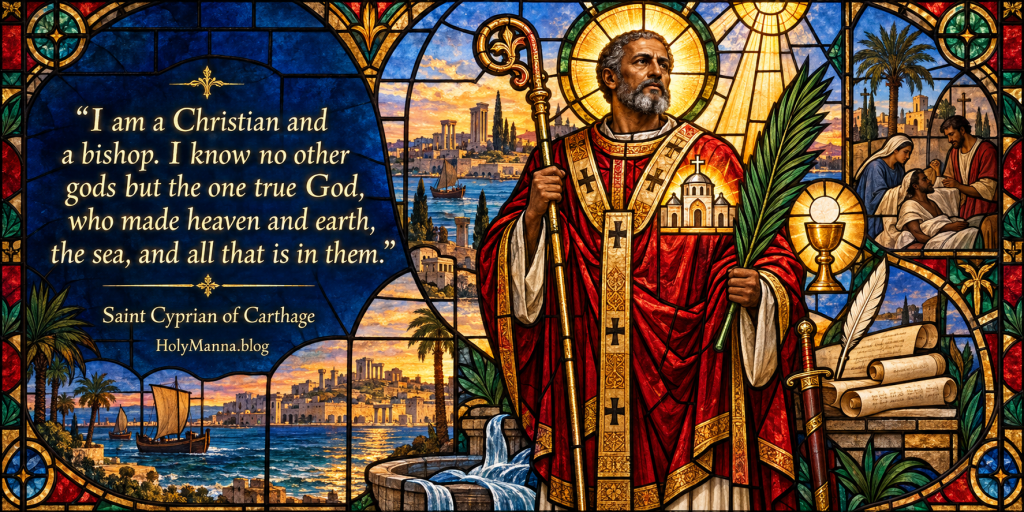
In the year 257 the Emperor Valerian turned on the Church, ordering bishops and clergy to acknowledge the Roman gods and forbidding Christian assemblies. Cyprian was brought before the proconsul Aspasius Paternus, and this time there was no withdrawal. The record of his interrogation survives in the Acta Proconsularia, drawn from official court records and regarded as among the most authentic martyrdom documents of the early Church. Asked to comply, Cyprian answered: “I am a Christian and a bishop. I know no other gods but the one true God, who made heaven and earth, the sea, and all that is in them.” He refused to betray the whereabouts of his priests, and he was sentenced to exile at Curubis, a small town on the coast.
It was at Curubis, according to Pontius, who accompanied him, that Cyprian received a vision on the very first day of his exile. A young man of unusual stature led him before the proconsul, who wrote a sentence on a tablet. The young man, reading it, signed to Cyprian with a gesture like the stroke of a sword. Understanding that his death was decreed, Cyprian asked for a delay until tomorrow to set his affairs in order, and the delay was granted. Pontius records that the tomorrow of the vision was fulfilled one year later, on the anniversary of the dream, when Cyprian was executed. This account comes from the earliest biography, written by an eyewitness companion, but it remains the report of a private vision handed down by tradition, and it cannot be verified.
In 258 Valerian issued a second, harsher edict: bishops, priests, and deacons were to be executed at once. Cyprian, recalled from exile, could have fled again; friends urged it. He refused. He had withdrawn once so his people would not be left shepherdless in chaos; now he stayed so his people would see their shepherd die well, wishing to be martyred in Carthage, before his own Church, so that his confession would belong to them.
On September 13th, 258 he was arrested at his gardens and lodged overnight at an official’s house, while the Christians of Carthage kept vigil in the street, unwilling to leave their bishop alone on his last night. The next morning he was brought before the proconsul Galerius Maximus at the Ager Sexti. The Acta preserve the exchange with courtroom plainness. The proconsul asked, “Are you Thascius Cyprianus?” He answered, “I am.” Told that the most sacred emperors commanded him to perform the Roman rites, he answered, “I refuse.” Urged to take heed for his own safety, he answered, “Do what you are commanded. In so just a cause there is no need for deliberation.” The sentence was read: Thascius Cyprianus was to be executed by the sword. And Cyprian gave the answer that has echoed through the Church ever since: “Thanks be to God!”
The crowd of the faithful cried out, “Let us also be beheaded with him!” They followed him to the place of execution. There Cyprian removed his outer garments, knelt in prayer, and blindfolded himself with his own hands. Unable to bind his own wrists, he was assisted by a priest and a deacon. Then, in a gesture that captures the whole man, he ordered that 25 gold pieces be given to his executioner; the famous advocate who had given his fortune to the poor forgave, and provided for, the man about to kill him. The sword fell, and the first bishop-martyr of Africa went to the Lord he had confessed. The faithful carried his body by night, with candles and torches, and buried him with prayer in the cemetery at Mappalia. The Catechism could be describing that procession when it teaches that the Church “has painstakingly collected the records of those who persevered to the end in witnessing to their faith”, the acts of the martyrs, which “form the archives of truth written in letters of blood” (CCC 2474).
A Legacy Written in Blood and Ink
Veneration of Cyprian began immediately and never stopped. His feast is among the oldest annually celebrated martyr commemorations in the Church, and two basilicas rose in his honor in Carthage, one near the place of his death and one at his tomb, where the Christians of Africa gathered each September. Saint Augustine, born a little over a century after Cyprian died, preached again and again at the Mensa Cypriani, the memorial shrine, holding up the martyr-bishop as the glory of the African Church. Augustine’s Confessions preserve a tender scene at Cyprian’s shrine: on the night the young, unconverted Augustine secretly sailed from Carthage for Rome, his mother Saint Monica spent that night in prayer at the memorial chapel of Cyprian by the harbor, weeping and begging God for her son. God answered her prayer in Italy rather than in Africa, and the future Doctor of Grace was won for Christ. It is hard not to see the intercession of Carthage’s bishop woven into the conversion of Carthage’s greatest son.
His 81 surviving letters and treatises became foundational texts of Latin theology, shaping how the Church speaks of unity, the episcopate, penance, and prayer. His formula “outside the Church there is no salvation” (Epistle 73) passed into the permanent vocabulary of the faith. The Catechism teaches how this affirmation is rightly understood: positively, it means that all salvation comes from Christ the Head through the Church which is His Body (CCC 846), while those who, through no fault of their own, do not know Christ or His Church yet sincerely seek God and strive to do His will may also achieve eternal salvation (CCC 847). Cyprian’s sentence was never a boast against the world; it was a lover’s plea not to abandon the Mother in whom the Father’s life is given. His name entered the Roman Canon of the Mass beside Pope Saint Cornelius, his friend and ally, so that to this day, whenever Eucharistic Prayer I is prayed anywhere on earth, Cyprian is remembered at the altar. Even secular history bears his fingerprint: the great epidemic of the 3rd century is still called the Plague of Cyprian.
Regarding miracles after his death, the same honesty that governed his life must govern his story. The earliest African sources celebrate Cyprian’s intercession, his memorial, and the graces sought and received at his shrine, but they did not preserve a detailed catalogue of individual healing stories in the way later medieval shrines would. What tradition does hand down concerns his relics. According to a 9th-century tradition, his relics were carried from Africa to France in the Carolingian era, with portions claimed by Lyon, by Arles, and most notably by the abbey of Saint-Corneille at Compiègne, which honored Cornelius and Cyprian together just as the liturgy does. This story of the translation of his relics cannot be verified.
One final clarification belongs here, because it protects the saint’s good name. Saint Cyprian of Carthage is frequently confused, especially online, with a different figure, Cyprian of Antioch, around whom later traditions of a converted magician grew, and to whom folk practice in some countries attaches a so-called book of spells. None of that has anything to do with the Bishop of Carthage, and the Catechism teaches plainly that all forms of magic and sorcery are gravely contrary to the virtue of religion (CCC 2117). Devotion to the true Cyprian leads only to Christ.
What Cyprian Asks of You
Cyprian’s life reads like a checklist of the very pressures Christians feel today, and that is what makes him such a practical companion. He knew what it was to be a successful, educated, comfortable adult who sensed that comfort was not the same thing as peace. If that describes you, his story insists that it is never too late; he was likely past 40 when the waters of baptism made him new, and within a decade he was a Father of the Church. What is the one attachment you suspect God has been asking you to sell, give away, or surrender so that your heart can finally breathe?
He knew what scandal and division inside the Church feel like. He watched clergy fail, watched thousands of believers cave under pressure, and watched a rival set himself up against the Pope. His answer was not to leave, and not to pretend, but to love the Church harder, as a son loves his mother precisely when her household is suffering. The Catechism echoes him in teaching that Christ always gives His Church the gift of unity, but the Church must always pray and work to maintain, reinforce, and perfect it (CCC 820). Cyprian’s witness is blunt: communion is not a consumer preference, it is a family bond sealed in the Blood of Christ. When the failures of Christians tempt you to walk away, do you bring that wound to prayer, or do you let it quietly harden into distance?
He knew how to hold mercy and truth together. Toward the lapsed he refused both the shrug that demands no conversion and the severity that offers no way home. Most people know someone who has drifted from the faith and is ashamed to return. Cyprian would say: open the door, require nothing less than honesty, and promise nothing less than mercy. Who in your life is waiting, perhaps without knowing it, for you to be the one who says that coming home is possible?
He knew what public crisis demands of Christians. When the plague came, the world saved itself and Cyprian’s people saved their neighbors, including the ones who had persecuted them. The application writes itself for anyone who has lived through an epidemic, a hurricane, or simply a hard season on their own street. Concrete charity toward people who cannot repay you is not extra credit in the Christian life; it is the family resemblance of the children of God (CCC 2447). What is one act of unglamorous, hands-on mercy you could take on this week for someone outside your circle?
And he knew how to die, because he had spent 12 years learning how to live. His “Thanks be to God” was not produced in the moment; it was the overflow of a soul that had already given everything away. Begin where he taught his people to begin, with the Our Father prayed slowly, as someone “who has now begun to be a son” (CCC 2782). If you received hard news today, is your soul close enough to God that gratitude would even be possible, and what daily habit of prayer would move you one step in that direction?
Engage With Us!
Saint Cyprian of Carthage still speaks with the voice of a father, and this community would love to hear how his story lands in your life. Share your thoughts, your questions, and your reflections in the comments below.
- Cyprian converted in middle age after years of outward success and inward restlessness. Where in your own life do you sense that restlessness, and what might it be inviting you toward?
- He taught that no one can have God as Father who does not have the Church as Mother. How would you describe your current relationship with the Church, and what would deepening it look like this month?
- Cyprian showed costly mercy to Christians who had failed under pressure. Is there someone you need to welcome back, or a failure of your own you need to bring to Confession?
- During the plague, his community served the sick regardless of who they were. What need in your city or parish is waiting for that same kind of courage from you?
- He answered his death sentence with thanks to God. What would it take for gratitude to become your first response to hardship rather than your last?
Saint Cyprian gave away his fortune, his comfort, his reputation, and finally his life, and he counted every loss as gain because he had found the pearl of great price. You are invited to the same adventure, right where you are, one act of faith at a time. Hold fast to the Church, forgive quickly, serve generously, and pray the Our Father like a beloved child. Live this day, and every day, with the love and mercy that Jesus taught us. Thanks be to God!
Saint Cyprian of Carthage, pray for us!
Follow us on YouTube, TikTok, Instagram and Facebook for more insights and reflections on living a faith-filled life.

 Holy Manna!
Leave a comment