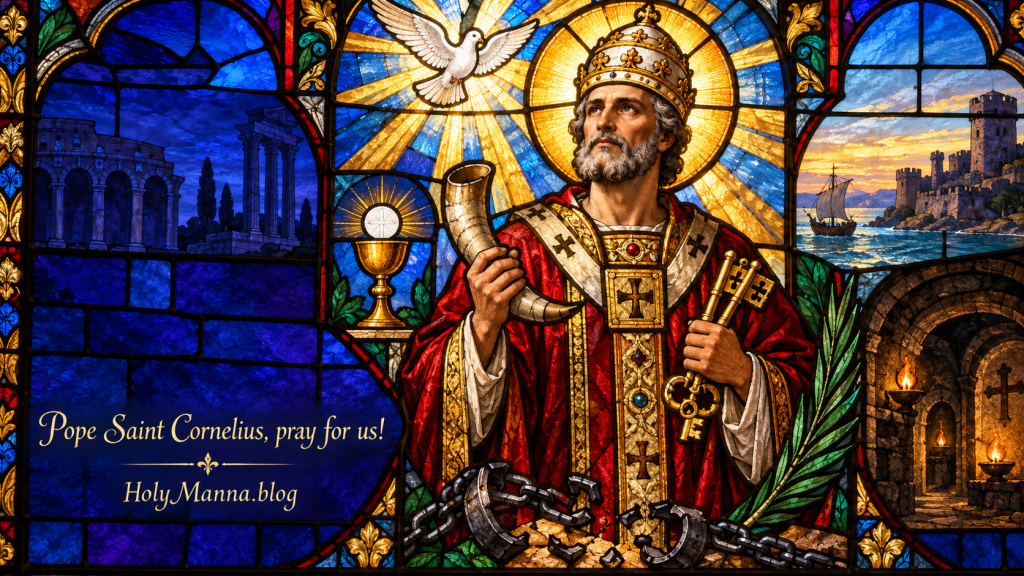
The Pope Who Proved That Mercy Is Stronger Than the Sword
Some saints are remembered for thundering sermons, others for dazzling miracles. Pope Saint Cornelius is remembered for something quieter and, in its own way, more radical. He is the pope who insisted, at the cost of his freedom and ultimately his life, that there is no sin so great that the Church cannot forgive it. In the middle of the third century, when the Roman Empire was doing everything in its power to crush Christianity, Cornelius governed the Church of Rome for a little over two years, from March of 251 to June of 253. In that short span he faced down an empire that wanted him dead and a rival bishop who wanted his chair, and he answered both with the same weapon: fidelity to the mercy of Jesus Christ.
The Church he defended still confesses what he defended. The Catechism teaches that “There is no offense, however serious, that the Church cannot forgive” (CCC 982). That sentence, so easy to read today, was purchased in blood in the age of Cornelius. He is venerated as a martyr, and his name is spoken at the altar to this day in the Roman Canon, the first Eucharistic Prayer, alongside his great friend Saint Cyprian of Carthage. His memorial is now celebrated on September 16 together with Cyprian, though his feast was anciently kept on September 14, the date on which, according to Saint Jerome, both men were martyred in different years.
Cornelius also holds several patronages. He is invoked against earache, epilepsy, fever, and twitching, and he is the patron of cattle and domestic animals, as well as of the town of Kornelimünster in Germany, where his head is enshrined. His very name means battle horn, which is why sacred art often shows him as a pope holding a cow’s horn or standing with a cow nearby. It is a gentle image for a man who fought one of the fiercest battles in the early Church, a battle not with a sword but with absolution.
A Roman Priest in the Worst of Times
History has preserved almost nothing about the childhood of Cornelius, and honesty demands saying so plainly. He was born in Rome, and he appears to have belonged to the ancient and distinguished Roman family known as the gens Cornelia, one of the great patrician clans of the city. Nothing verifiable is known about his parents, his upbringing, or the moment he came to faith. What is known is that by the year 250 he was a priest of the Church of Rome, formed in her clergy and trusted by her people, at the precise moment when being a Roman cleric was practically a death sentence.
In January of 250 the emperor Decius unleashed the first empire-wide, systematic persecution of Christians. Every citizen was ordered to sacrifice to the pagan gods before official commissioners and obtain a certificate proving it, or face imprisonment and death. Pope Fabian was martyred on January 20 of that year. The persecution was so intense that the Church of Rome did not dare elect a successor. For roughly fourteen months the Chair of Peter stood empty, and the Roman Church was governed by a council of priests, one of whom was a brilliant and severe theologian named Novatian. Remember that name.
In the spring of 251, Decius left Rome to fight rivals and invaders, and the pressure lifted just enough for sixteen bishops to gather in the city. They elected Cornelius, and the sources agree that he did not want the job. Saint Cyprian, bishop of Carthage, described the election in a letter, saying that Cornelius was chosen “by the judgment of God and of Christ, by the testimony of almost all the clergy, by the vote of the people then present, by the consent of aged priests and of good men, at a time when no one had been made before him, when the place of Fabian, that is the place of Peter, and the step of the sacerdotal chair were vacant” (Cyprian, Epistle 55). Accepting the papacy in 251 meant accepting a target on his back. Cornelius accepted anyway.
The Battle for the Lapsed
To understand why Cornelius matters, you have to understand the wound the Decian persecution left behind. Under threat of torture and death, many Christians had stood firm and died as martyrs. Many others had broken. Some actually offered the pagan sacrifice; others bribed officials for false certificates saying they had. These fallen Christians were called the lapsi, the lapsed. When the storm passed, thousands of them came back to the church doors weeping, begging to be readmitted to communion. The question that split the Church was simple and agonizing: could they come home?
Novatian said no. He argued that apostasy and idolatry were sins so grave that the Church had no power to absolve them; the lapsed could pray and hope in God’s mercy at death, but the Church could never restore them to the sacraments. It sounded rigorous and pure. It was also, Cornelius saw, a denial of the very power Christ had given His Church. Cornelius, supported by Cyprian and the council of Carthage, taught that the lapsed could be reconciled after sincere repentance and a real period of penance. Not cheap grace, and not a locked door; a genuine path home.
This is exactly what the Church still teaches. The Catechism explains that the Fathers of the Church presented the sacrament of Penance as “the second plank of salvation after the shipwreck which is the loss of grace” (CCC 1446), given precisely for those who fall into grave sin after Baptism. And it grounds that power in the words of Jesus to Peter in The Gospel of Matthew: “I will give you the keys of the kingdom of heaven, and whatever you bind on earth shall be bound in heaven, and whatever you loose on earth shall be loosed in heaven” (Mt 16:19). The Catechism comments that “The power to ‘bind and loose’ connotes the authority to absolve sins, to pronounce doctrinal judgements, and to make disciplinary decisions in the Church” (CCC 553). Cornelius was not inventing mercy. He was guarding the keys.
Novatian refused to yield. Instead, he had three bishops consecrate him as a rival bishop of Rome, making himself an antipope, one of the first in the history of the Church. Cornelius responded not with violence but with the instruments of communion: he convened a synod of sixty bishops in Rome in October of 251, which upheld his teaching, condemned Novatian’s rigorism, and excommunicated Novatian and his followers. Across the sea, Cyprian threw the full weight of Carthage behind Cornelius, writing in the same period, “There is one God and one Christ, and one Church, and one chair founded on Peter by the word of the Lord. It is not possible to set up another altar or for there to be another priesthood besides that one altar and that one priesthood. Whoever has gathered elsewhere is scattering” (Cyprian, Epistle 43). It should be said clearly, because the internet often gets this wrong, that these famous words belong to Cyprian writing in defense of Cornelius, not to Cornelius himself. Together, the two men held the Church to both truth and unity, the unity The Catechism describes when it teaches that the Church is “the sign and instrument of the full communion with God and unity among all men” and warns against the wound of schism (CCC 775, CCC 2089).
No miracles worked by Cornelius during his lifetime are recorded in any reliable source, and it would be dishonest to invent them. His wonder was of another kind. In his surviving letter to Fabius, the bishop of Antioch, preserved by the historian Eusebius, Cornelius gave a snapshot of the Church of Rome that still astonishes historians. Mocking Novatian’s ambition, he wrote, “This avenger of the Gospel then did not know that there should be one bishop in a catholic church; yet he was not ignorant (for how could he be?) that in it there were forty-six presbyters, seven deacons, seven sub-deacons, forty-two acolyths, fifty-two exorcists, readers, and janitors, and over fifteen hundred widows and persons in distress, all of whom the grace and kindness of the Master nourish” (Cornelius, Letter to Fabius of Antioch, in Eusebius, Church History 6.43). From those numbers, scholars estimate the Church of Rome held at least fifty thousand believers. Read that census slowly. In the middle of a persecution, the Church of Rome was feeding more than fifteen hundred widows and poor people. That is the miracle of Cornelius’s Rome: an outlawed community organized around charity. One more humanizing detail survives. Scholars note that Cornelius’s letters are written in the plain, colloquial Latin of the streets, not the polished classical style of the orator Cyprian or the philosopher Novatian. The pope of mercy wrote the way ordinary people talked.
Exile, Confession, and a Martyr’s Crown
The reprieve did not last. Decius died in battle, but his successor Gallus resumed the persecution, and this time the blow fell directly on the shepherd. Around 252 or early 253, the sources differ on the exact year, Cornelius was arrested and banished to Centumcellae, the harbor town known today as Civitavecchia, on the coast northwest of Rome. Exile in the Roman world was not a comfortable retirement; it meant deprivation, isolation, and slow suffering far from home.
What happened next is one of the most beautiful moments of the third century. The Christians of Rome, the very community that had produced so many lapsed believers just two years earlier, did not break this time. Not one. Cyprian wrote to Cornelius in exile with unconcealed joy, saying that Cornelius had led his brethren in confession, a deliberate echo of the confession of Saint Peter, and adding, “With one heart and one voice the whole Roman Church confessed. Then was seen, dearest Brother, that faith which the blessed Apostle praised in you; even then he foresaw in spirit your glorious fortitude and firm strength” (Cyprian, Epistle 60). Do you see the point Cyprian is making? The Church that had been treated with mercy after its failure now found the courage it had lacked before. Mercy had not made Rome’s Christians soft. Mercy had made them strong. This is the deep logic of the sacrament of Reconciliation, which, as The Catechism teaches, brings about “a true ‘spiritual resurrection,’ restoration of the dignity and blessings of the life of the children of God” (CCC 1468).
Cornelius died at Centumcellae in June of 253. The oldest and most reliable account holds that he died from the hardships of his exile, and the ancient Liberian Catalogue says simply that he died there gloriously. A later tradition, found in the Liber Pontificalis and drawn from a fifth-century account of his passion, says that he was brought back and beheaded; that dramatic version cannot be verified and rests on a document historians regard as apocryphal. The Church has never been troubled by the distinction, because Cyprian, who knew him, repeatedly and insistently called Cornelius a martyr, and the Church confirmed that judgment in her worship. Whether the sword fell or the exile simply ground his life away, Cornelius gave his life for Christ. The Catechism defines martyrdom as “the supreme witness given to the truth of the faith,” borne by one who “endures death through an act of fortitude” (CCC 2473). By that measure, Cornelius wears the crown. There is even a quiet piece of archaeology that tells the story. He was buried in the crypt of Lucina in the cemetery of Callistus on the Appian Way, and the marble slab over his tomb reads Cornelius Martyr. His is one of the earliest papal epitaphs written in Latin rather than Greek, and scholars note that the word martyr appears to have been added by a slightly later hand, as if the Church came back to his grave and wrote her verdict over it.
Relics, Pilgrims, and a Horn of Blessing
After his death, veneration of Cornelius spread far beyond Rome, carried along the ancient logic of the communion of saints, which The Catechism describes when it teaches that the saints in heaven “do not cease to intercede with the Father for us” and that “their intercession is their most exalted service to God’s plan” (CCC 956). Pilgrims sought his tomb on the Appian Way for centuries. Then, in the ninth century, his relics began to travel. A portion was given to a great abbey founded near Aachen in Germany, which took his very name and is known to this day as Kornelimünster, the minster of Cornelius. The abbey’s cherished tradition holds that it received the saint’s head, which is enshrined and venerated there still, and the town that grew around the abbey remains under his patronage. From Kornelimünster the devotion spread further: in 1138 the abbey of Ninove, near Brussels, dedicated to Saints Cornelius and Cyprian, received relics of its own and became a major pilgrimage destination, where the relics of the martyr pope were carried in procession through the town each year, and medieval pilgrims wore badges of Saint Cornelius as tokens of their journey.
Through the Middle Ages, countless healings and favors were attributed to his intercession at these shrines, above all deliverance from epilepsy, which people of that age called the falling sickness, along with relief from earaches, fevers, and convulsive twitching. These healing traditions are the root of his patronages, and while the medieval accounts of individual cures were treasured by the faithful, they cannot be individually verified today. In the Rhineland his intercession was held in such honor that he was counted among the Four Holy Marshals, four saints venerated together as standing especially close to the throne of God, alongside Saint Quirinus of Neuss, Saint Hubertus, and Saint Anthony the Great, and invoked with special confidence against disease and epidemic.
One charming tradition comes from Carnac in Brittany, France, where Cornelius is honored as a protector of horned cattle. The story told there says that the thousands of famous standing stones of Carnac were once ranks of pagan soldiers pursuing Cornelius, and that the saint turned them to stone as he fled. It is a wonderful tale, told for centuries by the faithful of Brittany, but it must be said plainly that this story cannot be verified and is pious tradition rather than history. What is entirely verifiable is the highest honor the Church gives him: at Mass, in the Roman Canon, the priest still prays in the company of Cornelius and Cyprian, two friends separated by the sea in life and joined forever at the altar. The Catechism explains that when the Church keeps the memorials of martyrs and saints in her liturgy, she “proclaims the Paschal mystery achieved in the saints who have suffered and been glorified with Christ” (CCC 1173).
What Cornelius Teaches a Fallen World
Here is the uncomfortable truth about the age of Cornelius: it looks a great deal like the human heart in every age. People break under pressure. People deny what they love when it costs too much to love it. And every one of us, if we are honest, has been among the lapsi in some way, through sins we swore we would never commit and compromises we made when faith got expensive. The question of the third century is the question of every confession line on a Saturday afternoon: can the fallen come home?
Cornelius staked his life on the answer Christ gave. Where in your own life have you quietly decided that some failure of yours is beyond forgiveness? The witness of Cornelius says that this decision is not yours to make, because Christ has already made the opposite one and entrusted it to His Church. The practical application of his life is almost embarrassingly concrete: go to Confession. Go especially if it has been years, and go especially if there is something you have never said out loud. The Catechism promises that those who approach the sacrament of Penance “obtain pardon from God’s mercy for the offense committed against him” and are “reconciled with the Church which they have wounded by their sins” (CCC 1422).
Cornelius also teaches something to those of us tempted in the opposite direction, toward the rigorism of Novatian. It is strangely satisfying to be severe, to write people off, to guard the doors of the Church as if mercy were a scandal. Is there someone you have mentally excommunicated, a family member, a friend, a fellow parishioner whose failure you have decided is final? Cornelius would remind you that severity which slams the door on the repentant is not holiness; it is a counterfeit of it, and it tore the Church of his day in two. Real love, as he lived it, holds truth and mercy together: sin is named honestly, penance is real, and the door stays open.
Finally, Cornelius teaches endurance without spectacle. He worked no recorded miracles. He simply did his duty, fed the widows, wrote his letters in street Latin, held the Church together, and walked into exile when the soldiers came. Most Christian lives look like that. Fidelity in ordinary duties, sustained through one hard season after another, is the stuff most saints are actually made of. What is the exile you are being asked to endure faithfully right now, the season you did not choose and cannot escape? Offer it as Cornelius offered Centumcellae, and let God write the word martyr, which means witness, over your ordinary days.
Engage With Us!
We would love to hear from you, so please share your thoughts and reflections on Pope Saint Cornelius in the comments below. His story of mercy, schism, and quiet martyrdom touches wounds and hopes that many carry today, and your experience might be exactly the encouragement another reader needs. To help you pray with his life, here are some questions to take to heart:
- When have you experienced the mercy of God in the sacrament of Confession, and what kept you away before you finally went?
- Cornelius refused to make the Church smaller and purer by locking out the repentant. Where are you tempted to prefer a Church, or a circle of friends, purged of people who have failed?
- The Christians of Rome, forgiven after their weakness, stood firm the second time persecution came. How has being forgiven changed your own courage?
- Cornelius served without visible miracles, in plain language, under constant threat. What ordinary, unglamorous duty is God asking you to be faithful to this week?
- If you were to write a one line epitaph of witness over your own life, as the early Church wrote Cornelius Martyr over his tomb, what would you want it to say, and what would need to change for it to be true?
Take heart from this humble pope who guarded the keys of mercy with his life. The same forgiveness he defended is waiting for you in every confessional, and the same grace that turned Rome’s lapsed into confessors can turn your worst chapter into your strongest one. Live this week as a life of faith, hold the door of mercy open for everyone God sends you, and do everything, absolutely everything, with the love and mercy that Jesus taught us.
Pope Saint Cornelius pray for us!
Follow us on YouTube, TikTok, Instagram and Facebook for more insights and reflections on living a faith-filled life.

 Holy Manna!
Leave a comment