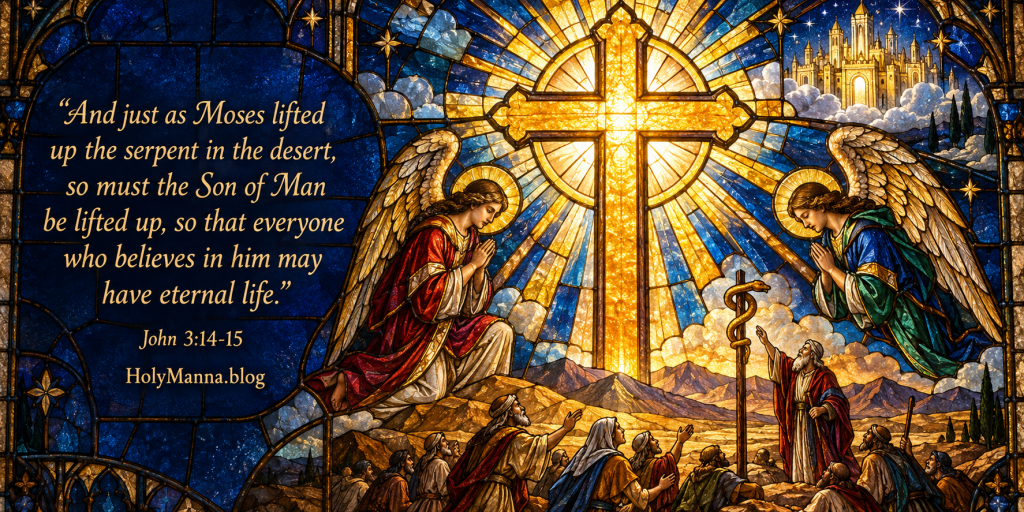
Feast of the Exaltation of the Holy Cross – Lectionary: 638
The Day the Church Looks Up
Some feasts celebrate a person. This one celebrates a piece of wood, and that should stop everyone in their tracks. On September 14th, the Feast of the Exaltation of the Holy Cross, the Church holds up the Roman empire’s most shameful instrument of execution and calls it glorious. The feast is rooted in real places and real dates. In the year 335, Constantine dedicated the Church of the Holy Sepulchre, built over Calvary and the empty tomb in Jerusalem. Tradition holds that his mother, St. Helena, had discovered the relic of the True Cross there around the year 326. Three centuries later, after Persian invaders carried the relic away, Emperor Heraclius recovered it and returned it to Jerusalem around the year 630, and tradition tells that he entered the city carrying the Cross stripped of his imperial robes, because glory and humility belong together on this day.
The readings the Church selects for this feast form one seamless story. In the desert, poisoned people are healed by looking at a serpent lifted on a pole. The psalmist begs Israel, and everyone since, never to forget what God has done. Paul sings of the Son of God who emptied Himself all the way down to a cross, and was therefore exalted above every name. And Jesus Himself, speaking quietly to Nicodemus at night, ties it all together: as Moses lifted up the serpent, so must the Son of Man be lifted up. The central theme is unmistakable. In God’s hands, the instrument of death becomes the instrument of life, and salvation comes by looking with faith upon the One lifted up. This is not defeat exalted. This is love exalted.
First Reading — Numbers 21:4b-9
The Strange Mercy of the Bronze Serpent
The scene comes near the end of Israel’s forty years in the wilderness. The people are detouring around the hostile territory of Edom, adding miles to an already exhausting journey, and their patience finally snaps. They have seen the Red Sea part and manna fall from heaven, yet they now call that miraculous bread wretched. What follows is one of the strangest and most important episodes in the Old Testament, because Jesus Himself will choose it, in today’s Gospel, as the image of His own crucifixion. This reading sets the pattern for the entire feast: sin brings poison, God provides the remedy, and the remedy requires looking up in faith.
Numbers 21:4b-9
With their patience worn out by the journey,
the people complained against God and Moses,
“Why have you brought us up from Egypt to die in this desert,
where there is no food or water?
We are disgusted with this wretched food!”In punishment the LORD sent among the people saraph serpents,
which bit the people so that many of them died.
Then the people came to Moses and said,
“We have sinned in complaining against the LORD and you.
Pray the LORD to take the serpents from us.”
So Moses prayed for the people, and the LORD said to Moses,
“Make a saraph and mount it on a pole,
and if any who have been bitten look at it, they will live.”
Moses accordingly made a bronze serpent and mounted it on a pole,
and whenever anyone who had been bitten by a serpent
looked at the bronze serpent, he lived.
Detailed Exegesis
Verses 4b-5: “With their patience worn out by the journey, the people complained against God and Moses, ‘Why have you brought us up from Egypt to die in this desert, where there is no food or water? We are disgusted with this wretched food!’” The complaint is not honest lament, which Scripture honors, but accusation against God’s goodness. Calling manna wretched means despising a daily miracle. Ingratitude is presented here as a spiritual poison before any serpent ever appears.
Verse 6: “In punishment the LORD sent among the people saraph serpents, which bit the people so that many of them died.” The Hebrew word saraph means fiery or burning, describing the venom’s effect. The outward plague makes visible the inward reality; grumbling had already been killing the camp from within.
Verse 7: “Then the people came to Moses and said, ‘We have sinned in complaining against the LORD and you. Pray the LORD to take the serpents from us.’ So Moses prayed for the people.” Confession comes first, then intercession. Moses standing between the sinful people and God prefigures the mediation of Christ and, in a lesser way, the intercessory role of priests and of all believers.
Verse 8: “And the LORD said to Moses, ‘Make a saraph and mount it on a pole, and if any who have been bitten look at it, they will live.’” Notice what God does not do. He does not remove the serpents, as the people asked. He provides healing within the affliction. The remedy demands an act of faith: to look at the very image of the thing that is killing them.
Verse 9: “Moses accordingly made a bronze serpent and mounted it on a pole, and whenever anyone who had been bitten by a serpent looked at the bronze serpent, he lived.” The bronze had no power of its own. Centuries later, when Israel began worshiping the object and burning incense to it, King Hezekiah destroyed it and called it Nehushtan, a mere piece of bronze, as recorded in 2 Kings 18:4. God heals; the sign only directs the gaze.
Teachings
The Catechism names this very object when explaining why God permitted certain images even under the old law. CCC 2130 teaches: “Nevertheless, already in the Old Testament, God ordained or permitted the making of images that pointed symbolically toward salvation by the incarnate Word: so it was with the bronze serpent, the ark of the covenant, and the cherubim.” The bronze serpent was never an idol; it was a prophecy in metal, pointing forward to the crucifix. This is precisely why Catholics keep the corpus on the cross. The Book of Wisdom, reflecting on this episode, calls the serpent a symbol of salvation and insists the people “were saved not by what they saw, but by you, the savior of all” (Wisdom 16:7). The sign and the Savior must never be confused, and the sign must never be discarded either.
Reflection
Everyone knows what it feels like to be snake-bitten by their own complaining. Gratitude fatigue is real; the daily bread of an ordinary life starts to look wretched when the journey drags on. The remedy in this reading is almost embarrassingly simple: confess, and look up. This week, try replacing one complaint each day with one spoken thanksgiving, and when sin has already bitten, look at a crucifix and hold the gaze for a full minute before saying anything. What “wretched food” in life is actually daily manna that has stopped being seen as gift? When sin wounds, is the first instinct to look inward in shame, or upward in faith?
Responsorial Psalm — Psalm 78:1bc-2, 7b, 34-38
A Song Against Forgetting
Psalm 78 is one of the great historical psalms, a maskil of Asaph that retells Israel’s story across seventy-two verses so that the next generation will not repeat it. The Church places it here because it is the desert story of the First Reading set to music, and because its refrain names the disease behind every grumble in the wilderness: forgetfulness. The verses chosen trace the whole painful cycle, punishment, shallow repentance, and the astonishing mercy of a God who forgives anyway. Remarkably, verse 2 is quoted in Matthew 13:35 as fulfilled when Jesus taught in parables, which means this psalm always had Christ hidden inside it.
Psalm 78:1bc-2, 7b, 34-38
R. (see 7b) Do not forget the works of the Lord!
Hearken, my people, to my teaching;
incline your ears to the words of my mouth.
I will open my mouth in a parable,
I will utter mysteries from of old.
R. Do not forget the works of the Lord!
While he slew them they sought him
and inquired after God again,
Remembering that God was their rock
and the Most High God, their redeemer.
R. Do not forget the works of the Lord!
But they flattered him with their mouths
and lied to him with their tongues,
Though their hearts were not steadfast toward him,
nor were they faithful to his covenant.
R. Do not forget the works of the Lord!
But he, being merciful, forgave their sin
and destroyed them not;
Often he turned back his anger
and let none of his wrath be roused.
R. Do not forget the works of the Lord!
Detailed Exegesis
Verses 1bc-2: “Hearken, my people, to my teaching; incline your ears to the words of my mouth. I will open my mouth in a parable, I will utter mysteries from of old.” The psalmist speaks like a father gathering his children. History, for Israel, is not trivia; it is revelation. The mysteries from of old will only fully open in Christ, the true teacher in parables.
Verse 7b, the refrain: “Do not forget the works of the Lord!” This single line diagnoses the desert generation and every generation since. Sin rarely begins with defiance; it begins with amnesia.
Verses 34-35: “While he slew them they sought him and inquired after God again, remembering that God was their rock and the Most High God, their redeemer.” Suffering jolts the memory. The people remember God as rock and redeemer only when the ground gives way, and God, in His mercy, accepts even that late-arriving prayer.
Verses 36-37: “But they flattered him with their mouths and lied to him with their tongues, though their hearts were not steadfast toward him, nor were they faithful to his covenant.” Here is the psalm’s most uncomfortable honesty: repentance can be shallow. Lips can move while hearts stay parked.
Verse 38: “But he, being merciful, forgave their sin and destroyed them not; often he turned back his anger and let none of his wrath be roused.” After all that flattery and lying, the sentence everyone expects never comes. The hinge of the whole psalm is the phrase “But he, being merciful.” God’s fidelity outlasts human infidelity.
Teachings
The Catechism defines the heart of the Gospel in exactly these terms. CCC 1846 teaches: “The Gospel is the revelation in Jesus Christ of God’s mercy to sinners.” The psalm shows that mercy operating centuries before Calvary, and Calvary shows how far that mercy was always willing to go. The Church’s constant remedy for spiritual amnesia is the liturgy itself; the Eucharist is commanded remembrance, done in memory of Him, so that no generation forgets the works of the Lord.
Reflection
Memory is a spiritual discipline, not a mood. Consider ending each day this week with a brief examen: name one work of the Lord from that day, thank Him for it, and write it down. A running list of God’s works becomes personal armor against the next season of desert grumbling. Which past rescue, healing, or undeserved grace has quietly slipped out of memory? Does personal repentance reach the heart, or does it sometimes stop at the lips, as in verse 36?
Second Reading — Philippians 2:6-11
The Hymn of the Descending God
Writing from prison to the Christians of Philippi, a proud Roman colony where crucifixion was the ultimate legal disgrace, Paul quotes what many scholars regard as one of the earliest hymns of the Church, the Carmen Christi. Its shape is a great V: the Son descends from equality with God down to slavery, down to death, down to the specific horror of a cross, and from that lowest point God exalts Him above everything. On the Feast of the Exaltation of the Holy Cross, this hymn explains what “exaltation” actually means. The Cross is not the obstacle to Christ’s glory. It is the road to it.
Philippians 2:6-11
Brothers and sisters:
Christ Jesus, though he was in the form of God,
did not regard equality with God something to be grasped.
Rather, he emptied himself,
taking the form of a slave,
coming in human likeness;
and found human in appearance,
he humbled himself,
becoming obedient to death,
even death on a cross.
Because of this, God greatly exalted him
and bestowed on him the name
that is above every name,
that at the name of Jesus
every knee should bend,
of those in heaven and on earth and under the earth,
and every tongue confess that
Jesus Christ is Lord,
to the glory of God the Father.
Detailed Exegesis
Verse 6: “Christ Jesus, though he was in the form of God, did not regard equality with God something to be grasped.” Where Adam grasped at equality with God and fell, the true Son, already possessing that equality, refused to cling to its privileges. Divinity, it turns out, is not self-assertion but self-gift.
Verse 7: “Rather, he emptied himself, taking the form of a slave, coming in human likeness.” This is the famous kenosis, the self-emptying. The Son did not stop being God; He veiled His glory and assumed the lowest human condition, that of a slave, the class for whom crosses were reserved.
Verse 8: “And found human in appearance, he humbled himself, becoming obedient to death, even death on a cross.” The hymn descends step by step and lands with a thud on its final phrase. To Roman ears, “even death on a cross” was scandalous beyond words. Obedience motivated by love transforms the empire’s instrument of terror into the supreme act of worship.
Verse 9: “Because of this, God greatly exalted him and bestowed on him the name that is above every name.” The turn is immediate and total. Exaltation is not compensation for the Cross; it flows from it. The Greek verb here is emphatic, a super-exaltation.
Verses 10-11: “That at the name of Jesus every knee should bend, of those in heaven and on earth and under the earth, and every tongue confess that Jesus Christ is Lord, to the glory of God the Father.” Paul deliberately echoes Isaiah 45:23, where every knee bends to the God of Israel alone, and applies it to Jesus. The confession “Jesus Christ is Lord” is the Church’s oldest creed, and in the first century it was a dangerous one, since Caesar claimed that title.
Teachings
The Catechism builds its teaching on the Incarnation directly upon this hymn; CCC 461 introduces its full text as the truth “the Church calls ‘Incarnation,’” the fact that the Son of God assumed a human nature in order to accomplish salvation in it. On the exalted Name, CCC 434 teaches: “Jesus’ Resurrection glorifies the name of the Savior God, for henceforth it is the name of Jesus that fully manifests the supreme power of the name which is above every name.” St. Andrew of Crete, in his great discourse for this very feast, sings the same paradox: “Had there been no cross, Christ could not have been crucified. Had there been no cross, life itself could not have been nailed to the tree… Therefore, the cross is something wonderfully great and honorable” (Oratio 10 in Exaltatione sanctae crucis). He goes on to call the Cross both the sign of God’s suffering and the trophy of His victory.
Reflection
The way up is down; this hymn makes that the family rule of every Christian. Look for one concrete act of self-emptying this week: take the task nobody wants, yield the argument that pride wants to win, serve someone who can never repay it, and do it quietly. Then bend the knee, literally, at the name of Jesus during the Creed or in personal prayer, and let the body teach the soul. Which privilege, comfort, or bit of status is hardest to release, and what would “emptying” look like there? Is Jesus confessed as Lord over every area of life, or only the convenient ones?
Holy Gospel — John 3:13-17
Lifted Up: The Conversation That Explains the Cross
It is night in Jerusalem, and a Pharisee named Nicodemus has come to Jesus quietly, full of questions. In the middle of that hushed conversation, Jesus reaches back to the strange desert story of the bronze serpent and makes it a prophecy of Himself. John’s Gospel loves the verb “lifted up,” in Greek hypsoō, precisely because it means two things at once: hoisted on a cross and exalted in glory. This passage, containing the most famous verse in all of Scripture, is the key that unlocks the entire feast, and the reason the Church can look at an instrument of execution and see the love of God.
John 3:13-17
Jesus said to Nicodemus:
“No one has gone up to heaven
except the one who has come down from heaven, the Son of Man.
And just as Moses lifted up the serpent in the desert,
so must the Son of Man be lifted up,
so that everyone who believes in him may have eternal life.”For God so loved the world that he gave his only Son,
so that everyone who believes in him might not perish
but might have eternal life.
For God did not send his Son into the world to condemn the world,
but that the world might be saved through him.
Detailed Exegesis
Verse 13: “No one has gone up to heaven except the one who has come down from heaven, the Son of Man.” Jesus asserts a unique authority; He alone can speak of heavenly things because He alone descended from heaven. The descent Paul sang about in Philippians 2 is here declared by the Lord Himself.
Verses 14-15: “And just as Moses lifted up the serpent in the desert, so must the Son of Man be lifted up, so that everyone who believes in him may have eternal life.” The little word “must” carries the weight of the divine plan. As the poisoned Israelites were healed by looking in faith at the raised serpent, so the human race, poisoned by sin, is healed by looking in faith at the crucified Christ. The typology is exact: the image of the curse, raised up, becomes the cure.
Verse 16: “For God so loved the world that he gave his only Son, so that everyone who believes in him might not perish but might have eternal life.” Often called the Gospel in miniature, this verse names the motive behind everything: love. The word “gave” includes both the Incarnation and the Cross. God’s answer to a perishing world was not a program but a Person, handed over.
Verse 17: “For God did not send his Son into the world to condemn the world, but that the world might be saved through him.” The mission is rescue, not condemnation. Whatever judgment exists falls on those who refuse the light, but the Son’s purpose, stated plainly, is salvation for the world.
Teachings
St. Augustine drew the connection between the two lifted signs with unforgettable clarity in his Tractate 12 on the Gospel of John: “Just as they who looked on that serpent perished not by the serpent’s bites, so they who look in faith on Christ’s death are healed from the bites of sins.” He adds that the figure procured only temporal life, while the reality procures eternal life. The Catechism gathers both threads of this Gospel. CCC 458 teaches: “The Word became flesh so that thus we might know God’s love: ‘For God so loved the world that he gave his only Son, that whoever believes in him should not perish but have eternal life.’” And CCC 662, commenting on the “lifted up” sayings, teaches: “The lifting up of Jesus on the cross signifies and announces his lifting up by his Ascension into heaven, and indeed begins it.” Crucifixion and exaltation are one single upward movement of love.
Reflection
Faith, at its simplest, is a direction of the gaze. The Israelites did not have to climb, pay, or perform; they had to look and trust. Keep a crucifix where the eyes land first each morning, and let looking at it become the day’s first prayer. When guilt over past sin resurfaces, resist the urge to stare at the wound and instead look at the Wounded One, ideally in Confession, where His healing is applied personally. When life stings, where does the gaze go first: the phone, the mirror, or the Cross? Is John 3:16 believed personally, with a name inserted where it says “the world”?
The Wood That Learned to Carry Glory
Set the four readings side by side and one story emerges. A grumbling people is poisoned by its own ingratitude, and God’s remedy is a sign lifted high: look and live. A psalmist pleads across the centuries, do not forget the works of the Lord, because forgetting is where the poison always starts. An early Christian hymn traces the Son of God descending past every human bottom, even death on a cross, and being exalted above every name precisely because of it. And Jesus, in a quiet nighttime conversation, gathers it all into one sentence: the Son of Man must be lifted up, so that everyone who believes may have eternal life.
This is why the Church does something on September 14th that the world will never fully understand. She takes the most brutal invention of Roman cruelty and lifts it up in triumph, processes behind it, kisses it, wears it, traces it on foreheads and hearts. Not because suffering is good, but because Love went into suffering and came out the other side dragging death behind it like a defeated enemy. The Cross is the proof, planted in history, that no poison in any life is beyond healing, and that God’s response to a perishing world was to give what was most precious to Him.
So the invitation of this feast is wonderfully simple. Look up. Look up from the grumbling, from the shame, from the endless scroll, and fix the eyes of faith on the One who was lifted up out of love. Then live like people who have been healed, because that is exactly what the Cross has made possible.
Engage With Us!
The comments below are open, and every reflection shared there helps someone else look up too. Take a moment with these questions and share where the readings landed:
- In Numbers 21:4b-9, the Israelites despised the manna before the serpents ever came. What daily gift from God is most easily taken for granted, and what would it look like to receive it with fresh gratitude this week?
- Psalm 78:1bc-2, 7b, 34-38 warns against forgetting the works of the Lord and against repentance that stays on the lips. What practice could help keep God’s past faithfulness in active memory?
- In Philippians 2:6-11, Christ empties Himself and is exalted because of His obedience. Where is God inviting a concrete act of self-emptying right now?
- In John 3:13-17, Jesus says the Son of Man must be lifted up so that believers may have eternal life. What does it mean, practically, to “look at the Cross” in the middle of an ordinary Tuesday?
- Taking all the readings together, where in life does the instrument of pain most need to become, through Christ, an instrument of grace?
Faith is lived one upward glance at a time. Walk through this feast, and every day after it, doing everything with the love and mercy Jesus taught us, and the Cross will keep turning poison into life.
Sacred Heart of Jesus, we trust in You!
Immaculate Heart of Mary, pray for us!
Saint Michael the Archangel, defend us in battle!
Follow us on YouTube, TikTok, Instagram and Facebook for more insights and reflections on living a faith-filled life.

 Holy Manna!
Leave a comment