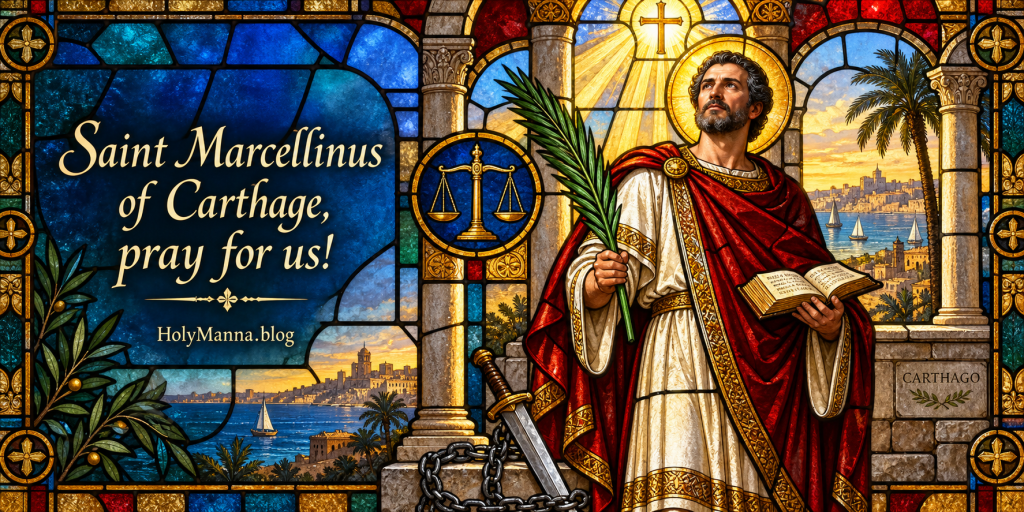
The Judge Who Chose Christ
Most saints of the early Church were bishops, priests, monks, or consecrated virgins. Saint Marcellinus of Carthage was none of these. He was a married layman with a demanding government job, a high official of the Western Roman Empire who answered directly to Emperor Honorius, and one of the closest friends Saint Augustine of Hippo ever had. When Augustine sat down to write The City of God, one of the most influential books in the history of Christianity, he opened it by addressing this busy imperial administrator by name. And when the enemies of the Catholic faith could not defeat Marcellinus in argument, they destroyed him with a lie, and he went to his death on September 13th, 413, a martyr in everything but the courtroom record, which the emperor himself would later correct.
Marcellinus matters because he shows that holiness does not require a cloister or a pulpit. The Church teaches that the laity are called by God to seek the Kingdom precisely by engaging in temporal affairs and directing them according to God’s will, sanctifying the world from within like leaven (CCC 898). Marcellinus did exactly that. He brought his faith into the imperial courtroom, into the most bitter Church controversy of his age, and finally into a prison cell in Carthage, where he waited for the executioner with a conscience so clean that Augustine never stopped marveling at it. He is honored as a martyr in the Roman Martyrology, where the great Cardinal Baronius inscribed his name, and he is venerated in both the Catholic and Eastern Orthodox Churches. His witness belongs in a special way to every Catholic who works a secular job and wonders whether sanctity is really possible there.
A Layman Formed for Great Things
Almost nothing certain is known about the beginnings of Marcellinus. The Catholic reference tradition, including the Catholic Encyclopedia and the New Catholic Encyclopedia, records no date of birth and no confirmed birthplace. Some modern accounts state that he was born in Toledo in Spain, but this claim does not appear in the classical Catholic sources and cannot be verified, so it is best held loosely as a report rather than a fact. What the sources do establish is his family and his rank. His full name was Flavius Marcellinus. He had a brother named Apringius, who rose to become proconsul of Africa, one of the highest civil offices in the Roman world. Marcellinus himself was married; his wife’s name, Anapsychia, is preserved because Saint Jerome addressed a letter to the couple, a letter that arrived, heartbreakingly, after Marcellinus was already dead. Marcellinus held the office of tribunus et notarius, tribune and notary, a senior post at the court of Emperor Honorius that combined administrative, legal, and diplomatic responsibility.
The old sources describe him as a cultured and generous man of unblemished conduct who possessed the full confidence of his emperor. But what set Marcellinus apart from a thousand other capable Roman officials was the direction of his heart. He was a serious, believing Catholic who loved theology the way other men of his class loved the games or the baths. He read deeply, asked hard questions, and sought out the best minds of the Church to answer them. There is no recorded dramatic conversion in his life; the sources present him as a man already formed in the faith, whose story is not one of turning from sin to God but of deepening, of a layman’s steady growth toward the moment when God would ask him for everything. The Catechism teaches that all the faithful, whatever their state in life, are called to the fullness of Christian life and to the perfection of charity (CCC 2013). Marcellinus is proof that this call reaches into government offices and imperial courts.
The Conference That Held the Church Together
To understand why Marcellinus matters, the reader has to understand the crisis he was sent to resolve. For a century, the Church in North Africa had been torn in two by the Donatist schism. The Donatists had broken away after the great persecution of Diocletian, claiming that bishops who had weakened under torture and handed over the Scriptures had lost the power to celebrate valid sacraments, and that the true Church was a Church of the pure alone. Catholics answered that the holiness of the sacraments comes from Christ, not from the personal worthiness of the minister. The Church would later state this teaching with precision: the sacrament is not wrought by the righteousness of the minister or the recipient but by the power of God, which is why the Church teaches that sacraments act ex opere operato, by the very fact of the action being performed (CCC 1128). She likewise confesses that the Church herself embraces sinners in her bosom and is at once holy and always in need of purification (CCC 827). The Donatists rejected all of this, rebaptized Catholics, and in some regions their partisans turned to intimidation and violence.
By 411 the schism had produced two rival hierarchies across North Africa, and Emperor Honorius decided to force a resolution. He chose Marcellinus as his plenipotentiary judge and sent him to Carthage to preside over a formal conference between the two sides and to pass binding sentence. The scale of the gathering was staggering. According to the records of the conference preserved in Catholic sources, 286 Catholic bishops and 279 Donatist bishops assembled at Carthage, with Saint Augustine himself serving as the leading voice for the Catholic side. The conference opened on June 1st, 411, and stretched over several sessions of dense argument about Scripture, history, and the nature of the Church.
Everything depended on the fairness of the judge, and here Marcellinus proved himself a man of extraordinary integrity. The Catholic Encyclopedia records that he conducted the negotiations with great patience and entire impartiality. He gave the Donatists every procedural courtesy, heard the arguments at length, and only then rendered his verdict: the Catholic side had proven its case. The Donatist claims collapsed under the weight of the evidence, and imperial decrees followed confirming the Catholic Church in her rights. The Donatists never forgave him. They accused him of taking bribes, an accusation the sources treat as baseless, and they waited for their moment.
It was through this conference that Marcellinus and Augustine became true friends. The imperial judge and the bishop of Hippo discovered in each other the same hunger for truth. Augustine wrote Marcellinus letter after letter, and Marcellinus kept sending Augustine questions, the kind of questions that draw great answers out of great minds. When educated pagans in Carthage, shaken by the sack of Rome in 410, blamed Christianity for the empire’s disasters, it was Marcellinus who pressed Augustine to respond. The result was The City of God. Augustine opened that masterpiece with a dedication that has carried the layman’s name across sixteen centuries: “the glorious city of God is my theme in this work, which you, my dearest son Marcellinus, suggested, and which is due to you by my promise.” Augustine also dedicated to him De peccatorum meritis et remissione and De spiritu et littera, the first great works against the Pelagian heresy, both written in answer to questions Marcellinus had raised. It is no exaggeration to say that some of the most important theology ever written exists because one layman kept asking his friend the bishop to explain the faith.
One episode reveals the quality of his soul in office. When Donatist partisans were convicted before his tribunal of murdering one Catholic priest and mutilating another, Augustine wrote to Marcellinus and to his brother Apringius begging that the guilty men be spared death, so that Catholic mercy would shine brighter than Donatist cruelty. Marcellinus, the judge with every legal right to order executions, received the appeal of the bishop with docility. He was a man who held real power and wielded it under the Gospel. No miracles are recorded of Marcellinus during his lifetime, and honesty requires saying so plainly. His wonders were of another kind: an incorruptible verdict, a friendship that produced The City of God, and a public life lived without stain in one of the most corrupt courts on earth.
The False Charge and the Executioner’s Sword
In 413 the moment the Donatists had waited for arrived. Heraclian, the count of Africa, rose in revolt against Emperor Honorius, and the rebellion was crushed by a general named Marinus. In the frightened aftermath, when accusations of treason flew cheaply, certain Donatists whispered to Marinus that Marcellinus and his brother Apringius had been secret supporters of the usurper. The charge was absurd; Marcellinus was the emperor’s own trusted envoy, the man who had risked Donatist hatred to carry out imperial policy. Saint Jerome, writing in Against the Pelagians, states flatly that the Donatists accused him falsely out of hatred. Ancient sources also suggest that Marinus, who was sympathetic to the Donatists, may have been bribed; the historian Orosius insinuates as much, though this cannot be established with certainty. What is certain is that Marinus arrested both brothers and threw them into prison at Carthage.
The Church of Africa rose to defend him. Augustine came to Carthage and visited his friend in prison. Several African bishops joined in a formal letter of intercession. In Letter 151, written after the tragedy, Augustine left a tribute to what he found in that cell, and it is one of the most moving character portraits in patristic literature. He recounts that he questioned Marcellinus privately about his past life, asking whether he had ever committed the kind of sin that required grave penance, and that the imprisoned judge, with deep modesty, made clear that he had kept himself pure. Augustine testified openly to his upright character, his chastity, and his Christian bearing in chains. The old Dictionary of Christian Biography, summarizing Augustine’s account, records that the brothers’ behavior in prison was edifying. Facing death on a lie, Marcellinus did not rage, did not despair, and did not compromise. Scripture describes exactly this kind of soul: “But the souls of the just are in the hand of God, and the torment of death shall not touch them” (Wisdom 3:1).
Then came the cruelest turn. An official named Caecilianus, who was in a position to influence the case, visited Augustine personally and gave him the strongest assurances that the prisoners would be released, solemnly protesting that he bore them no hostility. Augustine allowed himself to hope. The very next day, the sentence was carried out. Marcellinus was beheaded at Carthage in mid-September of 413, and the sources indicate his brother Apringius perished with him. The exact day is disputed and should be reported honestly: the Catholic Encyclopedia gives September 12th, the most widespread tradition and the Eastern churches keep September 13th, and one older reference places the execution on September 15th or 16th. What no source disputes is that an innocent Catholic layman died because he had defended the true Church.
The vindication came swiftly, though too late. Marinus was recalled from Africa in disgrace. The following year, in the imperial edict of August 30th, 414, which reaffirmed the decrees against the Donatists, Emperor Honorius referred to Marcellinus with honor, publicly exonerating the man his own officer had killed. Rome cleared his name; heaven had already crowned him. The Church came to venerate him as a martyr because his death was the direct result of his defense of orthodox Christianity. The Catechism teaches that “martyrdom is the supreme witness given to the truth of the faith” (CCC 2473), a witness borne even unto death. Marcellinus bore that witness not against pagan Rome but against heretics who wore the name of Christ, which makes his martyrdom a sobering reminder that fidelity can cost everything even inside the household of the baptized. The words of the Lord in The Gospel of Matthew belong to him: “Blessed are they that suffer persecution for justice’ sake: for theirs is the kingdom of heaven” (Matthew 5:10).
A Name Written into the City of God
Honesty requires stating plainly that no miracles are recorded through the intercession of Saint Marcellinus after his death, no healings are attached to his name in the sources, and no relic tradition or pilgrimage site is documented. His cause never needed wonders, because his sanctity was established by the testimony of a Doctor of the Church who knew him intimately and by the public record of his innocence. Centuries later, when Cardinal Baronius revised the Roman Martyrology, he inscribed Marcellinus among the martyrs, and the classical Catholic references list his feast under April 6th, while the day of his death in mid-September, kept as September 13th, remains his traditional commemoration in many calendars, including those of the Eastern Orthodox Church, which also venerates him. Both dates circulate in the sources, and the conflict is noted here rather than smoothed over.
His truest monument is a book. Every copy of The City of God ever printed carries his name in its opening line, which means that this African layman is quietly present in every seminary, every theology classroom, and every serious Catholic library on earth. The anti-Pelagian works Augustine dedicated to him helped the Church define her teaching on grace, original sin, and baptism, truths the Catechism still proclaims (CCC 405, CCC 1250). The verdict he rendered at Carthage in 411 marked the beginning of the end of the Donatist schism and preserved for the Church her understanding of the sacraments and of her own mixed, mercy-filled holiness (CCC 827). There are also visible memorials: modern catalogues of the great monuments report that a statue of Saint Marcellinus stands on the spire above the south transept of the Cathedral of Milan, and that a figure of the saint is counted among those crowning Bernini’s colonnade in Saint Peter’s Square. A martyred civil servant, falsely condemned in a provincial prison, now stands in stone above the very heart of the Catholic world. The psalmist’s word is fulfilled in him: “Precious in the sight of the Lord is the death of his saints” (Psalm 115:15, Douay-Rheims numbering).
Holiness in Ordinary Clothes
Saint Marcellinus never preached a homily, never founded an order, and never left the world for the desert. He answered emails, so to speak; he sat through long meetings, managed impossible personalities, and carried the weight of decisions that affected thousands. That is precisely why he is such a needed saint today. The Church teaches that lay people fulfill their mission in the ordinary circumstances of family and social life, and that they are called to illuminate and order temporal affairs so that they may always be effected and grow according to Christ (CCC 898, 899). She teaches too that the witness of a Christian life, and good works done in a supernatural spirit, have real power to draw others to the faith (CCC 2044, CCC 905). Marcellinus sanctified a courtroom. The reader is invited to consider what that means for a cubicle, a classroom, a job site, or a kitchen. Where has God placed you, and have you ever truly asked Him why He placed you there?
His life offers three lessons that fit daily living. The first is intellectual seriousness about the faith. Marcellinus asked questions, sought out sound teachers, and refused to let his soul starve while his career flourished. A Catholic today can imitate him by reading Scripture prayerfully, studying the Catechism a few paragraphs at a time, and bringing honest questions to the Church rather than to the noise of the internet. The second is integrity under pressure. Marcellinus judged fairly when partiality would have been easier, showed mercy when severity was legal, and told the truth when a small compromise might have saved his life. The Catechism names this virtue fortitude, the firmness in difficulties and constancy in the pursuit of the good that strengthens the resolve to resist temptations and even enables one to renounce and sacrifice his life in defense of a just cause (CCC 1808). When was the last time doing the right thing actually cost you something? The third is friendship ordered to heaven. The bond between Marcellinus and Augustine produced eternal fruit because it was built on a shared love of truth. Do your closest friendships push you toward God, and do you push your friends toward Him?
Finally, Marcellinus teaches something hard and precious about injustice. He died condemned, slandered, and abandoned by the very system he had served faithfully, and his vindication came only after his death. Every believer who has been lied about, passed over, or punished for honesty can bring that wound to this saint. The communion of saints means that his victory is shared with the whole Body of Christ, for the Church teaches that the union of the wayfarers with the brethren who sleep in the peace of Christ is in no way interrupted, and that the saints do not cease to intercede with the Father for those on earth (CCC 955, CCC 956). He stands now where no false witness can reach him, and he waits to help those still standing trial in one way or another below. The Lord’s own words before Pilate were the pattern of his death: “For this was I born, and for this came I into the world; that I should give testimony to the truth” (John 18:37).
Engage With Us!
The story of Saint Marcellinus of Carthage belongs to working Catholics everywhere, and HolyManna would love to hear how it lands in your life. Share your thoughts and reflections in the comments below, and consider these questions as a starting point for prayer and discussion.
- Saint Marcellinus lived his faith openly in a demanding secular career. What is one concrete way you can bring Christ more visibly into your work this week?
- Marcellinus asked Saint Augustine his hardest questions instead of hiding them. What question about the faith have you been carrying, and whom will you ask?
- He was slandered and condemned unjustly, yet he kept his peace in prison. How do you respond when you are treated unfairly, and what would it take to respond like him?
- His friendship with Augustine bore fruit that still feeds the Church. Which friendship in your life could become more centered on God, and how?
- Marcellinus showed mercy from the judge’s bench when severity was within his rights. Where in your life is God inviting you to choose mercy over strict justice?
Saint Marcellinus waited for a vindication he never saw on earth, and God gave him instead a crown that cannot be taken away. Let his witness stir you to live your ordinary life with extraordinary fidelity, to tell the truth when it is costly, to seek the face of God in study and in friendship, and to trust that no injustice has the final word. Go into this day resolved to do everything, in the office and in the home, with the love and mercy that Jesus taught.
Saint Marcellinus of Carthage, pray for us!
Follow us on YouTube, TikTok, Instagram and Facebook for more insights and reflections on living a faith-filled life.


Leave a Reply