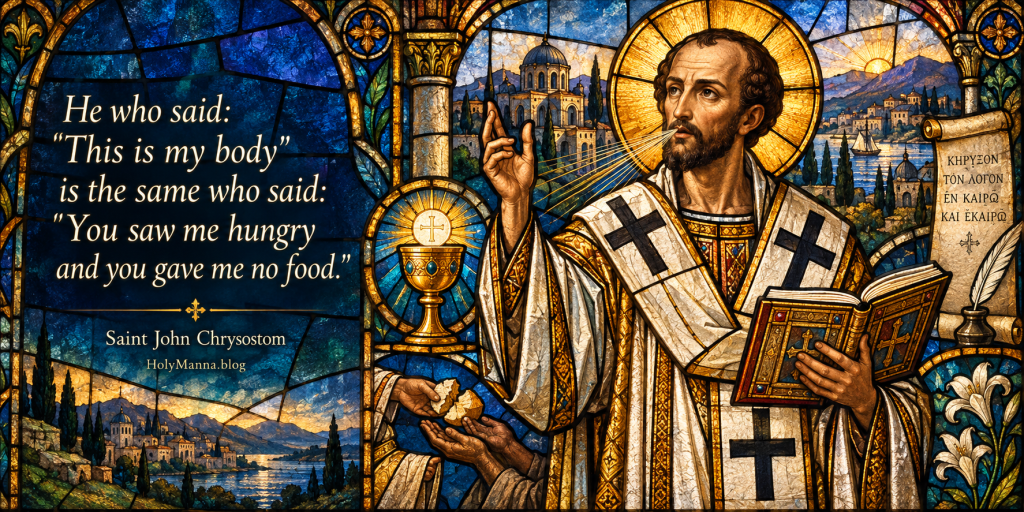
The Golden Mouth That Would Not Be Silenced
Every age of the Church has its preachers, but only one man in 2,000 years has been so identified with the preached word that the Church simply renamed him for it. John of Antioch, priest, monk, and Archbishop of Constantinople, died in the year 407, and within about a century the faithful were calling him Chrysostomos, the Golden Mouth. The name stuck so completely that almost nobody remembers he ever had another one. The Church celebrates his Memorial on September 13th, the day before the anniversary of his death, which fell on September 14th, 407, the feast of the Exaltation of the Holy Cross. In 1568 Pope St. Pius V named him a Doctor of the Church alongside Athanasius, Basil the Great, and Gregory Nazianzen, the four towering Fathers of the Christian East. In 1908 Pope St. Pius X formally declared him the patron of Christian preachers and orators, and he has long been venerated as a patron of the city of Constantinople.
His fingerprints are still everywhere. The principal Eucharistic liturgy of the Byzantine Rite, celebrated most days of the year by millions of Eastern Catholics and Orthodox Christians, bears his name as the Divine Liturgy of Saint John Chrysostom. The Catechism of the Catholic Church quotes him by name on prayer, on marriage, and on the poor. More than 700 of his authentic homilies survive, the largest body of preaching to come down from the early Church. He embodies what the Church still asks of every believer, that the faithful learn “the surpassing knowledge of Jesus Christ” by frequent reading of the Scriptures, as the Catechism urges in CCC 133. John did not merely read the Scriptures frequently. He gave his health, his career, and finally his life to make sure ordinary people could feed on them too.
A Widow’s Son in the Schools of Antioch
John was born at Antioch in Syria around the year 347; the sources do not fully agree, placing his birth anywhere between 344 and 349. Antioch was the city where, as The Acts of the Apostles records, the disciples were first called Christians, and in the 4th century it was a dazzling, worldly metropolis. His father, Secundus, was a high-ranking army officer who died while John was still an infant. His mother, Anthusa, found herself a widow at about 20 years old, and everything that followed in John’s life traces back to the decision she made next. She refused every offer of remarriage and poured herself entirely into raising her son in the Christian faith. John never forgot it. Years later, in his treatise To a Young Widow, he recorded his pagan teacher’s reaction upon learning that his brilliant student had been raised by a young Christian widow: “Heavens! What women these Christians have!”
Anthusa secured for her son the finest education in the Greek East, and John studied rhetoric under Libanius, the most celebrated pagan orator of the age. The historian Sozomen reports that Libanius, dying and asked who should succeed him, answered, “It would have been John, had not the Christians stolen him from us.” The greatest voice of dying paganism recognized, with a kind of grief, that the greatest voice of the next generation would speak for Christ.
John was baptized around the year 368 by St. Meletius, the bishop of Antioch, and was made a lector in the church. But the young man wanted more than a career, and he wanted more than a comfortable Christianity. He withdrew to the mountains outside Antioch and placed himself under an elderly Syrian hermit for about four years, then spent roughly two more years alone in a cave. There he slept little, stood for long stretches in prayer, and, tradition holds, committed the New Testament to memory. His stomach and kidneys were permanently damaged, and his broken health forced him back to the city he had tried to leave. God, it turned out, did not want John Chrysostom hidden in a cave. His early work On the Priesthood, one of the most beloved treatments of holy orders ever written, is framed by his own story of dodging episcopal consecration as a young man by letting his friend Basil be taken while he himself hid; scholars debate whether the episode is literal autobiography or a literary device, so it is best received as the frame John chose for teaching how sacred the priesthood is. He was ordained a deacon in 381 by Meletius and a priest in 386 by Bishop Flavian, and then the Golden Mouth opened.
The Preacher Who Set a City on Fire
For a dozen years, from 386 to 397, John preached at Antioch, and nothing quite like it had been heard before. He worked through the Scriptures book by book and verse by verse: 90 homilies on The Gospel of Matthew, 88 on The Gospel of John, great series on Genesis, Romans, and the whole Pauline corpus. He was the master of what scholars call the Antiochene school of interpretation, which attends first to the literal sense of the text and then drives it straight into the conscience. He spoke plainly enough for dockworkers and sharply enough for magistrates. His congregations applauded him like a performer, and he scolded them for applauding instead of repenting.
His moment of trial came in 387, in the event history calls the Riot of the Statues. Antioch, enraged by a new tax, rose up and toppled the statues of the emperor Theodosius and the imperial family, a crime that could mean the destruction of the entire city. While the aged Bishop Flavian raced to the capital to beg for mercy, John held the terrified city together through Lent with the 21 homilies known as On the Statues, preaching repentance and trust in God to people who did not know if they would be alive at Easter. The imperial pardon came, and Antioch never forgot who had steadied it. It is worth saying honestly that John is not primarily remembered as a wonder-worker; his contemporaries pointed not to dramatic signs but to the power of God working through his word and his charity. The Catechism teaches in CCC 875 that faith comes through hearing ministers sent by Christ; John took that mission so seriously that the preached word became, in him, the visible miracle.
And what a word it was, especially for the poor. No Father of the Church tied the Eucharist to the poor more fiercely. In his Homily 50 on Matthew he preached, “Do you wish to honor the body of Christ? Do not ignore him when he is naked. Do not pay him homage in the temple clad in silk, only then to neglect him outside where he is cold and ill-clad.” In the same homily he pressed the point home: “He who said: ‘This is my body’ is the same who said: ‘You saw me hungry and you gave me no food.’” The Church has never let go of that teaching; the Catechism declares in CCC 1397 that the Eucharist commits the faithful to the poor, and in CCC 2446 it quotes John himself as its authority: “Not to enable the poor to share in our goods is to steal from them and deprive them of life. The goods we possess are not ours, but theirs.” Sixteen centuries later, the universal Catechism still preaches with his voice.
Yet the fire-breathing prophet of social justice was also astonishingly tender toward ordinary life. He loved married people and preached to them constantly, and the Catechism in CCC 2365 quotes the words he urged young husbands to say to their wives: “I have taken you in my arms, and I love you, and I prefer you to my life itself. For the present life is nothing, and my most ardent dream is to spend it with you in such a way that we may be assured of not being separated in the life reserved for us.” He insisted that holiness belonged to laypeople in kitchens and marketplaces, and the Catechism preserves that teaching. CCC 2743 quotes him saying, “It is possible to offer fervent prayer even while walking in public or strolling alone, or seated in your shop, while buying or selling, or even while cooking.” And CCC 2700 carries his rule for all prayer: “Whether or not our prayer is heard depends not on the number of words, but on the fervor of our souls.”
In 397 the archbishopric of Constantinople fell vacant, and the imperial minister Eutropius decided the famous preacher of Antioch would fill it. Knowing Antioch would riot rather than surrender him, the government simply had John removed from the city by military escort, essentially a pious abduction, and he was consecrated Archbishop of Constantinople on February 26th, 398. He arrived in the most glittering, gossiping, politically poisonous city in the world and proceeded to behave exactly like himself. He slashed the expenses of the episcopal household, sold off the luxurious plate and furnishings his predecessor had accumulated, and poured the money into hospitals and care for the sick and the poor. He refused to host the lavish dinners the aristocracy expected. He disciplined worldly clergy, called wandering monks back to their monasteries, provided Gothic-speaking clergy for the Goths of the city, and preached, constantly, against the obscene gap between the banquets of the rich and the hunger at their gates.
One episode reveals his heart better than any other. In 399 Eutropius, the schemer who had dragged him to Constantinople and had earlier tried to strip the Church of its right of sanctuary, fell from power overnight and fled for his life to the one refuge left in the world, the altar of the Great Church. John stood over his trembling former patron and persecutor, faced down the soldiers and the howling crowd, and protected him, preaching one of the most famous sermons of antiquity on the vanity of worldly glory while its ruined embodiment clung to the altar cloth. The man who never flattered power also never abandoned the powerless, even when the powerless man was his enemy.
Two Exiles and a Long Road to Comana
A bishop like that accumulates enemies the way other men accumulate honors. The wealthy resented his preaching, worldly clergy resented his discipline, and the imperial court came to hear every sermon against luxury as a sermon against itself. The Empress Eudoxia, proud and easily offended, became convinced his rebukes were aimed at her. Into this tinderbox stepped Theophilus, the Patriarch of Alexandria, who had never forgiven being forced to consecrate John and who found his opening when John gave shelter to the Tall Brothers, monks fleeing Theophilus’s persecution. In 403, at a gathering remembered as the Synod of the Oak, Theophilus assembled a tribunal of John’s enemies, ran through a list of trumped-up charges, and declared him deposed. The emperor Arcadius ordered him into exile, and John, refusing to resist with force, quietly surrendered himself.
He was gone only days. The ancient church historians report that on the very night of his removal a calamity struck, described in the sources as an earthquake or a disaster touching the imperial palace, and the terrified Eudoxia begged for his recall; the recall is documented, though the precise nature of the omen varies in the telling. The city met his return with torches and songs. But the peace could not hold. Late in 403 a silver statue of the empress was erected beside the Great Church, and its dedication was celebrated with raucous public games that drowned out the sacred liturgy. John protested, and his enemies carried his words to the palace sharpened for maximum offense. A sermon later circulated under his name has him thundering, “Again Herodias raves; again she dances; again she demands the head of John on a platter.” The story must be told honestly: the historian Socrates Scholasticus reports the line, but scholars judge the sermon containing it spurious, and it cannot be verified that John ever spoke those words. What is beyond dispute is the hatred that now closed around him.
What is also beyond dispute is how he faced it. In the homily he preached before his exile, received into the Church’s own Liturgy of the Hours for his Memorial, he told his people, “The waters have risen and severe storms are upon us, but we do not fear drowning, for we stand firmly upon a rock. Let the sea rage, it cannot break the rock. Let the waves rise, they cannot sink the boat of Jesus.” His near-contemporary biographer Palladius records the horror of Easter 404, when imperial soldiers broke up the Easter Vigil and scattered the catechumens awaiting baptism. In June of 404 the final order came, and John was marched out of his city for the last time. Fires broke out behind him, consuming the Great Church and the senate house, and his followers, mocked as Joannites, were blamed and persecuted for refusing to abandon him.
He was sent to Cucusus, a bleak outpost in the Armenian mountains, and there the exiled archbishop simply kept being a shepherd. Roughly 240 of his letters survive from these years, including 17 addressed to the holy deaconess St. Olympias, letters of such courage that they remain spiritual classics. He directed missionary efforts from his exile as if distance were a rumor. Pilgrims streamed to Cucusus in such numbers that his enraged enemies obtained an order transferring him to Pityus at the far edge of the Black Sea. Palladius records that the journey was conducted with deliberate cruelty, on foot, in brutal weather, with his broken health ignored. At Comana in Pontus, his body finally failed. Palladius recounts that in the night the martyr St. Basiliscus, near whose shrine he lay, appeared to him and said, “Be of good cheer, brother John; tomorrow we shall be together.” This account comes from an early and near-contemporary source, though it is hagiographic in character and is received as Palladius’s testimony. The next day, clothed in white garments and strengthened by the Holy Eucharist, John died. It was September 14th, 407. Palladius records his last words, the sentence that has become his signature across 16 centuries: “Glory be to God for all things!”
He was not a martyr in the formal sense; he died a confessor, worn out by a persecution that stopped just short of the sword. But the Church has always seen in his death the fortitude she describes in CCC 1808, the virtue that gives firmness in difficulties and constancy in the pursuit of the good. And his dying words are a living catechism on divine providence, the truth taught in CCC 313 that God works all things together for the good of those who love him.
The Dead Man Who Got His Throne Back
The vindication began almost immediately. Pope St. Innocent I had defended John throughout the persecution and, after his death, broke communion with the churches that had condemned him until his name was restored to honor in the diptychs, the official prayers of the liturgy. One by one the great sees relented. Then, on January 27th, 438, some 31 years after his death, came one of the most dramatic scenes in Christian history. The emperor Theodosius II, son of Arcadius and Eudoxia, had the relics of John Chrysostom solemnly carried back to Constantinople. The emperor came out to meet the coffin, laid his face against it, and publicly begged forgiveness for the sins his parents had committed against the saint. That imperial penance is documented history. Eastern tradition adds two further details, that the saint’s body was found incorrupt after three decades in the grave, and that when the relics were enthroned in the church, the dead man’s lips uttered “Peace be to all,” the bishop’s ancient greeting to his people. These details are cherished tradition, and it must be said plainly that they cannot be verified.
His relics rested for centuries in the Church of the Holy Apostles among the tombs of the emperors, until the sack of Constantinople in 1204, when crusaders carried them to Rome. They were kept at St. Peter’s Basilica for exactly 800 years, until November 27th, 2004, when Pope St. John Paul II returned relics of St. John Chrysostom and St. Gregory Nazianzen to Ecumenical Patriarch Bartholomew I as a gesture of love toward the Orthodox Church. They now rest at the Patriarchal Church of St. George in the Phanar in Istanbul, and the journey of those bones, from Comana to Constantinople to Rome and home again, is itself a prayer for the healing of Christian division. The Church honors such veneration of relics as an authentic expression of popular piety, as CCC 1674 teaches.
Healings and favors have been reported across the centuries at his tomb at Comana and through his relics, though the individual accounts come largely from later lives of the saint and cannot be individually verified; honesty requires saying so plainly. One beloved story from the Eastern tradition tells of Bishop Adelphius, who had sheltered John during his exile. Grieving after the saint’s death, Adelphius begged God to show him John’s place in glory, and in a vision he saw the company of the holy bishops in heaven but could not find John among them. As he wept, he was told the reason: John Chrysostom could not be seen among the hierarchs because he stands closest of all to the very throne of God. It is a story the Christian East has treasured for centuries, and it cannot be verified.
His widest legacy, though, is not a shrine but a living voice. The Divine Liturgy of Saint John Chrysostom remains the ordinary Sunday liturgy of the entire Byzantine world, Catholic and Orthodox alike; the attribution of its core prayers to John is traditional, since the liturgy developed over centuries, but his name has been inseparable from it for more than a millennium. Every year at Pascha, in every Byzantine church on earth, the priest reads aloud the exultant Paschal Homily attributed to him by tradition, and a congregation that has never read a word of the Fathers hears the Golden Mouth announce the Resurrection. A famous story holds that St. Thomas Aquinas declared he would rather possess Chrysostom’s homilies on Matthew than be master of the city of Paris; it is a treasured tradition, and it cannot be verified. The communion of saints that the Catechism describes in CCC 956, in which the saints in heaven strengthen the pilgrim Church by their intercession, has few better illustrations than this man, dead for 16 centuries and still preaching every single day.
Lessons from the Golden Mouth
What does a 4th-century archbishop have to say to you, sitting in traffic with a phone full of notifications? More than almost anyone, precisely because John Chrysostom spent his life convincing busy, distracted, upwardly mobile city people that holiness was meant for them. He would not accept the excuse that prayer belongs to monks. His counsel preserved in CCC 2743 was meant for people exactly like you, prayer offered while walking, working, shopping, even cooking. Start there this week. Pick one ordinary task you already do daily and quietly hand it to God while you do it. What moment of your routine could become a hidden altar?
Then let him examine your relationship with your possessions, because he will anyway. John’s teaching, enshrined in CCC 2446, is that the goods withheld from the poor are not generosity postponed but theft in progress. That is uncomfortable on purpose. He asked his people to see Christ in the person who owned nothing, the same Christ they received at the altar, as CCC 1397 still teaches. When you look at your budget, could anyone tell from it that you believe the poor are Christ in disguise? Choose one concrete act of mercy this month, a donation, a meal, an hour given away, and attach it deliberately to your next reception of Holy Communion.
Learn from his courage, and from where it came. John did not defy an empress because he had a confrontational personality; he stood firm because decades of Scripture had convinced him the rock under his feet was real. His fearlessness was the fruit of formation. The Church urges all the faithful toward frequent reading of the Scriptures in CCC 133, and John shows what a soul soaked in the Word becomes. If you gave the Gospels 10 minutes a day, who might you be in a year?
Finally, take his last words with you: “Glory be to God for all things!” He said them not on a good day but at the end of a forced march that killed him, betrayed by brother bishops and abandoned by his emperor. That is not naive optimism; it is the hard-won confidence of CCC 313, that God is working even in what wounds us. And remember the fallen Eutropius clinging to the altar. The truest test of your faith is not how boldly you confront your enemies but how readily you shelter them when they fall. Is there someone who has wronged you to whom you could show unexpected mercy this week?
Engage With Us!
The story of Saint John Chrysostom is really a story about what one surrendered voice can do in the hands of God, and now the conversation belongs to you. Share your thoughts and reflections in the comments below; this community grows every time someone speaks honestly about the faith. Here are some questions to pray with and to discuss:
- John’s mother, Anthusa, shaped a Doctor of the Church through quiet, faithful sacrifice. Who formed your faith, and have you ever thanked them?
- Chrysostom taught that honoring Christ in the Eucharist while ignoring him in the poor is a contradiction. Where is that contradiction hiding in your own life?
- He prayed while walking, working, and cooking. What ordinary moment of your day could you turn into prayer starting tomorrow?
- John protected Eutropius, the enemy who fell. Whom would you find hardest to forgive and shelter, and what would it take?
- His last words were “Glory be to God for all things.” Can you say those words over the hardest thing in your life right now, and if not yet, what would help you get there?
Whatever this saint stirred in you, do not let it stay a feeling. Speak the truth with love, feed Christ in the hungry, open the Scriptures, and thank God in everything, the sweet and the bitter alike. Live this day, and every day, with the love and mercy that Jesus taught us, and let your one voice, surrendered to God, become golden in its own way.
Saint John Chrysostom, pray for us!
Follow us on YouTube, TikTok, Instagram and Facebook for more insights and reflections on living a faith-filled life.


Leave a Reply