Twenty-fourth Sunday in Ordinary Time – Lectionary: 130
The Ledger God Refuses to Keep
Nearly everyone keeps a quiet ledger of hurts, and the readings for the Twenty-fourth Sunday in Ordinary Time, September 13th, 2026, ask whether it is finally time to burn it. The central theme uniting this Sunday is unmistakable: mercy received must become mercy given, and forgiveness is not an optional virtue for the disciple but the very shape of a life that belongs to Christ.
The Church builds the case like a master storyteller. First comes Ben Sira, a Jerusalem sage writing two centuries before Christ, who names the strange human habit of hugging wrath tight and warns that no one can nurse a grudge and expect healing from the Lord. Then Psalm 103 answers with the reason forgiveness is even possible: God Himself is kind and merciful, slow to anger, and rich in compassion, the very words God spoke about Himself to Moses on Mount Sinai after Israel’s worst betrayal. St. Paul then reminds the Romans that no believer lives or dies as a private individual, because Christ died and rose to be Lord of the dead and the living. Finally, Jesus answers Peter’s tidy question about the limits of forgiveness with a number that means limitless, and a parable whose arithmetic is so lopsided it should make every hearer laugh, then wince.
There is even a hidden thread of history here. When Jesus says seventy-seven times, He is reversing Lamech’s ancient boast of seventy-sevenfold vengeance in Genesis 4:24. Where sin built an endless spiral of revenge, Christ builds an endless spiral of mercy. This Sunday invites every reader to step inside it.
First Reading — Sirach 27:30—28:7
When Wisdom Tells the Heart to Let Go
Around the year 180 BC, a sage named Jesus Ben Sira ran a school of wisdom in Jerusalem, and his grandson later translated his Hebrew teachings into Greek for the Jewish community in Egypt. The early Church treasured the book so much that it earned the Latin title Ecclesiasticus, meaning “the Church book,” and it remains part of the deuterocanonical Scriptures the Catholic Church has always received. Here Ben Sira delivers the Old Testament’s clearest anticipation of the Our Father, and he opens the day’s theme by exposing the absurdity of asking God for a pardon the heart refuses to give.
Sirach 27:30—28:7
Wrath and anger are hateful things,
yet the sinner hugs them tight.
The vengeful will suffer the LORD’s vengeance,
for he remembers their sins in detail.
Forgive your neighbor’s injustice;
then when you pray, your own sins will be forgiven.
Could anyone nourish anger against another
and expect healing from the LORD?
Could anyone refuse mercy to another like himself,
can he seek pardon for his own sins?
If one who is but flesh cherishes wrath,
who will forgive his sins?
Remember your last days, set enmity aside;
remember death and decay, and cease from sin!
Think of the commandments, hate not your neighbor;
remember the Most High’s covenant, and overlook faults.
Detailed Exegesis
Verse 27:30: “Wrath and anger are hateful things, yet the sinner hugs them tight.”
Ben Sira begins with brutal honesty about human psychology. Resentment is hateful, yet strangely comfortable, and the image of hugging captures how a grudge becomes a treasured possession the heart refuses to release even while it poisons everything it touches.
Verse 28:1: “The vengeful will suffer the LORD’s vengeance, for he remembers their sins in detail.”
Vengeance belongs to God alone, as Deuteronomy 32:35 teaches. Whoever seizes it for himself invites divine scrutiny of a personal record that no sinner would want examined in detail.
Verse 28:2: “Forgive your neighbor’s injustice; then when you pray, your own sins will be forgiven.”
Long before Christ, the Spirit was already teaching Israel that prayer and forgiveness rise or fall together, a truth Jesus would seal forever in the petition “forgive us our trespasses, as we forgive those who trespass against us.”
Verse 28:3: “Could anyone nourish anger against another and expect healing from the LORD?”
The verb is deliberate. Nourished anger is a wound kept open on purpose, and healing cannot enter a wound that its owner keeps reopening.
Verse 28:4: “Could anyone refuse mercy to another like himself, can he seek pardon for his own sins?”
The phrase “like himself” is the hinge. The neighbor is a fellow creature of flesh, equally frail and equally in need, so refusing mercy to an equal while begging it from God collapses under its own logic.
Verse 28:5: “If one who is but flesh cherishes wrath, who will forgive his sins?”
Mortal flesh has no standing to play the immortal judge. Cherished wrath is a role reversal in which the creature claims a throne that belongs to the Creator alone.
Verse 28:6: “Remember your last days, set enmity aside; remember death and decay, and cease from sin!”
Here is the ancient practice of memento mori, remembering death, which the Church’s spiritual tradition has always commended. Seen from a deathbed, almost every grievance shrinks to its true size.
Verse 28:7: “Think of the commandments, hate not your neighbor; remember the Most High’s covenant, and overlook faults.”
Covenant memory is the final motive. God overlooked Israel’s faults again and again throughout salvation history, so those who live inside that covenant are called to imitate the God who keeps it.
Teachings
The Catechism of the Catholic Church makes Ben Sira’s logic its own when it teaches on the fifth petition of the Lord’s Prayer: “Love, like the Body of Christ, is indivisible; we cannot love the God we cannot see if we do not love the brother or sister we do see. In refusing to forgive our brothers and sisters, our hearts are closed and their hardness makes them impervious to the Father’s merciful love; but in confessing our sins, our hearts are opened to his grace” (CCC 2840). The Church also names the sin Ben Sira describes with precision: “Deliberate hatred is contrary to charity. Hatred of the neighbor is a sin when one deliberately wishes him evil” (CCC 2303). Historically, Ben Sira wrote while Judea sat uneasily between rival Greek empires, so his insistence on mercy over vengeance was never abstract; it was survival for a community that could have torn itself apart.
Reflection
Ben Sira invites a fearless inventory. Name the one grudge that still gets hugged tight, then do three concrete things this week. First, pray for that person by name every day, even through gritted teeth, because intercession slowly softens what willpower cannot. Second, bring the resentment to Confession, where grace does the heavy lifting. Third, practice memento mori by asking whether this grievance deserves space in a life that will one day end. Which injury does your heart still hold onto most tightly? What would it cost you, honestly, to set it down before praying the Our Father this Sunday?
Responsorial Psalm — Psalm 103:1-4, 8-12
A Soul That Remembers Mercy
Psalm 103, attributed to David, is a beloved hymn of thanksgiving, and its placement this Sunday is a stroke of liturgical genius. Between Sirach’s warning and the Gospel’s parable, the psalm supplies the only reason forgiveness is possible at all: God has already forgiven more. Its refrain quotes the words God spoke about Himself to Moses on Sinai in Exodus 34:6, immediately after the golden calf, which means God defined His own name by mercy precisely at the moment of Israel’s worst betrayal.
Psalm 103:1-4, 8-12
R. (8) The Lord is kind and merciful, slow to anger, and rich in compassion.
Bless the LORD, O my soul;
and all my being, bless his holy name.
Bless the LORD, O my soul,
and forget not all his benefits.
R. The Lord is kind and merciful, slow to anger, and rich in compassion.
He pardons all your iniquities,
heals all your ills.
He redeems your life from destruction,
crowns you with kindness and compassion.
R. The Lord is kind and merciful, slow to anger, and rich in compassion.
He will not always chide,
nor does he keep his wrath forever.
Not according to our sins does he deal with us,
nor does he requite us according to our crimes.
R. The Lord is kind and merciful, slow to anger, and rich in compassion.
For as the heavens are high above the earth,
so surpassing is his kindness toward those who fear him.
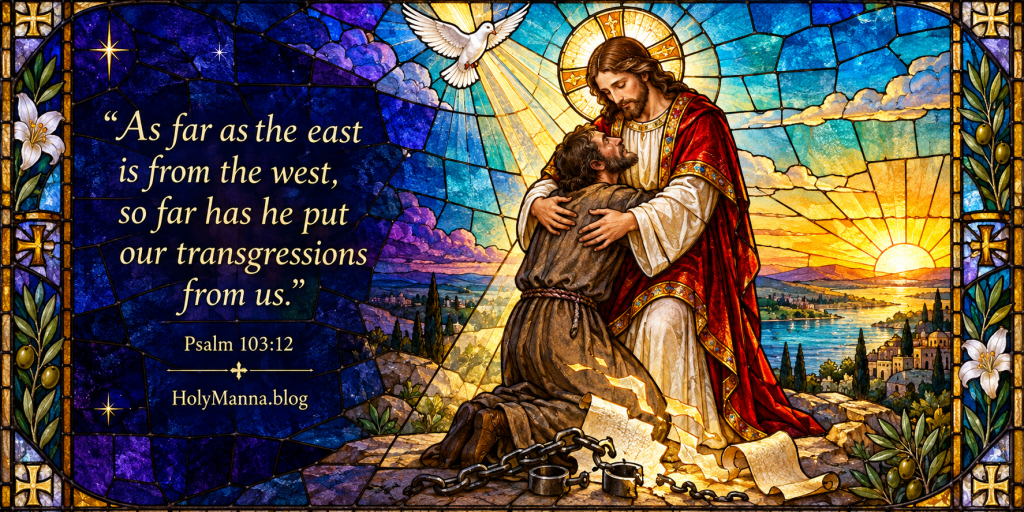
As far as the east is from the west,
so far has he put our transgressions from us.
R. The Lord is kind and merciful, slow to anger, and rich in compassion.
Detailed Exegesis
Verses 1-2: “Bless the LORD, O my soul; and all my being, bless his holy name. Bless the LORD, O my soul, and forget not all his benefits.”
The psalmist preaches to his own soul, commanding it to remember. The Hebrew word for soul, nephesh, means the whole self, and the warning against forgetting matters because forgotten mercies are the soil where resentment grows.
Verse 3: “He pardons all your iniquities, heals all your ills.”
Pardon and healing arrive in a single breath, because Scripture treats sin as a sickness God cures rather than merely a crime God punishes. Jesus would later forgive and heal in the same moment for the same reason.
Verse 4: “He redeems your life from destruction, crowns you with kindness and compassion.”
The word redeems evokes the go’el, the kinsman-redeemer who buys back a relative from slavery. God crowns the forgiven sinner not with wages earned but with hesed, covenant kindness, and rahamim, a tender mercy whose Hebrew root means the womb.
Verse 8, the refrain: “The Lord is kind and merciful, slow to anger, and rich in compassion.”
This is Sinai’s creed, God’s self-portrait given after the golden calf. Israel repeated it for a thousand years as the surest thing it knew about God.
Verse 9: “He will not always chide, nor does he keep his wrath forever.”
God refuses to nurse wrath, which is exactly the habit Sirach begs human beings to abandon. Divine anger has an expiration date; divine mercy does not.
Verse 10: “Not according to our sins does he deal with us, nor does he requite us according to our crimes.”
Strict bookkeeping would condemn everyone, so God simply declines to settle accounts that way. Mercy is not the suspension of justice but its surpassing.
Verses 11-12: “For as the heavens are high above the earth, so surpassing is his kindness toward those who fear him. As far as the east is from the west, so far has he put our transgressions from us.”
The psalmist reaches for two infinities, one vertical and one horizontal. East and west never meet, which means forgiven sins are not filed away for later; they are removed beyond retrieval.
Teachings
The Catechism teaches that this divine compassion is the wellspring of all Christian forgiveness: “Christian prayer extends to the forgiveness of enemies, transfiguring the disciple by configuring him to his Master. Forgiveness is a high-point of Christian prayer; only hearts attuned to God’s compassion can receive the gift of prayer” (CCC 2844). St. John Paul II devoted an entire encyclical, Dives in Misericordia (1980), to this theme, teaching that mercy is love’s response when it meets evil and suffering, and holding up the God of Psalm 103 as the Father whom Christ reveals.
Reflection
The psalmist’s remedy for a hard heart is deliberate remembering. Try his method this week by writing down ten concrete benefits God has given, from Baptism to this morning’s breath, and reading the list aloud before evening prayer. Gratitude and grudges cannot occupy the same room for long. Then take verse 12 personally: if God has thrown your confessed sins beyond the horizon, refuse to go digging for them, and refuse to dig up anyone else’s. Which of God’s benefits have you quietly forgotten? Do you truly believe your absolved sins are as far away as east from west?
Second Reading — Romans 14:7-9
Belonging to the Lord in Life and in Death
St. Paul wrote his Letter to the Romans from Corinth around AD 57, addressing a church he had not yet visited, a mixed community of Jewish and Gentile believers. By chapter 14, he is refereeing real conflict: the “strong” and the “weak” were judging one another over disputed foods and holy days. Paul’s solution is not a compromise but a revolution in identity. No one in the Church is a private individual with private grievances, because every baptized life, and every death, already belongs to Christ. This is the quiet foundation beneath the day’s theme, since people who do not own themselves cannot claim ownership of their resentments either.
Romans 14:7-9
Brothers and sisters:
None of us lives for oneself, and no one dies for oneself.
For if we live, we live for the Lord,
and if we die, we die for the Lord;
so then, whether we live or die, we are the Lord’s.
For this is why Christ died and came to life,
that he might be Lord of both the dead and the living.
Detailed Exegesis
Verse 7: “None of us lives for oneself, and no one dies for oneself.”
In a single line, Paul demolishes the illusion of autonomy. In the honor culture of ancient Rome, where status and self-assertion were everything, this claim was countercultural to the point of scandal, and it remains so in an age of radical individualism.
Verse 8: “For if we live, we live for the Lord, and if we die, we die for the Lord; so then, whether we live or die, we are the Lord’s.”
The title “the Lord” tolls three times like a bell. Life is consecrated, death is consecrated, and the believer’s deepest identity is possession by Christ. This is the logic that carried the martyrs to their deaths singing.
Verse 9: “For this is why Christ died and came to life, that he might be Lord of both the dead and the living.”
Paul grounds everything in the Paschal Mystery. The phrase “died and came to life” compresses Good Friday and Easter into five words, and the purpose clause is breathtaking: Christ underwent death itself precisely to claim lordship over every human being on both sides of the grave.
Teachings
The Catechism quotes this very passage to teach the communion of saints: “Communion in charity. In the sanctorum communio, ‘None of us lives to himself, and none of us dies to himself.’ In this solidarity with all men, living or dead, which is founded on the communion of saints, the least of our acts done in charity redounds to the profit of all. Every sin harms this communion” (CCC 953). That last sentence lands hard on this Sunday’s theme, because it means unforgiveness is never a private affair; a nursed grudge quietly wounds the whole Body of Christ, just as one hidden act of mercy enriches it. The Church also draws hope for the dying from this text: “Because of Christ, Christian death has a positive meaning: ‘For to me to live is Christ, and to die is gain’” (CCC 1010). Whoever belongs to the Lord in death can certainly entrust smaller losses, like a wounded ego, to Him in life.
Reflection
Paul offers a simple test for any decision, any relationship, any grudge: does this belong to the Lord, or is it being kept back as private property? This week, consciously offer one relationship that has gone cold to Christ’s lordship, declaring that this person and this hurt are the Lord’s. Consider also praying for a deceased person you once struggled to love, since Christ is Lord of the dead and the living, and mercy crosses that border freely. What part of your life have you not yet surrendered to the Lord’s ownership? If your death belongs to Christ, why should your grievances not belong to Him too?
Holy Gospel — Matthew 18:21-35
The Unpayable Debt and the Unforgiving Heart
This passage closes the fourth great discourse of The Gospel of Matthew, often called the community discourse, where Jesus teaches His disciples how to live together inside the Church. Some rabbinic opinion of the era suggested forgiving a repeat offender three times, so Peter’s seven, the biblical number of completeness, sounds generous. Jesus’ answer reaches back to Genesis 4:24, where Lamech boasted of seventy-sevenfold revenge, and turns the ancient spiral of vengeance inside out. Then comes a parable with numbers so absurd that the original audience must have laughed before they understood it was about them.
Matthew 18:21-35
Peter approached Jesus and asked him,
“Lord, if my brother sins against me,
how often must I forgive?
As many as seven times?”
Jesus answered, “I say to you, not seven times but seventy-seven times.
That is why the kingdom of heaven may be likened to a king
who decided to settle accounts with his servants.
When he began the accounting,
a debtor was brought before him who owed him a huge amount.
Since he had no way of paying it back,
his master ordered him to be sold,
along with his wife, his children, and all his property,
in payment of the debt.
At that, the servant fell down, did him homage, and said,
‘Be patient with me, and I will pay you back in full.’
Moved with compassion the master of that servant
let him go and forgave him the loan.
When that servant had left, he found one of his fellow servants
who owed him a much smaller amount.
He seized him and started to choke him, demanding,
‘Pay back what you owe.’
Falling to his knees, his fellow servant begged him,
‘Be patient with me, and I will pay you back.’
But he refused.
Instead, he had the fellow servant put in prison
until he paid back the debt.
Now when his fellow servants saw what had happened,
they were deeply disturbed, and went to their master
and reported the whole affair.
His master summoned him and said to him, ‘You wicked servant!
I forgave you your entire debt because you begged me to.
Should you not have had pity on your fellow servant,
as I had pity on you?’
Then in anger his master handed him over to the torturers
until he should pay back the whole debt.
So will my heavenly Father do to you,
unless each of you forgives your brother from your heart.”
Detailed Exegesis
Verse 21: “Peter approached Jesus and asked him, ‘Lord, if my brother sins against me, how often must I forgive? As many as seven times?’”
Peter thinks in arithmetic, seeking a rule with an endpoint, which makes Jesus’ reply all the more staggering.
Verse 22: “Jesus answered, ‘I say to you, not seven times but seventy-seven times.’”
Jesus is not proposing a tally of 77 that expires on offense 78. By reversing Lamech’s boast of limitless vengeance, He commands limitless mercy, a habit of being rather than a count.
Verses 23-24: “That is why the kingdom of heaven may be likened to a king who decided to settle accounts with his servants. When he began the accounting, a debtor was brought before him who owed him a huge amount.”
The “huge amount” in the original text is ten thousand talents. Since one talent equaled roughly 6,000 denarii, and a denarius was a laborer’s daily wage, the debt amounts to some sixty million days of work, more than the tax revenue of entire Roman provinces. The absurdity is the point: this is the debt of sin before God.
Verse 25: “Since he had no way of paying it back, his master ordered him to be sold, along with his wife, his children, and all his property, in payment of the debt.”
Debt slavery was real in the ancient world, yet even this drastic measure could never recover such a sum; the sentence dramatizes hopeless insolvency.
Verses 26-27: “At that, the servant fell down, did him homage, and said, ‘Be patient with me, and I will pay you back in full.’ Moved with compassion the master of that servant let him go and forgave him the loan.”
The servant’s promise to repay in full is delusional, yet the master, begged only for patience, grants cancellation instead. The Greek verb for “moved with compassion” is the same visceral word the Gospels use for Jesus’ own pity.
Verse 28: “When that servant had left, he found one of his fellow servants who owed him a much smaller amount. He seized him and started to choke him, demanding, ‘Pay back what you owe.’”
The smaller amount is a hundred denarii, about three months’ wages, a real debt but roughly 600,000 times smaller than the one just forgiven. The chokehold reveals what resentment actually is: violence looking for a justification.
Verses 29-30: “Falling to his knees, his fellow servant begged him, ‘Be patient with me, and I will pay you back.’ But he refused. Instead, he had the fellow servant put in prison until he paid back the debt.”
The plea is nearly word-for-word the one the first servant made moments earlier. Handed a perfect chance to imitate the mercy he received, he reenacts the scene with the roles reversed and fails completely.
Verse 31: “Now when his fellow servants saw what had happened, they were deeply disturbed, and went to their master and reported the whole affair.”
A sin against mercy is never private; it disturbs the whole household, which brings the matter to the master, echoing the fraternal correction Jesus taught just before this passage.
Verses 32-33: “His master summoned him and said to him, ‘You wicked servant! I forgave you your entire debt because you begged me to. Should you not have had pity on your fellow servant, as I had pity on you?’”
Notice what makes the servant “wicked” in the king’s eyes: not the original debt, but the refusal of pity after receiving it. Mercy received creates a debt of mercy owed.
Verse 34: “Then in anger his master handed him over to the torturers until he should pay back the whole debt.”
Since the debt is unpayable, the sentence has no natural end. Jesus is speaking soberly about final judgment, and the Church has always heard in this verse a warning that hell is a real possibility for the merciless heart.
Verse 35: “So will my heavenly Father do to you, unless each of you forgives your brother from your heart.”
The final phrase closes every loophole. Forgiveness is not a formula recited through clenched teeth but an interior act of the heart, the place where, as the Catechism says, everything is bound and loosed.
Teachings
St. John Chrysostom, Doctor of the Church, preached on this exact passage in his Homily 61 on Matthew: “though thou forgive seventy times seven, though thou continually pardon your neighbor for absolutely all his sins, as a drop of water to an endless sea, so much, or rather much more, does your love to man come short in comparison of the boundless goodness of God” (Homily 61 on Matthew). The Catechism teaches that this parable “crowns the Lord’s teaching on ecclesial communion” and then offers one of its most pastorally tender lines: “It is not in our power not to feel or to forget an offense; but the heart that offers itself to the Holy Spirit turns injury into compassion and purifies the memory in transforming the hurt into intercession” (CCC 2843). The Church does not command forgetting, which lies beyond human power; she commands handing the wound to the Holy Spirit, who alone can turn it into prayer.
Reflection
Start where the parable starts, with the ten thousand talents. Spend five minutes before a crucifix this week simply contemplating the size of the debt Christ canceled at the cost of His own blood. Then identify your hundred-denarii debtor, the person whose real but comparatively small offense still gets replayed in your mind, and pray one Hail Mary for that person daily. If the wound is deep, remember that forgiveness is a decision that can precede feelings by years, and that the Sacrament of Reconciliation supplies grace no willpower can. Who is your fellow servant, and what would it look like to loosen your grip on his throat? When you pray the Our Father and ask to be forgiven exactly as you forgive, do you actually mean it?
Where the Ledger Ends and Grace Begins
Set side by side, this Sunday’s readings tell a single story with one dramatic question at its center. Ben Sira opens it by catching humanity in the act, hugging wrath tight while asking heaven for healing. Psalm 103 interrupts with the truth that changes everything: the God being petitioned is kind and merciful, slow to anger, and rich in compassion, a God who has already hurled confessed sins beyond the meeting point of east and west. St. Paul raises the stakes by revealing that no life and no death is private property, because Christ died and came to life to be Lord of all. And then Jesus, with a storyteller’s genius, hands every listener a mirror shaped like a parable: a man forgiven sixty million days’ wages, choking a coworker over three months’ pay.
The mirror is uncomfortable, and it is meant to be. Every person who has knelt in a confessional or whispered an act of contrition has stood in the sandals of that first servant, begging patience and receiving cancellation instead. The only fitting response to a canceled debt is a canceled ledger.
So here is the invitation for this week. Go to Confession and feel the ten thousand talents lift. Receive the Eucharist, where Mercy Himself becomes food. Then pray the Our Father slowly, refusing to rush the dangerous clause in the middle. Somewhere in every life there is a fellow servant waiting to breathe. Let this be the Sunday the grip finally loosens, because the Father’s mercy is not merely a gift to enjoy; it is a current to be passed on.
Engage With Us!
Share your reflections in the comments below! Every honest wrestle with the Word strengthens this community, and your insight might be exactly what another reader needs. Here are questions to spark the conversation:
- In Sirach 27:30—28:7, Ben Sira observes that the sinner hugs wrath and anger tight. Which grudge have you held onto the longest, and what has holding it actually cost you?
- Psalm 103:1-4, 8-12 commands the soul to forget not all his benefits. What are three specific mercies God has shown you this year, and how does remembering them change the way you view those who have hurt you?
- Romans 14:7-9 declares that in life and in death every believer belongs to the Lord. What would change in your relationships this week if you truly believed that your grievances belong to Christ and not to you?
- In Matthew 18:21-35, the forgiven servant chokes a man who owes him a fraction of what he was forgiven. Who is the hundred-denarii debtor in your life, and what is one concrete step toward releasing that debt?
- Taken together, today’s readings teach that mercy received must become mercy given. Where is God inviting you to stop keeping score, and what practice, such as Confession, daily intercession, or a slow Our Father, will help you answer that invitation?
A life of faith does not mean pretending wounds never happened; it means handing them to the Holy Spirit, who turns injury into compassion and hurt into intercession. Keep showing up, keep forgiving, and keep doing everything with the love and mercy Jesus taught. The God who is slow to anger and rich in compassion is patient with every heart still learning to let go, and He never tires of forgiving. May this Sunday find every reader seventy-seven times freer.
Sacred Heart of Jesus, we trust in You!
Immaculate Heart of Mary, pray for us!
Saint Michael the Archangel, defend us in battle!
Follow us on YouTube, TikTok, Instagram and Facebook for more insights and reflections on living a faith-filled life.


Leave a Reply